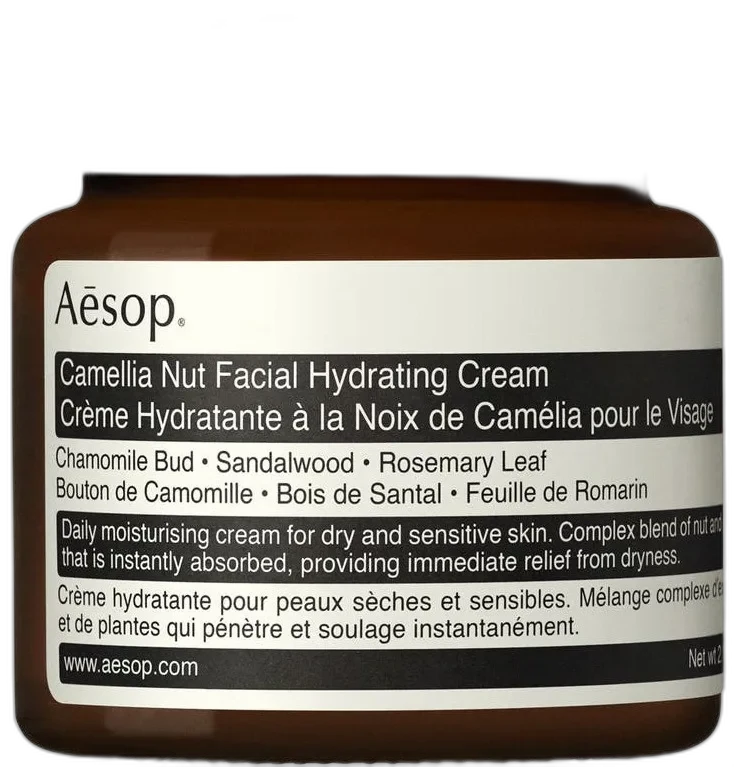
Camellia Nut Facial Hydrating Cream
Camellia-Rich Day Cream
 Verified reviewer
Pros & cons.
- +Camellia oil delivers a distinctive silky-cushion texture
- +Solid humectant-plus-emollient structure with glycerin and squalane
- +Genuinely rich and nourishing for dry and normal skin
- +Panthenol and allantoin soften the botanical intensity
- +Beautiful packaging and signature sensory experience
- +Vegan and Leaping Bunny certified
- +Plumps and brightens skin immediately on application
- −Steep $80 price difficult to justify on ingredient merit alone
- −Multiple essential oils rule it out for sensitive users
- −Too rich for oily and acne-prone skin
- −60ml size runs out quickly with daily use
- −Not fungal-acne safe due to oleic-rich oils and fragrance
The full review.
Camellia oil has one of the longer and more interesting histories in skincare. In Japan, it’s been known as tsubaki oil for centuries, pressed from the seeds of Camellia japonica and used by everyone from imperial court ladies to modern salarymen for its silky, fast-absorbing feel and its reputation for keeping skin and hair in good condition. In Chinese traditional cosmetology it has a similar pedigree. The oil itself is high in oleic acid — around 80%, depending on the cultivar — plus natural tocopherols, phytosterols, and a modest amount of linoleic acid. It absorbs with a specific satin-cushion feel that’s hard to replicate with other plant oils, which is why when you encounter it in a well-designed formula, it tends to be the texture you remember.
Aesop’s Camellia Nut Facial Hydrating Cream is what happens when that ingredient story gets translated into a Western luxury skincare context. The camellia oil is high on the ingredient list, right after water, glycerin, and caprylic/capric triglyceride — meaning Aesop is actually leading with the thing the product is named after, which is not always a given in this category. Supporting the camellia oil are a well-chosen emollient and humectant blend: squalane, cetearyl alcohol, glyceryl stearate, butylene glycol, panthenol, allantoin, and a small amount of niacinamide further down. This is a competent, classically structured day cream with no glaring gaps in its moisturizing logic.
Texture
On the skin, it performs about as you’d expect from the ingredient list. Texture is rich and creamy with a cushiony slip, absorbs into a satin finish within about a minute, and leaves skin looking plumper and more radiant immediately. Dry skin users will find it genuinely nourishing in a way that less emollient day creams can’t match. Normal and combination skin types get a comfortable, slightly luxurious daily moisturizer that plays well under sunscreen in the morning or as a final step at night. Oily skin users will almost certainly find it too heavy — the oleic-dominant profile and overall richness don’t suit skin that’s already producing ample sebum.
Scent
The fragrance is the Aesop signature, and as with their other botanically heavy products, it’s where your decision to buy or not buy will probably be made. The formula contains orange peel oil, lavender oil, geranium oil, and fragrance, with the usual disclosed allergens — linalool, limonene, geraniol, citronellol — openly listed because they’re required to be. The scent itself is beautiful in a distinctly herbal, apothecary-garden way: floral, slightly citrus, with a rounded herbaceous base. Users who love Aesop’s aesthetic will love the scent. Users with reactive, rosacea-prone, or eczema-prone skin should approach with real caution, because the cumulative essential oil content here is higher than in a typical moisturizer and can absolutely trigger reactions even if the individual oils are each at low concentrations.
Value
Value is where every Aesop review eventually lands, and this one is no exception. Eighty dollars for 60ml of moisturizer is a premium price, and the ingredient list, while solid, does not contain anything that would justify the cost on a purely clinical basis. CeraVe AM Facial Moisturizer delivers ceramides, niacinamide, and actual SPF for $18. La Roche-Posay Toleriane Double Repair has a more sophisticated barrier-repair system for $23. Even within the luxury tier, brands like Tatcha and Biossance offer camellia or squalane-led creams with similar textural benefits at $55-75 per 50ml. Aesop is not competing on ingredient-to-dollar efficiency in this category, and trying to evaluate it that way misses the point of why people buy it.
Who Should Buy
What Aesop competes on is the complete experience — the signature scent, the amber glass bottle, the ritual of using a product that looks like it belongs in a Kyoto apothecary. For customers who value that experience and use the cream daily because they enjoy it, the price premium is paying for real enjoyment and routine adherence. For customers whose priority is maximizing skincare outcomes per dollar, there are significantly better options and no clinical reason to choose this one. Both framings are legitimate; they’re just answering different questions.
Best for
The sweet spot for this cream is a specific user: someone with dry or normal skin who doesn’t react to fragrance, who values sensory ritual and brand coherence, and who has the budget to prioritize enjoyment over efficiency. For that user, this is a comfortable, texturally beautiful daily moisturizer that fits perfectly into an Aesop-centered routine. For everyone else, the trade-offs are enough that a recommendation has to come with asterisks. Know which user you are, and the decision will make itself.
Ingredient analysis.
Full INCI list
Water (Aqua), Glycerin, Caprylic/Capric Triglyceride, Camellia Japonica Seed Oil, Cetearyl Alcohol, Butylene Glycol, Squalane, Glyceryl Stearate, Panthenol, Tocopherol, Allantoin, Sodium PCA, Hydrolyzed Wheat Protein, Niacinamide, Aloe Barbadensis Leaf Juice, Rosmarinus Officinalis (Rosemary) Leaf Extract, Cetyl Alcohol, Sodium Stearoyl Glutamate, Xanthan Gum, Citrus Aurantium Dulcis (Orange) Peel Oil, Lavandula Angustifolia (Lavender) Oil, Pelargonium Graveolens (Geranium) Oil, Fragrance (Parfum), Linalool, Limonene, Geraniol, Citronellol, Citric Acid, Phenoxyethanol, Ethylhexylglycerin.
Skin match.
The science.
The Science
Camellia japonica seed oil has a documented cosmetic profile based on its fatty acids (roughly 80% oleic acid, 8-10% linoleic acid, plus smaller amounts of palmitic and stearic acids) and its natural tocopherols and phytosterols. Its oleic-dominant profile works as a barrier-supporting emollient for dry and normal skin, while the tocopherol content provides modest antioxidant activity. Research in journals like Food Chemistry and International Journal of Cosmetic Science shows the oil has relatively good oxidative stability compared to polyunsaturated oils like rosehip and moderate skin penetration properties.
The humectant system is well-chosen. Glycerin sits at a prominent position; it is one of the best-documented humectants in dermatology and improves stratum corneum hydration across many concentrations. Butylene glycol adds secondary humectant activity and helps the cream spread. Squalane, a hydrogenated version of squalene, is a skin-identical lipid with an excellent safety profile and a strong track record in barrier support. Panthenol and allantoin provide soothing effects, both with well-established use in skincare for calming and mild wound-healing.
The science is less compelling regarding the essential oil supporting cast. Orange peel oil contains limonene and furocoumarins, which can be photosensitizing at sufficient concentrations. Lavender oil and geranium oil contribute linalool, geraniol, and citronellol—all documented fragrance allergens with published sensitization data. Daily facial use of a leave-on product increases cumulative exposure to these compounds compared to rinse-off products. This is why dermatologists flag fragranced moisturizers as a potential concern even when individual ingredient concentrations are low. This is a trade-off between sensory experience and clinical safety margin—Aesop chose sensory richness, and the science shows both the upside and the downside of that choice.
Dermatologist Perspective
Dermatologists generally view luxury botanical day creams like this one as acceptable for non-reactive patients who enjoy the experience, though most do not recommend them as first-line treatments. Board-certified dermatologists often note that for dry skin patients seeking a thick, emollient day cream, ingredient-focused options like CeraVe, La Roche-Posay, or Vanicream deliver superior barrier-repair benefits at a lower cost. For patients with rosacea, eczema, perioral dermatitis, or fragrance sensitivity, dermatologists typically advise against any moisturizer with a disclosed allergen list of this length. This cream is usually a patient-chosen aesthetic preference rather than a clinical recommendation, and its use is acceptable for non-reactive dry-to-normal skin without specific concerns.
Where it fits in your routine.
Cleanse, tone, and apply serums or treatments first. Press one pump from clean hands evenly across the face and neck. Wait 60-90 seconds for full absorption before applying sunscreen (AM) or going to bed (PM). Use once or twice daily. In the morning, always apply a broad-spectrum sunscreen; the citrus oil content is mildly photosensitizing. If you have a history of fragrance sensitivity, patch test on the jawline before full-face use.
At $80 for 60ml, this is one of the more expensive Aesop moisturizers. Value depends on your criteria. Functional equivalents with better clinical profiles cost $15-30 (CeraVe, La Roche-Posay, Vanicream). Even in the luxury tier, cheaper alternatives offer transparent active concentrations and no essential oils. At $80, you buy the Aesop total experience — the scent, the amber glass bottle, the apothecary ritual, and brand coherence for an all-Aesop routine. The value makes sense for Aesop enthusiasts. For outcome-focused buyers, it is hard to defend.
Dry and normal skin types who like sensory-led skincare and the Aesop aesthetic, loyal Aesop customers building a branded routine, and users seeking a camellia oil-based day cream for its texture and ingredient heritage. Best for non-reactive skin in colder climates.
Avoid this cream if you have oily, acne-prone, rosacea-prone, or fragrance-reactive skin. Users seeking clinical efficacy and better cost-to-benefit optimization will find better options at a fraction of the price. Skip this if you want a lightweight day cream for warm climates.
Product details.
The signature Aesop botanical — floral and herbaceous with notes of orange, lavender, and geranium. Medium intensity, lingers briefly after application. ***
The iconic Aesop amber glass bottle uses a pump dispenser and beige label. The design is hygienic, but the pump works inconsistently near the end.
The texture is creamy and cushiony at first, then absorbs into a soft satin finish within a minute. Skin looks plumper and more radiant immediately. The fragrance is noticeable but fades fast.
3-4 months with once-daily face use. ***
12 months ***
All Year ***
The backstory.
Camellia oil has a long history in Japanese and Chinese skincare traditions, where it's been used for centuries as a silky facial and hair oil. Aesop's Camellia Nut cream takes that ingredient heritage and places it in a Western luxury moisturizer context, pairing it with the brand's signature herbaceous fragrance and apothecary packaging.
About Aesop
Legacy Brand (20+ years)Aesop has nearly four decades of credibility from botanical formulation, design consistency, and a loyal global customer base. Its reputation relies on aesthetic and brand values instead of clinical validation or dermatologist endorsement.
Common myths.
Camellia oil outperforms other facial oils for all skin types.
Camellia oil has high oleic acid levels. This suits dry and normal skin but feels too heavy for oily or acne-prone skin. It works well for specific skin types, not all of them.
Luxury day creams always outperform drugstore options.
Luxury and drugstore creams often use similar functional ingredients. At the luxury tier, you pay for packaging, scent, and brand experience instead of superior clinical performance.
FAQ.
Is the Aesop Camellia Nut Cream worth $80?
On pure ingredient merit, no—cheaper creams have similar emollients and humectants. The price reflects the brand experience, packaging, and sensory ritual Aesop customers expect. Buy it for the aesthetic and experience, not for cost-to-efficacy.
Can I use it in the morning and at night?
The thick texture suits nighttime use for most users, especially combination skin. Dry skin types can use it AM and PM. Apply sunscreen in the morning for full protection.
Is it safe for sensitive skin?
Use caution. The formula contains multiple essential oils and fragrance with disclosed allergens. Users with rosacea, eczema, or known fragrance sensitivity need a fragrance-free alternative.
Will it clog my pores?
Camellia oil is moderately occlusive and oleic-dominant, so it's best suited to dry and normal skin. Acne-prone and oily users may find it too heavy and should patch test first, or choose a lighter moisturizer instead.
How does it compare to other Aesop creams?
Camellia Nut is the more emollient option in the Aesop moisturizer lineup. Sublime Replenishing Night Masque is thicker and for nighttime use only. Mandarin Facial Cream is lighter and works better for combination skin. Camellia Nut is the 'daily rich' option.
Does it contain actual nut allergens?
Camellia is a seed, not a true nut. People with severe allergies must consult a healthcare provider before using botanically rich products and should patch test on the wrist or jawline.
What the community says.
"Rich, cushiony texture"
"Skin looks plumper immediately"
"Signature Aesop scent"
"Doesn't feel greasy despite being rich"
"Very expensive"
"Essential oils irritate reactive skin"
"Small 60ml size"
"Fragrance too strong for some"