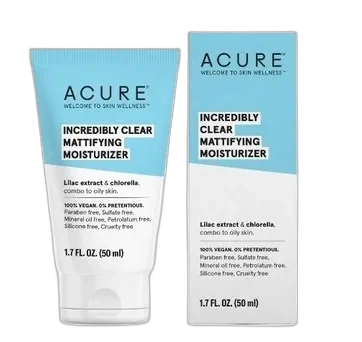
Incredibly Clear Mattifying Moisturizer
Natural Beauty Aisle Staple
 Verified reviewer
Pros & cons.
- +Glycerin-forward formula delivers meaningful hydration
- +Affordable clean-beauty pricing under $20
- +Vegan, cruelty-free, and leaping-bunny certified
- +Soft satin finish layers well under sunscreen
- +No added fragrance or synthetic dyes
- +Plant-oil emollient stack suitable for non-reactive combination skin
- −Not actually mattifying despite the product name
- −Contains cocoa butter and oils that can trigger acne
- −Not fungal-acne safe due to fatty-acid-rich plant oils
- −Lilac and chlorella 'clarifying' claims lack clinical backing
- −Jar packaging exposes antioxidants to air degradation
The full review.
Walk through any Whole Foods skincare aisle and you will find a clean-beauty brand that built a product around one dramatic plant. Acure’s Incredibly Clear Mattifying Moisturizer centers on lilac leaf cell extract—a botanical the natural-beauty industry has treated as a plant-based salicylic acid for nearly ten years. The pitch sounds good: a fancy flower replaces a chemical exfoliant. The reality is more modest, and this review addresses that gap.
First, the effective components. The formula is glycerin-forward—glycerin is second on the INCI list, meaning it is present in high amounts—and this provides most of the hydration. Acure builds an emollient stack of sunflower seed oil, argan oil, safflower oil, and evening primrose oil around that humectant base, plus cocoa butter to give the cream a soft-cushion feel. A botanical antioxidant mix—calendula, chamomile, rooibos, CoQ10—layers on top; it is less load-bearing than the label suggests but gives the product a coherent clean-beauty identity. For someone with combination skin seeking a simple, affordable daily moisturizer from a vegan brand, the hydration works well.
On the skin, it feels like a medium-weight plant-oil cream that spreads easily, absorbs within one or two minutes, and leaves a soft satin finish. It is not sticky or heavy, and it does not pill under sunscreen if you let it settle briefly. The scent is subtle and herbal—no added fragrance, just the faint smell of botanical extracts—which is a quiet win for anyone tired of perfumed clean-beauty products.
Now, the claim that needs scrutiny. The name says ‘mattifying,’ and the marketing relies on lilac leaf cell extract and chlorella as the clarifying, oil-balancing actives. However, independent clinical evidence for either acting as meaningful sebum regulators is thin. Lilac extract contains verbascoside, which shows antioxidant activity in vitro, but the claim that it ‘works like salicylic acid’ is marketing, not data. Users consistently report that the cream hydrates well but does not actually mattify dramatically—you get a satin finish, not a powder finish, and the T-zone remains shiny on oily skin by midday. This is not a dealbreaker, but it requires honest expectations.
The second, more consequential issue affects anyone who interprets ‘incredibly clear’ as ‘good for acne.’ The formula contains cocoa butter and several fatty-acid-rich plant oils that can be comedogenic for acne-prone skin. It is also not fungal-acne safe—several oils feed Malassezia—so anyone with seborrheic dermatitis or fungal-driven breakouts should skip it. The product works best as a maintenance moisturizer for normal-to-combination skin that gets slightly shiny, not as a treatment for active breakouts.
At around $15 for 1.7 ounces, the value is favorable. You get a well-hydrating glycerin-and-plant-oil cream from a brand with wide distribution, vegan and cruelty-free certifications, and an honest botanical antioxidant story. That is a reasonable trade for the price. You are not getting a true oil-control solution or a clinically-backed acne product, even though the marketing pushes those claims harder than the formulation supports. If Acure had named this ‘Hydrating Plant Oil Cream’ and removed the mattifying language, it would be a cleaner recommendation.
Used in the right routine—a gentle cleanser, a niacinamide or BHA serum to handle oil control, then this as the daily hydration layer—it earns its place. Used as your only defense against shine and breakouts, it will disappoint you. The product itself is not the problem; the positioning is. Treat it for what it is: a fine drugstore-to-Whole-Foods crossover that hydrates at a fair price.
Ingredient analysis.
Full INCI list
Aqua, Glycerin, Helianthus Annuus (Sunflower) Seed Oil, Cetearyl Alcohol, Glyceryl Stearate Citrate, Argania Spinosa (Argan) Kernel Oil, Carthamus Tinctorius (Safflower) Seed Oil, Theobroma Cacao (Cocoa) Seed Butter, Oenothera Biennis (Evening Primrose) Oil, Aloe Barbadensis Leaf Juice, Syringa Vulgaris (Lilac) Leaf Cell Extract, Chlorella Vulgaris Extract, Calendula Officinalis Flower Extract, Chamomilla Recutita (Matricaria) Flower Extract, Aspalathus Linearis (Rooibos) Leaf Extract, Ubiquinone (CoQ10), Tocopherol, Xanthan Gum, Glyceryl Caprylate, Glyceryl Undecylenate, Citric Acid, Sodium Phytate
Skin match.
The science.
The Science
The evidence splits in two. Glycerin and plant-derived emollients have decades of dermatological research. Glycerin is a top-tier studied humectant; data shows it improves stratum corneum hydration and barrier function at these concentrations. The linoleic acid content in sunflower, argan, and evening primrose oils is well-characterized and supports barrier lipid function. The brand's clarifying claims lack similar evidence. Lilac leaf cell extract contains verbascoside, which shows antioxidant activity in lab models, but no peer-reviewed clinical evidence shows it regulates sebum or penetrates follicles like BHAs. Chlorella extract provides algae-derived peptides and antioxidants, but lacks substantive evidence as a human sebum regulator or comedolytic. A significant gap exists between the formula's real mechanism (humectant-plus-emollient hydration with antioxidant garnish) and its marketing claim (clarifying and mattifying via botanical actives).
Dermatologist Perspective
Dermatologists often tell combination skin patients that effective daily moisturizing doesn't require exotic actives; glycerin plus a moderate emollient layer often works. Board-certified dermatologists note that products using botanical extracts as alternatives to evidence-based actives like salicylic acid can disappoint consumers, especially when genuine comedolytic action is needed. This moisturizer is generally not a first-line recommendation for acne-prone skin because the fatty-acid-rich oils and cocoa butter can worsen breakouts. It fits patients with combination or normal skin seeking an affordable vegan daily moisturizer without added fragrance.
Where it fits in your routine.
Massage a pea-size amount into clean, slightly damp skin every morning and night until absorbed. Wait one minute before applying sunscreen in the AM to stop pilling. Use a BHA or niacinamide serum alongside this if you need oil control; this moisturizer provides hydration, not active treatment. Use clean hands or a spatula with the jar packaging to limit contamination, and use the product within 12 months of opening.
At roughly $15 for 1.7 ounces, this product is affordable clean beauty. The price is fair for the hydration alone; Burt's Bees or Alba Botanica creams with similar glycerin-and-plant-oil levels cost about the same. This formula does not provide a genuine mattifying or clarifying effect. If you want a basic daily hydration layer from a vegan brand with transparent sourcing, the value is solid. If you buy it for oil control or breakout prevention, the price feels too high.
Combination and normal skin types want an affordable, vegan, fragrance-free daily moisturizer that hydrates without a heavy feel. It suits clean-beauty shoppers who value transparent sourcing and do not expect a moisturizer to solve oily-skin or acne concerns alone.
Skip this if you have active acne, oily skin, fungal acne, or reactive sensitivity. The formula lacks a silicone-based mattifying finish. Users needing comedolytic action should use a BHA treatment with a gel-cream instead of botanical alternatives.
Product details.
All Year Certifications vegancruelty-freeleaping-bunny
The backstory.
Acure was founded in 2009 as a vegan, certified cruelty-free natural skincare brand with distribution through Whole Foods and eventually Target. The Incredibly Clear line was introduced to give the brand a dedicated oily-skin offering, built around lilac leaf cell extract as the hero ingredient — a botanical choice popular among clean-beauty formulators chasing a plant-based alternative to BHA.
About Acure
Acure launched in 2009 as a vegan, cruelty-free natural skincare brand. Target, Whole Foods, and Amazon distribute it widely. The brand has a moderate independent review footprint, but its formulas use botanical actives instead of clinically validated actives.
Common myths.
Lilac extract works like salicylic acid.
Lilac leaf cell extract has verbascoside, an antioxidant. No robust clinical evidence shows it penetrates the follicle for comedolytic action like BHA. Use it as a botanical, not a BHA substitute.
Clean-beauty moisturizers are always better for acne.
This formula contains cocoa butter and several fatty-acid-rich oils that clog pores in acne-prone skin. 'Clean' and 'non-comedogenic' are not the same.
FAQ.
Is this moisturizer actually mattifying?
It does not provide a traditional powder-finish. It leaves a soft satin finish that shows less shine than thicker creams, but it does not mattify like a silicone-based oil-control product. Set realistic expectations.
Will it break out acne-prone skin?
It can. The formula uses cocoa butter and several fatty-acid-rich plant oils that trigger breakouts in acne-prone users. If you have active acne, avoid this moisturizer — use a gel-cream formulated without heavy emollients.
Is it fungal-acne safe?
No. The formula uses multiple fatty-acid-rich oils (sunflower, safflower, argan, evening primrose) that feed Malassezia. Skip it if you have fungal acne or seborrheic dermatitis.
Does it contain salicylic acid?
No. The brand calls lilac leaf cell extract a botanical alternative, but these are different ingredients. For actual BHA action, use this with a dedicated salicylic acid treatment.
Can I use this under sunscreen?
Yes. It layers well under chemical and mineral SPF once fully absorbed. Wait 60 seconds after application before applying sunscreen to prevent pilling.
Is the jar packaging a problem for the actives?
Jar packaging exposes the formula to air during use, which degrades CoQ10 and other antioxidants over time. Use it within 12 months of opening for best results.
Community
What the community says.
"affordable"
"hydrating without being heavy"
"clean ingredients"
"not actually mattifying"
"botanical scent"
"broke some users out"