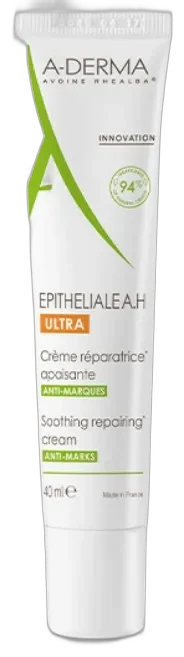
Epitheliale A.H Ultra Repairing Cream
Post-Procedure MVP
 Verified reviewer
Pros & cons.
- +Three-weight hyaluronic acid complex delivers multi-depth hydration to compromised skin
- +Rhealba oat and madecassoside provide layered anti-inflammatory and healing support
- +Trace mineral trio supports enzymatic barrier reconstruction
- +Shea butter base gives genuine protective occlusion without greasiness
- +Fragrance-free and well-tolerated by post-procedure and sensitive skin
- +Versatile for face, body, and friction-damage areas
- +Clinically established in European dermatology and hospital settings
- +Reasonable per-ml cost for the ingredient density
- −Too rich for daily facial use on oily skin
- −Contains mineral oil which some users prefer to avoid
- −100ml aluminum tube is bulky for travel
- −Not a substitute for prescription treatment in severe cases
- −Heavier finish may not be pleasant under daytime makeup
The full review.
The Epitheliale line shows what A-Derma produces when it shifts from a consumer pharmacy brand to a hospital-dermatology supplier. In France and other European markets, doctors hand out these creams after in-office procedures, recommend them after minor dermatological surgery, and stock them in hospital dermatology wards for eczema flares and friction injuries that do not require prescriptions. The Ultra Repairing Cream is the line’s workhorse; it reaches consumer bathrooms through over-the-counter availability and dermatologist word-of-mouth. The ingredient list explains its transition from clinical settings to home routines: it is one of the most thoughtfully stacked barrier-repair formulas in its price range.
The ‘A.H’ in the name refers to acide hyaluronique—specifically, three molecular weights. Sodium hyaluronate crosspolymer sits at the outer layer, standard sodium hyaluronate stays in the middle, and hydrolyzed hyaluronic acid reaches the deeper level. This triple-weight approach works for compromised skin because barrier disruption causes transepidermal water loss at multiple depths, and a single-weight HA only addresses part of that loss. This hydration holds over an emollient base of shea butter and caprylic/capric triglyceride. The formula adds Rhealba oat—Pierre Fabre’s proprietary juvenile oat extract—as the anti-inflammatory backbone, panthenol as a humectant-healer, and madecassoside, the purified centella fraction with the strongest evidence for supporting wound recovery. Finally, a trace mineral trio of copper sulfate, zinc sulfate, and manganese sulfate acts as cofactors in skin enzymes involved in barrier reconstruction. This is a comprehensive repair formula—more so than many pharmacy competitors that use only two or three of these ingredients.
Texture
The texture makes the cream work as a real-world product. It is medium-thick—substantial enough to form a protective layer over compromised skin, but light enough to avoid a greasy residue. When applied to a recently peeled, laser-treated, or friction-damaged area, the cream settles in quickly and immediately reduces the tightness of compromised skin. Within 24 to 72 hours, most users see a visible reduction in redness and flaking. Over one to two weeks, scabs resolve, friction damage fades, and eczema flare sites regain normal texture. This is not a miracle, and it does not substitute for prescription-strength treatment when a case requires it—but for compromised-skin situations that do not require prescriptions, it is the right tool.
Best for
This cream has specific limits. It is not a daily face moisturizer for normal skin; it is too thick and too narrowly targeted for a daily routine. It is not a treatment for severe atopic dermatitis or conditions requiring topical steroids—it is a complementary product. It is not fragrance-heavy or sensorially elaborate—the scent is absent and the utilitarian aluminum tube reminds you this is a clinical product, not a spa product. If you want a luxurious nightly face cream, this is not it. If you want to treat a compromised patch of skin that needs to heal, it is one of the best over-the-counter options.
Common Complaints
The limitations are minor. Oily skin may find the cream too thick for daily facial use, though it works as a spot treatment. The 100ml tube is bulky for travel, though some markets offer a 50ml option. The formula contains a small amount of mineral oil, which some users avoid for ideological reasons. Cosmetic-grade mineral oil has an excellent safety profile in dermatology and is not a problem, but if you avoid it, this is not your cream. The price is reasonable for the ingredients, but higher than the cheapest generic barrier creams; you pay for the specific combination of actives rather than the base.
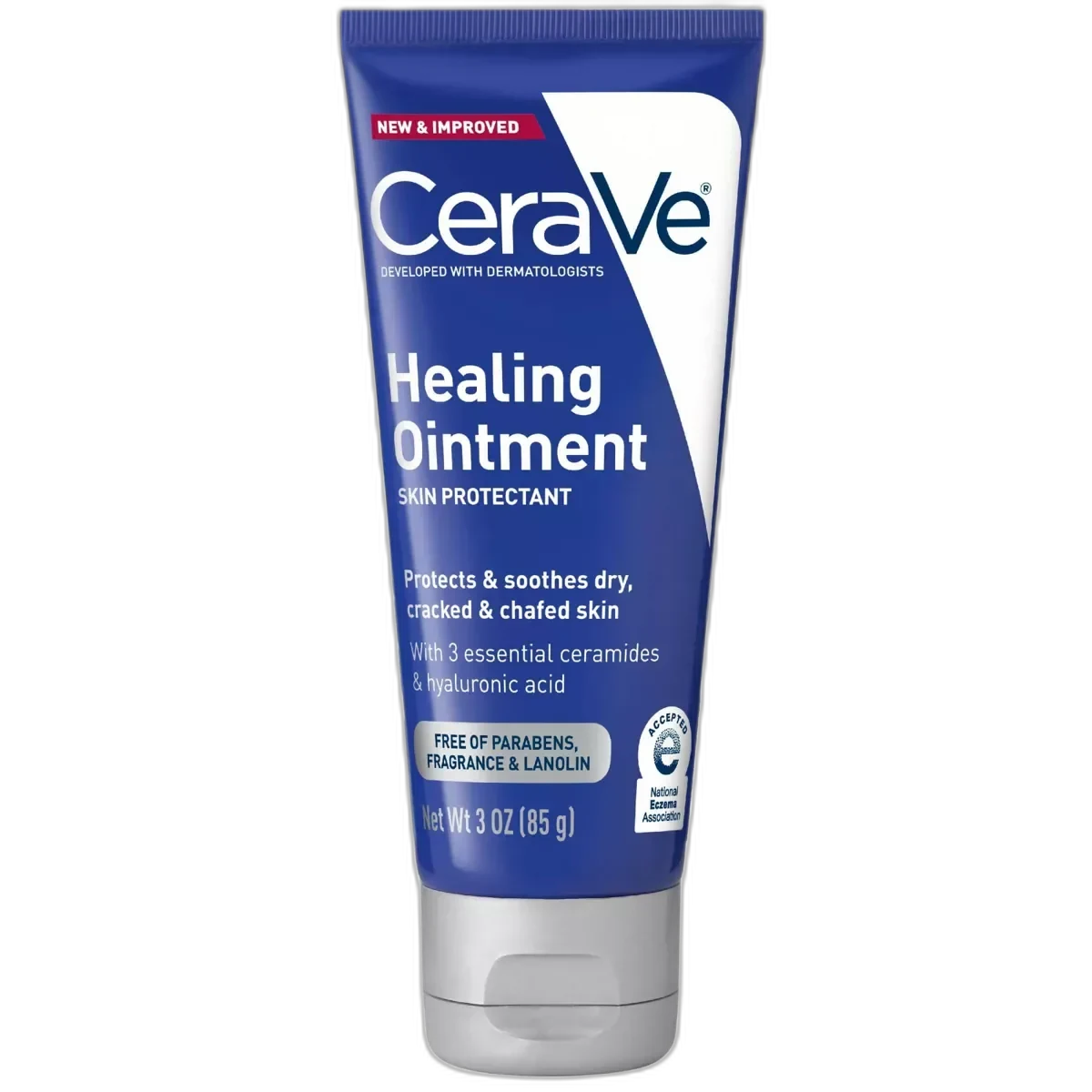
Epitheliale A.H earns its place in pharmacy repair rotations by combining multiple evidence-backed ingredients instead of relying on a single hero. Cicaplast Baume B5, the most famous competitor, uses panthenol and madecassoside in a more occlusive balm. CeraVe’s Healing Ointment is an ointment that prioritizes petrolatum. Epitheliale takes a different position: a cream-textured formula that integrates HA, oat, panthenol, madecassoside, and trace minerals. This layered approach works reliably across compromised-skin scenarios—from wind-burned face in winter to a peeled cheek after an in-office procedure or a flaking tattoo. It is the kind of product you keep in your cabinet and use more often than expected.
Ingredient analysis.
Full INCI list
Aqua, Glycerin, Paraffinum Liquidum, Caprylic/Capric Triglyceride, Pentylene Glycol, Butyrospermum Parkii Butter, Avena Rhealba Extract, Cera Alba, Sodium Hyaluronate, Hydrolyzed Hyaluronic Acid, Sodium Hyaluronate Crosspolymer, Cetyl Alcohol, Glyceryl Stearate, Dimethicone, Panthenol, Tocopherol, Madecassoside, Copper Sulfate, Zinc Sulfate, Manganese Sulfate, Bisabolol, Disodium EDTA, Xanthan Gum, Sodium Hydroxide, Hydroxyethylcellulose, Phenoxyethanol
Skin match.
The science.
The Science
This cream's ingredients synthesize current evidence on barrier repair. Panthenol is a long-studied ingredient in wound-healing dermatology; multiple trials show it accelerates epithelialization and reduces transepidermal water loss in compromised skin. A 2017 paper in the Journal of Dermatological Treatment reviewed topical dexpanthenol's effect on post-laser skin recovery and found consistent improvements in comfort, erythema, and barrier restoration — findings that support this cream's positioning.
Madecassoside is the active centella fraction with the strongest evidence for wound healing support. A 2015 paper in the Journal of Ethnopharmacology reviewed the in vivo effects of purified madecassoside on fibroblast activity and collagen synthesis, showing consistent support for granulation tissue formation and reduced inflammation in wound models. Pairing madecassoside with panthenol is not unique to Epitheliale — it is a signature combination in French pharmacy repair creams — but the addition of Rhealba oat provides anti-inflammatory effects that the panthenol-madecassoside pair lacks alone.
The multi-weight hyaluronic acid complex uses the same evidence base as other multi-weight HA serums: a 2014 paper in the Journal of Cosmetic Dermatology documented how different HA molecular weights complement hydration at different skin depths. This matters for compromised skin that has lost barrier function across multiple layers. The trace mineral trio of copper, zinc, and manganese sulfates is the formula's most traditional part — pharmacy repair creams have used these minerals since before modern cosmetic science, with copper specifically linked to lysyl oxidase activity in collagen cross-linking. Evidence for dramatic topical effects from these minerals at cream concentrations is modest, but they act as cofactors for endogenous repair processes in a comprehensive repair formula.
This cream is clinically meaningful because the combination is not redundant. Each ingredient addresses a different aspect of compromised-skin recovery — hydration, inflammation, healing support, barrier occlusion, and enzymatic cofactor availability. Most products in this category pick one or two angles; Epitheliale A.H covers five or six.
Dermatologist Perspective
Dermatologists frequently recommend Epitheliale A.H for post-procedure and barrier-compromised scenarios — after chemical peels, laser treatments, dermatological surgery, and during eczema flares. Board-certified dermatologists note that the combination of panthenol, madecassoside, multi-weight HA, and the trace mineral trio is an unusually comprehensive formulation for an over-the-counter repair cream. Doctors often prescribe it alongside prescription treatments as a supportive daily cream to maintain hydration and reduce inflammation at the affected site, and recommend it for patients who want one cream for face, body, and friction damage.
Where it fits in your routine.
Apply a thin layer to affected areas two to three times a day during acute skin compromise—post-procedure, during an eczema flare, or on friction-damaged skin. Once skin visibly recovers, taper to once a day or switch to a lighter moisturizer. Use on face and body; for facial use, apply after cleansing, optionally after a thermal water mist, and follow with SPF in the daytime. Do not apply active treatments like retinoids or acid exfoliants directly to the area while using it as a repair cream.
At roughly 22 US dollars for 100ml, Epitheliale A.H is a high-value comprehensive repair cream found on pharmacy shelves. The ingredient density—five evidence-backed active ingredients in a clinical-grade base—usually commands a higher price. Epitheliale A.H uses pharmacy-brand pricing because of Pierre Fabre's positioning, not lower formulation quality. A 50ml size is also available for travel or spot use; the larger tube offers better per-ml value for body or frequent-use scenarios. For post-procedure or compromised-skin moments, the cost-per-symptom-managed is low.
Anyone with frequent compromised-skin situations — post-procedure patients, eczema sufferers, people with seasonal friction damage or wind-burned faces, parents with kids prone to scrapes. A good keep-on-hand cream for anyone with sensitive reactive skin.
This works for users wanting a daily face moisturizer with a light finish, oily skin that needs no extra occlusion, and anyone who avoids mineral oil in skincare. For non-compromised skin, a lighter moisturizer from the same brand works better.
Product details.
Thick cream with a cushiony glide; it forms a protective film that sits slightly more on the skin than a standard moisturizer.
Fragrance-free.
Large aluminum tube with a screw cap, sized for body use and clinical settings.
The first application instantly comforts dry or irritated skin. The cream is thick but not greasy, and tightness in a damaged area reduces within minutes. Redness and flaking typically reduce over 24-72 hours. This is a treatment product — apply it to the affected area instead of the whole face as a general moisturizer.
100ml lasts 1-2 months for regular body-area use, or several months for spot use.
12 months
All Year
The backstory.
The Epitheliale range was developed as A-Derma's clinical-strength answer to compromised skin scenarios — post-laser, post-peel, minor burns, scarring, eczema flares, friction damage. It sits one step up in intensity from the brand's general sensitive-skin moisturizers and is used in European hospital dermatology settings as a non-prescription recovery aid alongside prescription treatments.
About A-Derma
Legacy Brand (20+ years)A-Derma's Epitheliale line is the brand's clinical-repair franchise. European hospitals and dermatology practices use it for post-procedure skin. Pierre Fabre has published research on Rhealba oat and hyaluronic acid repair complexes that support the line.
Common myths.
Repair creams can replace prescription wound care.
For serious wounds, burns, or surgical incisions, prescription care is required. This cream supports minor post-procedure skin and friction damage — it's an adjunct, not a replacement.
Mineral oil is harmful in skincare.
Cosmetic-grade mineral oil is one of the safest, most studied occlusive agents in dermatology. It stays on the skin surface, is non-comedogenic in typical formulations, and medical-grade barrier products use it often.
FAQ.
How is Epitheliale A.H different from La Roche-Posay Cicaplast Baume B5?
Both are French pharmacy repair creams. Cicaplast uses more panthenol and madecassoside in a thick, occlusive balm. Epitheliale A.H uses Rhealba oat, three-weight HA, and a trace mineral trio in a light cream base. Choose based on texture preference or if you want the oat angle.
Can I use this cream after a chemical peel or laser?
Yes — this is a primary use case. Apply a thin layer to clean skin several times a day right after the procedure to aid comfort and healing. Always follow the specific instructions from the clinician who performed the procedure.
Is it safe for eczema flares?
Yes. The Rhealba oat and madecassoside combination works for eczema flares as a supportive cream alongside any prescribed topical treatment. Severe flares require a dermatologist's guidance.
Can I use it on tattoos during healing?
Many tattoo artists recommend fragrance-free pharmacy healing creams for fresh tattoos once the initial sealing phase ends. Check with your artist first — some prefer specific aftercare products with different occlusive properties.
Is Epitheliale A.H safe during pregnancy?
Yes — the formula has no retinoids, no high-strength acids, and no essential oils flagged during pregnancy. It works for stretch-mark-prone skin and post-C-section scar support.
How often should I apply it?
Apply two to three times a day on affected areas during the acute phase. Once the skin visibly recovers, taper to once a day or switch to a lighter moisturizer.
Does it leave residue?
The cream is thicker than A-Derma's Biology line but lacks grease. It leaves a soft satin finish and is more occlusive than a lightweight moisturizer, which makes it an effective repair cream.
What the community says.
"rapid visible healing on compromised skin"
"gentle enough for post-laser recovery"
"fragrance-free and well-tolerated"
"versatile for face and body"
"too rich for oily skin as a daily moisturizer"
"100ml tube is bulky for travel"
"contains mineral oil which some users prefer to avoid"
Featured in.
People also looked at.