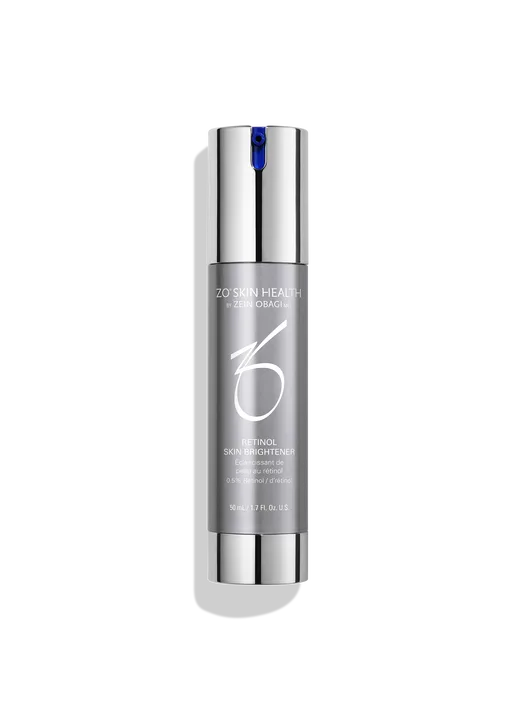
Retinol Skin Brightener 0.5%
Derm-Office Brightening Powerhouse
 Verified reviewer
Pros & cons.
- +Five distinct brightening pathways targeting hyperpigmentation at multiple points in the melanin cascade
- +Oleosome delivery system provides gradual retinol release for reduced initial irritation
- +Bakuchiol complements retinol through independent retinoid-like pathways while stabilizing the formula
- +Elegant silky texture that absorbs quickly and layers well under nighttime moisturizer
- +Available in three strengths (0.25%, 0.5%, 1%) allowing graduated introduction
- +Ascorbyl glucoside provides stable vitamin C brightening alongside the retinol
- +Bisabolol and bakuchiol provide soothing support during the retinol adjustment period
- +Clinical-grade formulation backed by a dermatologist-founded brand with nearly two decades of history
- −Contains lavender and geranium essential oils plus six fragrance allergens in an otherwise clinical formula
- −At $132 for 50 mL, the price is steep for ingredients that are individually accessible at lower cost
- −Not suitable for sensitive skin due to combined retinol and fragrance irritation potential
- −Significant peeling and redness expected during the 2-4 week acclimation period
- −Contains denatured alcohol which can contribute to dryness on already retinol-stressed skin
- −Limited public review data since the product is primarily sold through physician channels
The full review.
It is contradictory that a product sold only in dermatologist offices contains lavender and geranium essential oils. Dr. Zein Obagi built his career on skin health restoration—treating skin as an organ, not a canvas—and ZO Skin Health has earned clinical credibility for nearly two decades. When you check the Retinol Skin Brightener 0.5% label and see pelargonium and lavandula oils among the actives, you must ask: is the fragrance worth the trade-off?
About ZO Skin Health
Ignore the scent for a moment, because the formula is impressive. This is not a standard retinol cream with a brightening claim. The ingredient architecture targets hyperpigmentation through five distinct biochemical pathways, a level of formulation sophistication rare in one product. Retinol at 0.5% does the heavy lifting—accelerating epidermal turnover to shed pigmented cells faster than they accumulate. But the supporting cast earns the formula its clinical reputation.
Ascorbyl glucoside sits high in the ingredient list, providing a stable vitamin C that inhibits tyrosinase—the enzyme that produces melanin. Acetyl glucosamine takes a similar, complementary route, blocking a different step in the melanin synthesis pathway. Glutathione, a tripeptide antioxidant, shifts the type of melanin your skin produces, nudging production from darker eumelanin toward lighter pheomelanin. Soy isoflavones round out the approach by reducing melanosome transfer—the process where melanin granules move from producing cells to the cells that display them on your skin’s surface.
The delivery system matters too. ZO uses oleosome encapsulation for the retinol, so the active releases gradually rather than hitting the skin all at once. This means a less aggressive initial experience than a comparable free-retinol formula. You will still peel. You will still see some redness, especially in the first two weeks. But the slow-release mechanism softens what would otherwise be a potent retinol introduction.
Bakuchiol complements this approach. A 2019 study in the British Journal of Dermatology shows bakuchiol achieves anti-aging results comparable to retinol through retinoid-like gene expression pathways, but without binding to the same receptors. In this formula, it has dual duties: supporting the retinol’s collagen-boosting effects and helping stabilize the retinol molecule against oxidative degradation. This pairing reflects genuine formulation knowledge.
The texture is a surprise. For a cream with this many actives, it feels silky, lightweight, and non-greasy due to the dimethicone base. Sweet almond and apricot kernel oils provide emolliency without heaviness, and bisabolol adds soothing for retinol-adjusting skin. It absorbs quickly and layers well under a nighttime moisturizer.
Back to the essential oils. Pelargonium graveolens and lavandula angustifolia are aromatic plant extracts that add a floral scent. They also provide linalool, citronellol, geraniol, limonene, citral, and coumarin—all recognized fragrance allergens under EU cosmetics regulation. In a product for skin already challenged by retinol-induced turnover, this matters. For users with contact dermatitis, fragrance sensitivity, or reactive skin, these ingredients pose a risk. This decision feels driven by consumer experience rather than clinical philosophy, and it prevents the formula from being universally recommendable.
The price is $132 for 50 milliliters. This is normal for physician-dispensed skincare; ZO prices for the medspa channel, where overhead and margins differ from retail. However, the individual actives are not exotic or proprietary. Retinol, vitamin C, glucosamine, glutathione, and soy isoflavones are well-studied, widely available ingredients. You pay for the specific combination, the delivery system, and the clinical brand. Whether that premium is worth it depends on if you value a multi-pathway approach in one product over layering individual treatments.
The brightening results are real. Retinol-experienced users who tolerate the formula report visible improvement in dark spots and skin clarity within four to six weeks, with more significant hyperpigmentation reduction at eight to twelve weeks. The multi-active approach produces more even-toned results than a retinol-only product because it does not rely solely on turnover to fade pigment.
Despite its contradictions, the ZO Retinol Skin Brightener 0.5% takes hyperpigmentation seriously. It is ambitious, well-architected, and backed by a dermatologist who has spent decades studying skin restoration. The essential oils are a drawback—not a dealbreaker for everyone, but a frustrating inclusion in a rigorous formula. If your skin tolerates fragrance and you want one product that addresses pigmentation from multiple angles, this works. If you have fragrance sensitivity, the formula’s intelligence does not offset the irritation risk.
Ingredient analysis.
Full INCI list
Water/Aqua/Eau, Dimethicone, Cetearyl Isononanoate, Glycerin, Prunus Amygdalus Dulcis (Sweet Almond) Oil, Cetearyl Alcohol, Steareth-20, Pentylene Glycol, Ascorbyl Glucoside, Cetyl Alcohol, Acrylamide/Ammonium Acrylate Copolymer, Prunus Armeniaca (Apricot) Kernel Oil, Pelargonium Graveolens Flower Oil, Lavandula Angustifolia (Lavender) Oil, Propylheptyl Caprylate, Bakuchiol, Acetyl Glucosamine, Cetearyl Glucoside, Polysorbate 20, Retinol, Lecithin, Polyisobutene, Alcohol, Glutathione, Carbomer, Caprylyl Glycol, Bisabolol, 1,2-Hexanediol, Silica, Polysorbate 80, Pentaerythrityl Tetra-di-t-butylHydroxyhydrocinnamate, Disodium EDTA, Sorbitan Isostearate, BHT, Gluconolactone, Tocopheryl Acetate, Sodium Sulfite, Sodium Metabisulfite, Ascorbyl Palmitate, Soy Isoflavones, Sodium Hydroxide, Potassium Sorbate, Sodium Benzoate, Linalool, Citronellol, Geraniol, Limonene, Citral, Coumarin
Skin match.
The science.
The Science
This formulation attacks hyperpigmentation at multiple points in the melanin production and distribution pathway. Retinol, the primary active at 0.5%, converts to retinoic acid in the skin and accelerates keratinocyte turnover, shedding pigmented cells before they accumulate visibly. A meta-analysis in the Journal of Cosmetic Dermatology (Mukherjee et al., 2006) confirmed that retinol at 0.25-1% concentrations produces statistically significant improvements in photodamage markers, including mottled pigmentation.
Bakuchiol inclusion is supported by a 2019 randomized, double-blind study in the British Journal of Dermatology (Dhaliwal et al., 2019). That study showed bakuchiol 0.5% achieved comparable reductions in wrinkle surface area and hyperpigmentation to retinol 0.5% over 12 weeks, with less scaling and stinging. For this formula, subsequent research shows bakuchiol upregulates type I, III, and IV collagen expression through functional analogy to retinoids. It works through retinoid-like pathways without competing for retinoid receptors, providing additive rather than redundant effects when combined with retinol.
Ascorbyl glucoside is a glycosylated form of ascorbic acid that skin enzymes hydrolyze to release active vitamin C. A 2004 study in the Journal of the American Academy of Dermatology showed stable vitamin C formulations significantly reduce UV-induced hyperpigmentation by inhibiting tyrosinase. This stability advantage over pure L-ascorbic acid matters for this emulsion, as it maintains efficacy throughout the product's shelf life without the pH constraints that pure ascorbic acid demands.
The glutathione and soy isoflavone combination targets later pigmentation stages. Glutathione inhibits tyrosinase and shifts melanogenesis toward lighter pheomelanin production. Soy isoflavones reduce melanosome transfer via PAR-2 receptor inhibition, a mechanism shown in research in the Journal of Investigative Dermatology. The oleosome delivery system encapsulates retinol in lipid vesicles from plant seeds, providing controlled release that reduces peak irritation while maintaining bioavailability.
References
- Prospective, randomized, double-blind assessment of topical bakuchiol and retinol for facial photoageing — British Journal of Dermatology (2019)
- Retinoids in the treatment of skin aging: an overview of clinical efficacy and safety — Clinical Interventions in Aging (2006)
Dermatologist Perspective
Dermatologists often recommend retinol-based brightening products as a first-line approach for mild to moderate hyperpigmentation before using prescription retinoids or in-office procedures. This formula's multi-active approach aligns with dermatological thinking that combination therapy targeting multiple melanin pathway steps produces superior results to single-agent treatment. Board-certified dermatologists note the 0.5% concentration suits patients who have acclimated to lower-strength retinol, and the graduated strength options (0.25% to 1%) reflect good clinical practice for retinoid introduction. The oleosome delivery system reduces the sharp irritation curve that causes many patients to stop retinol treatment prematurely. However, dermatologists focusing on sensitive skin may worry about the essential oil content in a product for skin already under retinoid stress.
Where it fits in your routine.
Apply a pea-sized amount to clean, dry skin at night. Use it twice weekly for the first two weeks, then every other night during weeks three and four. Use it nightly once your skin acclimates, if tolerated. Always follow with a hydrating moisturizer to buffer the retinol and support your barrier during the adjustment period. Use a broad-spectrum SPF 30 or higher every morning — retinol increases photosensitivity, so sun protection is non-negotiable. Do not combine with other active treatments (AHAs, BHAs, benzoyl peroxide) on the same night to prevent over-exfoliation.
At $132 for 50 mL, this is a high-tier OTC retinol treatment. The price makes sense in the physician-dispensed channel where ZO products usually sell; these are recommended treatments, not impulse purchases. The multi-pathway formulation offers complexity that requires multiple products to replicate, providing value. However, you can find the individual actives (retinol, vitamin C, glucosamine, glutathione) in effective standalone products for much less. The premium buys formulation sophistication, the oleosome delivery system, and clinical brand backing—not rare or proprietary ingredients. For patients seeing a dermatologist for hyperpigmentation, the convenience and curated approach may justify the cost. Budget-conscious shoppers can achieve comparable results by layering products at a fraction of the price.
This works best for retinol-experienced users with normal to combination skin targeting hyperpigmentation, dark spots, or uneven skin tone via a multi-active approach in one product. It suits those under a dermatologist's care who prefer physician-dispensed formulations.
People with sensitive or reactive skin should avoid this. The 0.5% retinol and multiple essential oils cause irritation. This formula contains too many triggers for those with fragrance allergies, contact dermatitis, rosacea, eczema, or a compromised skin barrier.
Product details.
Thick, silky cream with a dimethicone-smoothed finish. It feels better than a typical retinol serum. The formula spreads easily and absorbs without a heavy residue.
Geranium and lavender essential oils create a noticeable floral scent. It is pleasant but unavoidable for fragrance-sensitive users.
An opaque pump bottle protects retinol from light and air degradation. The clean, clinical aesthetic matches the ZO Skin Health line.
Redness, peeling, and mild stinging occur during the first 1-2 weeks. This retinol adjustment period is normal. Use it twice weekly to reduce intensity. Skin acclimates within 2-4 weeks as you increase frequency.
2-3 months with nightly use on face only
12 months
All Year
The backstory.
Dr. Zein Obagi built his career around the concept of 'skin health restoration' — the idea that skin should be treated as an organ, not just decorated. After leaving Obagi Medical Products in 2006, he founded ZO Skin Health in 2007 to create clinical-grade products distributed through physician channels. The Retinol Skin Brightener line represents his multi-layered approach to hyperpigmentation, available in 0.25%, 0.5%, and 1% strengths to allow graduated retinol introduction.
About ZO Skin Health
Established Brand (5–20 years)Dr. Zein Obagi, a board-certified dermatologist with over 35 years in skin health science, founded ZO Skin Health in 2007. Dermatologist offices and medspas primarily dispense the brand, and its formulations use a clinical-grade philosophy.
Common myths.
This product contains prescription-strength retinol because dermatologists sell it.
At 0.5%, this remains an over-the-counter retinol concentration. The physician-dispensed channel shows the brand's distribution model, not a prescription requirement. However, the multi-active brightening formula is more sophisticated than most drugstore retinol products.
The bakuchiol in this product replaces retinol.
In this formula, bakuchiol complements retinol instead of substituting it. Research in the British Journal of Dermatology shows bakuchiol uses retinoid-like pathways and stabilizes retinol against degradation. This makes the two more effective together than alone.
FAQ.
How often should I use ZO Retinol Skin Brightener 0.5%?
Apply twice weekly to clean, dry skin. Increase to every other night, then nightly as your skin tolerates it. The oleosome delivery system provides slow-release retinol, but the 0.5% concentration needs an acclimation period to minimize peeling and redness.
Can I use ZO Retinol Skin Brightener 0.5% with vitamin C?
This product contains ascorbyl glucoside, a stable vitamin C derivative. If you add a separate vitamin C serum, use it in the morning and save this retinol for nighttime. Layering an additional vitamin C directly with this product is unnecessary and increases irritation.
What's the difference between the 0.25%, 0.5%, and 1% versions?
These three strengths move you from beginner to advanced retinol use. The 0.25% ($117) works for retinol newcomers or sensitive skin, the 0.5% ($132) suits those with some retinol experience, and the 1% ($153) is for seasoned retinol users. All three use the same multi-pathway brightening formula; only the retinol concentration differs.
Is ZO Retinol Skin Brightener safe during pregnancy?
No. This product contains retinol, which is not recommended during pregnancy or breastfeeding. While bakuchiol is pregnancy-safe on its own, this product contains both retinol and bakuchiol, so avoid it entirely. Consult your dermatologist for pregnancy-safe brightening alternatives.
Why is ZO Retinol Skin Brightener so expensive compared to drugstore retinol?
The price covers the multi-active brightening formula (five distinct pathways targeting pigmentation), the oleosome retinol delivery system, and physician-channel distribution. Whether $132 is worth it depends on your priorities — the formula is more complex than a basic retinol cream, but layering individual products at a lower total cost yields comparable results.
Does ZO Retinol Skin Brightener cause purging?
Retinol-induced purging—a temporary increase in breakouts as cell turnover accelerates—can happen during the first 2-4 weeks. The bakuchiol and bisabolol in this formula soothe the skin, but some peeling, redness, and stinging are expected. If irritation is severe or lasts beyond 4-6 weeks, reduce frequency or consult your dermatologist.
Is this product fragrance-free?
No. This formula uses pelargonium (geranium) and lavender essential oils. It also contains fragrance allergens: linalool, citronellol, geraniol, limonene, citral, and coumarin. This is a major drawback for reactive skin or fragrance sensitivities in an otherwise clinical-grade formula.
What the community says.
"Visible brightening within weeks"
"Improved skin texture and smoothness"
"Effective for dark spots and hyperpigmentation"
"Elegant cream texture absorbs well"
"Significant irritation during initial use period"
"High price point"
"Contains fragrance and essential oils"
"Peeling and flaking expected during acclimation"
People also looked at.