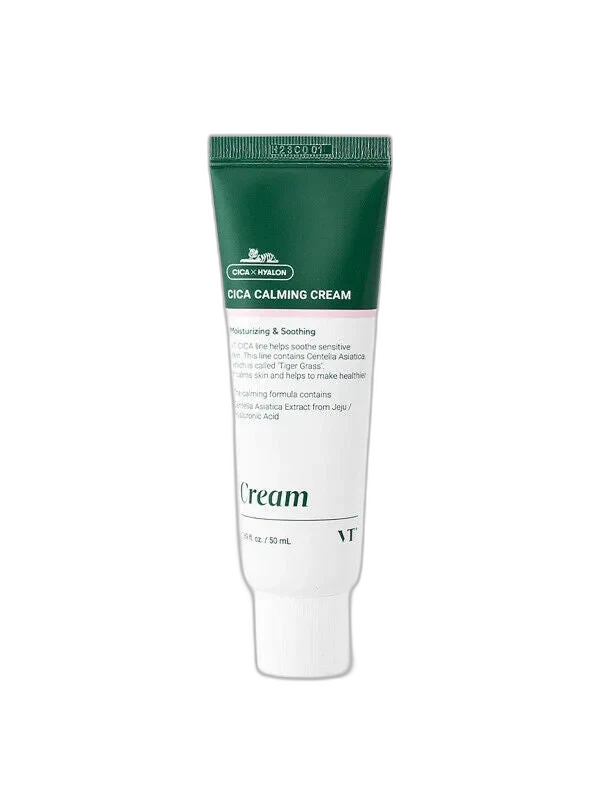
Cica Calming Cream
K-Beauty Cica Staple
 Verified reviewer
Pros & cons.
- +Layers isolated madecassoside and asiaticoside over Centella extract
- +Fragrance-free, alcohol-free formula safe for reactive skin
- +Visible redness reduction within the first application
- +Generous 150ml jar size for the price point
- +Medium-weight texture works year-round for most skin types
- +Compatible with post-procedure and sensitized skin
- +Adds niacinamide and squalane for barrier support
- −Jar packaging exposes formula to air and fingers
- −Not certified vegan despite clean ingredient list
- −Slight cooling sensation can surprise first-time users
- −Texture may feel heavy on oily skin in hot weather
- −Not transformational for pigmentation or fine lines
The full review.
About VT Cosmetics
VT has made this cream since 2017, refining it as the brand grew internationally via its BTS collaboration and expansion into Sephora and Amazon.
Myth
Most aren’t. Brands add a splash of the extract and rely on marketing.
Reality
VT Cosmetics’ Cica Calming Cream actually uses the ingredient seriously. The base extract is present, but the formula works because it adds four isolated Centella triterpenoids: madecassoside, asiaticoside, asiatic acid, and madecassic acid. This is a dermatology-grade approach to Centella. It matters because whole-plant extract triterpenoid content varies by batch. Isolating the actives ensures every bottle delivers a similar soothing effect.
Texture
The texture is medium-weight—silkier than expected for a moisturizing cream. It feels slightly cool on application, which some users love and others find surprising.
Scent
It has no fragrance, no essential oils, and no alcohol.
Packaging
The jar packaging is standard for K-beauty but less hygienic than an airless pump.
Common Praise
Upon application, the most immediate result is what doesn’t happen: no sting, no burn, no reactivity. That absence is the product’s purpose. If your skin is post-procedure, windburned, over-exfoliated, rosacea-flared, or chronically sensitive, feeling nothing at all is the clinical result you want. Visible redness typically softens within fifteen to twenty minutes. Consistent use over the first few days tends to drop baseline skin reactivity. After a couple of weeks, you usually feel the difference throughout the week, not just immediately after application.
Best for
Sensitive-skin users, people recovering from procedures or active breakouts, or anyone needing a reliable calming anchor should reach for this first.
Not ideal for
This isn’t a cream to aggressively fade pigmentation or smooth fine lines. The niacinamide helps tone slightly and barrier repair helps overall skin appearance, but the mission is soothing, not transformation. The cream is thick enough that very oily skin in summer might prefer the gel version of VT’s Cica line instead.
Ingredient analysis.
Full INCI list · pH 5.8
Water, Glycerin, Centella Asiatica Extract, Caprylic/Capric Triglyceride, Butylene Glycol, Niacinamide, Squalane, Cetearyl Alcohol, Glyceryl Stearate, PEG-100 Stearate, Madecassoside, Asiaticoside, Asiatic Acid, Madecassic Acid, Panthenol, Allantoin, Sodium Hyaluronate, Adenosine, Tocopherol, Carbomer, Arginine, Phenoxyethanol, Ethylhexylglycerin
Skin match.
The science.
The Science
Centella asiatica science relies on decades of research into four triterpenoids: asiaticoside, madecassoside, asiatic acid, and madecassic acid. Older dermatology literature calls these TECA (titrated extract of Centella asiatica). These compounds affect fibroblast proliferation, collagen synthesis, and inflammation modulation. Research in journals like the Journal of Ethnopharmacology and Phytomedicine shows madecassoside reduces inflammatory cytokine expression and supports wound healing. This formulation combines whole-plant extract with isolated individual triterpenoids. Whole extract provides the full botanical complex but varies in content; isolated compounds provide consistent, measurable amounts of the most active components. Using both gives the formulator predictability and breadth. The supporting ingredients are also well-chosen. Niacinamide is a clinically supported barrier-repair active; studies show it improves transepidermal water loss and skin elasticity at 2-5% concentrations. Panthenol (provitamin B5) provides hydration and soothing properties. Squalane, a stable derivative of natural squalene, offers non-comedogenic lipid replenishment. Together, these ingredients target inflammation and barrier dysfunction in compromised or reactive skin. The formula uses a well-understood approach with higher ingredient quality than many competitors in this price range.
Dermatologist Perspective
Dermatologists often recommend Centella asiatica-based products for rosacea, post-procedure recovery, and chronic sensitivity. The isolated triterpenoid approach in this cream matches how dermatology literature defines Centella's most clinically useful components. Board-certified dermatologists note that while whole-plant extracts are valuable, products including madecassoside and asiaticoside tend to produce more predictable soothing results. The niacinamide inclusion is also a positive, as it adds barrier-repair function to an anti-inflammatory formula. For patients over-exfoliating or starting retinoids, dermatologists often suggest this type of cream as an evening layering option to buffer irritation and support barrier recovery.
Where it fits in your routine.
Apply a pea-sized amount to clean skin after serums and essences but before sunscreen. Warm the product between fingertips and press it into skin instead of rubbing. Use a thicker layer as a calming treatment on reactive or post-procedure days. Most skin types can use it twice daily, but very oily users may prefer evening use during warmer months. Use clean hands or a spatula to keep the product stable in the jar packaging.
At $24 for 150ml, this cream costs less per milliliter than Western soothing creams, which often cost 30-50% more for 50ml tubes. The ingredient list justifies the price. Adding isolated triterpenoids to Centella extract is a formulation upgrade, not marketing. For a brand with a decade-plus track record in the K-beauty soothing category, this price reflects ingredient quality instead of brand prestige. One jar lasts roughly four to six months with twice-daily full-face use, making the cost-per-use low.
This works for sensitive, reactive, or post-procedure skin, people recovering from over-exfoliation, rosacea-prone users needing a soothing daily cream, and anyone wanting a well-made cica product without European pharmacy-brand prices.
This is not a transformational anti-aging or brightening cream. Skip this if you want airless packaging, a vegan-certified moisturizer, or if medium-weight creams feel heavy on very oily skin in summer.
Product details.
Medium-weight cream that melts into a silky finish
Fragrance-free with a faint herbal note from the Centella
Wide-mouth jar with plastic inner cap
It feels mildly cool on application and absorbs fast. Redness often calms visibly within 15-20 minutes of the first use. It does not sting, even on flared or reactive skin.
4-6 months with twice-daily face and neck application
12 months
All Year
The backstory.
VT Cosmetics built its international profile on the Cica line after launching in 2013 in Seoul. The Calming Cream became the brand's anchor product as Korean dermatology shifted toward Centella as the go-to soothing active, and it was later part of the product rollout associated with VT's high-profile partnership with BTS.
About VT Cosmetics
Established Brand (5–20 years)VT Cosmetics launched in 2013 in South Korea. It gained global recognition via its Cica line and a BTS collaboration. The brand uses Centella asiatica formulations and has a steady reputation in the K-beauty soothing category for the last decade.
Common myths.
Cica creams are only for damaged or post-procedure skin.
Centella helps barrier recovery, but the niacinamide, squalane, and humectants make this a reasonable everyday moisturizer for normal-to-sensitive skin, not just an emergency product.
All cica products work the same.
Generic Centella extract triterpenoid content varies widely. Products that add isolated madecassoside and asiaticoside provide more consistent calming action than plain extract formulas.
FAQ.
What does cica actually mean in skincare?
Cica is short for Centella asiatica, a plant used in Asian medicine for wound healing. In modern skincare, it refers to products using Centella extract and its isolated compounds to soothe reactive skin and support barrier repair.
Can I use Cica Calming Cream after a chemical peel or laser?
Yes. This fragrance-free Centella-dominant formula is a common post-procedure recovery recommendation. Added niacinamide and panthenol reinforce the skin barrier during rebuilding. Check with your provider for specific procedure timing.
Is this cream heavy enough for dry winter skin?
This medium-weight cream works alone for normal to combination skin year-round. For very dry skin in cold weather, layer a heavier occlusive on top at night.
Does VT Cica Calming Cream help with rosacea?
Centella asiatica and its triterpenoids have documented anti-inflammatory effects that help many rosacea-prone users. The fragrance-free, alcohol-free base is rosacea-friendly. It does not treat the underlying condition but calms visible redness.
Is the jar packaging a problem?
Jars expose product to air and fingers every time you use them. Phenoxyethanol and ethylhexylglycerin preserve the formula. This is standard, but using a spatula or clean fingers extends product integrity. The plastic inner cap reduces air exposure between uses.
What the community says.
"Visible redness reduction"
"Non-greasy despite richness"
"Works on reactive skin where other creams sting"
"Large 150ml jar lasts a long time"
"Jar packaging not hygienic"
"Slight cooling sensation some dislike"
"Thicker than expected for oily skin in summer"