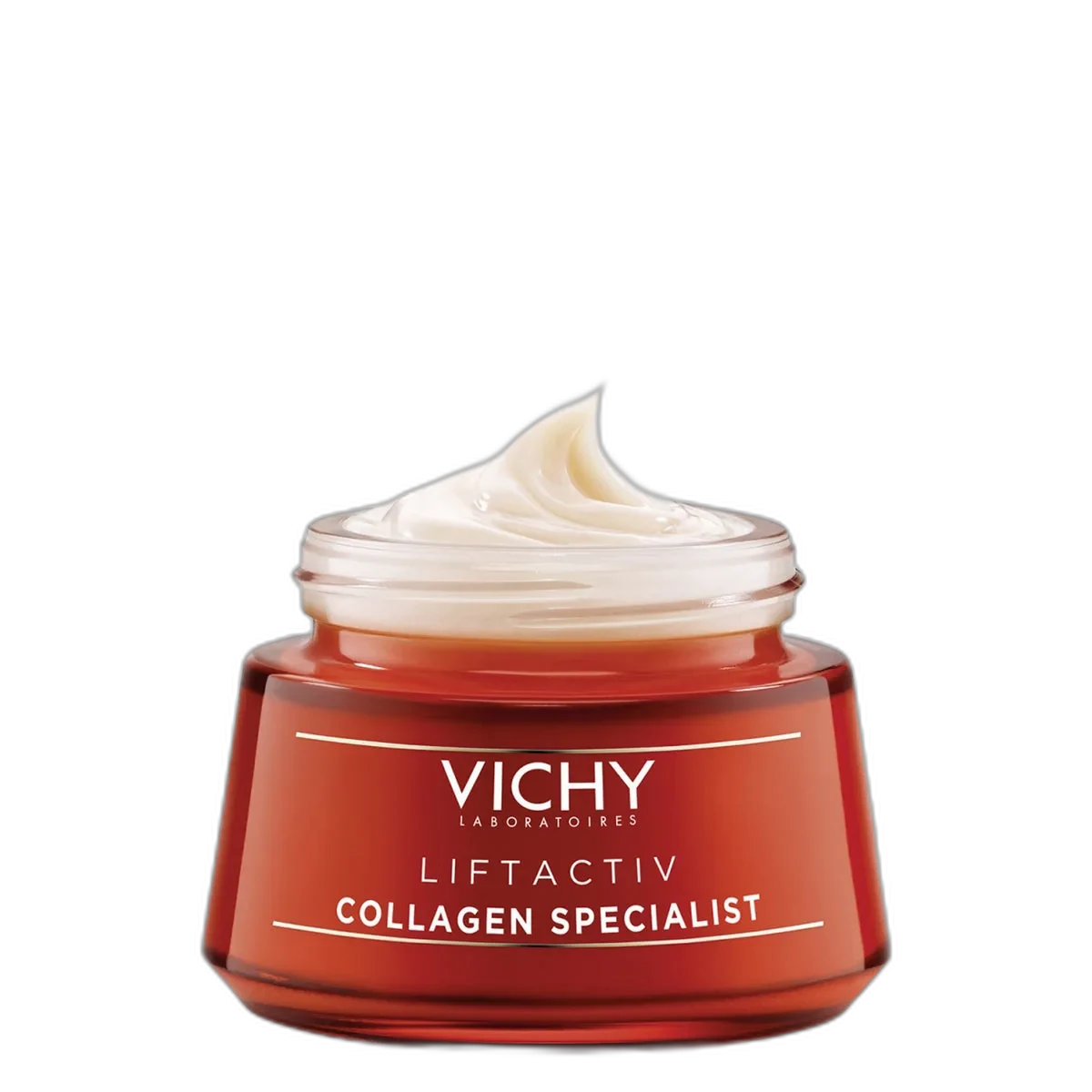
LiftActiv Collagen Specialist
Anti-Aging Makeup Primer Hybrid
 Verified reviewer
Pros & cons.
- +Exceptional matte, powdery finish that doubles as a genuine makeup primer
- +Lightweight gel-cream texture absorbs quickly without tackiness or greasiness
- +Acetyl Tetrapeptide-9 targets collagen organization through lumican, not just collagen volume
- +Adenosine provides well-validated wrinkle-smoothing effects at regulatory-approved levels
- +Instant soft-focus optical blurring effect on fine lines from first application
- +Solid daily hydration from high-concentration glycerin and dimethicone occlusion
- +Elegant French pharmacy formulation feel that rivals luxury-priced competitors
- −Key actives (peptide, vitamin C) sit low in the INCI list, suggesting low concentrations
- −Alcohol denat. at fifth position may irritate sensitive or barrier-compromised skin
- −Strong fragrance polarizes users and limits suitability for scent-sensitive individuals
- −Jar packaging exposes antioxidant ingredients to air degradation with each use
- −Some users report pilling when layered over other serums or treatments
The full review.
The sunscreen compliance problem is real. Dermatologists have been begging us to wear SPF daily for decades, and most of us still don’t — because most sunscreens are, frankly, unpleasant to wear. They’re too thick, too white, too greasy, or too expensive to justify slathering on every morning. Innisfree’s Daily UV Defense SPF 36 exists to systematically eliminate every one of those excuses, and at sixteen dollars, it succeeds more convincingly than products costing three times as much.
The formula’s UV protection comes from a three-filter chemical system: homosalate and octisalate handle UVB rays, while avobenzone provides the critical UVA coverage that prevents photoaging and hyperpigmentation. The clever addition here is ethylhexyl methoxycrylene — not a UV filter itself, but a photostabilizer that prevents avobenzone from degrading in sunlight. Avobenzone is one of the best UVA filters available in the US market, but it’s notoriously unstable; without a stabilizer, it loses efficacy within hours. This formula addresses that weakness directly, which is a level of formulation sophistication you don’t usually see at this price point.
Texture is where this product converts skeptics. It applies like a lightweight moisturizer — fluid, non-greasy, and completely invisible within seconds. There is genuinely no white cast, which matters enormously for darker skin tones that have been poorly served by the sunscreen market for decades. Under makeup, it creates a smooth, slightly dewy base that actually improves foundation application. No pilling, no balling up, no weird interactions with other products. It just disappears into the skin and lets you forget you’re wearing sunscreen at all — which, ironically, is the highest compliment you can pay a sunscreen.
The botanical supporting cast reflects Innisfree’s roots in Korean skincare philosophy, where the idea that every product should do more than one thing is practically gospel. Centella asiatica extract — the ‘cica’ that has become a K-beauty staple — provides anti-inflammatory benefits that help counteract any irritation from the chemical UV filters. Green tea delivers antioxidant polyphenols that work alongside the sunscreen as a second line of UV defense, scavenging the free radicals that slip past the filters. Sunflower seed oil and its unsaponifiable fraction contribute both emolliency and phytosterols that support barrier function. Portulaca oleracea (purslane) extract adds another layer of antioxidant and anti-inflammatory support. This isn’t a formula that just protects — it actively cares for the skin underneath, which is a distinctly Korean approach to sun protection.
The price deserves its own paragraph. Sixteen dollars for 1.69 ounces of a well-formulated, broad-spectrum, cosmetically elegant sunscreen from a reputable brand is remarkable. For context, comparable products from prestige brands often run thirty to fifty dollars for similar or even smaller sizes. At this price point, there’s genuinely no financial excuse to skip sunscreen — which may be the most important thing about this product. You could buy three of these for the cost of one tube of some competitors, and you could actually afford to apply the dermatologist-recommended amount without wincing at how fast the bottle empties.
Innisfree was founded in 2000 by Amorepacific, South Korea’s largest beauty conglomerate with roots dating to 1945. That corporate backing means serious R&D resources and quality control infrastructure that smaller indie brands simply cannot match. The brand’s philosophy centers on Jeju Island-sourced natural ingredients, and while this particular formula is more cosmetic chemistry than island botanicals, the centella, green tea, and citrus unshiu peel extracts nod to that heritage authentically. South Korean sunscreen technology is widely regarded as the most advanced in the world, and this formula reflects that national expertise.
There are legitimate caveats. The formula contains fragrance, which, while faint and fast-dissipating, is unnecessary in a sunscreen and excludes some fragrance-sensitive users. SPF 36 is perfectly adequate for daily use — blocking 97.2% of UVB rays compared to SPF 50’s 98% — but if you live in a high-UV area or spend significant time outdoors, you might prefer a higher number for the wider margin of error with imperfect application. Innisfree now offers an SPF 50+ version for exactly this purpose, so the brand has you covered either way.
The finish trends slightly dewy, which is a feature for dry and normal skin but may read as shiny on very oily complexions by midday. Setting with a light dusting of powder easily addresses this. Combination skin types generally find the finish ideal — natural-looking and healthy without tipping into greasy territory.
The tube packaging is practical and hygienic — no dipping fingers into a jar, no exposure to air. The flip-cap dispenses product cleanly and travels well. It’s an unglam but smart design choice that prioritizes daily usability over shelf appeal.
In a sunscreen market full of compromises — protection vs. comfort, efficacy vs. affordability, invisible finish vs. broad-spectrum coverage — the Innisfree Daily UV Defense SPF 36 offers a genuinely balanced answer. It won’t win awards for maximum SPF, but it will earn something more valuable: consistent daily use. And consistent use of a good sunscreen beats occasional use of a perfect one every time.
Formula
About Innisfree
Innisfree was founded in 2000 by Amorepacific, South Korea’s largest beauty conglomerate with roots dating to 1945. That corporate backing means serious R&D resources and quality control infrastructure that smaller indie brands simply cannot match. The brand’s philosophy centers on Jeju Island-sourced natural ingredients, and while this particular formula is more cosmetic chemistry than island botanicals, the centella, green tea, and citrus unshiu peel extracts nod to that heritage authentically. South Korean sunscreen technology is widely regarded as the most advanced in the world, and this formula reflects that national expertise.
Texture
Texture is where this product converts skeptics. It applies like a lightweight moisturizer — fluid, non-greasy, and completely invisible within seconds. There is genuinely no white cast, which matters enormously for darker skin tones that have been poorly served by the sunscreen market for decades. Under makeup, it creates a smooth, slightly dewy base that actually improves foundation application. No pilling, no balling up, no weird interactions with other products. It just disappears into the skin and lets you forget you’re wearing sunscreen at all — which, ironically, is the highest compliment you can pay a sunscreen.
Scent
There are legitimate caveats. The formula contains fragrance, which, while faint and fast-dissipating, is unnecessary in a sunscreen and excludes some fragrance-sensitive users.
Packaging
The tube packaging is practical and hygienic — no dipping fingers into a jar, no exposure to air. The flip-cap dispenses product cleanly and travels well. It’s an unglam but smart design choice that prioritizes daily usability over shelf appeal.
Best for
In a sunscreen market full of compromises — protection vs. comfort, efficacy vs. affordability, invisible finish vs. broad-spectrum coverage — the Innisfree Daily UV Defense SPF 36 offers a genuinely balanced answer. It won’t win awards for maximum SPF, but it will earn something more valuable: consistent daily use. And consistent use of a good sunscreen beats occasional use of a perfect one every time.
Works for
The finish trends slightly dewy, which is a feature for dry and normal skin but may read as shiny on very oily complexions by midday. Setting with a light dusting of powder easily addresses this. Combination skin types generally find the finish ideal — natural-looking and healthy without tipping into greasy territory.
Ingredient analysis.
Full INCI list
Aqua/Water, Glycerin, Dimethicone, Isohexadecane, Alcohol Denat., Silica, Hydroxyethylpiperazine Ethane Sulfonic Acid, Propanediol, Synthetic Wax, PEG-10 Dimethicone, Eperua Falcata Bark Extract, PEG-30 Dipolyhydroxystearate, Stearyl Alcohol, Sorbitan Oleate, Dimethicone/PEG-10/15 Crosspolymer, Dimethicone/Polyglycerin-3 Crosspolymer, Ceteareth-6, Sodium Acrylates Copolymer, Sodium Citrate, Sodium Hydroxide, Sodium Phytate, Cyclodextrin, Adenosine, Ascorbyl Glucoside, Nylon-12, Isopropyl Alcohol, Propylene Carbonate, Dipropylene Glycol, Caprylic/Capric Triglyceride, Caprylyl Glycol, Acetyl Tetrapeptide-9, Synthetic Fluorphlogopite, Disteardimonium Hectorite, Dextrin, Pisum Sativum Extract/Pea Extract, Tocopherol, Phenoxyethanol, CI 15985/Yellow 6, CI 77891/Titanium Dioxide, Parfum/Fragrance
Skin match.
The science.
The Science
The formulation uses Acetyl Tetrapeptide-9, a synthetic peptide, to drive its collagen strategy by stimulating lumican synthesis. Lumican is a small leucine-rich proteoglycan that organizes collagen fibrils; without enough lumican, collagen fibers form thin, disorganized bundles even if collagen levels are high. A study in the International Journal of Cosmetic Science shows Acetyl Tetrapeptide-9 increased lumican synthesis by 115% over controls. Additionally, a clinical trial on 17 female volunteers showed thicker, firmer skin after four months of topical application.
The ascorbyl glucoside component adds a second mechanism: it increases collagen type I production by dermal fibroblasts in a dose-dependent manner, as Gref et al. showed in the International Journal of Cosmetic Science (2008). As a glucoside derivative, it is more stable than pure L-ascorbic acid, but skin alpha-glucosidase must enzymatically cleave it to release active ascorbic acid. This conversion process limits its potency compared to direct L-AA application.
Adenosine provides wrinkle-reducing effects. Regulatory bodies in South Korea and the EU approve adenosine as an anti-wrinkle active at concentrations as low as 0.04%. Its mechanism—promoting fibroblast proliferation and collagen synthesis via adenosine receptor activation—is well-documented in dermatological literature.
The HEPES buffer (hydroxyethylpiperazine ethane sulfonic acid) has two roles: it maintains pH stability and provides gentle exfoliation through mild keratolytic effects, which promotes cell turnover alongside the anti-aging actives.
References
- Topical Peptide Treatments with Effective Anti-Aging Results — Cosmetics (2017)
- Effect of vitamin C and its derivatives on collagen synthesis and cross-linking by normal human fibroblasts — International Journal of Cosmetic Science (2008)
Dermatologist Perspective
Dermatologists value peptide-based anti-aging formulations in a skincare routine, but most say peptides complement established actives like retinoids and well-formulated vitamin C serums. Board-certified dermatologists note that the Acetyl Tetrapeptide-9 in this formula targets collagen organization rather than just production. However, they typically advise patients that topical peptides work better as maintenance treatments than as corrective interventions for significant photoaging. Dermatologists also note that the inclusion of alcohol denat. and fragrance is a limitation, as these ingredients can compromise barrier function in the demographic most likely to use anti-aging products.
Where it fits in your routine.
Apply a thin layer to cleansed, dry skin every morning after treatment serums. Wait 1-2 minutes for the cream to set before applying sunscreen or makeup; the powdery finish works best once it dries down completely. This is a daytime moisturizer; use a richer night cream for PM use. This does not contain SPF, so always follow with broad-spectrum sunscreen.
At approximately $45 for 50 mL, this cream costs more than most pharmacy brands. The texture and finish justify the price — the matte, primer-friendly finish is rare in the anti-aging category. However, the active ingredient concentrations suggest you pay more for the sensorial experience than for collagen-boosting efficacy. Vichy's 95-year-old French pharmacy brand history adds credibility, but the formulation offers better value if the peptide and vitamin C appear higher in the ingredient list.
Normal and combination skin types aged 35+ seeking an anti-aging moisturizer with a matte, primer-friendly finish and no greasiness. This works well for those who find dewy or thick anti-aging creams too heavy under makeup.
People with sensitive or barrier-compromised skin should be cautious because of the alcohol denat. and fragrance. Those wanting high-potency anti-aging treatment with clinically significant active concentrations may find the formulation underwhelming for its positioning.
Product details.
Noticeable Vichy signature fragrance — stronger than the brand's other moisturizers. Divisive: some find it fresh and sophisticated, others describe it as overpowering or reminiscent of cologne.
White glass jar with a coral-accented screw-top lid fits Vichy's clean pharmacy aesthetic. The jar format looks good but hurts the stability of the ascorbyl glucoside and tocopherol — a pump or tube protects these antioxidant ingredients from air better. Finish mattevelvetynon-greasy
Silica and synthetic fluorphlogopite create an immediate soft-focus effect by blurring fine lines optically. The cream feels silky and dries to a powdery finish within 1-2 minutes. It has no tingling or adjustment period. Most users notice the fragrance first.
2-3 months with once-daily facial application
12 months
All Year
The backstory.
Launched in 2019 as Vichy's answer to the collagen-banking trend, the Collagen Specialist was designed to address the gap between lightweight daily moisturizers and heavy-duty anti-aging treatments. It draws on L'Oréal's research into peptide-driven collagen architecture rather than the traditional approach of simply boosting collagen volume.
About Vichy
Legacy Brand (20+ years)Vichy launched in 1931 near the thermal springs of Vichy, France, and belongs to L'Oréal's Dermatological Beauty division. Dermatologists develop the brand's formulations and clinical testing backs them. Peer-reviewed research includes the brand's Mineralizing Thermal Water.
Common myths.
Topical collagen in skincare products replaces lost collagen
This product avoids that approach. Collagen molecules are too large to penetrate the skin barrier. Instead, it uses Acetyl Tetrapeptide-9 to stimulate skin collagen organization via lumican synthesis — a more effective strategy.
Anti-aging creams do not need a thick or heavy texture to work
This gel-cream's lightweight, powdery texture delivers actives as effectively as a thicker cream. Silica and dimethicone create a smooth finish without affecting ingredient delivery to the skin.
FAQ.
Can I use Vichy Collagen Specialist under makeup?
Yes — this is a genuine strength. The silica, dimethicone, and nylon-12 create a powder-like, matte finish that works as an effective makeup primer. Wait 1-2 minutes for full absorption before applying foundation.
Is Vichy Collagen Specialist good for sensitive skin?
This product contains alcohol denat. and fragrance, both known irritants for sensitive skin. Vichy markets it as hypoallergenic and dermatologist-tested, but reactive or sensitized skin types should patch test carefully or use the brand's fragrance-free alternatives.
How long does Vichy Collagen Specialist take to show results?
Optical blurring ingredients provide an immediate soft-focus smoothing effect. Hydration and texture improve within 1-2 weeks. Consistent daily use for 4-8 weeks reduces fine lines and improves firmness, as Vichy's clinical data shows 16% wrinkle reduction after one month.
Is the jar packaging a problem for Vichy Collagen Specialist?
Opening the jar exposes ascorbyl glucoside and tocopherol to air, which accelerates antioxidant degradation. The formula uses a stable vitamin C derivative, but a pump or tube preserves the active ingredients better over the product's lifespan.
What the community says.
"Lightweight gel-cream texture absorbs quickly without greasiness"
"Velvety, powdery matte finish that works beautifully under makeup"
"Noticeable improvement in skin radiance and smoothness after 4+ weeks"
"Good daily hydration without feeling heavy on combination skin"
"Elegant formulation feel that rivals luxury-priced competitors"
"Strong fragrance that some users find overpowering"
"Contains alcohol denat. which can irritate sensitive or dry skin"
"Jar packaging exposes antioxidant ingredients to air and light"
"Some users experience pilling when layered over other products"
"Active ingredient concentrations likely too low for dramatic anti-aging results"