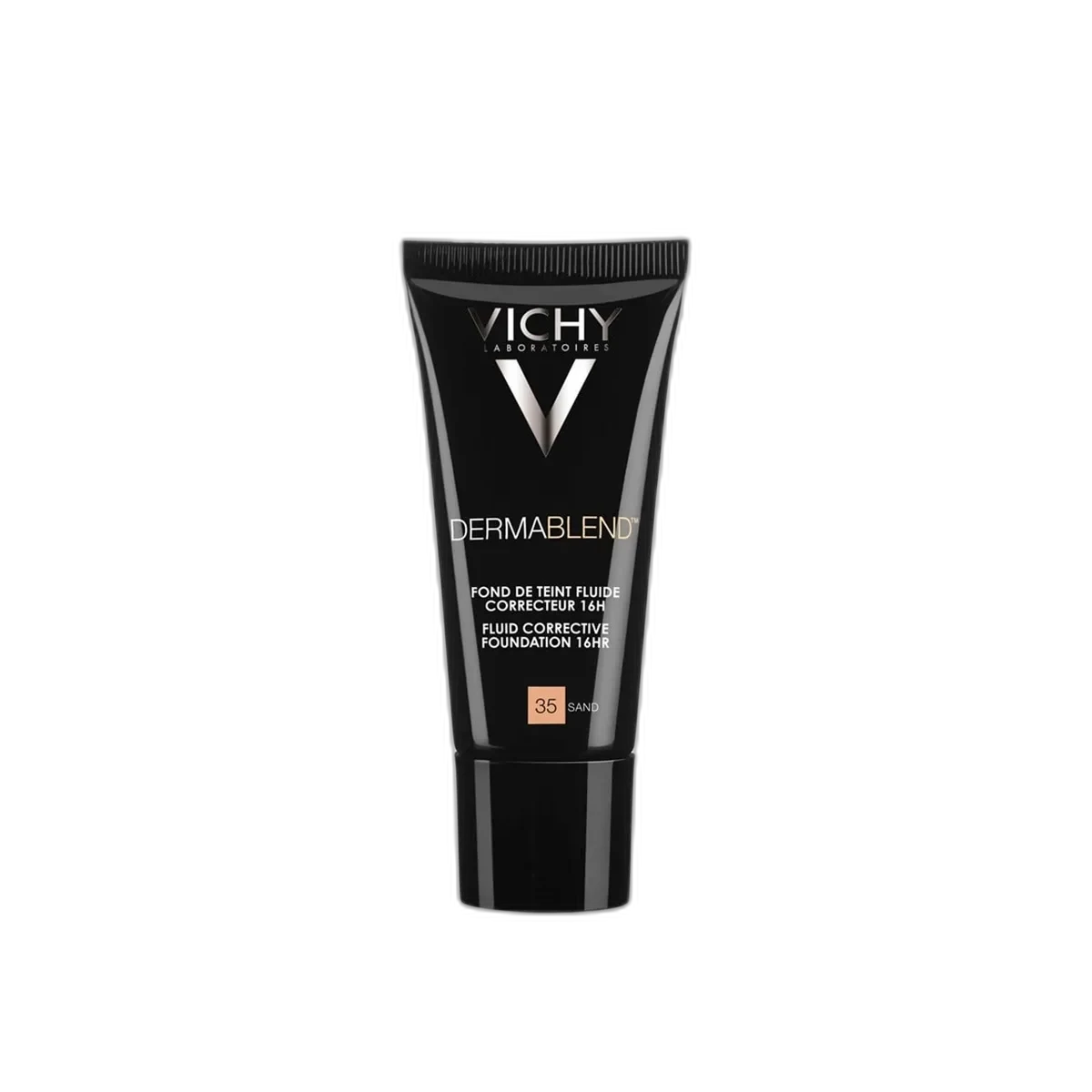
Dermablend Corrective Foundation
Derm-Grade Coverage Pioneer
 Verified reviewer
Pros & cons.
- +25% pigment concentration delivers corrective-level coverage for rosacea, vitiligo, scars, and hyperpigmentation
- +Surprisingly lightweight and blendable despite the highest-density pigment load in its class
- +Completely fragrance-free, paraben-free, and allergy-tested for compromised and sensitive skin
- +SPF 35 from mineral titanium dioxide adds photoprotection without chemical filter sensitization
- +Long 16-hour wear claim with setting powder holds up well through a full workday
- +Non-comedogenic tested formula won't worsen acne despite full coverage
- +Excellent per-use value due to high pigment concentration requiring minimal product
- +Dermatological heritage dating to 1981 with extensive clinical testing credentials
- −Only 8 shades with yellow-skewing undertones fails to serve the diverse population that needs this product
- −Transfers to fingers, phones, and clothing without setting powder
- −Some oxidation reported — foundation may darken half a shade within 30 minutes of application
- −US version (Dermafinish) discontinued — requires international purchase for US consumers
- −Requires setting powder for advertised longevity which adds an extra product and step
- −May feel heavier than expected for those accustomed to sheer or medium-coverage formulas
The full review.
In 1981, American dermatologist Dr. N. Craig Roberts had a problem that no product on the market could solve. His wife had vitiligo — patches of depigmented skin that standard cosmetics couldn’t adequately conceal. So he developed his own formula, one dense enough in mineral pigment to make those patches invisible while remaining gentle enough for the compromised skin that often accompanies the condition. That formula became Dermablend, and four decades later, the Vichy Dermablend Corrective Foundation carries its DNA forward.
The defining number is 25%. That’s the pigment concentration — roughly double what you’ll find in a standard liquid foundation. Titanium dioxide and iron oxides, packed at this density, can conceal almost anything the skin presents: the diffuse redness of rosacea, the purple-brown of post-inflammatory hyperpigmentation, the stark contrast of vitiligo, the textured landscape of acne scars. This is the foundation dermatologists recommend to patients who need their skin conditions made invisible before they walk out the door.
What’s remarkable is how the formula delivers this coverage without the expected tradeoffs. Full-coverage products have traditionally been thick, suffocating, obviously present on the skin — the kind of makeup that conceals one problem while creating another. The Vichy Dermablend uses a dimethicone-based vehicle that gives the concentrated pigments a fluid, melt-into-skin quality. One pump from the bottle covers half the face. The texture is creamy but thin, and it blends with far less resistance than you’d expect from something this opaque. Once set, the finish is satin-natural — it looks like good skin, not like heavy makeup.
The ingredient list reads like a dermatologist wrote it, which, given the product’s heritage, is essentially true. No fragrance. No parabens. No alcohol. No traditional oils. Glycerin provides hydration — the formula claims 24 hours of it, which is ambitious but reflects real moisturizing capacity beneath the pigment layer. Pentylene glycol and ethylhexylglycerin handle preservation without the parabens that the earlier formulation contained. The current 16-hour version, reformulated around 2015-2016, cleaned up the ingredient list considerably from its predecessor.
The SPF 35 from titanium dioxide is a meaningful bonus. Mineral UV protection in a foundation is ideal for the sensitive, reactive skin types this product was designed for — no chemical filter sensitization risk, no stability concerns. It won’t replace a dedicated sunscreen for a day at the beach, but for daily urban wear, it adds a functional layer of photoprotection.
Application technique matters with this product. The instinct with foundation is to apply a single layer and blend. With Dermablend, two thin layers outperform one medium layer — the coverage looks more natural, the finish more skin-like, and the wear time improves. A beauty sponge or fingertips both work well; brushes can lift product if you go over the same area too many times. Set with translucent powder. This step isn’t optional if you want the 16-hour longevity claim to have any relationship to reality. Without powder, the formula transfers — to phones, fingertips, shirt collars, steering wheels. With powder, transfer drops dramatically.
The shade range is the product’s most frustrating limitation. Eight shades — 15 Opal through 95 Chestnut — with a pronounced yellow undertone bias. This is a corrective product meant for people with visible skin conditions, a population that includes every skin tone and undertone imaginable. Eight yellow-leaning shades don’t serve that population adequately. It’s the kind of gap that feels like a manufacturing efficiency decision rather than a formulation one, and it’s worth noting because the people who most need this product are the ones most likely to be failed by the limited shade range.
Some oxidation has been reported — the foundation can darken slightly about thirty minutes after application. This isn’t dramatic, but if you’re shade-matching at the counter, go half a shade lighter than your immediate impression. The oxidized shade is the one you’ll wear.
At $36 for 30 mL, the value is actually quite good. The high pigment concentration means you use significantly less product per application than a standard foundation, extending the bottle to two or three months of daily wear. Compare that to medical-grade camouflage products that can cost $40-60 for similar amounts, and the Dermablend pricing looks reasonable.
Vichy’s pharmacy heritage and L’Oréal’s formulation resources give this product credibility that a new brand couldn’t replicate. The dermatological testing, the ophthalmological testing, the allergy testing, the non-comedogenic certification — these aren’t marketing checkboxes for a product in this category. They’re the minimum requirements for something designed to be worn daily by people whose skin is already dealing with an active condition.
The Dermablend Corrective Foundation isn’t trying to compete with prestige beauty foundations on finish elegance or shade diversity. It’s a tool — a highly effective, thoughtfully formulated tool for people who need their skin to disappear before they can feel comfortable being seen. That it also happens to be a pleasant daily-wear foundation for anyone who prefers full coverage is almost incidental to its real purpose. The origin story still matters. Forty years on, this formula still puts the patient first.
Formula
Ingredient analysis.
Full INCI list
Aqua/Water, Undecane, Dimethicone, Glycerin, Tridecane, Polyglyceryl-4 Isostearate, Pentylene Glycol, Cetyl PEG/PPG-10/1 Dimethicone, Hexyl Laurate, Magnesium Sulfate, Disteardimonium Hectorite, Trihydroxystearin, Cellulose Gum, Aluminum Hydroxide, Disodium Stearoyl Glutamate, Acetylated Glycol Stearate, Acrylonitrile/Methyl Methacrylate/Vinylidene Chloride Copolymer, Ethylhexylglycerin, \[+/- CI 77891/Titanium Dioxide, CI 77491/CI 77492/CI 77499/Iron Oxides\]
Skin match.
The science.
The Science
The 25% mineral pigment concentration in this formula represents a deliberate engineering choice with clinical implications. Titanium dioxide and iron oxides at this density provide coverage that can fully conceal the erythema characteristic of rosacea subtypes 1 and 2, the depigmentation of vitiligo, and the post-inflammatory hyperpigmentation common after acne resolution or dermatological procedures.
A study published in the Journal of Cosmetic Dermatology (Seité et al., 2012) evaluated corrective cosmetics including Dermablend products in patients with facial skin conditions, demonstrating significant improvements in quality of life scores and self-perception when corrective coverage was incorporated into dermatological treatment plans. The research underscored that effective camouflage cosmetics serve a therapeutic function beyond aesthetics — patients with visible skin conditions experience measurable psychological benefit from products that reliably conceal their conditions.
The mineral-only UV protection from titanium dioxide is particularly relevant for the sensitive skin population this product targets. Unlike chemical UV filters that absorb UV energy and can release heat or degradation products that irritate reactive skin, titanium dioxide reflects and scatters UV photons without chemical transformation. This makes it the preferred UV filter in dermatological practice for patients with contact dermatitis, rosacea, and post-procedural sensitivity.
The dimethicone vehicle is also clinically significant. Dimethicone creates a semi-occlusive barrier that reduces transepidermal water loss without fully occluding the skin — a balance that supports the 24-hour hydration claim while maintaining breathability. For compromised skin barriers, this protective film function has been demonstrated to reduce irritation from external environmental exposures.
References
- Corrective camouflage in pediatric dermatology — Journal of Cosmetic Dermatology (2012)
Dermatologist Perspective
Dermatologists have recommended Dermablend products for decades, and this corrective foundation remains a standard recommendation for patients needing daily coverage of visible skin conditions. Board-certified dermatologists note that the fragrance-free, non-comedogenic, allergy-tested formulation is one of the few full-coverage foundations they can confidently recommend for active rosacea, post-procedure recovery, and vitiligo management. The mineral SPF 35 adds therapeutic value without chemical filter sensitization. Dermatologists commonly instruct patients to apply in thin, buildable layers and set with powder for all-day wear, and emphasize the importance of thorough double-cleansing at night to ensure complete removal of the dense pigment layer.
Where it fits in your routine.
Apply to a well-moisturized face. Dispense one pump of foundation and dot it on your forehead, cheeks, chin, and nose. Blend outward with fingertips, a damp beauty sponge, or a flat foundation brush. Do not use a brush over the same area repeatedly or the product lifts. For maximum coverage, let the first layer set for 30 seconds, then apply a second thin layer. Set with a light dusting of translucent loose powder pressed gently with a puff to ensure longevity and transfer resistance. Remove at night with an oil-based cleanser and then a water-based cleanser for complete removal.
At $36 for 30 mL, this foundation provides high value compared to mass-market or medical-grade options. The 25% pigment concentration allows one pump to cover half the face. A bottle lasts two to three months with daily use, making the effective cost roughly $12-18 per month. Dermablend pricing is competitive with medical camouflage products like Covermark or Keromask, which cost $40-60 for similar volumes, but Dermablend offers pharmacy-channel accessibility. Availability is the only value concern; US consumers may face import costs since the domestic Dermafinish version was discontinued.
This works for anyone with visible skin conditions — rosacea, vitiligo, hyperpigmentation, acne scars, or surgical scars — who needs reliable daily concealment safe for sensitive and compromised skin. Post-procedure patients cleared by their dermatologist for cosmetic coverage can use it. It suits anyone wanting full coverage without fragrance, parabens, or chemical UV filters.
People needing a shade match outside the 8-shade yellow undertone range. Users wanting sheer or medium coverage and a dewy finish. Consumers avoiding setting powder as a required extra step. Those with fungal acne needing to avoid certain esters in the formula.
Product details.
This smooth, creamy fluid contains 25% pigment concentration. It melts into skin and blends easily. The lightweight, full-coverage formula has a 'melting' texture that feels like wearing less product than is actually on the skin.
Fragrance-free. Some users notice a faint, neutral cosmetic smell when first applying it, which disappears within seconds.
30 mL glass bottle with pump dispenser. The white and silver design has a clean, clinical Vichy pharmacy-brand aesthetic. The pump dispenses precise amounts, which matters because a tiny amount provides substantial coverage.
The first application feels pleasant for a corrective-grade product. The fluid blends easier than expected for its coverage level. One pump covers about half the face. Build coverage gradually; two thin layers look more natural than one thick application. It causes no stinging, burning, or tightness.
Apply daily to the face for 2-3 months — high pigment concentration means a little goes a long way.
12 months
All Year
The backstory.
The Dermablend story begins in 1981 when American dermatologist Dr. N. Craig Roberts developed a corrective cosmetic for his wife, who had vitiligo. That original formulation evolved into a brand that eventually joined L'Oréal's portfolio alongside Vichy. This Corrective Foundation carries that medical heritage forward — a product designed not for vanity but for patients who needed their skin conditions made invisible.
About Vichy
Legacy Brand (20+ years)Dermatologist Dr. Prosper Haller founded Vichy in 1931, now part of L'Oréal's Dermatological Beauty division. The Dermablend line uses corrective cosmetics methods from 1981, when American dermatologist Dr. N. Craig Roberts made the first Dermablend formula for vitiligo patients. Over 70,000 dermatologists worldwide recommend the brand.
Common myths.
Full-coverage foundations always clog pores and worsen breakouts.
This foundation tests non-comedogenic despite its 25% pigment load. The mineral pigments (titanium dioxide and iron oxides) and silicone base do not clog pores. The fragrance-free, paraben-free formula minimizes the irritation risk that triggers breakouts.
Corrective cosmetics are thick, uncomfortable, and visible on the skin.
Modern corrective formulations like this one use advanced dispersal technology to deliver high pigment loads in lightweight vehicles. The dimethicone base feels like a second skin, and the 'melting' texture provides coverage that makes skin look flawless without looking made up.
FAQ.
Can Vichy Dermablend cover rosacea redness?
Yes — the 25% pigment concentration corrects rosacea by fully concealing diffuse redness and visible blood vessels. The fragrance-free, non-comedogenic formula is safe for rosacea-prone skin, but the dimethicone base creates a barrier that minimally traps heat.
How many shades does Vichy Dermablend Corrective Foundation come in?
There are 8 shades, from 15 Opal (lightest) to 95 Chestnut (deepest). The shade range favors light-to-medium tones with yellow undertones. This is the product's main limitation—shades may look warm if you have pink, olive, or neutral undertones.
Is this foundation safe to use after cosmetic procedures?
Yes — the fragrance-free, paraben-free, allergy-tested formula targets sensitive and compromised skin. Dermatologists often recommend Dermablend products for post-procedure coverage after initial skin healing. Always confirm timing with your treating physician.
Does Vichy Dermablend need setting powder?
To maximize longevity, use a light dusting of translucent setting powder. This reduces transfer and helps the foundation reach its full 16-hour claim. Without powder, the foundation transfers to phones, fingers, and clothing, especially on oily skin.
Is Vichy Dermablend the same as Dermablend Professional?
No — Vichy Dermablend and Dermablend Professional are different product lines in the L'Oréal portfolio. Dermablend Professional targets camouflage cosmetics in the US market. Vichy Dermablend is the international European line. Formulations, shade ranges, and pricing vary between them.
Can this foundation cover vitiligo patches?
The Dermablend line launched in 1981 to cover vitiligo. Its 25% pigment concentration provides the opacity required to hide depigmented patches. For best results, apply thin layers, build coverage to your desired level, and set with powder for longevity.
Does Vichy Dermablend Corrective Foundation have SPF?
Yes — SPF 35 from titanium dioxide (mineral/physical filter). This provides meaningful daily UV protection, though dermatologists recommend a dedicated sunscreen underneath for extended outdoor exposure since foundation application rarely achieves the tested SPF amount.
Community
What the community says.
"Full corrective coverage without looking cakey or mask-like"
"Surprisingly lightweight feel despite 25% pigment concentration"
"Long-wearing formula that lasts 12-16 hours with setting powder"
"Fragrance-free and gentle enough for post-procedure and sensitive skin"
"Effectively covers redness, acne scars, dark circles, and hyperpigmentation"
"Smooth blendable texture that melts into skin naturally"
"Only 8 shades available with limited undertone diversity"
"Can transfer onto fingers, clothes, and phone screens throughout the day"
"Some oxidation reported — foundation may darken slightly after 30 minutes"
"US version (Dermafinish) has been discontinued making domestic purchase harder"
"Requires setting powder for best longevity on oily skin"
"May feel heavier than expected for those used to tinted moisturizers"
Featured in.
People also looked at.