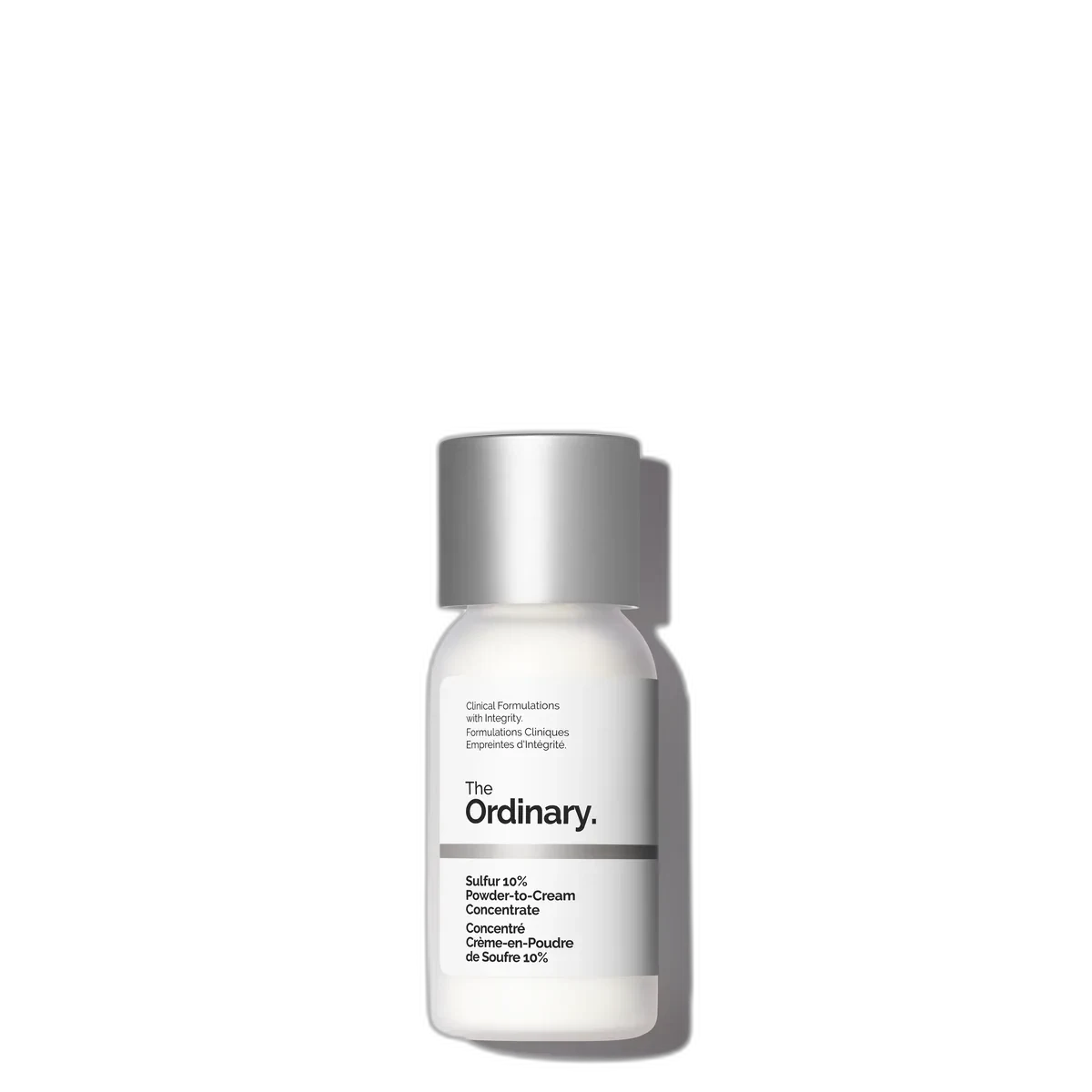
Sulfur 10% Powder-to-Cream Acne Spot Treatment Concentrate
Overnight Pimple Flattener
 Verified reviewer
Pros & cons.
- +10% colloidal sulfur with no compromise on the pharmacologically effective dose
- +Powder-to-cream dries to a matte, invisible finish — no yellow residue
- +Essentially no sulfur smell unlike traditional formulas
- +Niacinamide addresses the redness component sulfur alone ignores
- +Poly-L-lysine adds supplementary antimicrobial action
- +Visible spot flattening within an hour for most inflammatory pimples
- +Does not bleach fabric like benzoyl peroxide
- +Pregnancy-compatible alternative to retinoids and some acne actives
- −5 g tube is small for heavy or cystic acne users
- −Not a face-wide treatment — spot use only
- −Can irritate surrounding skin if over-applied
- −Should not be layered with benzoyl peroxide or retinoids on same spot
- −Powder-to-cream format has a brief learning curve
Ingredient analysis.
Full INCI list
Sulfur, Acacia Senegal Gum, Chlorphenesin, Citric Acid, Ethylhexylglycerin, Glycerin, Kaolin, Levocarnitine, Niacinamide, Phenoxyethanol, Poly-L-Lysine (30000-70000 MW), Propanediol, Silica Silylate, Sodium Citrate, Aqua/Water/Eau
Skin match.
The science.
The Science
Sulfur is a long-documented topical treatment for inflammatory acne. Clinical literature from the mid-twentieth century supports its use for acne vulgaris, rosacea, and seborrheic conditions. It works through several mechanisms: it is mildly keratolytic, breaking down the corneocyte plug that blocks sebaceous follicles; it has antimicrobial activity against Cutibacterium acnes (formerly Propionibacterium acnes), the bacterium linked to the inflammatory phase of acne; and it has sebostatic effects that reduce local surface oil. The 10% concentration used here matches ranges studied in prescription and over-the-counter acne preparations and is a proven-effective load. The innovation in this specific product is the delivery, not the active itself—colloidal sulfur's finer particle size improves follicular penetration and lowers perceived smell, as noted in formulation chemistry literature. The supporting actives also have evidence bases. Peer-reviewed work establishes niacinamide for reducing erythema and inflammatory lesion count in acne. Food-science and cosmetic literature characterize Poly-L-lysine's antimicrobial activity, while emerging skincare-specific work suggests it supports acne formulations. Small published studies show topical Levocarnitine reduces facial sebum secretion through sebum modulation. Deciem's in-house testing claims this specific formula visibly reduces pimple redness, height, and diameter at the 1-hour mark. While no independent peer-reviewed literature has replicated this, the observation matches the known pharmacology of the ingredients and user experience.
Dermatologist Perspective
Dermatologists recognize sulfur as an effective, often underused acne active. It suits patients who cannot tolerate benzoyl peroxide, pregnant patients needing non-retinoid options, or those with comorbid rosacea where benzoyl peroxide is inappropriate. Board-certified dermatologists frequently recommend sulfur-based preparations to these patients, traditionally via compounded formulations or classic over-the-counter sulfur masks. A well-formulated consumer product that maintains the effective 10% concentration while fixing smell and visibility issues helps patients who avoided older sulfur formulations due to the sensory experience. Standard derm-level cautions apply: use as a spot treatment rather than full-face application, layer carefully with other keratolytics and retinoids to avoid over-drying, and stop use if the surrounding skin stays irritated. For patients with dry or sensitive skin, clinicians recommend thin, targeted application and moisturizing the surrounding skin to support the barrier.
Where it fits in your routine.
At night, cleanse your skin and apply your usual serums. Press a small amount onto each active pimple using a fingertip. The product turns from powder to cream under fingertip pressure. Use only enough to cover the spot; do not smear it onto healthy surrounding skin. Let it dry for one minute, then apply moisturizer around the treated area. Do not use your usual retinoid or benzoyl peroxide on the same spot the same night. Cleanse normally in the morning. Most inflammatory spots resolve within 2–4 nights of consistent use. If the surrounding skin dries or flakes, use it every other night or reduce the amount applied.
At $9.90 for 5 g, this modern sulfur spot treatment is cheap. Specialist acne brands charge $15–$30 for similar or larger sizes, and most lack the colloidal-sulfur upgrade, the powder-to-cream format, or the niacinamide, poly-l-lysine, and levocarnitine. Treating one or two spots occasionally makes the 5 g tube last two to three months, keeping weekly costs low. Users with heavy or cystic acne treating many spots nightly will run out faster; at that usage, a larger dedicated acne treatment product is more economical.
This works for occasional inflammatory acne needing a fast-acting overnight spot treatment that won't bleach pillowcases. It suits those seeking pregnancy-compatible acne options and patients with comorbid rosacea who cannot use benzoyl peroxide. It also fits anyone who finds classic sulfur products effective but cosmetically unbearable.
Skip this if you need a face-wide acne treatment; this is a spot product only. Skip this if your skin is very dry, sensitized, or actively compromised, because sulfur's drying effect feels too harsh. Users with severe cystic acne need a more comprehensive routine and cannot rely on a spot treatment alone.
Product details.
It starts as a pale powder. Fingertip pressure turns it into a light cream-emulsion on the skin, which dries to a matte, barely visible finish.
Almost none — it has a faint mineral note instead of the classic sulfur smell found in older acne creams.
5 g aluminum squeeze tube with a narrow nozzle for targeted application.
Users familiar with older sulfur products find the first use surprising. It has no rotten-egg smell and leaves no chalky yellow color on the skin. The treated spot looks calmer and drier ten minutes after application. Most people see the first visible flattening within an hour — matching Deciem's in-house data — and significant overnight resolution on typical inflammatory pimples.
Roughly 2–3 months with targeted nightly use on 1–3 spots at a time.
12 months
All Year
The backstory.
Deciem developed this product as part of a push to modernize older, proven acne actives rather than chase newer ones. The in-house clinical test at the 1-hour mark was explicitly designed to make the case that a century-old active, reformulated properly, could compete with modern spot treatments on speed — and the powder-to-cream delivery is directly inspired by pharmaceutical-compounded sulfur preparations that dermatologists have quietly recommended for years.
About The Ordinary
Established Brand (5–20 years)The Ordinary launched in 2016. It has a decade of experience making targeted acne care with salicylic acid solutions, azelaic acid, and niacinamide products. The acne lineup is one of the range's most clinically focused sections and dermatologists on social media widely recommend it for mild-to-moderate breakouts.
Common myths.
Sulfur spot treatments are outdated and work less effectively than benzoyl peroxide.
Sulfur works well for inflammatory acne and rosacea, even in head-to-head comparisons against other actives for specific pimple presentations. It fell out of fashion for cosmetic reasons—smell and visible residue—not efficacy. This formula fixes both issues while keeping the effective 10% load.
More is better — load it on thick for faster results.
Applying too much keratolytic spot product dries the surrounding skin and compromises the barrier. This makes the spot look more inflamed during healing. A thin, targeted dot on the pimple works better than a thick blob covering healthy skin.
FAQ.
How is this different from classic sulfur acne lotions?
Two big differences. First, the sulfur is colloidal — finer particle size than traditional precipitated sulfur, which improves delivery into the pore and dramatically reduces the smell. Second, the powder-to-cream format dries to a matte, near-invisible finish, unlike older yellow sulfur spot creams that were obvious even under makeup. The 10% load is preserved — it is more cosmetically acceptable, not weaker.
Does it really work in one hour?
Deciem's in-house clinical testing measured reductions in pimple redness, height, and diameter one hour after application compared to baseline. This is an internal brand claim, not independently replicated work, but it matches sulfur's known pharmacology and user reports of visible flattening within an hour.
Can I use it on my whole face?
No — this is a targeted spot product, not a face-wide treatment. Applying 10% sulfur and kaolin to a full face over-dries healthy skin and compromises your barrier. Use salicylic acid or azelaic acid for broad acne-prone areas and save this product for active, localized pimples.
Can I use it with benzoyl peroxide or retinoids?
Don't use this on multiple spots the same night; the combined keratolytic and drying effect is too aggressive. Instead, use benzoyl peroxide or a retinoid on other areas and use this for one or two spots you want to treat overnight, or alternate nights.
Will it bleach my pillowcase like benzoyl peroxide?
No — sulfur lacks the oxidizing bleach effect of benzoyl peroxide. The powder-to-cream dries to a matte finish and does not transfer or stain fabric like BPO products, making it a better option for anyone who has ruined pillowcases.
Is it safe during pregnancy?
Topical sulfur is one of the few traditional acne actives considered safe during pregnancy. Dermatologists often recommend topical sulfur as an alternative to retinoids and certain other actives for pregnant patients with acne. Always confirm your specific situation with your OB or dermatologist.
What if my skin is very dry and sensitive?
Sulfur dries skin more than it reduces inflammation. If you have dry or sensitive skin, apply a thin layer only on the active spot. Avoid the surrounding skin and follow with a barrier-repair moisturizer. Use it every other night if irritation spreads beyond the pimple.
Community
What the community says.
"Visibly flattens spots overnight"
"No sulfur smell unlike traditional formulas"
"Dries to near-invisible finish"
"Doesn't over-dry or crust"
"5g tube is small for heavy users"
"Can still dry out the surrounding skin if over-applied"
"Powder-to-cream texture takes a moment to get used to"
People also looked at.