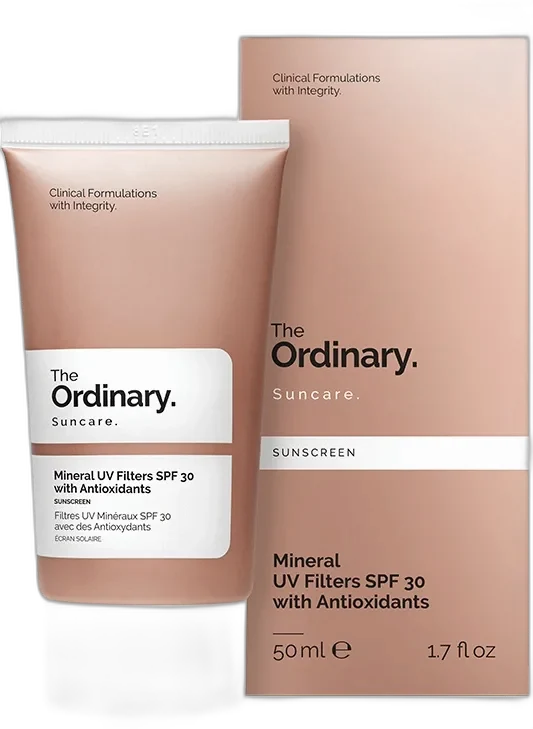
Mineral UV Filters SPF 30 with Antioxidants
Budget Mineral Shield
 Verified reviewer
Pros & cons.
- +Genuinely impressive antioxidant blend including astaxanthin and ethyl ferulate behind the UV filters
- +Under 0 for a mineral SPF 30 with a comprehensive NMF complex and hyaluronic acid
- +Purely mineral filters — gentle, pregnancy-safe, and suitable for the most sensitive skin
- +Matte-satin finish once set is comfortable and works well under makeup
- +Full skincare treatment in a sunscreen — amino acids, urea, allantoin, and glycerin
- −Discontinued in October 2023 — only available through remaining third-party stock
- −Noticeable white cast on medium-to-dark skin tones makes it unusable for many
- −Thick texture requires significant effort to blend and 2-3 minutes to set
- −Not water resistant — requires reapplication during sweating or water exposure
- −SPF 30 rather than 50 may feel insufficient for high-UV environments
The full review.
The Ordinary’s Mineral UV Filters SPF 30 with Antioxidants had the ingredients list of a product that should have cost 0 and the texture of a product that explained why it cost .70. That tension — between what is inside the tube and how it feels coming out — defined this product’s entire existence, from its 2018 launch to its quiet discontinuation in October 2023.
The formula was ambitious by any standard. Zinc oxide at 14.03% and titanium dioxide at 5.44% provided the purely physical UV protection that sensitive skin types, post-procedure patients, and mineral-sunscreen devotees specifically seek. But the real story was behind the filters. Astaxanthin — a potent carotenoid sourced from Haematococcus pluvialis microalgae — provided antioxidant defense that clinical studies have shown can reduce UV-induced oxidative damage. Ethyl ferulate, a stabilized form of ferulic acid, enhanced the photoprotective profile. Rosemary leaf extract, Tasmannia lanceolata, black spruce bark extract, and an Isochrysis galbana marine algae extract rounded out what amounted to a five-deep antioxidant lineup rarely seen in sunscreens at any price.
And then it kept going. The formula included a full Natural Moisturizing Factor complex — eleven amino acids, sodium PCA, PCA, sodium lactate, multiple sugars, urea, and allantoin — alongside sodium hyaluronate, glycerin, and sunflower seed oil. This was not a sunscreen that happened to have some skincare benefits. This was a comprehensive skincare treatment that happened to include mineral UV filters.
On paper, it was remarkable. In practice, it was a product you had to believe in.
The texture was thick. Not cream-thick in the pleasant, moisturizing sense — thick in the way that mineral sunscreens with high zinc oxide concentrations inevitably are when they do not use nano particles or tinting agents to mitigate the whiteness. Blending required patience, effort, and a willingness to spend two to three minutes working the product into the skin before it cooperated. Once set, the finish was matte-satin and genuinely comfortable — a quality that oily skin types in particular appreciated. Under makeup, it performed respectably. But the journey to get there tested the resolve of anyone who had ever tried an elegant Asian beauty sunscreen or a modern tinted chemical SPF.
The white cast was the other inescapable reality. At 14% zinc oxide and 5.4% titanium dioxide in an untinted formula, the white cast was visible on fair skin and pronounced on medium-to-dark tones. DECIEM marketed it as “minimal white cast,” which was optimistic to the point of being misleading for anyone darker than Fitzpatrick II. For a brand that positioned itself on honesty and transparency, this was a rare blind spot — or perhaps an honest acknowledgment that the laws of physics make white, opaque mineral particles difficult to render invisible at protective concentrations.
The lack of water resistance was a practical limitation that narrowed its use case further. This was an everyday-commute, office-worker sunscreen. For outdoor activities, sports, or any situation involving sweat, it needed to be paired with a water-resistant alternative — which somewhat defeated the purpose of having a single affordable sunscreen.
When The Ordinary discontinued this product in October 2023, they replaced it with the UV Filters SPF 45 Serum — a chemical sunscreen in a lighter, more cosmetically elegant format. The decision made commercial sense: the mineral version had attracted a loyal but small following, while its texture and white cast concerns limited broader adoption. The chemical reformulation addressed the complaints but abandoned the mineral-only positioning that a subset of consumers specifically valued.
For those who used and loved this product, its discontinuation left a gap. There is still no mineral sunscreen at this price point that offers a comparable antioxidant blend and NMF complex. The closest alternatives cost two to four times as much. The Ordinary Mineral UV Filters SPF 30 was, in the end, a product that was too good on the inside and not good enough on the outside — a formula that could not overcome the cosmetic reality that most people will not use a sunscreen they do not enjoy wearing.
Formula
 ### Texture

 The texture was thick. Not cream-thick in the pleasant, moisturizing sense — thick in the way that mineral sunscreens with high zinc oxide concentrations inevitably are when they do not use nano particles or tinting agents to mitigate the whiteness. Blending required patience, effort, and a willingness to spend two to three minutes working the product into the skin before it cooperated. Once set, the finish was matte-satin and genuinely comfortable — a quality that oily skin types in particular appreciated. Under makeup, it performed respectably. But the journey to get there tested the resolve of anyone who had ever tried an elegant Asian beauty sunscreen or a modern tinted chemical SPF.


 ### Common Complaints

 The white cast was the other inescapable reality. At 14% zinc oxide and 5.4% titanium dioxide in an untinted formula, the white cast was visible on fair skin and pronounced on medium-to-dark tones. DECIEM marketed it as "minimal white cast," which was optimistic to the point of being misleading for anyone darker than Fitzpatrick II. For a brand that positioned itself on honesty and transparency, this was a rare blind spot — or perhaps an honest acknowledgment that the laws of physics make white, opaque mineral particles difficult to render invisible at protective concentrations.

The lack of water resistance was a practical limitation that narrowed its use case further. This was an everyday-commute, office-worker sunscreen. For outdoor activities, sports, or any situation involving sweat, it needed to be paired with a water-resistant alternative — which somewhat defeated the purpose of having a single affordable sunscreen.Ingredient analysis.
Full INCI list
Active Ingredients: Zinc Oxide 14.03%, Titanium Dioxide 5.44%. Inactive Ingredients: Aqua (Water), Cyclopentasiloxane, Zinc Oxide, Titanium Dioxide, PEG-10 Dimethicone, Glycerin, Helianthus Annuus Seed Oil, PEG-9 Polydimethylsiloxyethyl Dimethicone, Hexyl Laurate, Polyglyceryl-4 Isostearate, Caprylic/Capric Triglyceride, Dimethicone/PEG-10/15 Crosspolymer, Astaxanthin, Disodium Uridine Phosphate, Ethyl Ferulate, Rosmarinus Officinalis Leaf Extract, Tasmannia Lanceolata Fruit/Leaf Extract, Haematococcus Pluvialis Extract, Picea Mariana Bark Extract, Arginine, Aspartic Acid, Glycine, Alanine, Serine, Valine, Isoleucine, Proline, Threonine, Histidine, Phenylalanine, Sodium PCA, PCA, Sodium Lactate, Glucose, Maltose, Fructose, Trehalose, Urea, Allantoin, Sodium Hyaluronate, Linoleic Acid, Oleic Acid, Phytosteryl Canola Glycerides, Palmitic Acid, Stearic Acid, Isochrysis Galbana Extract, Lysolecithin, Lecithin, Triolein, Pentylene Glycol, Dipropylene Glycol, Polyglyceryl-10 Oleate, Polyglyceryl-5 Trioleate, Polyglyceryl-10 Stearate, Tocopherol, Alumina, Citric Acid, Trisodium Ethylenediamine Disuccinate, Sodium Chloride, Sodium Hydroxide, Phenoxyethanol, Chlorphenesin
Skin match.
The science.
The Science
This product uses a dual mineral filter system — 14.03% zinc oxide and 5.44% titanium dioxide — to provide broad-spectrum UV protection by scattering and reflecting UV photons. Zinc oxide is the only single UV filter the FDA approves for full-spectrum protection, including the UVA I range (340-400 nm) that causes photoaging and melanoma risk. Titanium dioxide adds UVB protection but offers less UVA coverage.
The antioxidant strategy supports the mineral filters. Multiple antioxidant pathways address UV radiation that passes the mineral barrier or reactive oxygen species generated by the filters. Astaxanthin, a keto-carotenoid roughly 6,000 times more potent than vitamin C at quenching singlet oxygen, reduces UV-induced skin damage markers in clinical studies when applied topically. Ethyl ferulate, an ester of ferulic acid, increases the photoprotective efficacy of UV filters in combination studies.
A Natural Moisturizing Factor complex — amino acids, PCA, sodium PCA, sodium lactate, sugars, urea, and allantoin — manages the transepidermal water loss caused by UV exposure and mineral filter application. Research shows NMF-depleted skin is more vulnerable to UV-induced damage, so maintaining NMF levels during UV exposure may provide synergistic photoprotective benefits.
The mineral filter approach avoids concerns about chemical filters like oxybenzone and octinoxate regarding endocrine disruption and coral reef toxicity. However, dermatological literature does not show conclusive evidence of endocrine effects from topical chemical sunscreen at recommended levels, and the FDA classifies zinc oxide and titanium dioxide as GRASE (Generally Recognized as Safe and Effective).
Dermatologist Perspective
Dermatologists recommend mineral sunscreens for patients with sensitive, rosacea-prone, or post-procedure skin because zinc oxide and titanium dioxide sit on the skin surface instead of absorbing and converting to heat like chemical filters. Board-certified dermatologists note the antioxidant-enriched formula in this product provides a level of photoprotective sophistication rare at this price point. However, dermatologists also note that sunscreen compliance depends on cosmetic elegance — a product people skip because of white cast or texture provides zero protection. The discontinuation of this product reflects the industry tension between formulation quality and user experience in mineral sunscreen design.
Where it fits in your routine.
Apply a thick, even layer to the face and exposed areas 15 minutes before sun exposure. This is the final step of your morning skincare routine. Use about 1/4 teaspoon on the face to get the labeled SPF 30 protection. Blend it well; the thick consistency takes time. Reapply at least every 2 hours during prolonged sun exposure, and immediately after swimming or sweating, because this product is not water resistant.
At .70 for 50 mL, this was one of the cheapest mineral sunscreens ever made—and likely the cheapest with a legitimate antioxidant blend. Comparable mineral sunscreens with antioxidant support usually cost 5-45. Discontinuation means you can no longer find this value through official channels. Check expiration dates on remaining stock from third-party sellers before purchase.
This works for sensitive skin types needing mineral-only UV protection, such as those with rosacea, post-procedure skin, or chemical filter sensitivities. It is also suitable for pregnancy and breastfeeding. Buy remaining stock if you prioritize ingredient quality and antioxidant support over cosmetic elegance.
This product leaves a white cast, so it does not work for medium-to-dark skin. It lacks water resistance, making it unsuitable for swimming, outdoor sports, or high-sweat activities. If you prioritize cosmetic elegance for daily sunscreen compliance, use The Ordinary's replacement SPF 45 Serum or other modern mineral formulations.
Product details.
This thick, white lotion requires deliberate blending. The mineral filters create initial resistance, but the silicone base smooths into a matte-satin finish. It takes 2-3 minutes of working to blend fully.
A faint mineral/sunscreen scent exists that most users find neutral — no added fragrance
White squeeze tube with black text in The Ordinary's standard minimalist design. Screw-top cap. 50 mL capacity.
The thick consistency and visible white cast can surprise on first application. The formula takes more effort to blend than most modern sunscreens. After it sets (2-3 minutes), the finish is matte-satin and reasonably comfortable. The white cast is manageable on fair skin tones but may be unacceptable on darker tones.
1-2 months with daily face application
12 months
All Year
The backstory.
The Ordinary launched this mineral sunscreen in 2018 as part of their strategy to cover every essential skincare category at disruptive pricing. At under 0 for a mineral SPF 30 with a legitimate antioxidant blend, it was priced far below any comparable product. However, the cosmetic elegance challenges — white cast, thick texture, limited shade inclusivity — led to its discontinuation in October 2023. The Ordinary subsequently launched the UV Filters SPF 45 Serum, a chemical sunscreen formula designed to address the elegance complaints.
About The Ordinary
Established Brand (5–20 years)The Ordinary launched under DECIEM in 2016. It disrupted skincare by offering clinical-grade actives at unprecedented price points. Now owned by Estée Lauder Companies, the brand has nearly a decade of consumer trust from ingredient transparency and accessible pricing.
Common myths.
Mineral sunscreens outperform chemical sunscreens.
Mineral and chemical sunscreens both provide effective UV protection through different mechanisms. Mineral filters (zinc oxide, titanium dioxide) sit on the skin and scatter UV, while chemical filters absorb UV and convert it to heat. Mineral filters are gentler and preferred for sensitive skin, but their white cast and thick texture can reduce compliance — and a sunscreen that people skip because of cosmetic issues provides zero protection.
SPF 30 provides half the protection of SPF 50
SPF 30 blocks about 97% of UVB rays, while SPF 50 blocks about 98%. The difference is 1%, not 50%. SPF 30 provides enough protection for daily use. Applying enough product (1/4 teaspoon for the face) and reapplying every 2 hours during prolonged sun exposure matters more.
FAQ.
Does The Ordinary Mineral SPF 30 leave a white cast?
Yes. The 14% zinc oxide and 5.4% titanium dioxide combination leaves a visible white cast, especially on medium-to-dark skin tones. On very fair skin, the cast is manageable and fades after blending and setting. The product is not tinted, and no tinted version exists.
Is The Ordinary Mineral SPF 30 reef safe?
This sunscreen uses only mineral filters (zinc oxide and titanium dioxide) and lacks oxybenzone or octinoxate — the two chemical filters most linked to reef-safety concerns. While "reef safe" is not a regulated term, mineral-only formulations are generally the most environmentally friendly option for marine ecosystems.
Can I use The Ordinary Mineral SPF 30 on sensitive skin?
Mineral sunscreens work best for sensitive, rosacea-prone, and post-procedure skin because they sit on the surface instead of absorbing. This formula is fragrance-free and uses soothing ingredients like allantoin, urea, and Tasmannia lanceolata. It is safe during pregnancy and breastfeeding.
What replaced The Ordinary Mineral UV Filters SPF 30?
The Ordinary UV Filters SPF 45 Serum replaced this product. The new formula uses chemical UV filters instead of mineral ones to provide a more cosmetically elegant finish without white cast. Users who prefer mineral-only sunscreens must choose other brands.
What the community says.
"Exceptional value at under 0 for a mineral sunscreen with antioxidants"
"No irritation — mineral filters are gentle enough for post-procedure and rosacea-prone skin"
"Impressive antioxidant blend including astaxanthin and ethyl ferulate"
"Dries to a matte-satin finish that works well under makeup"
"Truly 100% mineral with no chemical UV filters"
"Noticeable white cast, especially on medium-to-dark skin tones"
"Thick, difficult-to-blend consistency requires patience"
"Can feel greasy or tacky before fully setting"
"Not water resistant — needs reapplication if sweating"
"Product has been discontinued"
People also looked at.