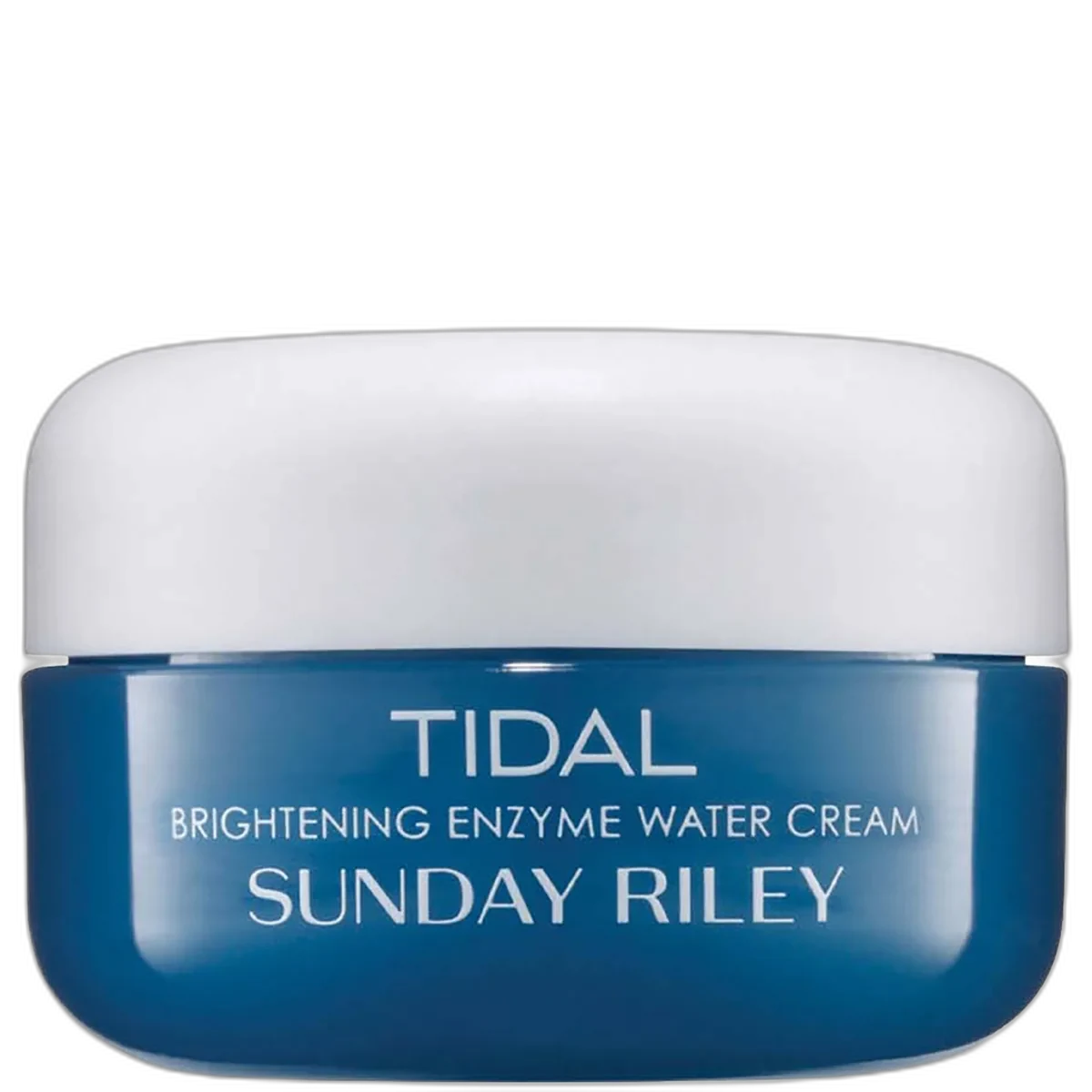
Tidal Brightening Enzyme Water Cream
Lightweight Glow Getter
 Verified reviewer
Pros & cons.
- +Alpha-arbutin provides stable, effective brightening without the irritation of vitamin C or acids
- +Dual hyaluronic acid system delivers immediate and sustained hydration at different skin depths
- +Gel-cream texture is genuinely excellent for oily and combination skin — hydrates without weight
- +Papain enzyme provides subtle continuous exfoliation without pH dependency or harsh peeling
- +Fragrance-free formula with no essential oils or synthetic perfumes
- +Oil-free formulation won't clog pores or trigger excess sebum production
- +Absorbs rapidly and layers beautifully under sunscreen and makeup
- −At $65 for 1.7 oz, the price is hard to justify as alpha-arbutin has become widely available at lower price points
- −Jar packaging compromises the stability of enzyme and antioxidant ingredients through air exposure
- −Product appears to be discontinued with limited remaining availability
- −Brightening results are inconsistent — works best on superficial pigmentation, less effective on deep discoloration
- −Some users experience stinging from the papain enzyme, especially on compromised or freshly exfoliated skin
- −Blue color is purely cosmetic and may mislead consumers expecting active blue ingredients
The full review.
Alpha-arbutin is everywhere now. You can find it in serums from budget brands, in Korean essences, in drugstore dark-spot correctors. But when Sunday Riley launched Tidal in 2016, the ingredient was still relatively obscure in Western prestige skincare. Most brightening products relied on vitamin C (unstable, often irritating) or hydroquinone (effective but controversial). Alpha-arbutin offered a third path: a stable, gentle tyrosinase inhibitor derived from bearberry that could suppress melanin production without the oxidation headaches of ascorbic acid or the safety debates around hydroquinone. Sunday Riley bet on it early, and the bet was good.
Tidal’s formula approaches brightening from two angles simultaneously. The alpha-arbutin works below the surface, intercepting melanin production at the enzymatic level by inhibiting tyrosinase — the enzyme responsible for converting tyrosine to melanin. Meanwhile, papain — a proteolytic enzyme derived from papaya — works at the surface, gently dissolving the protein bonds that hold dead, pigmented cells in place. The result is a one-two combination: less new pigment being formed, and faster removal of existing discolored cells. It is a thoughtful approach, and it avoids the pH-dependency and irritation potential of AHA-based brightening.
The texture is where Tidal earned its devoted following. This is a true water cream — a gel-like consistency that feels substantial in the jar but melts into nearly nothing on the skin. It delivers a burst of coolness on contact, absorbs within seconds, and leaves behind a dewy, plumped finish without any greasiness or residue. For oily and combination skin types who struggle to find moisturizers that hydrate without adding weight, Tidal was revelatory. It sits beautifully under sunscreen and makeup, and a small amount covers the entire face efficiently.
The hydration architecture is more sophisticated than it first appears. Two forms of hyaluronic acid work at different depths: standard sodium hyaluronate penetrates to hydrate the epidermis, while sodium hyaluronate crosspolymer — a larger, mesh-structured molecule — forms a moisture-retaining film on the surface for sustained-release hydration throughout the day. Tamarind seed gum adds another layer of film-forming moisture retention. The brand claimed a 68% increase in hydration within 15 minutes and up to 24 hours of moisture, and the real-world experience supports this — skin feels genuinely plumped and hydrated, not just superficially coated.
The brightening results are real but require patience and realistic expectations. Users who committed to daily use for eight to twelve weeks generally reported noticeable improvements in overall radiance and mild hyperpigmentation. Deeper melasma or post-inflammatory hyperpigmentation responded more slowly or not at all, which is consistent with alpha-arbutin’s mechanism — it is effective at preventing new pigment formation but less potent at clearing established deep pigmentation than prescription options. The brand cited a 44% reduction in the appearance of discolorations over four weeks, which tracks with what consistent users experienced for superficial dark spots and overall unevenness.
The product is not without shortcomings, and the most significant one is practical rather than formulaic: the jar packaging. A formula containing papain enzyme and tocopherol — ingredients that degrade with air exposure — is best protected in an airless pump. Instead, Tidal comes in an open jar that users dip their fingers into twice daily. Some users reported the formula changing color (browning) or thickening over time, which is consistent with enzyme degradation and oxidation. It is a packaging choice that prioritizes aesthetics over ingredient integrity, and for a $65 product, that is a frustrating compromise.
The blue color of the cream, incidentally, is purely cosmetic. Synthetic fluorphlogopite and tin oxide create the tint — it is not blue tansy or any active blue ingredient. It looks beautiful in the jar and photographs exceptionally well for Instagram, but it contributes nothing to the skincare performance.
Some users reported stinging on initial application, likely from the papain enzyme contacting reactive or compromised skin. This is worth noting for anyone with an impaired barrier — the enzymatic exfoliation, while gentle, is not invisible, and it may cause temporary discomfort until the skin adjusts.
Value was always Tidal’s most debatable quality. At $65 for 1.7 ounces, you are paying prestige prices for a moisturizer whose most impressive active — alpha-arbutin — is now widely available at a fraction of the cost. When Tidal launched in 2016, alpha-arbutin at this quality in a thoughtfully formulated water cream was genuinely uncommon. By 2025, the ingredient had been democratized across price points. The dual-HA system, the papain enzyme approach, and the overall formulation elegance are real differentiators, but they may not be sufficient differentiators for sixty-five dollars.
Tidal appears to have been quietly discontinued around 2025, with Sunday Riley refocusing the Tidal line on a plumping serum. This is unfortunate — it was a genuinely well-formulated brightening moisturizer that solved a real problem for oily-skinned people who wanted pigmentation correction without the heaviness or instability of vitamin C creams. If you find remaining stock, it is still a quality product. But its disappearance from the market is a reminder that sometimes the products that are ahead of their time do not survive long enough to enjoy the vindication.
Ingredient analysis.
Full INCI list
Water/Eau/Aqua, Neopentyl Glycol Diethylhexanoate, Propanediol, Polyglycerin-6, Sodium Acrylates Copolymer, Glycerin, Hydrolyzed Jojoba Esters, Caprylyl Caprylate/Caprate, Isododecane, Alpha-Arbutin, Cucumis Sativus (Cucumber) Fruit Extract, Allantoin, Pentylene Glycol, Adipic Acid/Neopentyl Glycol Crosspolymer, Lauryl Dimethicone, Sodium Hyaluronate, Sodium Hyaluronate Crosspolymer, Tamarindus Indica Seed Gum, Aesculus Hippocastanum (Horse Chestnut) Seed Extract, Strelitzia Nicolai (White Bird Of Paradise) Seed Aril Extract, Papain, Algin, Lecithin, Melia Azadirachta (Neem) Leaf Extract, Melia Azadirachta (Neem) Flower Extract, Corallina Officinalis Extract, Coccinia Indica Fruit Extract, Solanum Melongena (Eggplant) Fruit Extract, Aloe Barbadensis Flower Extract, Ocimum Sanctum (Holy Basil) Leaf Extract, Ocimum Basilicum (Basil) Flower/Leaf Extract, Curcuma Longa (Turmeric) Root Extract, Sodium Phytate, Hydrogenated Polyisobutene, Xanthan Gum, Synthetic Fluorphlogopite, Titanium Dioxide, Tin Oxide, Caprylyl Glycol, Tocopherol, Ethylhexylglycerin, Phenoxyethanol, Carbomer, 1,2-Hexanediol, Sodium Benzoate, Potassium Sorbate, Pentaerythrityl Tetra-Di-T-Butyl Hydroxyhydrocinnamate, Benzotriazolyl Dodecyl P-Cresol, Decyl Glucoside, Lauryl Glucoside, Citric Acid
Skin match.
The science.
The Science
Alpha-arbutin is a well-studied brightening agent in cosmetic dermatology. A 2004 study by Sugimoto et al. in Biological & Pharmaceutical Bulletin shows alpha-arbutin inhibits tyrosinase activity in cultured human melanoma cells, cutting melanin synthesis to 76% of control levels at 0.5 mM. In a three-dimensional human skin model, it reduced melanin content to 40% of control without the cytotoxicity risks of hydroquinone (Sugimoto et al., Biol Pharm Bull, 2004). A 2021 review by Boo in Antioxidants confirms alpha-arbutin works as a competitive tyrosinase inhibitor and has a better safety profile than hydroquinone and beta-arbutin (Boo, Antioxidants, 2021).
The papain enzyme provides gentle exfoliation. A 2008 clinical study found that topical proteolytic enzymes at 15% concentration improved epidermal properties after one month and both epidermal and dermal properties after three months, matching results from higher-concentration AHAs (Draelos et al., 2008). A 2021 literature review in the Journal of Cosmetic Dermatology concludes that while clinical evidence for enzymatic exfoliation is less abundant than for acid-based exfoliation, data shows it works with a favorable tolerability profile — especially for patients who cannot tolerate AHAs or BHAs (Suhail et al., J Cosmet Dermatol, 2021).
The dual hyaluronic acid approach uses established hydration science. Standard sodium hyaluronate (molecular weight typically 100-300 kDa) penetrates the upper epidermis, while the crosspolymer form builds a three-dimensional matrix on the skin surface that resists wash-off and releases moisture steadily — extending the hydration curve beyond what a single HA form does.
References
- Inhibitory effects of alpha-arbutin on melanin synthesis in cultured human melanoma cells and a three-dimensional human skin model — Biological & Pharmaceutical Bulletin (2004)
- Arbutin as a Skin Depigmenting Agent with Antimelanogenic and Antioxidant Properties — Antioxidants (2021)
- Topical proteolytic enzymes affect epidermal and dermal properties — Dermatologic Therapy (2008)
- An overview of the use of proteolytic enzymes as exfoliating agents — Journal of Cosmetic Dermatology (2021)
Dermatologist Perspective
Dermatologists view alpha-arbutin as a well-tolerated depigmenting agent for patients who cannot use hydroquinone due to sensitivity, regulatory restrictions, or long-term safety concerns. Board-certified dermatologists note that alpha-arbutin's competitive inhibition of tyrosinase brightens mild to moderate hyperpigmentation without the rebound hyperpigmentation risk seen when stopping hydroquinone. The papain enzyme is a gentler alternative to acid-based exfoliation for reactive skin. Dermatologists usually recommend alpha-arbutin-based products within a pigmentation protocol alongside daily sunscreen, noting that results take 8-12 weeks of consistent use and that alpha-arbutin alone rarely resolves deep melasma or post-inflammatory hyperpigmentation.
Where it fits in your routine.
Use a spatula or clean fingers to scoop a small amount from the jar. Apply evenly to the face and neck after cleansing and serums. Press gently into the skin instead of rubbing. Use morning and evening. Always follow morning application with SPF 30+ sunscreen because brightening actives increase photosensitivity. The lightweight texture lets you layer sunscreen or makeup immediately.
At $65 for 1.7 fl oz, Tidal is a premium-priced moisturizer for its ingredients. A $22 mini size at 0.5 fl oz lets users trial it. When it launched in 2016, the formulation led the market — alpha-arbutin in a water cream was rare. By 2025, that same key ingredient is in many cheaper products. The dual-HA system, enzymatic exfoliation approach, and formulation elegance add value, but for a brand founded in 2009 without the clinical heritage of legacy derm brands, the price reflects brand positioning more than ingredient exclusivity.
Tidal works for oily and combination skin types with dullness and mild hyperpigmentation who want a brightening moisturizer without heaviness. It suits anyone seeking a vitamin-C-free brightening approach and people who find most moisturizers too thick or greasy for daily wear.
Skip Tidal for intensive depigmentation of deep melasma or stubborn PIH; alpha-arbutin alone lacks sufficient strength. The gel-cream texture provides little moisture for very dry skin, and users with papaya-derived enzyme sensitivity should patch test carefully.
Product details.
It has no added synthetic fragrance, but cucumber fruit extract, basil, and holy basil create a noticeable cucumber and herbal scent. Most users find the scent fresh and pleasant; some find the herbal notes stronger than expected for a fragrance-free product.
Blue-tinted glass jar with a screw-top lid. The blue color shows through the glass. The jar format requires scooping with fingers. This is less hygienic than pump packaging and exposes the product to air during use, which affects the stability of the enzyme and antioxidant ingredients.
The first application provides immediate hydration and a visible dewy glow. Users with sensitive skin may feel mild tingling from the papain enzyme; this usually stops after a few uses as skin adjusts. No purging occurs. The lightweight texture may feel insufficient for very dry skin types on first use.
2-3 months with twice-daily use on face and neck
12 months
All Year
The backstory.
Tidal launched in 2016 as Sunday Riley's answer to the growing K-beauty influence on Western skincare — a lightweight, hydration-forward moisturizer that looked and felt like something from Seoul but was formulated in Houston. The enzyme water cream format was novel for Western markets, and the alpha-arbutin inclusion predated the ingredient's widespread popularity by several years. The product appears to have been quietly discontinued around 2025, with Sunday Riley refocusing the Tidal line on a plumping serum.
About Sunday Riley
Established Brand (5–20 years)Cosmetic chemist Sunday Riley founded Sunday Riley in 2009 in Houston, Texas. The brand is Leaping Bunny and PETA certified cruelty-free and B Corp certified. Sunday Riley discontinued The Tidal Brightening Enzyme Water Cream as of 2026, shifting The Tidal line toward a hydration serum.
Common myths.
The cream's blue color comes from blue tansy or other blue-hued ingredients.
Synthetic fluorphlogopite and tin oxide provide the blue tint. These are cosmetic colorants, not blue tansy or active blue ingredients. The color is aesthetic, not functional, and does not affect the product's performance.
Papaya enzymes are too harsh for daily use on the face.
Low concentrations of Papain in a leave-on moisturizer work gently over time, unlike a concentrated enzyme peel or mask. This formula uses subtle, continuous enzymatic activity, while allantoin and hyaluronic acid provide a soothing buffer.
FAQ.
Is Sunday Riley Tidal discontinued?
The Tidal Brightening Enzyme Water Cream appears to have been discontinued by Sunday Riley as of 2025-2026. The product page on the official site returns an error, and most major retailers show it as out of stock. Sunday Riley has shifted the Tidal line toward a Deep Hydration + Plumping Serum. Remaining inventory may still be available through third-party sellers.
Does Sunday Riley Tidal actually brighten skin?
Tidal uses alpha-arbutin, a studied tyrosinase inhibitor that lowers melanin production, and papain enzyme to gently exfoliate pigmented cells. Clinical claims show a 44% reduction in discoloration appearance over 4 weeks. User results vary; some see brightening while others see minimal change, depending on pigmentation type and depth.
Can I use Sunday Riley Tidal with retinol?
Yes, Tidal pairs well with retinol products. The alpha-arbutin and hyaluronic acid complement retinol's cell turnover effects. The hydrating gel-cream formula buffers potential retinol dryness. Apply retinol first, wait for absorption, then layer Tidal on top. The papain enzyme is gentle and does not compound retinol irritation.
Is Sunday Riley Tidal good for oily skin?
Tidal is a top prestige moisturizer for oily skin. Its oil-free gel-cream texture hydrates without adding weight or shine. This lightweight, fast-absorbing formula works well under SPF and makeup. Oily skin types consistently rate Tidal as one of the few moisturizers that hydrate without triggering excess oil production.
Why does Sunday Riley Tidal sting when I apply it?
The papain enzyme typically causes mild stinging on application. This enzyme causes temporary sensitivity on reactive or compromised skin. Recent exfoliation, micro-tears, or a disrupted skin barrier can cause brief tingling from the enzymatic activity. This sensation usually subsides within the first week of use. Persistent stinging means the product is not right for your skin.
Community
What the community says.
"Lightweight gel-cream texture absorbs quickly without greasiness"
"Visible brightening and glow with consistent daily use"
"Works beautifully under makeup as a hydrating base"
"Cooling and refreshing application experience"
"Small amount covers the entire face efficiently"
"Suitable for oily and combination skin that finds most moisturizers too heavy"
"High price at $65 for 1.7 oz feels excessive for the ingredient complexity"
"Cucumber-herbal scent is polarizing despite no added fragrance"
"Some users report stinging on first application or sensitive skin"
"Brightening results vary widely and are inconsistent across users"
"Jar packaging exposes product to air and bacteria with each use"
"Formula may change color or consistency over time once opened"