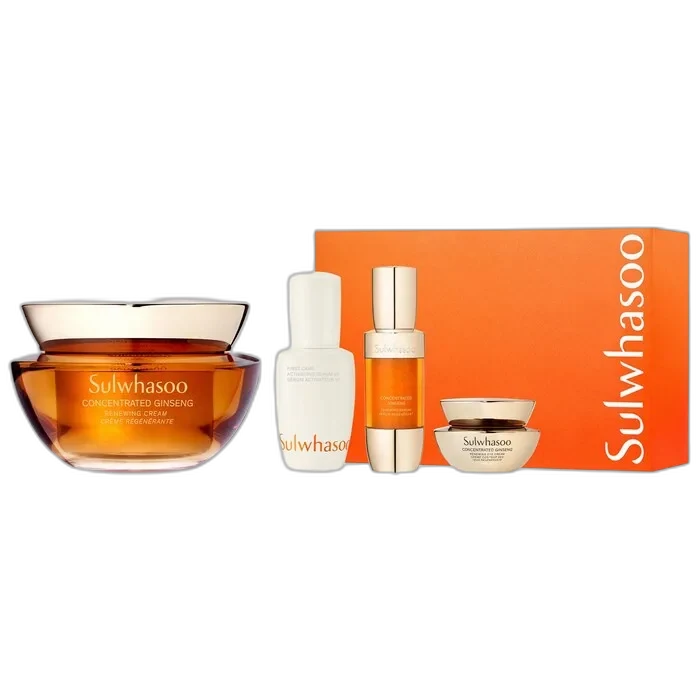
Concentrated Ginseng Renewing Cream
Sulwhasoo Iconic Flagship
 Verified reviewer
Pros & cons.
- +Niacinamide, adenosine, and ceramide complex deliver measurable anti-aging activity
- +Genuinely luxurious texture, scent, and sensorial application experience
- +Heritage botanical research and proprietary ginsenoside processing
- +Visibly plumps and brightens dry mature skin over 4–12 weeks
- +Iconic flagship product backed by decades of brand investment
- +Pairs beautifully with the rest of the Concentrated Ginseng line for the full ritual
- −$295 price tag is hard to justify on actives alone
- −Contains signature fragrance unsuitable for fragrance-sensitive skin
- −Jar packaging exposes actives to air rather than protecting them
- −Marketing claims around ginseng exceed published external clinical evidence
- −Not the right product for younger skin without specific anti-aging concerns
The full review.
Ask anyone in the global beauty industry for the most important Sulwhasoo product, and they will name this. The Concentrated Ginseng Renewing Cream moved Sulwhasoo from a Korean heritage brand to a global luxury name, securing shelf space at Bergdorf Goodman and Selfridges. Amorepacific reformulates it every few years not due to low sales, but to invest in its high performance. The 2020 version costs $295 for 60 ml and comes in a heavy ceramic-style jar with a rose gold lid. Few K-beauty products combine brand heritage, sensorial ritual, and global recognition so precisely. Regardless of your view on the price, this jar carries real cultural weight.
The formulation uses decades of Amorepacific research on ginseng saponins. The first ingredient is concentrated panax ginseng root extract; this high botanical ranking shows Sulwhasoo prioritizes its core focus. Hydrolyzed ginseng saponins appear later—a pre-broken-down form for better skin bioavailability—alongside ginseng callus culture extract, a stem-cell-style botanical source. Niacinamide also sits high in the deck to provide measurable brightening and barrier support. Adenosine acts as the second well-validated active, smoothing fine lines by supporting dermal fibroblasts. Near the end of the list, ceramide NP, cholesterol, and phytosphingosine form a small, legitimate barrier-lipid trio rare in luxury anti-aging creams. It is not a barrier repair formula, but the structure exists.
The skin experience justifies the price for many users. The texture is thick and dense but not heavy; it melts under warm fingertips and leaves a dewy, plump, glowing finish. The signature ginseng-herbaceous-floral fragrance rises during application and lingers gently. For brand fans, this scent is part of the product. Sulwhasoo recommends a brief acupressure-style massage ritual, which many users adopt to make the routine more deliberate. Within one week, skin looks dewier and more refined. By week four, tone and texture improve visibly. By twelve weeks, the cumulative niacinamide and adenosine effects show on fine lines.
The limitations match most luxury jar creams. The packaging is beautiful but functionally suboptimal; the heavy jar exposes niacinamide and other oxidation-sensitive ingredients to air. An airless pump would protect the formula better but would change the ritual. The fragrance makes the cream a poor fit for skin with severe fragrance sensitivity or rosacea. The value math is also difficult: $295 for 60 ml is about $5 per milliliter. Most measurable effects can be reproduced by a $50 to $80 cream containing niacinamide, adenosine, ceramides, and peptides. The $215 difference pays for the brand experience, heritage, jar, scent, and ritual.
Evaluate this product based on your buyer profile. If you want the luxury sensorial experience, value the connection to a heritage Korean luxury house, and can afford the price, the cream is a legitimate, competent, and effective luxury option. If you optimize for results-per-dollar, the cream cannot win that argument. The Concentrated Ginseng Renewing Cream is a true luxury good: its value depends on whether you prize what it represents alongside what it does. For the target buyer, that is a fair exchange. For others, it shows how much skincare pricing relies on factors other than actives.
Ingredient analysis.
Full INCI list
Panax Ginseng Root Extract, Water, Glycerin, Macadamia Ternifolia Seed Oil, Niacinamide, Cetyl Ethylhexanoate, Butylene Glycol, Hydrogenated Polyisobutene, Ginseng Callus Culture Extract, Sodium Hyaluronate, Hydrolyzed Ginseng Saponins, Beeswax, Glyceryl Stearate, Cetearyl Olivate, Sorbitan Olivate, Astragalus Membranaceus Root Extract, Cnidium Officinale Root Extract, Adenosine, Tocopherol, Squalane, Ceramide NP, Cholesterol, Phytosphingosine, Disodium EDTA, Fragrance
Skin match.
The science.
The Science
Niacinamide and adenosine drive the clinically validated parts of this formulation. Decades of research show niacinamide brightens skin, stimulates ceramide synthesis, and improves the barrier. Hakozaki et al.'s 2002 BJD study established 5% niacinamide as effective for hyperpigmentation, while follow-up studies confirmed efficacy at 2–5% concentrations. Korean regulators approve adenosine as a functional anti-aging cosmetic ingredient; clinical settings show it affects dermal fibroblast activity and improves fine line appearance. The cream also contains ceramide NP, cholesterol, and phytosphingosine—three components of the Elias barrier-repair lipid family—which support hydration claims even at these modest concentrations. The ginseng story is more complex. Panax ginseng saponins (ginsenosides) show antioxidant activity, mild tyrosinase inhibition, and possible improvements in skin elasticity in cell culture and small clinical studies. Amorepacific has published in-house research suggesting fermented and hydrolyzed ginseng forms have improved bioavailability in skin. Independent peer-reviewed evidence is less robust than the brand's marketing implies; most reviewers should treat the ginseng contribution as an interesting addition rather than a primary driver of results. This cream is well-formulated and works as advertised, but the actives doing the heaviest lifting are well-known ingredients found in many less expensive products.
References
- The effect of niacinamide on reducing cutaneous pigmentation and suppression of melanosome transfer — British Journal of Dermatology (2002)
Dermatologist Perspective
Dermatologists generally view the Sulwhasoo Concentrated Ginseng line as well-formulated and safe, especially for mature, dry, or sensitive skin. Board-certified dermatologists note that niacinamide and adenosine are reasonable anti-aging actives with real evidence. A luxury cream delivering both alongside a small ceramide complex is a competent moisturizer. Dermatologists rarely call this category of luxury K-beauty cream the most cost-effective way to deliver any specific active, but they acknowledge that the sensorial experience and brand ritual can support skincare consistency—and consistency is a strong predictor of long-term skin improvement. For patients who can afford it, this cream is a safe and well-made luxury choice.
Where it fits in your routine.
Apply morning and evening after toner and serums. Warm a small amount on the back of your hand between fingertips. Press it into the skin, moving from the face center outward toward the hairline. Sulwhasoo recommends a brief acupressure-style massage during this ritual. Apply SPF 30+ in the morning. A pearl-sized amount per application works.
At $295 for 60 ml, this ranks among the most expensive moisturizers in the K-beauty luxury tier. The actives that drive measurable improvement — niacinamide, adenosine, ceramides — exist in dozens of cheaper formulations. The price difference pays for the Sulwhasoo brand, proprietary ginseng processing, heritage research, the ceramic-style jar, the signature fragrance, the in-store ritual, and decades of brand investment. For a luxury buyer who values these elements and can afford the cost, it is an honest premium product and the line's flagship option. For a value-focused shopper, an $80 anti-aging cream from a clinical brand delivers comparable measurable results.
Mature dry or normal skin types seeking a luxury anti-aging cream, Sulwhasoo fans wanting the flagship product, gift buyers choosing high-end skincare, and anyone who values the daily ritual as much as the formulation.
This $40 niacinamide-and-adenosine cream suits value-focused shoppers, oily or acne-prone skin, fragrance-sensitive skin, and 20-somethings without specific anti-aging concerns.
Product details.
Rich, dense whipped cream with a deeply cushiony slip
Distinctive ginseng-herbaceous-floral fragrance, the signature Sulwhasoo scent
Thick ceramic jar with a rose gold lid and Sulwhasoo branding — luxury-coded, but jar packaging exposes actives to air
First application is a sensorial event — the cream melts into skin under warm fingertips, the signature scent rises, and the face looks immediately plumped. No purging or stinging. Most users report a smoother, glowier face within the first week.
3–4 months with twice-daily face application
12 months
All Year
The backstory.
The original Concentrated Ginseng Renewing Cream launched in the 2000s and has been reformulated several times, most recently in 2020. Sulwhasoo's commitment to ginsenoside research dates back to Amorepacific's founding in the 1940s, and this cream is the most direct expression of that heritage in the modern lineup. Internationally, it was the product that introduced most Western luxury buyers to the Sulwhasoo brand.
About Sulwhasoo
Legacy Brand (20+ years)Sulwhasoo is Amorepacific's flagship luxury brand, founded in 1966. The Concentrated Ginseng Renewing Cream is the brand's most iconic product and has decades of in-house ginsenoside research behind it.
FAQ.
How is this different from the Bloomstay Cream?
Bloomstay is the brand's plum-blossom mid-tier line at around $230, targeting younger luxury buyers. Concentrated Ginseng is the heavier, ginseng-forward flagship at around $295, for mature skin with more pronounced anti-aging concerns. The Concentrated Ginseng cream is thicker and focuses more on the brand's heritage botanical.
Is this cream good for younger skin in their 30s?
It works well as a hydrating anti-aging step, but most users in their 30s won't see the full benefit until age-related dryness and elasticity loss increase. Sulwhasoo's other lines like Bloomstay or First Care often offer a better entry point for younger luxury buyers.
Does it contain fragrance?
Yes — the signature Sulwhasoo ginseng-herbaceous-floral fragrance defines the brand's sensorial identity. People with fragrance-sensitive or rosacea-prone skin should test it on the inner arm or jaw before using it twice daily.
How long does the 60 ml jar last?
Apply to the face and neck twice daily for 3–4 months. Sulwhasoo also sells a smaller travel size for newcomers to test before buying the full jar.
What the community says.
"Visibly firms and plumps mature skin"
"Luxurious sensorial experience and signature scent"
"Cushiony rich texture without feeling greasy"
"Pairs beautifully with the rest of the Concentrated Ginseng line"
"Beautiful packaging worth displaying"
"Extremely expensive at $295 for 60 ml"
"Contains fragrance"
"Jar packaging exposes actives to air"
"Effects can be partially replicated by cheaper niacinamide-and-adenosine creams"
"Not vegan or cruelty-free"