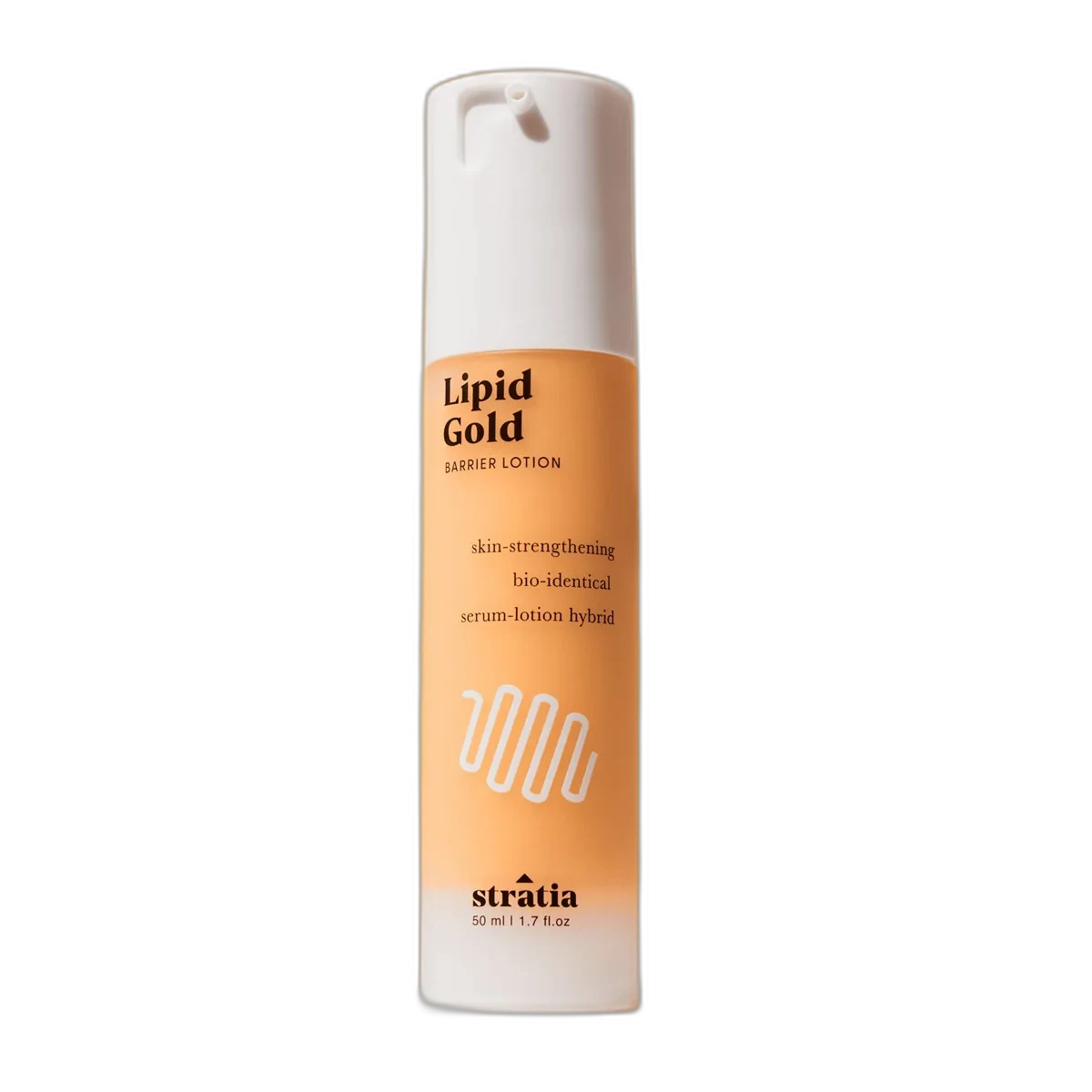
Liquid Gold Moisturizer
Barrier Repair Cult Classic
 Verified reviewer
Pros & cons.
- +Three ceramide types with cholesterol and phytosphingosine replicate the skin's natural lipid ratio
- +Niacinamide at meaningful concentration brightens while stimulating endogenous ceramide production
- +Sea buckthorn and rosehip oils deliver antioxidants and essential fatty acids for barrier support
- +Fragrance-free and essential oil-free — suitable for sensitive and reactive skin types
- +Lightweight lotion texture absorbs quickly and layers well under other products
- +Excellent buffer for retinol — protects and repairs barrier during retinoid treatment
- +Significant value relative to prestige ceramide moisturizers with comparable formulations
- −Contains methylparaben and propylparaben, which some consumers prefer to avoid
- −Propylene glycol base may irritate very sensitive or eczema-prone skin
- −Golden tint can leave temporary visible color on very fair skin during absorption
- −May not be occlusive enough as sole moisturizer for severely dry skin in winter
- −Not vegan — cholesterol is derived from lanolin
The full review.
Liquid Gold had no marketing budget. It lacked a celebrity founder, a PR team, or paid advertisements. Instead, it used a Reddit post, a formulation based on published dermatological research, and a price that made clinical-grade barrier repair accessible to those who cannot afford prestige brands charging three times the cost for the same science.
Alli Reed’s origin story mirrors an indie skincare garage startup. A chemistry minor who studies deeply, she used Reddit’s skincare communities to learn why the skin’s moisture barrier fails and how to fix it. Decades of dermatological literature provide a consistent answer: ceramides, cholesterol, and free fatty acids in specific ratios create a functional barrier. Most market moisturizers use ceramides as a marketing ingredient—adding a tiny amount near the bottom of the INCI list without the essential cholesterol and fatty acid partners. Reed built the formula the science actually prescribes.
The result is distinctive before application. Sea buckthorn oil—both seed and fruit extracts—provides the golden color, delivering omega-7 fatty acids and carotenoid antioxidants. It looks like liquid honey in the pump bottle and leaves a subtle glow on the skin, absorbing within a minute to leave a dewy finish that sits under sunscreen or makeup.
The ingredient architecture justifies Liquid Gold’s cult status. Three ceramide types—NP, AP, and EOP—form the backbone, representing the major ceramide classes in healthy human stratum corneum. Cholesterol fills the interstitial spaces between ceramide bilayers to create a cohesive barrier structure. Phytosphingosine, a sphingoid base precursor to ceramides, supports the skin’s own ceramide synthesis. This is ceramide as lipid replacement therapy, not a marketing buzzword.
Niacinamide is listed fourth, a concentration that suggests meaningful inclusion rather than label decoration. Niacinamide works two ways: it provides well-documented benefits (pore refinement, brightening, anti-inflammatory activity) and stimulates the skin’s endogenous ceramide production. The exogenous ceramides patch existing barrier damage while the niacinamide tells the skin to make more of its own. This formulation strategy addresses both the symptom and the cause.
Rosehip oil, cranberry seed oil, and squalane complete the lipid profile with essential fatty acids and emollients. Panthenol provides vitamin B5’s wound-healing and humectant properties, while glycerin and sodium hyaluronate handle hydration. The formula contains silicone (dimethicone provides occlusion and slip) but is fragrance-free, alcohol-free, and essential oil-free—a clean profile for sensitive skin.
Texture
The texture is lighter than the oil content suggests. It is a lotion, not a cream—spreadable, fast-absorbing, and layerable. For dry skin, it may lack enough occlusion for harsh winter conditions, but it layers under a heavier cream or sleeping mask. For normal to slightly oily skin, it provides enough hydration as a standalone moisturizer.
Performance
Consumer testimony proves the performance. Users with compromised barriers—from over-exfoliation, retinoid irritation, environmental damage, or eczema—report measurable improvement within two to four weeks. Skin feels more resilient, less reactive, and better hydrated. Niacinamide delivers visible brightening over that same timeframe, and the antioxidant-rich oils provide cumulative improvement in skin tone.
Common Complaints
The limitations are clear: the formula contains methylparaben and propylparaben. These are well-studied, effective preservatives, but they are a dealbreaker for consumers who avoid parabens. The propylene glycol base can irritate very sensitive or eczema-prone skin—a paradox for a barrier repair product—though most users tolerate it. Also, the golden color can leave a faint, temporary tint on very fair skin during absorption.
Best for
At $29 for 1.7 ounces (with a 3.4 oz option available), Liquid Gold offers value compared to prestige ceramide moisturizers that use similar strategies at two to four times the price. You pay for a science-driven formulation, not a brand name or luxury packaging. The pump bottle works, the recycled plastic fits the no-frills ethos, and the product delivers on barrier repair.
Nearly a decade after Reed mixed the first batch in her kitchen, Liquid Gold—recently renamed Lipid Gold—is Stratia’s bestseller and a top recommendation in independent skincare communities. That longevity comes from a formula that works, not hype.
Ingredient analysis.
Full INCI list
Water (Aqua), Propylene Glycol, Ethoxydiglycol, Niacinamide, Polyglyceryl-3 Methylglucose Distearate, Rosa Mosqueta (Rose) Hip Oil, Hippophae Rhamnoides (Sea Buckthorn) Seed Oil, Hippophae Rhamnoides (Sea Buckthorn) Fruit Oil, Panthenol, Dimethicone, Glycerin, Squalane (Olive-Derived), Cetyl Alcohol, Vaccinium Macrocarpon (Cranberry) Seed Oil, Tocopherol, Camellia Sinensis Leaf Extract, Ceramide NP, Ceramide AP, Ceramide EOP, Phytosphingosine, Cholesterol, Sodium Hyaluronate, Sodium Lauroyl Lactylate, Carbomer, Xanthan Gum, Methylparaben, Propylparaben, Disodium EDTA
Skin match.
The science.
The Science
Liquid Gold uses decades of research on stratum corneum lipid composition. Imokawa and colleagues published work in the Journal of Investigative Dermatology showing ceramides make up about 50% of the stratum corneum's intercellular lipid matrix, with cholesterol and free fatty acids forming the rest in an approximately equimolar ratio. Over-cleansing, environmental damage, or conditions like atopic dermatitis disrupt this ratio, increasing transepidermal water loss and compromising barrier function.
Liquid Gold contains three ceramide classes: Ceramide NP (N-stearoyl phytosphingosine), Ceramide AP (alpha-hydroxy-N-stearoyl phytosphingosine), and Ceramide EOP (N-stearoyl-oxidized linoleoyl phytosphingosine). These are the main ceramide subclasses in human skin. Cholesterol and phytosphingosine complete the lipid triad required for functional barrier repair.
In a 2005 Journal of Investigative Dermatology study, Chamlin et al. showed that topical application of ceramide-dominant formulations with all three lipid classes (ceramides, cholesterol, fatty acids) in an equimolar ratio accelerated barrier recovery in atopic dermatitis patients more than formulations with incomplete lipid profiles. This research supports the multi-lipid approach in Liquid Gold.
Niacinamide adds a pharmacological layer to the barrier repair strategy. A 2000 study by Tanno et al. in the British Journal of Dermatology showed niacinamide upregulates the synthesis of ceramides, cholesterol, free fatty acids, and other intercellular lipids in the stratum corneum. Niacinamide provides direct benefits and potentiates the barrier repair of the exogenous ceramides in the formula.
References
- Ceramides are bound covalently to structural proteins of the human foreskin epidermal cornified cell envelope — Journal of Biological Chemistry (1998)
- Nicotinamide increases biosynthesis of ceramides as well as other stratum corneum lipids to improve the epidermal permeability barrier — British Journal of Dermatology (2000)
Dermatologist Perspective
Board-certified dermatologists often recommend ceramide-based moisturizers for patients with compromised skin barriers, especially those using retinoid therapy or recovering from procedures. Dermatologists say effective barrier repair requires the complete lipid triad — ceramides, cholesterol, and free fatty acids — in appropriate ratios. Liquid Gold's three-ceramide formulation with cholesterol and phytosphingosine matches clinical evidence for optimal barrier repair. Dermatologists also recognize that niacinamide stimulates endogenous lipid synthesis, making this formulation approach doubly effective for barrier recovery.
Where it fits in your routine.
Apply 1-2 pumps to clean skin after water-based serums and treatments. Press the lipid-rich formula into the skin with light patting instead of aggressive rubbing to improve absorption. Use morning and evening for barrier repair. In the morning, follow with sunscreen. At night, use it as the final step or layer it under a heavier occlusive for severely compromised barriers. Wait 30-60 seconds for full absorption before applying the next product.
At $29 for 1.7 ounces (or $53 for the larger 3.4 oz), Liquid Gold offers strong value among ceramide moisturizers. Prestige brands with similar three-ceramide-plus-cholesterol formulations usually cost $45-80 for these sizes. The 3.4 oz bottle has better per-ounce value for frequent users. The science-driven formulation, lack of fragrance, and niacinamide concentration justify the price, which sits between drugstore and prestige.
This works for anyone with a compromised skin barrier—from over-exfoliation, retinoid irritation, environmental damage, or chronic conditions like eczema. It also suits anyone wanting a science-driven ceramide moisturizer without the prestige markup. Retinol users needing barrier support alongside an anti-aging routine will find it particularly valuable.
Avoid this if you strictly avoid parabens. People with known propylene glycol sensitivity may experience irritation. The oil content feels too thick for very oily skin types that prefer gel-based moisturizers. This formula is not vegan because it contains lanolin-derived cholesterol.
Product details.
No added fragrance. The rosehip and sea buckthorn create a faint, natural oil scent that dissipates within minutes.
The pump bottle uses 34-40% upcycled recycled plastic. Its opaque design protects the antioxidant-rich oils from light degradation. The pump dispenser is hygienic and delivers a controlled amount of product.
The golden color is striking; it looks like liquid honey on the skin. It absorbs in 30-60 seconds and leaves a subtle dewy finish. There is no tingling, stinging, or adjustment period. Skin feels softer and more resilient within the first week.
2-3 months using 1.7 oz twice daily; 4-5 months for 3.4 oz size
12 months
All Year
The backstory.
Alli Reed created Liquid Gold in her kitchen in 2016 after diving deep into research on the skin's moisture barrier. As a chemistry enthusiast active in Reddit's skincare communities, she identified a gap: most affordable moisturizers contained token amounts of ceramides without the cholesterol and fatty acid components needed for effective barrier repair. Liquid Gold was designed to fill that gap — a ceramide moisturizer that took the science seriously at an accessible price point. The product became a Reddit skincare community sensation and remains Stratia's bestseller nearly a decade later.
About Stratia
Established Brand (5–20 years)Stratia was founded in 2016 by Alli Reed, a former chemistry minor who developed Liquid Gold in her kitchen after extensive research on the skin barrier's lipid composition. The brand is science-first, woman-owned, and made in Los Angeles. While it lacks the clinical resources of larger derm-developed brands, its formulations are based on published dermatological research, particularly around the ceramide-cholesterol-fatty acid ratio that mirrors the skin's natural lipid barrier.
Common myths.
Any moisturizer with ceramides repairs the skin barrier.
Ceramides alone do not work. Research shows effective barrier repair needs ceramides, cholesterol, and free fatty acids in specific ratios. Liquid Gold contains all three — ceramides NP, AP, and EOP with cholesterol and phytosphingosine — so it repairs the barrier better than products that list only ceramides.
The golden color means this product stains or discolors skin.
Sea buckthorn oil's natural carotenoids create the golden hue. It absorbs fully into the skin within a minute. The color shows only during the brief application window before absorption; it leaves no lasting stain or discoloration.
FAQ.
Does Stratia Liquid Gold actually repair the skin barrier?
Yes — Liquid Gold uses three ceramide types (NP, AP, EOP), cholesterol, and phytosphingosine to replicate the skin's natural lipid barrier composition. It adds niacinamide to stimulate the skin's own ceramide production. This formula repairs the barrier through both external supplementation and internal stimulation. Most users report improved barrier resilience within 2-4 weeks.
Why is Stratia Liquid Gold that color?
Sea buckthorn oil gives the product its golden color. This oil contains carotenoids, which are natural orange-yellow pigments that work as antioxidants. Natural ingredients provide the color, and it absorbs fully into the skin without staining or discoloring it.
Can I use Liquid Gold with retinol?
It is one of the best moisturizers to pair with retinol. The ceramide-cholesterol complex repairs and maintains the barrier retinol can compromise, while niacinamide and panthenol soothe the skin. Apply your retinol first, then follow with Liquid Gold to buffer irritation.
Is Stratia Liquid Gold the same as Lipid Gold?
Yes — Stratia recently renamed 'Liquid Gold' to 'Lipid Gold.' The formulation is the same; only the name changed. Both names refer to the same ceramide-cholesterol barrier repair moisturizer.
Does Stratia Liquid Gold contain parabens?
The formula uses methylparaben and propylparaben as preservatives. Parabens are effective and have extensive safety data from many studies, but some consumers avoid them. If parabens concern you, use paraben-free alternatives.
---
What the community says.
"Visibly repairs compromised skin barrier within weeks of consistent use"
"Distinctive golden color and lightweight texture feel luxurious without heaviness"
"Excellent under retinol — buffers irritation while supporting barrier recovery"
"Fragrance-free formula works on sensitive and reactive skin types"
"Niacinamide provides visible brightening alongside the barrier repair"
"Contains parabens, which some consumers prefer to avoid"
"Golden/yellow tint can temporarily leave a slight cast on lighter skin tones"
"Propylene glycol may irritate very sensitive or eczema-prone skin"
"Not rich enough as a sole moisturizer for very dry skin in winter"