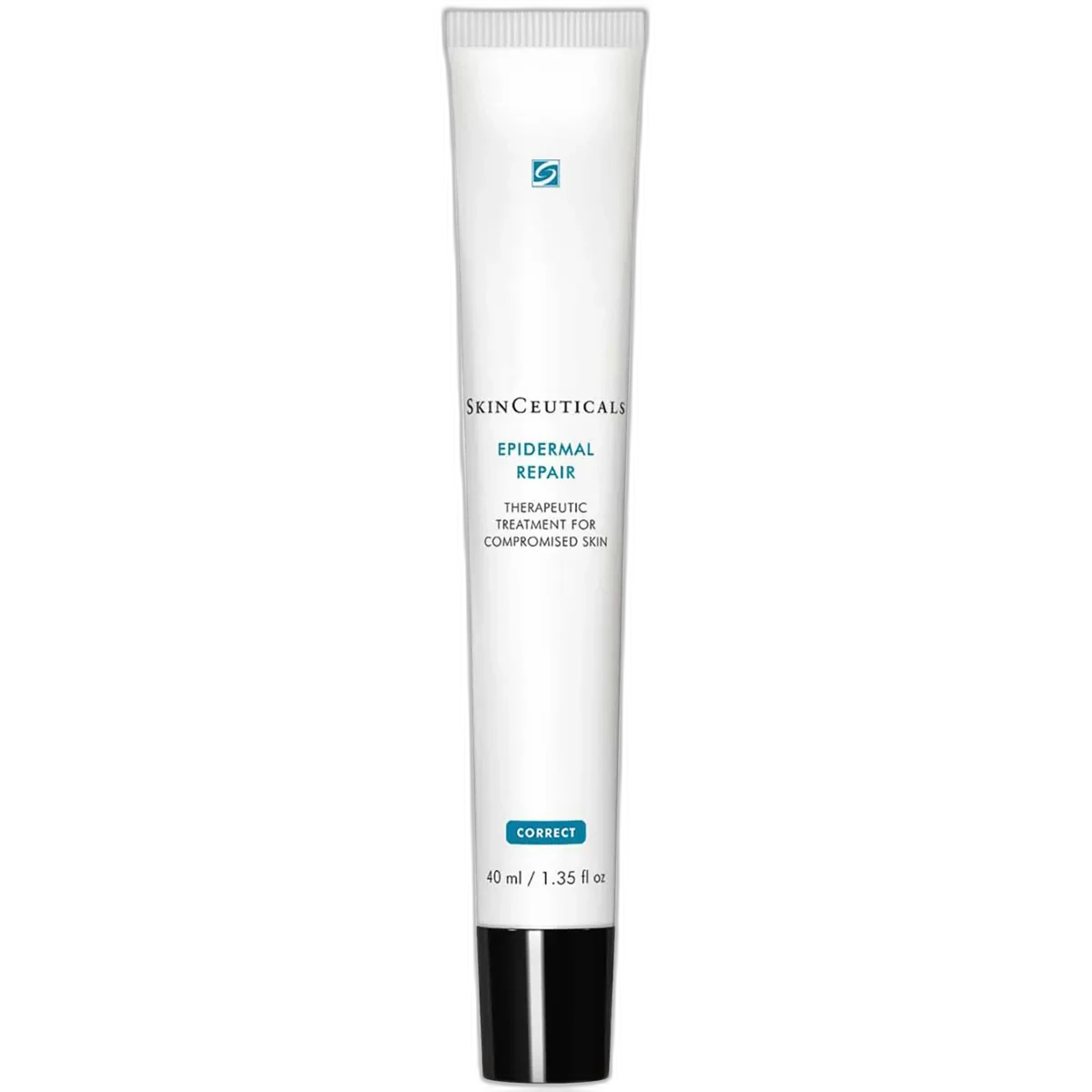
Epidermal Repair
Post-Procedure MVP
 Verified reviewer
Pros & cons.
- +Meaningful ~4% niacinamide plus strong soothing active stack
- +Non-stinging on freshly peeled or lasered skin
- +Cool, cushiony texture that feels good on raw skin
- +Pregnancy-friendly with no restricted ingredients
- +Fragrance-free and alcohol-free
- +Doubles as a rescue cream for rosacea and reactive flares
- +Decades of dermatology-office validation
- −High price for a small 1 oz tube
- −Too expensive to justify as an everyday moisturizer
- −Tube packaging runs out quickly with heavy use
- −Limited retail availability outside clinical channels
The full review.
If you have ever walked out of a dermatologist’s office after a fractional laser or a TCA peel, you have probably been handed a small white-and-grey tube and told to use it twice a day for the next week. That tube, in a huge number of US dermatology and plastic surgery offices, is SkinCeuticals Epidermal Repair — a product that exists almost entirely for the 72-hour window when your face feels like it was sanded.
The formulation logic here is tight and purpose-built. Niacinamide sits high on the ingredient list — industry teardowns and SkinCeuticals’ own marketing place it around 4%, which is a meaningful concentration for a cream of this size. Niacinamide is one of the most dermatologically validated actives for supporting ceramide synthesis, calming redness, and improving the speed of barrier recovery. Layered around it are centella asiatica extract (the classic cica active for post-inflammatory redness), panthenol for transepidermal water loss, allantoin to smooth flakiness, bisabolol and dipotassium glycyrrhizate for soothing, and yeast-derived beta-glucans for a gentle water-binding film. There is no fragrance, no essential oils, no denatured alcohol, no acids, and no retinoids. Nothing on the list picks a fight with already-compromised skin.
The texture matches the brief. This is a medium-weight cream that pushes out of the tube as a cool, slightly cushiony stripe and spreads easily without dragging on raw or peeling areas. The finish is non-greasy, which matters when the goal is to apply it every few hours without the occlusive heaviness of a post-procedure ointment. Most users report immediate cooling, a noticeable reduction in visible pink by the end of day one, and a meaningful step down in tightness by the end of day two. This is not a cream that makes dramatic claims — its job is to let your face calm down faster, and within a narrow scope it does that very well.
Where Epidermal Repair earns its place is in the quiet moments most aftercare products miss. It does not sting when applied to freshly peeled skin, which anyone who has accidentally put a ceramide cream with a whiff of fragrance on a chemical peel can tell you is not universal. It is pregnancy-friendly. It plays well as a standalone during the recovery window — you genuinely do not need a serum underneath for the first few days, which simplifies things when your skin is in no mood for decisions. And for people with rosacea or reactive skin having a flare, it doubles as a rescue cream outside of the post-procedure context.
There is exactly one real criticism, and it is a loud one: seventy-six dollars for a one-ounce tube is a lot, particularly because Epidermal Repair is not a cream most people should use as their daily moisturizer. The value math only works if you think of it the way dermatologists prescribe it — a short-course product, used heavily for five to ten days after a procedure or during a flare, then shelved. If you try to justify it as everyday skincare, the tube will be empty in a month and your wallet will not love you. Compared to Phyto Corrective Gel, which is lighter and more general-purpose for sensitive skin, Epidermal Repair is the more situational but more capable option when things are genuinely bad.
A few practical notes from years of this product living in derm offices. The tube size is deliberately small because the brand expects you to use it in short courses; do not be surprised if you burn through it during an aggressive recovery week. The packaging is fine but unremarkable — a standard squeeze tube that will eventually get uneven toward the end. And while SkinCeuticals is owned by L’Oréal now, that corporate ownership has not meaningfully changed the formulation, which has stayed remarkably consistent since it launched in the early 2000s.
The honest positioning is this: Epidermal Repair is not the best value cream in skincare, and it is not the most exciting launch on any “new in” list. What it is, is a genuinely well-made, institutionally trusted recovery cream that has sat on dermatology shelves for over twenty years without anyone finding a reason to stop recommending it. If you are about to book a laser, a deep peel, or microneedling, it is worth having a tube in your bathroom before you walk into the appointment. The day after, you will be glad you did.
Formula
Ingredient analysis.
Full INCI list
Water, Glycerin, Dicaprylyl Carbonate, Cetearyl Alcohol, Glyceryl Stearate, Niacinamide, PEG-100 Stearate, Centella Asiatica Extract, Yeast Extract, Panthenol, Dipotassium Glycyrrhizate, Tocopheryl Acetate, Bisabolol, Allantoin, Caprylyl Glycol, Dimethicone, Phenoxyethanol, Chlorphenesin, Xanthan Gum, Disodium EDTA, Carbomer, Sodium Hydroxide
Skin match.
The science.
The Science
Epidermal Repair relies on a high concentration of niacinamide. Research shows topical niacinamide at 2% to 5% improves skin barrier function, reduces transepidermal water loss, and increases ceramide synthesis. Centella asiatica extract and its isolated triterpenoids (asiaticoside, madecassoside) have extensive literature supporting wound-healing and anti-inflammatory effects in animal and human models; madecassoside specifically has been studied in post-laser and post-peel contexts and helped make the cica category a dermatology staple. Panthenol (provitamin B5) has established data on supporting disrupted stratum corneum recovery and reducing transepidermal water loss. Allantoin is a classic keratolytic and soothing agent used in OTC and cosmetic formulations. The formulation adds dipotassium glycyrrhizate (licorice-derived) and bisabolol, both of which have consistent data for calming erythema. Notably, this is not a ceramide-cholesterol-fatty-acid biomimetic cream — SkinCeuticals did not design it to compete on lipid replacement. The design logic is "calm first, then restore" — stop inflammatory signaling and support niacinamide-driven repair in the days after a procedure, assuming a richer ceramide or lipid cream returns to the routine after the acute phase ends.
Dermatologist Perspective
Board-certified dermatologists frequently recommend Epidermal Repair as a first-line post-procedure cream after lasers, chemical peels, microneedling, and aggressive rosacea flares. It is commonly prescribed because it is non-stinging, fragrance-free, and contains a meaningful dose of niacinamide with well-established soothing actives — a combination uncommon in drugstore recovery creams. Dermatologists typically instruct patients to use it two to three times daily during the first five to seven days after a procedure, often with a simple petrolatum-based occlusive at night for deeper lipid support. It also works as a rescue cream for patients with reactive skin during seasonal flares or as a bridging product after a reaction to retinoids or acids.
Where it fits in your routine.
Apply a small amount to cleansed skin two to three times daily for five to ten days after an in-office procedure. For the first 48-72 hours, use it alone over gently rinsed skin—skip serums, acids, retinoids, and physical scrubs. After day three, many dermatologists approve using a mineral SPF during the day. Transition back to your regular moisturizer once the acute recovery window ends. For rosacea or sensitivity flares, use twice daily as your only treatment step until the flare subsides, then return to your usual routine. Do not apply over open wounds or broken skin.
At $76 for 1 ounce, Epidermal Repair costs more per ounce, but the price makes sense if you use it as a short-course product instead of a daily moisturizer. Use Epidermal Repair as dermatologists intend — five to ten days post-procedure or during acute flares — and one tube lasts through multiple episodes over several months. The value fails if you use it as everyday skincare; you will spend $76 every few weeks. Compared to cheaper cica creams from French pharmacy brands, the higher niacinamide content and institutional track record justify the premium. The price is worth it for post-procedure use; look elsewhere for general sensitive-skin moisturizing.
Anyone booking a cosmetic procedure — laser, peel, microneedling — should have a dermatologist-trusted recovery cream ready at home before the appointment. It also works well for people with rosacea, reactive skin, or a history of flare-ups who need a rescue cream for bad weeks.
Epidermal Repair costs too much for daily moisturizer or general sensitive-skin cream use. Shoppers on a tight budget can use Avène Cicalfate or La Roche-Posay Cicaplast Baume B5 as cheaper recovery-cream alternatives.
Product details.
Medium-weight cream that feels cool and cushioning on contact
Unscented with a faint neutral base note
Small white and grey tube
Expect immediate cooling and visible redness reduction within the first hour. It does not sting, tingle, or cause purging. Most users apply it freely for 3-5 days after a procedure before returning to regular skincare.
Use heavily for about 2 weeks post-procedure, or 4-6 weeks for occasional flare support
12 months
All Year
The backstory.
Epidermal Repair was developed in the early 2000s as SkinCeuticals built out a recovery protocol for dermatologist and plastic-surgeon offices that were increasingly offering laser resurfacing, peels, and microneedling. It was designed to be the cream patients could apply freely in the first days after a procedure without irritating already-compromised skin.
About SkinCeuticals
Legacy Brand (20+ years)SkinCeuticals launched in 1997 from Dr. Sheldon Pinnell's antioxidant research at Duke University. It remains a staple in dermatology offices. Clinical skincare protocols frequently reference its formulations, especially for barrier support and post-procedure care.
Common myths.
Epidermal Repair is a standard aftercare moisturizer; any ceramide cream works the same way.
Epidermal Repair uses a 4% niacinamide plus centella-panthenol combination for acutely compromised skin. This formulation works when standard ceramide creams sting on application. The soothing active load is higher and more targeted than typical drugstore options.
FAQ.
What is SkinCeuticals Epidermal Repair used for?
This targeted recovery cream works after cosmetic procedures like laser resurfacing, chemical peels, or microneedling, and during acute rosacea or dermatitis flares. It soothes and supports the barrier with niacinamide and centella.
How to Use
You can, but most dermatologists recommend short courses — typically 5-10 days post-procedure or during a flare. Once skin calms, switching to a regular moisturizer like Triple Lipid Restore or Emollience saves money.
Reality
The formula has no fragrance, no alcohol, and no acids. Users with just-lasered or actively peeling skin typically report a cooling sensation instead of stinging upon application.
How does Epidermal Repair compare to Phyto Corrective Gel?
Phyto Corrective Gel has a lighter, serum-like texture for general redness and post-treatment calming. Epidermal Repair is a thicker cream with more niacinamide, better for compromised skin that needs more moisture.
Is Epidermal Repair safe during pregnancy?
The formulation contains no ingredients typically restricted in pregnancy — no retinoids, no high-dose salicylic acid, and no hydroquinone. As always, consult your OB-GYN if you are uncertain.
Can I layer Epidermal Repair with vitamin C?
During active recovery, no — skip actives entirely for the first several days. Once skin has re-epithelialized, you can cautiously reintroduce vitamin C underneath Epidermal Repair, but most dermatologists have patients use it alone during the recovery window.
Community
What the community says.
"Calms redness quickly after procedures"
"Comfortable on raw, angry skin"
"Non-stinging and fragrance-free"
"Works for rosacea flares"
"Helps with peel recovery"
"Very expensive for small tube"
"Only useful short-term"
"Packaging runs out quickly"
"Hard to find outside professional channels"
People also looked at.