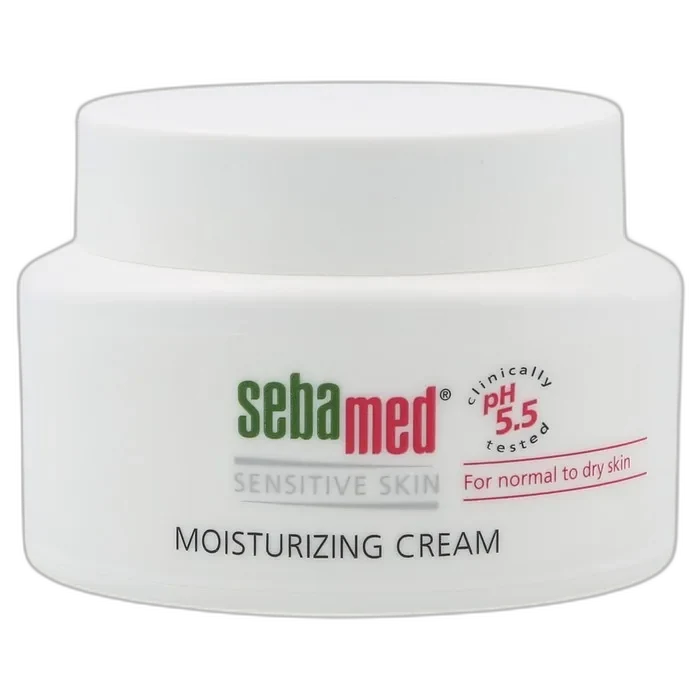
Moisturizing Cream
German Pharmacy Minimalist
 Verified reviewer
Pros & cons.
- +Only 12 ingredients — radical simplicity that minimizes the risk of sensitization reactions
- +pH 5.5 formulation matches healthy skin's acid mantle — dermatologically grounded, not marketing
- +2% vitamin E at a clinically relevant concentration provides real antioxidant protection
- +Under $15 for a German-made, clinically-backed moisturizer — outstanding value
- +Silicone-free, paraben-free, sulfate-free — clean formula by any definition
- +Over 150 scientific studies backing the Sebamed pH 5.5 formulation approach
- +Lightweight, non-greasy texture absorbs quickly and works well under makeup and SPF
- −Contains fragrance — an inconsistency in a product explicitly marketed for sensitive skin
- −Formula is intentionally basic — no sophisticated actives beyond vitamin E and glycerin
- −Hydration may not last all day for very dry skin types — may need reapplication or a richer layer
- −Benzyl alcohol as a preservative may be a concern for a small subset of sensitive individuals
- −Not widely available at US brick-and-mortar retailers — primarily an online purchase
- −Cetearyl alcohol has low comedogenicity potential — worth noting for very acne-prone skin
The full review.
In the 1950s, at the University Clinic Bonn’s dermatology ward, a young doctor named Heinz Maurer broke the rules. His eczema patients were forbidden from washing with soap — it destroyed the painstaking work of their treatment protocols. So Maurer, without authorization, tried something different: he washed them with acid tensides, cleansers formulated at the same pH as healthy skin. The results were striking. The crusting dissolved, irritation disappeared, and skin became receptive to treatment again. That unauthorized experiment became the founding principle of Sebamed: formulate everything at pH 5.5, match the skin’s own acid mantle, and stop doing damage in the name of cleanliness.
The Moisturizing Cream is perhaps the purest expression of that philosophy applied to hydration. Twelve ingredients. That is the entire formula. In an industry where a typical moisturizer contains thirty to forty components — peptides, botanical extracts, proprietary complexes, fragrance maskers for fragrance maskers — Sebamed’s approach is so restrained it reads almost like a dare. Can a moisturizer with fewer ingredients than most people have fingers actually do its job?
The answer, for the skin types this cream targets, is a clear yes. The formula operates on foundational principles rather than ingredient fashion. Caprylic/capric triglyceride — a coconut-derived emollient so gentle it appears in infant formula — forms the lipid base, contributing to the cream’s 26% total lipid content. Glycerin provides the humectant pull, drawing water into the stratum corneum. Tocopheryl acetate at a confirmed 2% concentration delivers meaningful antioxidant protection. Biosaccharide gum-1 adds a modern sustained-hydration component. Glyceryl stearate citrate and cetearyl alcohol serve as emulsifiers. Citric acid adjusts the pH to the precise 5.5 that Sebamed considers non-negotiable. Preservatives keep it safe. That is it.
The texture is pleasantly unremarkable. It is a cream that feels like a cream — not a gel-cream hybrid trying to seem innovative, not a whipped mousse trying to seem luxurious, not a jelly trying to seem fun. It spreads smoothly, absorbs within a minute or two, and leaves skin feeling soft and hydrated without greasiness or residue. Under makeup, it behaves. Under sunscreen, it cooperates. In a nighttime routine, it quietly does its job while your actives do theirs.
The pH 5.5 formulation deserves more than a marketing bullet point. The skin’s acid mantle — a thin film of amino acids, fatty acids, and lactic acid on the skin surface — maintains a pH between 4.5 and 5.5. This slightly acidic environment inhibits pathogenic bacteria, supports the skin microbiome, and maintains the structural integrity of the intercellular lipid matrix. When you apply a product at a significantly different pH, you temporarily disrupt this environment. Most moisturizers do not disclose their pH, and many test alkaline. Sebamed’s insistence on pH 5.5 across every product is not marketing theater — it is a dermatologically grounded design decision that particularly benefits sensitive and eczema-prone skin where the acid mantle is already compromised.
The 2% vitamin E concentration is worth highlighting because it stands in sharp contrast to how most brands use this ingredient. Vitamin E appears in thousands of moisturizers, but typically at concentrations below 0.5% — present for label appeal rather than clinical effect. At 2%, this cream delivers enough tocopheryl acetate to provide measurable antioxidant protection against UV-induced and environmental free radical damage. Research has demonstrated that topical vitamin E at 1-5% can reduce lipid peroxidation and support the skin’s own antioxidant defenses. This is a cream that actually delivers what vitamin E promises rather than name-checking it.
And then there is the fragrance. It must be addressed because it is genuinely puzzling. Sebamed built an entire brand on the premise of protecting sensitive skin. They formulate at pH 5.5, they use twelve ingredients, they cut every corner that could cause a reaction — and then they add Parfum. The scent is mild, a clean floral note that most users find inoffensive. But fragrance remains the single most common cause of contact dermatitis in cosmetic products, and its presence in a cream marketed explicitly for sensitive skin is an inconsistency that costs Sebamed points it should not be losing. The brand offers other fragrance-free formulations, which makes this choice even harder to defend.
The value proposition, however, is nearly unassailable. At under fifteen dollars for 75 milliliters that last two to three months, this is one of the most affordable clinically-backed moisturizers available. You are paying for German pharmaceutical formulation, pH-controlled manufacturing, 2% vitamin E, and over 150 scientific studies backing the brand’s approach — at a price point that makes most drugstore moisturizers look expensive by comparison. A 100-milliliter pump bottle is also available for those who prefer that format.
The limitations are the limitations of minimalism itself. This cream will not wow you with exotic ingredients or visible instant effects. It will not address hyperpigmentation, fine lines, or acne. It is not formulated to impress — it is formulated to work. For sensitive skin that has been burned by complicated formulas full of potential triggers, for eczema-prone skin that needs hydration without risk, for anyone who believes that the best skincare is the kind that does no harm, Sebamed’s Moisturizing Cream is a quiet argument for doing less, better.
Ingredient analysis.
Full INCI list · pH 5.5
Water (Aqua), Caprylic/Capric Triglyceride, Glycerin, Tocopheryl Acetate, Glyceryl Stearate Citrate, Cetearyl Alcohol, Biosaccharide Gum-1, Citric Acid, Sodium Carbomer, Fragrance (Parfum), Benzyl Alcohol, Phenoxyethanol
Skin match.
The science.
The Science
A pH 5.5 formulation principle forms the scientific foundation of this cream. The skin's acid mantle — produced mainly by lactic acid, amino acids, and free fatty acids from the stratum corneum — creates an acidic environment (pH 4.5-5.5) with multiple protective functions. A study in the International Journal of Cosmetic Science shows that keeping the skin surface at its natural acidic pH optimizes stratum corneum integrity, improves antimicrobial defense, and supports pH-dependent enzymes for lipid processing and desquamation.
Research shows that alkaline products (soaps, some cleansers) disrupt the acid mantle, which increases transepidermal water loss, alters skin microbiome composition, and impairs barrier recovery. Sebamed formulates all products at pH 5.5 to ensure the moisturizer supports the natural skin environment instead of disrupting it.
The 2% tocopheryl acetate (vitamin E) concentration is clinically meaningful. A review in Molecular Aspects of Medicine established that topical vitamin E at 1-5% concentrations provides photoprotective and antioxidant benefits by scavenging reactive oxygen species from UV radiation and environmental pollutants. Skin esterases convert tocopheryl acetate, the ester form, to active tocopherol after application, which provides a stable delivery mechanism.
Biosaccharide gum-1 is a biotechnology-derived polysaccharide that shows moisturizing and soothing properties in clinical studies. It forms a breathable film on the skin surface that reduces transepidermal water loss and provides sustained hydration, complementing the immediate humectant action of glycerin.
Dermatologist Perspective
European dermatologists often recommend Sebamed as a baseline moisturizer for patients with eczema, contact dermatitis, and compromised skin barriers. Board-certified dermatologists note the pH 5.5 formulation, minimal ingredient count, and absence of common irritants (parabens, sulfates, silicones) make it a low-risk option for reactive skin. However, dermatologists consistently flag the fragrance content as an unnecessary addition that limits use for the most sensitive patients. The 2% vitamin E is a meaningful antioxidant contribution — a clinical dose rather than a marketing token.
Where it fits in your routine.
Cleanse first (ideally with a pH-balanced cleanser) and apply treatment serums. Spread a small amount evenly over the face and neck. Use morning and night. Apply SPF sunscreen in the morning. The lightweight formula layers easily under other products. For very dry skin, apply a thicker layer at night or over a hydrating serum.
At approximately $14.99 for 75ml, this is a top value among clinically-backed sensitive-skin moisturizers. Most brands charge more for German pharmaceutical heritage, a pH 5.5 manufacturing standard, and 2% vitamin E concentration. Sebamed also sells a 50ml 3-pack and a 100ml pump bottle. With over 150 scientific studies and decades of dermatological recommendation, the sub-$15 price reflects pharmaceutical-brand pricing instead of prestige markup.
This works for sensitive, reactive, or eczema-prone skin needing a simple, reliable daily moisturizer with low irritation risk. It suits people recovering from skin reactions, starting new active treatments, or seeking a cost-effective, clinically-backed baseline moisturizer. The gentle, barrier-supportive formula also works well as a retinol buffer cream.
This moisturizer is for people with very oily skin who need an oil-free or gel moisturizer. It is intentionally basic and lacks anti-aging actives, brightening ingredients, or multi-functional skincare. Users with extreme fragrance sensitivity should note that this cream contains Parfum, despite its sensitive-skin positioning.
Product details.
The fragrance is mild, clean, and slightly floral. The scent is light but detectable. Some users like it, while others want a fragrance-free formula for sensitive skin.
White tube or jar (75 ml) uses Sebamed's clinical blue-and-white branding. A 100 ml pump bottle and 50 ml size also exist. The packaging is clean, pharmacy-style, and utilitarian — a no-frills design that shows the brand's clinical heritage.
The first application is unremarkable: smooth, comfortable, and neutral. It has no tingling, no warming, and no adjustment period. Skin feels soft and hydrated immediately without heaviness. This cream stays out of the way and keeps skin comfortable. ***
2-3 months with twice-daily use ***
12 months ***
All Year ***
The backstory.
Dr. Heinz Maurer developed Sebamed's core philosophy while treating acute eczema patients at the University Clinic Bonn in the 1950s. His patients were forbidden from using soap because it destroyed therapeutic progress. Maurer's unauthorized experiment with acid tensides — cleansers that matched the skin's natural pH rather than the alkaline pH of soap — showed remarkable results. The entire Sebamed brand grew from that insight: formulate everything at pH 5.5, use the minimum necessary ingredients, and let the skin's own acid mantle do its job undisturbed.
About Sebamed
Legacy Brand (20+ years)Dr. Heinz Maurer founded Sebamed in 1967. He created soap-free cleansing based on his work at the University Clinic Bonn dermatological department. All Sebamed products use a pH 5.5 to match the healthy skin acid mantle. Over 150 scientific studies include the brand, and dermatologists worldwide recognize it.
Common myths.
A moisturizer with only 12 ingredients lacks the efficacy of one with 30+.
Fewer ingredients often mean fewer triggers for sensitive skin. This cream provides the fundamentals — emollient, humectant, antioxidant — without botanical extracts, essential oils, or specialty actives that sensitize reactive skin. The 2% vitamin E concentration is higher than many 'luxury' creams that list vitamin E lower on longer ingredient lists.
pH doesn't matter in a moisturizer — only in cleansers.
The skin's acid mantle (approximately pH 4.5-5.5) is critical for barrier function and microbiome health. A moisturizer formulated at pH 5.5 supports this protective layer instead of disrupting it. This subtle impact follows dermatological guidance: every product applied to the skin should respect its natural acid environment.
FAQ.
Why is pH 5.5 important in a moisturizer?
Healthy skin has a natural acid mantle at pH 4.5-5.5. This layer protects against bacteria, maintains barrier function, and supports the skin microbiome. Sebamed formulates all products at pH 5.5 to match and support this protective layer instead of disrupting it. This matters for sensitive and eczema-prone skin.
Is Sebamed Moisturizing Cream good for eczema?
Many eczema sufferers find this cream helpful. It uses a simple 12-ingredient formula with a pH 5.5 formulation and lacks common irritants like parabens, sulfates, and silicones. However, it contains fragrance and benzyl alcohol, which some eczema patients react to. Patch test first if you have active eczema.
Can I use Sebamed Moisturizing Cream with retinol?
Yes — this simple, soothing formula works well as a buffer cream over retinol treatments. Glycerin and vitamin E counteract retinol-induced dryness, and the pH 5.5 formulation supports the skin barrier that retinol can temporarily compromise.
Is this moisturizer safe during pregnancy?
Yes. This cream has no retinoids, no salicylic acid, and no ingredients flagged as pregnancy concerns. The simple formula uses vitamin E, glycerin, and gentle emollients. It is suitable for pregnancy and breastfeeding.
Why does Sebamed Moisturizing Cream contain fragrance if it's for sensitive skin?
This criticism is fair. The fragrance is mild, but adding it to a product for sensitive skin contradicts the brand's cautious formulation philosophy. Highly fragrance-sensitive users can find fragrance-free formulations in other Sebamed products.
Is 2% vitamin E enough to make a difference in skincare?
Yes. Research shows topical vitamin E at 1-5% concentrations provides measurable antioxidant protection against UV-induced free radical damage. At 2%, this cream uses a clinically relevant concentration — higher than many moisturizers that list vitamin E as a minor ingredient near the bottom of their INCI.
What the community says.
"Extremely gentle formula that never causes irritation even on the most sensitive skin"
"Lightweight, non-greasy texture that absorbs quickly and works well under makeup"
"Excellent value — affordable price for a clinically-backed, German-made moisturizer"
"pH 5.5 formulation respects the skin's acid mantle and supports barrier function"
"Simple ingredient list with only 12 components reduces the risk of reactions"
"2% vitamin E provides meaningful antioxidant protection at a clinical concentration"
"Contains fragrance despite being marketed for sensitive skin — an inconsistency"
"Hydration may not last all day for very dry skin types"
"Scent receives mixed reactions — some find it pleasant, others too strong"
"Formula is very basic — no sophisticated actives beyond vitamin E"
"Not widely available at US brick-and-mortar retailers"