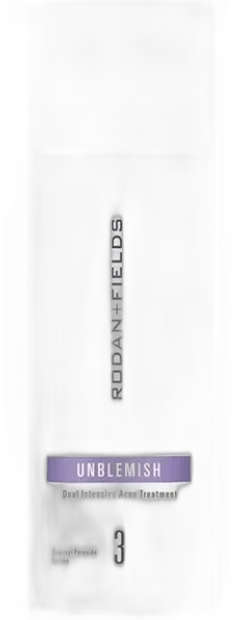
Unblemish Dual Intensive Acne Treatment
Barrier-Buffered BPO
 Verified reviewer
Pros & cons.
- +2.5% benzoyl peroxide is the efficacy-tolerability sweet spot
- +Full ceramide-cholesterol-phytosphingosine barrier complex buffers dryness
- +Niacinamide and panthenol reduce BPO-driven inflammation
- +Backed by 25+ years of the founders' acne expertise
- +Less purging and flaking than conventional BPO products
- +Lightweight lotion absorbs quickly without residue
- −Added fragrance with EU allergens is risky for reactive skin
- −Expensive compared to drugstore BPO alternatives
- −Will bleach colored fabrics, towels, and pillowcases
- −Can deactivate most retinoids when layered wet-on-wet
- −Dual-bottle packaging is awkward compared to single tube
The full review.
If you watched 1990s infomercials, you remember Proactiv. It featured two dermatologists, a three-step system, a 2.5% benzoyl peroxide lotion, and celebrities discussing skin changes. Proactiv works, but it reflects an era that treated acne by stripping the skin and accepting peeling. The two Stanford-trained dermatologists who created Proactiv, Katie Rodan and Kathy Fields, have had 25 years to refine acne treatment since that launch. This Unblemish Dual Intensive treatment shows that extra quarter-century of experience. It uses the same 2.5% benzoyl peroxide and core philosophy, but includes a built-in barrier-support system instead of leaving barrier care to the user.
Reality
The INCI list leads with 2.5% benzoyl peroxide. This number matters. Clinical studies from the last two decades show 2.5% benzoyl peroxide has comparable antibacterial efficacy to 5% and 10% versions for most acne cases, but with much less irritation, dryness, and flaking. Choosing 2.5% is a smart tolerability decision. Benzoyl peroxide’s mechanism—generating free radicals to kill C. acnes on contact—does not scale linearly with concentration. The loss at 2.5% is minor; the gain is users who use the treatment long enough to see results.
Reality
The barrier complex makes this formula interesting. Beyond the benzoyl peroxide, the formula contains ceramide NP, ceramide AP, ceramide EOP, cholesterol, and phytosphingosine. This five-ingredient barrier lipid stack mirrors the composition of a healthy stratum corneum. This is vital for a BPO product, as barrier damage, transepidermal water loss, and flaky dryness are the main reasons people quit benzoyl peroxide. Most BPO treatments leave barrier repair to a separate moisturizer. This one builds repair into the treatment. Niacinamide and panthenol add inflammation control and barrier support, while aloe, chamomile, and allantoin provide soothing effects. On paper, it reads more like a sensitive-skin moisturizer than a BPO lotion.
How to Use
The formula performs as expected. Users typically report a purge period common to all benzoyl peroxide: new surface breakouts in the first two to three weeks as clogged pores release, followed by fewer inflamed lesions and steady acne improvement. The main difference is what stays absent: the flaking and tightness common in old-school Proactiv is significantly muted. Users who quit BPO due to dryness often tolerate this version. This is a clinical advantage, as benzoyl peroxide only works with consistent use.
Common Complaints
There are real complications. The biggest is fragrance. Including fragrance—specifically EU-flagged allergens like citronellol, geraniol, limonene, and linalool—in an acne treatment for reactive adult skin is a strange choice. BPO is already irritating, so adding potential sensitizers is a move that would face criticism on r/SkincareAddiction, and it offers no consumer upside. It may mask the slight sulfur-like note of BPO, but other formulas mask that scent without the fragrance load. If you have a fragrance mix allergen sensitivity, avoid this.
Common Complaints
The second complication is price. Rodan + Fields uses a multi-level distribution model, so the cost includes various commissions. Eighty dollars for 45ml of 2.5% benzoyl peroxide is a significant premium over drugstore options, even with the ceramide complex. The CeraVe Benzoyl Peroxide Cleanser, Paula’s Choice Clear, and other retail options provide benzoyl peroxide and some barrier support for much less. The question is: is this specific ceramide lipid stack and niacinamide-plus-panthenol layer better than drugstore versions? Perhaps slightly. Is it better enough to justify the price? Likely only for users committed to the Rodan + Fields regimen or those who struggle to tolerate other BPO products.
Common Complaints
Benzoyl peroxide also bleaches fabric permanently. You must use white pillowcases and white towels and avoid getting it on favorite shirts. This is not a product flaw, but a property of benzoyl peroxide chemistry that all users must manage. Also, BPO can oxidize and deactivate most retinoids. If you use retinol or tretinoin, alternate applications or use them at different times of day. Adapalene is more stable with BPO if you need to combine them.
Best for
This formula suits users who quit BPO due to dryness, want a barrier-aware approach, and will pay for a pre-built system. For those users, the ceramide complex and 2.5% dose are a thoughtful combination. For others, the price-to-value comparison against retail alternatives makes it a harder sell.
Formula
Ingredient analysis.
Full INCI list · pH 5
Active: Benzoyl Peroxide 2.5%. Inactive: Water, C13-14 Isoalkane, Ethoxydiglycol, Aminomethyl Propanol, Glycerin, Polyacrylamide, Niacinamide, Laureth-7, Aloe Barbadensis Leaf Juice, Biosaccharide Gum-1, Chamomilla Recutita (Matricaria) Flower Extract, Punica Granatum Fruit Extract, Yucca Glauca Root Extract, Ceramide NP, Ceramide AP, Ceramide EOP, Phytosphingosine, Cholesterol, Panthenol, Allantoin, Leuconostoc/Radish Root Ferment Filtrate, Corn Starch Modified, Sodium Lauroyl Lactylate, PEG-7 Glyceryl Cocoate, Carbomer, Xanthan Gum, Disodium EDTA, Ethylhexylglycerin, BHT, Benzyl Alcohol, Phenoxyethanol, Fragrance, Citronellol, Geraniol, Limonene, Linalool
Skin match.
The science.
The Science
Two well-researched ingredient categories form the clinical foundation for this product. Benzoyl peroxide has worked against Cutibacterium acnes (formerly P. acnes) for over 50 years. It releases oxygen free radicals that kill bacteria without promoting antibiotic resistance; this is why dermatologists often pair it with topical antibiotics to prevent resistance. Multiple randomized trials show 2.5% benzoyl peroxide reduces inflammatory and non-inflammatory lesions as well as 5% and 10% versions, but with lower irritation scores. This makes 2.5% the preferred starting concentration in evidence-based acne management. The ceramide complex is the innovation in this formula. Research on ceramide-cholesterol-fatty acid ratios in skin barrier repair shows that a physiological blend of these lipids—matching the natural stratum corneum composition—accelerates barrier recovery faster than any single lipid alone. Niacinamide's role in barrier support is well-established. Studies show topical 2-5% niacinamide improves transepidermal water loss and reduces the sensitization potential of other combined actives.
Dermatologist Perspective
Dermatologists often recommend 2.5% benzoyl peroxide as a first-line topical therapy for mild-to-moderate inflammatory acne. They often pair it with barrier-supporting moisturizers to improve tolerability and patient adherence. Board-certified dermatologists note that patients fail on benzoyl peroxide because of irritation and dryness in the first several weeks, not because the drug lacks efficacy. A formulation that integrates barrier-support lipids directly into the treatment, as this one does, solves that dropout problem at the formulation level. Dermatologists also typically advise patients to start BPO once daily for the first week, move to twice daily as tolerated, and use a gentle cleanser and ceramide moisturizer alongside treatment. Standard patient education includes warnings about fabric bleaching and retinoid interactions.
Where it fits in your routine.
Apply a thin layer to the entire affected area twice daily, morning and evening, after cleansing. Use it once daily for the first week so your skin adjusts, then increase to twice daily as tolerated. Always follow with a moisturizer and, in the morning, broad-spectrum sunscreen — benzoyl peroxide increases photosensitivity. Wash hands thoroughly after application and use white pillowcases and towels to avoid bleaching. Do not apply to broken or severely irritated skin.
At roughly $80 for 45ml, this treatment costs more than most acne treatments. The premium price comes from the brand's multi-level distribution costs, not the raw ingredient cost. The formulation works well — the ceramide complex adds value that retail alternatives often lack — but drugstore options like CeraVe's benzoyl peroxide cleanser or Paula's Choice Clear provide 2.5% benzoyl peroxide and barrier support for much less. The value is logical if you need this specific pre-built barrier-support system because cheaper BPO products failed you. For most users, retail alternatives offer better value.
Adults with mild to moderate inflammatory acne who find other benzoyl peroxide products too drying. People seeking a barrier-integrated treatment who accept the price. Users already using Rodan + Fields.
People with fragrance sensitivity, rosacea, eczema, or highly reactive skin. Budget-conscious users who get similar results from drugstore benzoyl peroxide products. Those seeking vegan and cruelty-free certification.
Product details.
All Year Background
The backstory.
Rodan + Fields built its reputation on Proactiv, the original mass-market benzoyl peroxide system that transformed drugstore acne care in the 1990s. The Unblemish line is the brand's evolution of that philosophy for adult acne — same core active, but with the benefit of 25 years of formulation learning about barrier support and how to keep users on BPO long enough to see results.
About Rodan + Fields
Established Brand (5–20 years)Dr. Katie Rodan and Dr. Kathy Fields, the Stanford-trained dermatologists who developed Proactiv, founded Rodan + Fields in 2002. The brand has proven acne expertise, but its multi-level distribution model limits independent clinical reviews of specific SKUs.
Common myths.
Higher percentage benzoyl peroxide always works better
Clinical studies show 2.5% benzoyl peroxide works nearly as well as 5% or 10% versions for most acne, but causes less irritation. This formula uses a 2.5% dose to balance efficacy and tolerability.
FAQ.
How is this different from Proactiv?
The same dermatologists developed Proactiv and use the same benzoyl peroxide foundation. However, this Unblemish treatment uses a full ceramide barrier complex that Proactiv's original formulas lack. It targets mature, adult acne-prone skin with less drying effects.
Will this bleach my clothes and towels?
Yes — benzoyl peroxide is a strong bleaching agent that permanently lightens colored fabrics on contact. Use white towels and pillowcases during treatment, and wash your hands thoroughly after application.
Can I use this with retinol?
Do not apply them together. Benzoyl peroxide oxidizes and deactivates most retinoids. Use them on different nights, or use Benzoyl peroxide in the morning and retinol in the evening. Adapalene is more stable with Benzoyl peroxide than retinol or tretinoin.
Is this safe during pregnancy?
Topical benzoyl peroxide is generally safe during pregnancy because systemic absorption is minimal. However, confirm with your OB/GYN before starting any new acne treatment during pregnancy or breastfeeding.
How long until I see results?
Expect initial improvement in inflamed lesions within 1-2 weeks, though a brief worsening period is possible as clogged pores surface. Meaningful reduction in overall breakout frequency typically takes 4-6 weeks of consistent twice-daily use.
Is 2.5% benzoyl peroxide strong enough?
Yes. Clinical research shows 2.5% benzoyl peroxide works nearly as well as 5% or 10% versions for typical acne, but causes much less irritation. For most users, 2.5% is the efficacy-tolerability sweet spot.
Does this contain fragrance?
Yes, the formula contains fragrance and the allergens citronellol, geraniol, limonene, and linalool. This choice is unusual for an acne treatment and makes it less suitable for fragrance-sensitive users.
What the community says.
"Clears breakouts within 2-3 weeks"
"Less drying than other BPO products"
"Ceramides prevent typical BPO flaking"
"Works well on adult hormonal acne"
"Bleaches towels and pillowcases"
"Contains fragrance"
"Expensive compared to OTC alternatives"
"Dual bottle packaging is awkward"
People also looked at.