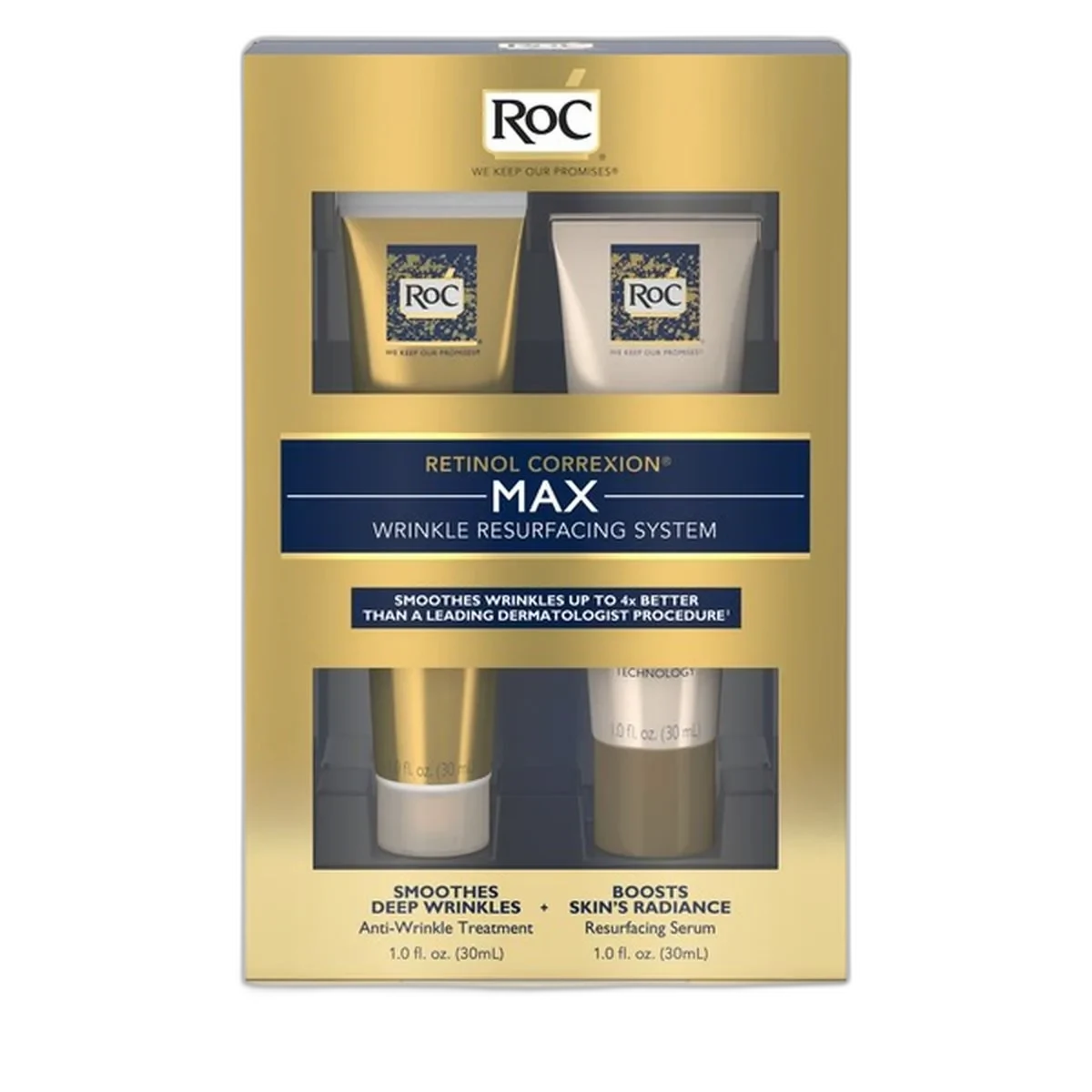
Retinol Correxion Max Wrinkle Resurfacing System
OG Two-Step Retinol System
 Verified reviewer
Pros & cons.
- +Two-step approach separates retinol treatment from physical resurfacing for layered benefits
- +Step 2 creates an immediate visible smoothing and blurring effect from the first application
- +RoC's stabilized retinol with dihydroxy methylchromone protection delivers proven anti-aging results
- +Under $30 for a two-product retinol treatment system is genuine value
- +Copper and zinc in Step 2 provide supplementary mineral support for skin repair
- +Hydrolyzed hyaluronic acid in Step 1 offers deeper penetrating hydration than standard HA
- −Contains three parabens (methyl, ethyl, propyl) — outdated preservation system that RoC's newer products have dropped
- −Fragrance in Step 1 is unnecessary and limits suitability for sensitive and mature skin
- −Contains octinoxate, an increasingly controversial UV filter with environmental concerns
- −Two-step routine feels cumbersome compared to modern single-product retinol treatments
- −Availability is inconsistent — harder to find at major retailers than individual Correxion products
- −Formula has not been updated since launch, falling behind RoC's own newer innovations
The full review.
The RoC Retinol Correxion Max Wrinkle Resurfacing System reflects a specific skincare era. In that era, more steps signaled sophistication, and a two-tube boxed kit suggested serious anti-aging intent. Launched around 2012, it was RoC’s most ambitious drugstore retinol approach: it separated treatment from finish, let each product perform one task, and provided a regimen instead of a single product. It was ahead of its time, but time has moved past it.
The system uses two stages. Step 1 is the Anti-Wrinkle Treatment — a retinol cream with core Correxion DNA: stabilized retinol protected by dihydroxy methylchromone, hydrolyzed hyaluronic acid and allantoin for hydration and soothing, plus ascorbic acid and tocopheryl acetate as antioxidants. Without the packaging and marketing, Step 1 is a standard RoC retinol treatment. It does what retinol does — stimulates collagen, accelerates turnover, and gradually reduces wrinkles and uneven tone.
Step 2 is where the system changes. The Resurfacing Serum is a pure silicone matrix — cyclopentasiloxane, dimethicone, and silicone crosspolymers — infused with elemental zinc and copper powder. It has no water, no traditional actives, and no preservatives (pure silicone does not need them). It creates an immediate physical smoothing effect on the skin surface. Apply it over Step 1 to see pores appear smaller, texture blur, and the surface become velvety and airbrushed. It functions as a treatment-grade primer.
Copper and zinc in Step 2 are marketed as mineral support for skin repair, which has a scientific basis. Copper helps collagen cross-linking and wound healing. Zinc is anti-inflammatory and supports cellular repair. Whether these minerals provide meaningful benefits when applied as elemental forms in a silicone matrix is less certain than when used as bioavailable salts like copper peptides or zinc gluconate. The smoothing effect is real and immediate — it provides instant gratification while the retinol works slowly underneath.
The caveats are substantial. Step 1’s ingredient list resembles an early-2010s cosmetic formulation. Methylparaben, ethylparaben, and propylparaben are all present. They are safe according to major regulatory bodies, but the market has moved toward paraben-free formulation. RoC’s newer Correxion products lack parabens, so their presence here suggests the product has not been reformulated in over a decade.
The fragrance is the same artificial floral note found in older RoC products. This is unnecessary in a nighttime treatment and a mistake for wrinkle-concerned skin, which is often mature and potentially more sensitized. Ethylhexyl methoxycinnamate (octinoxate) is also in Step 1, likely as a photostabilizer for the retinol, but it is a UV filter that faces environmental controversy.
The two-step format is now a liability. When this system launched, multi-step routines were aspirational. Today, most consumers and dermatologists prefer streamlined routines. Using two products when one suffices — especially since RoC’s own Deep Wrinkle Serum delivers comparable retinol treatment in one step — adds complexity without proportional benefit.
The results are real. Consistent users report visible improvement in crow’s feet, forehead lines, and skin texture within eight to twelve weeks — the standard retinol timeline. The combination of retinol treatment and surface smoothing creates a noticeable before-and-after. At under thirty dollars for a two-product system, the value is reasonable. Users who use the system for months report sustained improvements in skin tone, reduced dark spots, and a more refined complexion.
The question is not whether it works — it does. The question is whether it justifies an outdated formula when RoC’s own line offers modern alternatives at comparable prices. The Deep Wrinkle Serum provides retinol with better soothing agents and no parabens. The Max Hydration Cream Fragrance Free provides retinol with hyaluronic acid and no fragrance. The Capsules Night Serum provides retinol with superior stability engineering. Each newer product has evolved past the compromises in the Resurfacing System.
This product earned its reputation and still delivers its core promise. Long-term users have no urgent reason to switch. But for those discovering RoC’s retinol lineup, the brand’s newer Correxion products are a better starting point — they are simpler, cleaner, and align with modern formulation science and consumer expectations.
Formula
Ingredient analysis.
Full INCI list
Step 1 (Anti-Wrinkle Treatment): Water, Pentaerythrityl Tetraethylhexanoate, Glycerin, PEG-8, PPG-15 Stearyl Ether, Nylon-12, Butylene Glycol, Stearyl Alcohol, Cetearyl Alcohol, Dimethicone, Ethylhexyl Methoxycinnamate, Cyclohexasiloxane, Ceteareth-20, Isohexadecane, Butyrospermum Parkii (Shea) Butter, Polyacrylamide, Phenoxyethanol, Caprylyl Glycol, Pentylene Glycol, Ammonium Acryloyldimethyltaurate/VP Copolymer, C13-14 Isoparaffin, Fragrance, Methylparaben, Tocopheryl Acetate, Ethylparaben, Propylparaben, Laureth-7, BHT, Dihydroxy Methylchromone, Disodium EDTA, Allantoin, Hydrolyzed Hyaluronic Acid, Cyclopentasiloxane, Ascorbic Acid, Hydroxyphenyl Propamidobenzoic Acid, Polysorbate 20, Retinol, Sodium Hydroxide. Step 2 (Resurfacing Serum): Cyclopentasiloxane, Dimethicone, Dimethicone Crosspolymer, Trisiloxane, Silica, Dimethicone/Vinyl Dimethicone Crosspolymer, Zinc, Tocopheryl Acetate, Copper Powder.
Skin match.
The science.
The Science
The retinol in Step 1 works like other RoC Correxion products — it converts to retinoic acid at the keratinocyte level, activates retinoid receptors, upregulates collagen gene expression, and speeds epidermal turnover. Dihydroxy methylchromone provides antioxidant stabilization, while hydrolyzed hyaluronic acid uses a lower-molecular-weight form to penetrate the stratum corneum more easily than native hyaluronic acid.
Step 2's mineral component adds an interesting, though less proven, element. Copper's role in collagen synthesis is well-documented — it acts as a cofactor for lysyl oxidase, the enzyme that cross-links collagen and elastin. Studies on copper peptides (GHK-Cu) show wound healing and collagen-stimulating properties, but the elemental copper powder in this formula differs from the peptide-bound form in bioavailability and delivery mechanism.
Zinc has established anti-inflammatory properties; dermatological literature shows topical zinc compounds reduce inflammation and support wound healing. However, the silicone vehicle in Step 2 focuses on occlusion and smoothing rather than ingredient delivery, which questions how effectively the metallic minerals interact with the underlying skin.
Clinical evidence for this specific two-step system is limited compared to RoC's standalone retinol products. The brand's strongest clinical data — the 52-week vehicle-controlled trial (Randhawa et al., 2015) and the 2024 pooled analysis (Farris et al.) — tested their stabilized retinol technology generally, not this specific kit format.
References
- One-year topical stabilized retinol treatment improves photodamaged skin in a double-blind, vehicle-controlled trial — Journal of Drugs in Dermatology (2015)
Dermatologist Perspective
Dermatologists generally see the Resurfacing System as a competent but outdated retinol delivery method. Board-certified dermatologists note the two-step format adds complexity without clear clinical advantages over a single well-formulated retinol product. Additionally, the paraben and fragrance content makes it harder to recommend to patients with sensitivity concerns. Most dermatologists familiar with RoC's current lineup would suggest the brand's newer Correxion products — specifically the fragrance-free Max Hydration Cream or the Capsules Night Serum — which provide cleaner formulas with comparable or better retinol delivery.
Guidance
Where it fits in your routine.
Apply Step 1 (Anti-Wrinkle Treatment) to clean, dry skin at night. Wait 1-2 minutes to absorb. Apply Step 2 (Resurfacing Serum) over the treatment; a small amount works well. Use moisturizer after if needed. Use nightly, but start every other night for the first 2-3 weeks. Always use SPF 30+ the next morning. ### Value Assessment At $29.99 for two 1 oz products, the per-ounce cost is fair and includes both a retinol treatment and a finishing serum. However, the system's dated formula complicates the value. RoC's Deep Wrinkle Serum ($22.99) or Capsules Night Serum ($24.99) use more modern retinol technology in one product for less money. The Resurfacing System provides value for users who want a two-step approach, but newer RoC products offer better value for most. ### Who Should Buy Long-time users who see results from this system and have no reason to switch. It also suits anyone who prefers a two-step ritual and wants the immediate smoothing of Step 2 alongside the gradual retinol benefits of Step 1. ### Who Should Skip Retinol beginners—RoC's newer Correxion products are better starting points. People with fragrance or paraben sensitivities should avoid this entirely. Pregnant or breastfeeding individuals must skip this because of the retinol and octinoxate. Anyone wanting a simple, streamlined routine will find the two-step format too complex.### Details
Product details.
Step 1 has a distinct artificial fragrance, like older RoC formulations. Step 2 is unscented because it uses a pure silicone base.
A boxed kit contains two separate tubes — one for the Anti-Wrinkle Treatment and one for the Resurfacing Serum. Opaque tubes protect retinol from light degradation. Finish satinvelvetynon-greasy What to Expect on First Use Step 1 applies like a standard lightweight cream with a slight fragrance. Step 2 uses a different silicone texture that blurs skin immediately — skin looks smoother right away. During weeks 1-3, the retinol in Step 1 may cause dryness. Start with every other night.
6-8 weeks with nightly use of both steps
12 months
All Year
The backstory.
The Resurfacing System represents an earlier generation of RoC's Correxion philosophy — a time when the brand believed that retinol treatment and surface resurfacing were better delivered as separate steps rather than combined. The two-step approach was innovative for drugstore anti-aging when it launched around 2012, though the modern trend toward simplified routines has made multi-step systems less popular.
About RoC
Legacy Brand (20+ years)French pharmacist Dr. Jean-Charles Lissarrague founded RoC in 1957. The brand pioneered shelf-stable retinol and owns foundational patents on retinol stabilization technology, backed by over 250 clinical studies across its portfolio.
Common myths.
A two-step system works twice as well as a single retinol product.
The retinol in Step 1 drives collagen stimulation and cell turnover. Step 2's copper and zinc in silicone provides cosmetic smoothing and minor mineral supplementation. The system works, but Step 1 provides most anti-aging benefits — Step 2 acts as a finishing touch rather than a second active treatment.
Products with parabens are unsafe to use.
Parabens are some of the most studied and understood preservatives in cosmetics. At skincare concentrations (typically 0.1-0.3%), the FDA, EU regulators, and the Cosmetic Ingredient Review panel consider them safe. Many consumers prefer paraben-free alternatives, so RoC's newer products use them.
FAQ.
Is the RoC Resurfacing System better than using a single retinol product?
The anti-aging benefits come mostly from the retinol in Step 1, which matches RoC's standalone retinol products. Step 2 uses a silicone and mineral formula for immediate surface-smoothing. Whether the two-step approach is 'better' depends on if you value that smoothing step enough to manage a slightly more complex routine.
Does this product contain parabens?
Yes — Step 1 uses methylparaben, ethylparaben, and propylparaben as preservatives. If you want paraben-free retinol, RoC's newer Correxion products, such as the Deep Wrinkle Night Cream and Max Hydration Cream, are reformulated without parabens.
Is this system safe during pregnancy?
No. Step 1 contains retinol, a vitamin A derivative dermatologists advise avoiding while pregnant or breastfeeding. Step 1 also contains ethylhexyl methoxycinnamate (octinoxate), an ingredient some doctors recommend avoiding during pregnancy.
Can I use Step 1 and Step 2 separately?
Yes. Step 1 works as a standalone retinol treatment. Step 2 works alone as a smoothing and blurring primer-like serum. The system is designed and priced for use together to get the combined treatment and resurfacing effect.
What the community says.
"Two-step system creates both deep treatment and visible surface smoothing"
"Fine lines and crow's feet diminish noticeably with consistent 8-12 week use"
"Step 2 resurfacing serum creates an immediate blurring and smoothing effect"
"Skin tone becomes more even over time with reduced dark spots"
"Good value for a two-product retinol treatment system under $30"
"Contains parabens (methylparaben, ethylparaben, propylparaben) — a dealbreaker for many"
"Fragrance is noticeable and unnecessary in a treatment product"
"Two-step routine feels cumbersome compared to modern all-in-one retinol products"
"Contains octinoxate, a controversial UV filter increasingly avoided by consumers"
"Availability is inconsistent — harder to find at major retailers than other RoC products"
People also looked at.