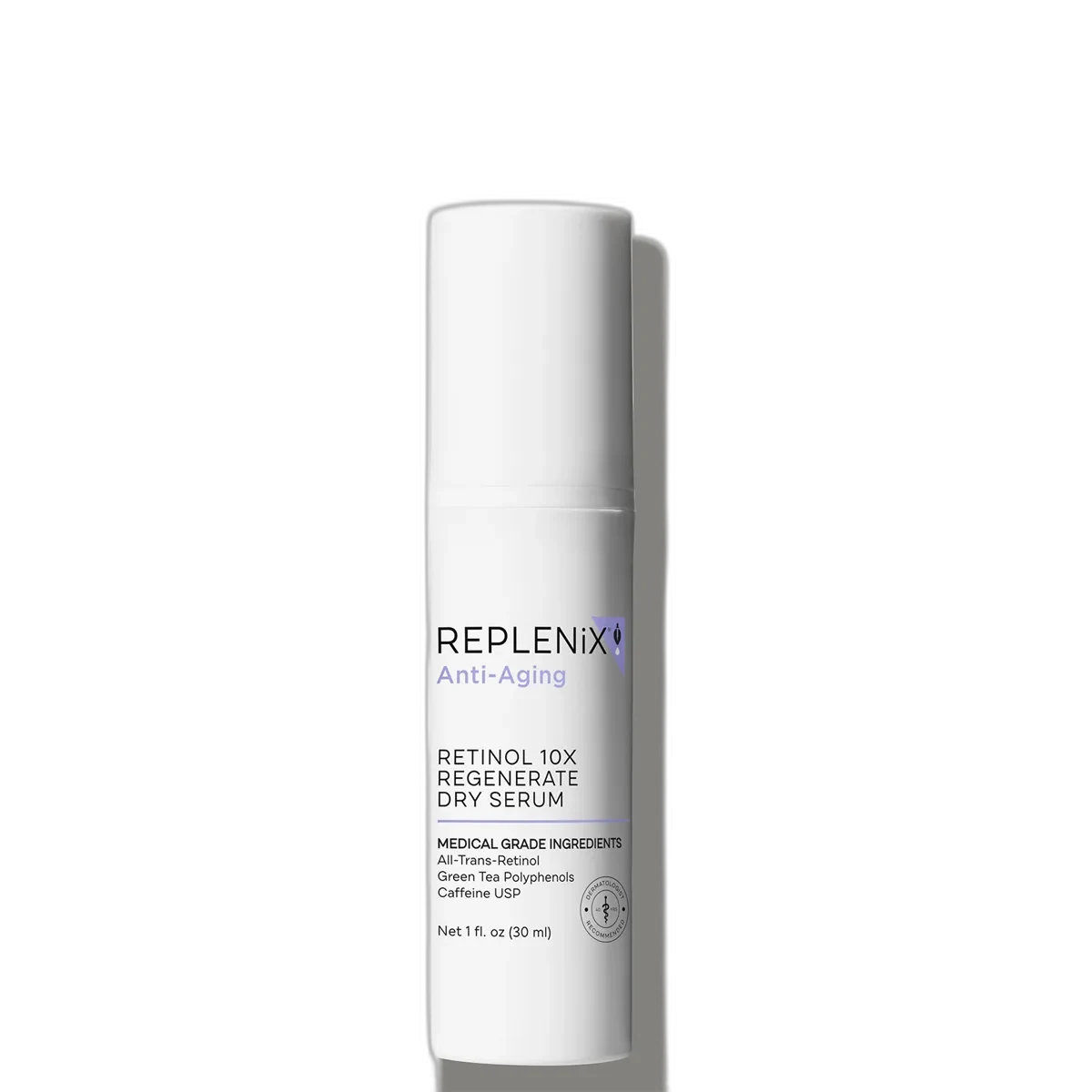
Retinol 10x Regenerate Dry Serum
High-Strength Retinol for Retinol Pros
 Verified reviewer
Pros & cons.
- +Approximately 1% retinol — top tier of over-the-counter strength
- +Anhydrous silicone base keeps retinol stable over shelf life
- +Green tea polyphenol and caffeine support reduce typical retinol irritation
- +Fragrance-free and fungal-acne safe
- +Visible fine-line and tone improvement within 2 months
- +Tiny 2-3 drop dose covers the whole face
- +Long professional-channel track record and review volume
- −Expensive at $104 for 1 oz
- −Far too strong for retinol beginners or sensitive skin
- −Dry silicone texture takes getting used to
- −Not compatible with same-night acids, vitamin C, or BPO
- −Not suitable during pregnancy or breastfeeding
The full review.
Most retinol shoppers overlook a key problem: the retinol you buy might not be the retinol you apply. Retinol is an unstable molecule. Water, oxygen, or light cause it to oxidize into less active byproducts. A formula labeled 1% retinol may deliver only half that amount a few months after opening. The industry uses light-blocking packaging, encapsulation systems, and stabilizing antioxidants with mixed success. Replenix’s Retinol 10X Regenerate Dry Serum uses a different approach: it removes water entirely. The base is almost pure silicone — caprylyl methicone, PEG-12 dimethicone crosspolymer, dimethicone, cyclomethicone — so the retinol has nothing to react with or degrade into. This is one of the few commercial formulation strategies that solves the shelf-life problem, keeping this serum on Dermstore’s top-seller lists for more than a decade.
The active ingredients are straightforward. At the 10X tier — Replenix’s internal strength label, which corresponds to roughly 1% retinol — you use the highest concentration available over-the-counter before switching to prescription tretinoin. This concentration is serious and not for fresh skin. Replenix offers 1X, 2X, 3X, and 5X versions because users must build tolerance. The supporting ingredients include the brand’s signature green tea polyphenol complex to target oxidative stress and low-grade inflammation from high-dose retinol, caffeine for vasoconstriction and mild anti-inflammatory support, and a small amount of sodium hyaluronate to provide hydration despite the anhydrous base.
The texture is unique. A small pump dispenses a few drops of a powdery-dry silicone fluid that spreads thin and leaves a smooth, velvety finish without residue. It feels different because most serums feel wet. After a few uses, the texture becomes a benefit: it sits well under a night cream, does not pill, and does not slide like water-based retinols. The retinol works as 1% retinol does for experienced skin: expect mild to moderate flaking in the first 1-2 weeks and possible purging around week 2-3 if you are acne-prone. By week six, skin texture looks measurably smoother. At eight to twelve weeks, fine lines soften, tone evens, pores look tighter, and skin surface quality improves visibly under makeup. This follows the same retinol results seen in clinical trials for decades — Replenix just uses a formulation that maintains the labeled concentration from bottle to bottle.
The price is high. At $104 for 30ml, this is a luxury retinol that competes with La Roche-Posay’s Retinol B3 Pure, SkinCeuticals Retinol 1.0, and other high-strength dermatology-channel options. Using two to three drops nightly lasts roughly 3-4 months per bottle, costing $25-30 a month for retinol. This price makes sense for users with specific anti-aging goals and resilient skin who have already tested their tolerance, but it is too expensive for beginners. If you are starting from zero, use a $20 0.25% drugstore retinol first; graduate to this product after a year of consistent use.
This product is not for everyone. Sensitive, rosacea-prone, or eczema-prone skin should not use 1% retinol; no delivery system makes that concentration comfortable for reactive skin. Pregnant or breastfeeding users must avoid retinoids. If you use prescription tretinoin, this adds nothing because you are already past retinol in the active-conversion chain. For everyone else who has built tolerance through lower strengths and wants top-tier over-the-counter retinol, this is a legitimate option.
One unexpected benefit: the anhydrous silicone base is fungal-acne friendly. Most retinol serums use fatty alcohols, esters, or oils that feed malassezia. This formula uses almost pure silicone, which is inert and safe for fungal acne sufferers who struggle to find retinoids that do not trigger breakouts. The brand does not market this, but it is a meaningful differentiator for those users.
Formula
Ingredient analysis.
Full INCI list
Caprylyl Methicone, PEG-12 Dimethicone/PPG-20 Crosspolymer, Dimethicone, Caffeine, Cyclomethicone, PEG/PPG-18/18 Dimethicone, Camellia Sinensis (Green Tea) Polyphenols, Retinol, Sodium Hyaluronate, Polysorbate 20.
Skin match.
The science.
The Science
Retinol is a proven non-prescription anti-aging active with decades of clinical literature. The skin converts retinol to retinaldehyde and then to retinoic acid via a two-step enzymatic process. Retinoic acid binds to nuclear retinoic acid receptors to drive collagen synthesis, cell turnover, and pigment cycling. Because this conversion is inefficient, topical retinol requires higher concentrations than prescription tretinoin to match efficacy. Published research shows 1% retinol roughly approximates 0.025-0.05% tretinoin in long-term clinical outcomes, though results appear more slowly. The delivery system is the key differentiator here. Retinol oxidizes easily when exposed to water, heat, and light, creating a persistent challenge for high-percentage retinols; a 1% retinol in a water-containing base with air-exposed packaging may degrade significantly. Replenix's anhydrous silicone dry-serum base removes the water phase to improve stability, while the airless pump packaging minimizes oxygen contact. The supporting ingredients—green tea polyphenols (EGCG-rich), caffeine, and sodium hyaluronate—serve functional purposes. Topical green tea polyphenols have a strong evidence base for mitigating UV-induced oxidative stress, and clinical studies show caffeine reduces post-retinol erythema in small trials. Combining these three elements with a stable delivery system justifies the 10X positioning.
Dermatologist Perspective
Dermatologists usually view 0.5-1% retinol as the top tier of over-the-counter options; patients seeking more potency typically move to prescription tretinoin or adapalene. Board-certified dermatologists often recommend Replenix's 10X as a bridge between 0.5% drugstore retinols and prescription-strength protocols, particularly for patients who tolerate lower concentrations well but want to avoid tretinoin. The anhydrous delivery system is well-regarded in dermatology because its stability profile meets the needs of a long-term retinol regimen. Experienced users should use it nightly, while others should use it 3-5 nights per week to build tolerance. Always pair use with daily broad-spectrum sunscreen and do not layer with in-office treatments or same-night acid exfoliants.
Where it fits in your routine.
Apply 2-3 drops to clean, dry skin at night. Avoid the eye and lip area. Wait 15-20 minutes for absorption before using a ceramide moisturizer. Use 2-3 nights per week for the first two weeks to test tolerance, then increase to nightly use over 4-6 weeks. Do not layer with glycolic acid, salicylic acid, vitamin C, benzoyl peroxide, or other exfoliants on the same night. Use broad-spectrum SPF 30 or higher every morning. Stop use if significant irritation or barrier disruption occurs.
At $104 for 1 oz this is one of the more expensive over-the-counter retinols on the market. The per-month math is roughly $25-30, which is actually not outrageous for a genuinely high-strength, stable 1% retinol when compared to the La Roche-Posay and SkinCeuticals options in the same tier. That said, it's a poor value for anyone who hasn't already built tolerance to lower strengths — most users get 80% of the benefit from a $25 drugstore 0.5% retinol used consistently, and the last 20% improvement from graduating to this strength comes with steep incremental cost. Buy it because you've earned it, not because you're hoping to skip the gradual build-up.
This is for experienced retinol users who built tolerance with lower strengths and want the top tier of over-the-counter options. It also works for fungal-acne prone users needing a silicone-based retinoid that won't feed malassezia, and for people wanting a stable, high-concentration retinol without using a prescription.
Skip this if you are a retinol beginner, have sensitive or rosacea-prone skin, are pregnant or breastfeeding, or use prescription tretinoin. It is also poor value for casual anti-aging maintenance — a cheaper 0.5% retinol is a better first purchase.
Product details.
Unscented.
An opaque airless pump bottle protects the retinol from light and oxygen — 30ml. Finish satin-fast-absorbing-non-greasy-velvety What to Expect on First Use The first application leaves a silky-dry finish. Most users see mild dryness and minor flaking during the first 1-2 weeks while the skin adjusts. True purging (new breakouts in previously active areas) often occurs around week 2-3 and ends by week 6. Texture and tone improvements show around week 4-6 and increase after that. How Long It Lasts 30ml lasts 3-4 months using 2-3 drops nightly. Period After Opening 6 months
fall winter Certifications Cruelty-FreeFragrance-FreeVegan
The backstory.
The Retinol 10X Regenerate Dry Serum was developed as the top tier of Replenix's retinol ladder (1X, 2X, 3X, 5X, 10X), positioned for patients who had worked up through the lower strengths and wanted a prescription-adjacent retinol experience. The dry-serum delivery system was patent-pending when it launched and was one of the first commercial attempts to solve retinol stability through anhydrous formulation rather than encapsulation.
About Replenix
Replenix has sold dermatology-channel retinol products for over ten years. These products use a proprietary silicone-based dry serum delivery system and the brand's signature green tea polyphenol technology.
Common myths.
A 10X retinol means ten percent retinol.
The 10X is Replenix's internal strength tier label, not a percentage. The product contains approximately 1% retinol, the upper limit for non-prescription formulations. 10% retinol does not exist in any commercial skincare product and would cause catastrophic irritation if it did.
An emollient cream delivers retinol better than a dry silicone serum.
Silicone-based anhydrous delivery works well for retinol. It protects retinol from water-driven oxidation and provides a spreading base for uniform delivery. Creams with water phases lose significant retinol potency over a few months of shelf life.
FAQ.
Is Replenix Retinol 10X actually 10% retinol?
No. The 10X labeling describes Replenix's internal strength tier—their highest retinol concentration. The product contains approximately 1% retinol, the top end for over-the-counter formulations. No commercial retinol product contains 10% retinol.
Should I start with Replenix 10X or a lower strength?
Skip this if you are new to retinol. Use a 0.25% or 0.5% product first. Build tolerance for 2-3 months before using this strength. Replenix offers lower-tier versions (1X through 5X) as better entry points.
How does Replenix 10X compare to prescription tretinoin?
Retinol and tretinoin are related but not equivalent. Tretinoin is the active form (retinoic acid) and works faster; retinol requires skin conversion. A 1% retinol roughly approximates a 0.025-0.05% tretinoin in effect over a longer time, but causes less irritation.
Pairs Well With
Can I use this with glycolic acid or vitamin C?
Do not use them on the same night or morning. Layering strong acids or vitamin C with a 1% retinol in one application increases irritation risk. Alternate nights (retinol one night, acid the next) or use vitamin C in the morning and retinol at night. This gets benefits from both without overwhelming the barrier.
Not ideal for
Is Replenix Retinol 10X safe during pregnancy?
No. Retinol and all retinoids are contraindicated during pregnancy and breastfeeding. Use bakuchiol or another anti-aging route then, and resume retinol afterward.
Why is it so expensive?
You pay for the high retinol concentration, the patent-pending anhydrous delivery system that keeps potency stable through the shelf life, the green tea polyphenol and caffeine supporting cast, and the professional-channel distribution. Drugstore retinols cost much less but usually have lower concentration and less stability.
What the community says.
"Remarkably tolerable for a 10X strength"
"Visible fine-line improvement within 2 months"
"Doesn't cause the typical retinol flaking"
"Tiny amount goes a long way"
"Very expensive"
"Silicone-heavy base feels unusual at first"
"Too strong for beginners"
"Small 1 oz size"
Featured in.
People also looked at.