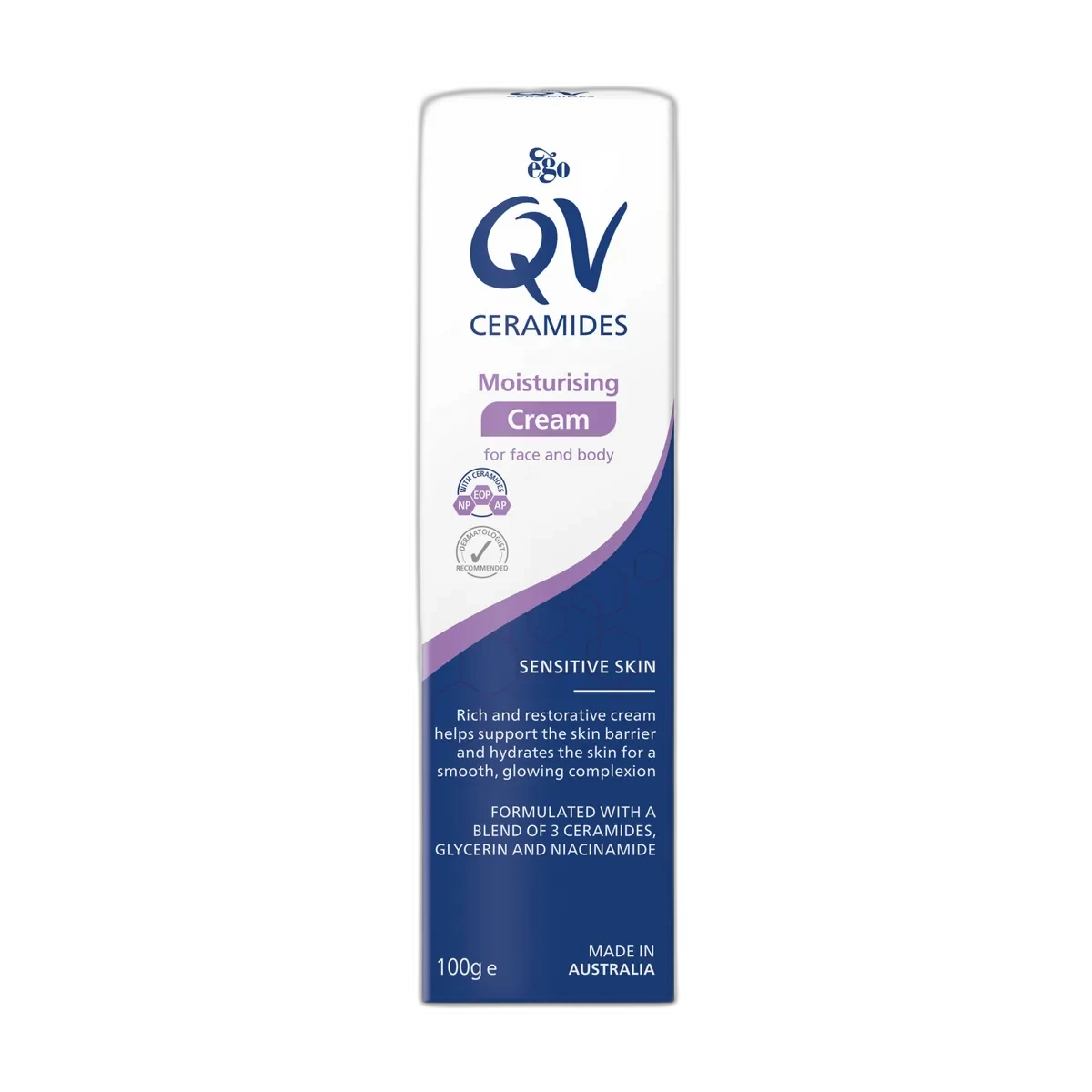
Intensive with Ceramides Moisturising Cream
Australian Pharmacy Classic
 Verified reviewer
Pros & cons.
- +Three bioidentical ceramide types (NP, AP, EOP) rather than the usual one
- +Cholesterol and phytosphingosine complete a clinical-grade lipid matrix
- +Petrolatum-anchored occlusive seal locks in hydration effectively
- +Fragrance-free and suitable for eczema and sensitive skin
- +Backed by nearly 50 years of Australian pharmacy recommendation history
- +Pregnancy-safe and suitable for most of the family
- +Cushioned texture that doesn't finish greasy or tacky
- −Too heavy for oily or acne-prone skin types
- −Contains petrolatum and mineral oil which some prefer to avoid
- −Limited availability outside Australia, NZ, and UK markets
- −Plain plastic tub packaging feels utilitarian
- −100g size disappears quickly if used on body as well as face
The full review.
Before ceramides were something you could buy in an airport duty-free, QV was already the cream Australian pharmacists handed to parents whose kids had eczema that wouldn’t quit. Ego Pharmaceuticals — the family-owned Melbourne pharmaceutical company behind QV — founded the brand in 1977 specifically to fill a gap for gentle, fragrance-free moisturizers in an era when most drugstore options were either scented lotions or Vaseline. That heritage is important context, because it means QV’s positioning isn’t invented-for-Instagram skincare — it’s a clinical pharmacy line that has been on the recommendation sheet of Australian dermatologists for nearly fifty years. The Intensive with Ceramides range is the modernized update of that legacy, and it’s where QV steps fully into the barrier-repair conversation with CeraVe, Epiceram, and the prescription lipid creams that live alongside them. What makes this particular cream worth a closer look is the specificity of the lipid architecture. Most ceramide moisturizers on the market use one ceramide type — usually ceramide NP because it’s the cheapest and most studied. This formula uses three: NP, AP, and EOP. That matters because healthy skin doesn’t contain just one ceramide species; it contains a spectrum, and barrier repair research going back to the 1990s has shown that restoring the full lipid profile is more effective than topping up one. QV then pairs the ceramides with cholesterol, which completes two of the three essential lipid classes, and adds phytosphingosine — a ceramide precursor that also contributes to the skin’s antimicrobial defense, relevant for eczema-prone skin where microbiome dysregulation is part of the picture. The supporting cast is unfussy in a way that’s actually the point. Petrolatum sits early in the ingredient list, forming the occlusive seal that traps water against the skin while the ceramides work underneath. Glycerin is the humectant. There’s dimethicone for slip and a tiny bit of lipid support, sodium lauroyl lactate to help the lipids distribute evenly, and a handful of phosphates as pH buffers. No fragrance. No botanical extracts. No essential oils. Nothing marketed as a hero ingredient that isn’t doing real work in the formula. The texture is where this cream’s personality shows up. It’s rich — richer than you’d expect from looking at the packaging, which is plain white plastic with a sealed lid and absolutely no luxury pretensions. On application it feels substantial, almost thick, and then within a couple of minutes it settles into a satin finish that isn’t tacky. People with eczema know this feeling: it’s the “oh, my skin is actually being held” response that comes from something with enough occlusive payload to stop water loss but without the greasy film that plain ointment leaves behind. For compromised barriers, the effect is noticeable fast. Itching tends to calm within the first few applications, flaking reduces within a week, and the kind of rough, sandpapery feel that comes with barrier damage starts to soften by the end of week two. Full barrier restoration takes longer — 2-4 weeks depending on severity — but the early response is what keeps people using it consistently. The limits are worth naming clearly. This isn’t the right cream for oily or acne-prone skin. The petrolatum and occlusive load that make it wonderful for dry, cracked, winter-ravaged skin will feel heavy and potentially congesting on skin that doesn’t need that much occlusion. If you’re sensitive to mineral oil derivatives on principle, this isn’t going to convert you. And outside of Australia, New Zealand, and the UK, QV can be frustratingly hard to find — the brand’s distribution footprint hasn’t yet caught up to its clinical reputation. But for anyone navigating eczema, barrier damage, or a dry-winter skin emergency, this is genuinely one of the best pharmacy-tier options in the category, and the fact that it comes from a brand with almost half a century of dermatologist trust makes the recommendation stickier still.
Ingredient analysis.
Full INCI list · pH 5.5
Aqua, Glycerin, Petrolatum, Paraffinum Liquidum, Cetearyl Alcohol, Cetearyl Glucoside, Dimethicone, Glyceryl Stearate, PEG-100 Stearate, Ceramide NP, Ceramide AP, Ceramide EOP, Phytosphingosine, Cholesterol, Sodium Lauroyl Lactate, Carbomer, Xanthan Gum, Sodium Hydroxide, Dipotassium Phosphate, Disodium Phosphate, Phenoxyethanol, Ethylhexylglycerin
Skin match.
The science.
The Science
Multi-ceramide barrier repair creams have a strong, well-replicated scientific basis. Research in the Journal of Investigative Dermatology (Man et al.) shows that topical lipids accelerate barrier recovery after acute disruption. The best formulations use ceramides, cholesterol, and free fatty acids in approximately physiologic ratios. Clinical work in atopic dermatitis patients shows that ceramide-containing moisturizers improve skin hydration, reduce TEWL, and decrease eczema severity scores with consistent use over 4-8 weeks. QV's formulation uses a specific spectrum of ceramides. Most commercial products use Ceramide NP (formerly ceramide 3), but research shows ceramide AP and ceramide EOP have distinct structural and functional roles in the stratum corneum lipid matrix. EOP specifically helps the skin lipid organization that resists water loss. Phytosphingosine, a minor ingredient here, is a ceramide precursor and a sphingoid base with documented antimicrobial activity against Staphylococcus aureus. This is clinically relevant because atopic skin often has high S. aureus loads. Dermatological research shows petrolatum occlusion alone can reduce TEWL by up to 98%. Combining occlusion with active barrier-repair lipids works better than either method alone.
References
- Optimization of physiological lipid mixtures for barrier repair — Journal of Investigative Dermatology (1996)
Dermatologist Perspective
Dermatologists often recommend ceramide-based moisturizers as first-line therapy for eczema, compromised skin barriers, and winter-dry skin. Board-certified dermatologists note that ceramide products vary; formulations with multiple ceramide types, cholesterol, and fatty acids mimic the skin's native lipid architecture and produce better clinical outcomes for atopic patients. Australian dermatology practice often references QV as a pharmacy-accessible option with a long track record. The Intensive with Ceramides line appears in clinical recommendation patterns alongside lipid-focused brands like CeraVe, La Roche-Posay Lipikar, and Eucerin Eczema Relief. Dermatologists also emphasize that consistency matters more than concentration—daily use of an effective barrier cream beats intermittent use of a more expensive one.
Where it fits in your routine.
Apply to clean skin morning and night as the last moisturizing step (under SPF in the AM). For severely compromised or eczema-prone skin, apply within three minutes of bathing while skin is damp. Occlusives trap water in the stratum corneum most effectively during this window. Use a thick layer for flare-ups and a thin layer for maintenance. Layer under other occlusives like plain petrolatum for overnight slugging on severely dry patches.
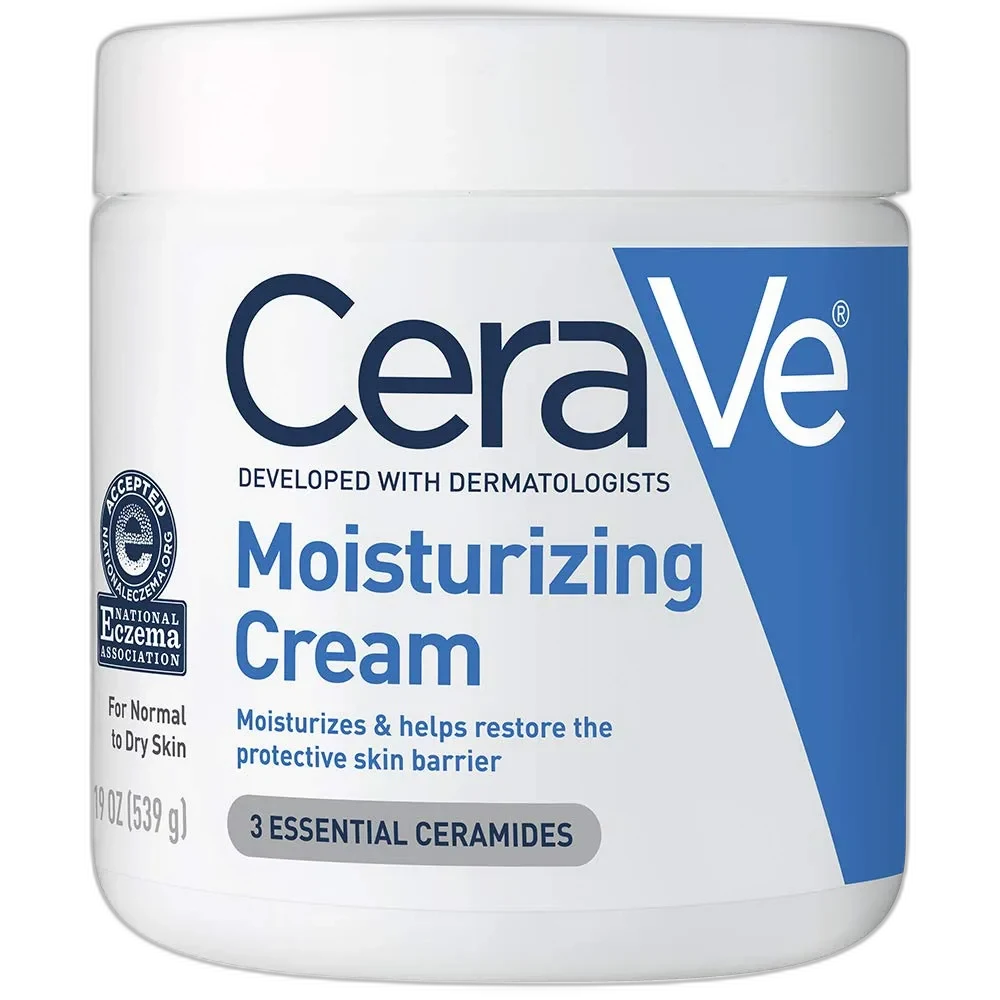
At about $16 USD for 100g, this cream offers a reasonable price for clinical-tier barrier repair. Compared to CeraVe Moisturizing Cream at a similar price, QV's formulation uses a wider ceramide spectrum and includes phytosphingosine, which makes the formulation density higher. Compared to prescription lipid creams like EpiCeram, which can cost $200+ without insurance, this costs a fraction for a similar lipid approach. The value is highest on the face rather than the whole body — 100g lasts 2-3 months for facial application but lasts only weeks if used head-to-toe. Larger sizes in some markets offer better per-gram value for full-body use.
This cream works for dry, sensitive, or eczema-prone skin needing a clinically-formulated barrier repair cream from a brand with dermatologist heritage. It helps during winter flare-ups, post-procedure recovery, or when the skin barrier needs rebuilding.
Oily or acne-prone skin will find this too heavy. If you're sensitive to mineral oil or petrolatum on principle, the formulation won't work for you. Anyone looking for a lightweight daily moisturizer with no occlusive payload should reach for a gel-cream instead.
Product details.
Rich, cushiony cream that spreads smoothly and settles into a satin finish
None
White plastic tub with sealed lid
The texture is thick but absorbs into a non-tacky satin finish within minutes. Users with severely compromised barriers often see less itching after the first few applications; full barrier rebuilding takes 2-4 weeks of consistent use.
2-3 months with twice-daily facial use; significantly less if used on body too
12 months
All Year
The backstory.
QV was developed by Ego Pharmaceuticals, an Australian family-owned pharmaceutical company founded in 1953 in Melbourne. The original QV bar soap launched in 1977 as a response to dermatologist demand for a genuinely gentle cleanser for eczema patients. The Intensive with Ceramides range, launched in 2021, is the brand's modernized barrier-repair line that combines their clinical legacy with updated lipid science.
About QV
Legacy Brand (20+ years)Ego Pharmaceuticals, an Australian pharmaceutical company, developed QV in 1977. Australian dermatologists and pediatricians have recommended QV for eczema and sensitive skin for decades. The Intensive with Ceramides line is a newer extension that uses the same clinical positioning.
FAQ.
How is QV Intensive with Ceramides different from regular QV Cream?
The Intensive with Ceramides line adds three bioidentical ceramides, cholesterol, and phytosphingosine to QV's classic humectant-occlusive base. This line targets compromised or eczema-prone skin needing active barrier repair, whereas the classic cream is a simpler daily moisturizer.
Is this suitable for eczema?
Yes — this formulation targets eczema and compromised barriers. QV has decades of pharmacy recommendations for eczema patients in Australia, and this line adds a ceramide lipid spectrum.
Can I use this on my face and body?
Yes, but 100g disappears fast if used head-to-toe. For facial use, a small amount lasts a long time. For body application during a flare-up, pair it with a larger body moisturizer to save money.
Is it safe during pregnancy?
Yes — the formula has no retinoids, salicylic acid, or essential oils. This makes it safe for use during pregnancy and breastfeeding.
Does it contain fragrance?
No. The formula is fragrance-free, which is essential for the sensitive and eczema-prone skin it targets.
Can oily or acne-prone skin use this?
This is not the best match. The thick texture and occlusive load that help dry and compromised skin can feel heavy on oily skin and cause breakouts in acne-prone users. A lighter ceramide lotion works better.
What the community says.
"Genuinely calms eczema flare-ups"
"Rich but non-greasy finish"
"Holds hydration overnight on very dry skin"
"Safe for sensitive and children's skin"
"Too heavy for oily or acne-prone users"
"Contains petrolatum and mineral oil which some prefer to avoid"
"Limited availability outside Australia, NZ, and UK"