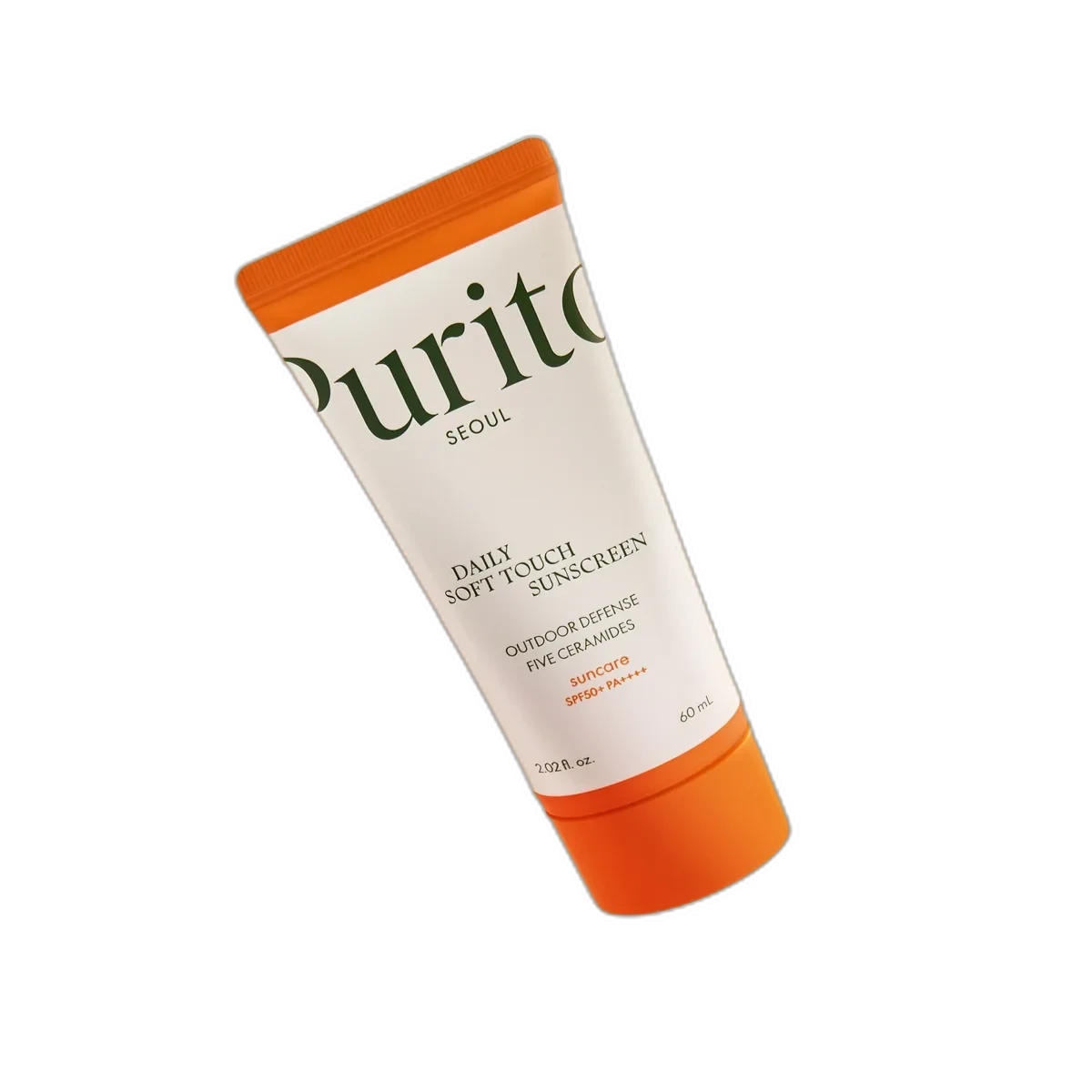
Daily Soft Touch Sunscreen SPF 50+
K-Beauty Redemption Arc MVP
 Verified reviewer
Pros & cons.
- +Four next-generation UV filters provide verified, photostable broad-spectrum SPF 50+ protection
- +Five ceramides with cholesterol and lecithin create a genuinely barrier-supportive base formula
- +Completely fragrance-free with no detectable scent — ideal for reactive and sensitive skin
- +Zero white cast on all skin tones despite including the particulate Tinosorb M filter
- +Truly silicone-free formula that still achieves elegant, non-pilling application
- +Centella asiatica and bisabolol provide anti-inflammatory and soothing benefits during wear
- +Independently verified SPF by two separate labs post-reformulation
- +Vegan, cruelty-free, and reef-safe formulation
- −Ceramide-rich base can appear shiny on oily skin types in humid conditions
- −60ml tube lasts only 6-8 weeks with proper daily application amounts
- −Limited availability outside specialized K-beauty retailers and online shops
- −No tinted version available for those wanting additional coverage
- −Slightly higher price point than comparable Korean sunscreens in the drugstore tier
The full review.
In December 2020, the K-beauty world held its collective breath as independent testing revealed that Purito’s beloved Centella Green Level Unscented Sunscreen — the one everyone swore by, the one that converted an entire generation of skincare enthusiasts to Korean sunscreens — delivered roughly SPF 19. Not 50. Nineteen. The fallout was immediate and brutal. Retailers yanked the product. Refund requests flooded in. And Purito, a small Korean brand built on trust and transparency, found itself at the center of the biggest skincare scandal in recent memory.
The Daily Soft Touch Sunscreen is what happened next. Rather than quietly releasing a reformulated version and hoping everyone forgot, Purito burned the old playbook entirely. They rebranded as Purito Seoul, rebuilt their sun care line from scratch using next-generation European UV filters, and submitted the new formulas to not one but two independent testing labs — KIDCS in Korea and ABICH in Italy. Both confirmed SPF values well above the 50+ claim. This is not a rebrand. It is a reconstruction.
The formula itself reads like a studied response to every criticism the original invited. Where the old sunscreen relied on just two chemical filters at concentrations that apparently could not hold up, the Daily Soft Touch deploys four: Tinosorb S (Bisethylhexyloxyphenol Methoxyphenyl Triazine), Uvinul A Plus (Diethylamino Hydroxybenzoyl Hexyl Benzoate), Uvinul T 150 (Ethylhexyl Triazone), and Tinosorb M (Methylene Bis-Benzotriazolyl Tetramethylbutylphenol). These are newer-generation filters favored by European and Asian formulators for their photostability and broad-spectrum coverage. Tinosorb M is particularly interesting — a particulate filter that both absorbs and scatters UV radiation, offering a mineral-sunscreen-like protective mechanism without the white cast.
But what elevates this above a competent sunscreen is the base formula. Five ceramides — NP, AS, AP, NS, and EOP — are paired with cholesterol and hydrogenated lecithin in a ratio that mirrors the skin’s natural lipid structure. Centella asiatica extract, the ingredient that built the original Purito brand, provides anti-inflammatory support. Panthenol strengthens the barrier. Bisabolol soothes. The result is a sunscreen that genuinely functions as a moisturizing skincare step, not just a protective top layer you tolerate because you have to.
The texture delivers on the “soft touch” promise. It applies as a lightweight, slightly creamy fluid that absorbs in seconds, leaving behind a natural, satin-like finish with the subtlest hint of luminosity. There is no white cast — none, not even from the Tinosorb M — and no pilling under makeup. The complete absence of silicones is notable here: many sunscreens achieve their smooth slip through dimethicone and its cousins, but the Daily Soft Touch manages it through propanediol and dibutyl adipate instead. This makes it genuinely silicone-free, not in the marketing-adjacent way where brands exclude two silicones and include three others.
The fragrance situation is refreshingly simple: there is none. No essential oils masquerading as “natural fragrance.” No parfum buried on the INCI list. Nothing. The sunscreen smells like absolutely nothing, which for sensitive skin is exactly right.
On the skin, it wears comfortably throughout the day without the tight, filmy feeling that plague some chemical sunscreens. Dry skin types report genuine hydration from the ceramide complex. Sensitive skin types — including those with rosacea and eczema — report no stinging, no burning, even around the delicate eye area. This is a sunscreen that invites reapplication rather than making you dread it.
The honest limitations are few but worth noting. Oily skin types may find the finish slightly too dewy, particularly in humid conditions — the ceramide-rich base that dry skin loves can read as shine on an already-oily T-zone. The 60ml tube, while generous by K-beauty standards, will last only six to eight weeks with proper daily application, and at roughly $21.50 per tube, the annual cost of proper sunscreen use adds up. Availability outside of K-beauty retailers can be spotty, though this has improved significantly as the brand rebuilt its distribution network.
At $21.50 for 60ml, the Daily Soft Touch sits in a sweet spot. You are getting four advanced UV filters, five ceramides, centella, and panthenol in a cosmetically elegant formula that has been independently verified for protection. For a brand that had every reason to cut corners and quietly move on, the investment in both formula and verification feels like genuine accountability rather than marketing theater.
The Purito Daily Soft Touch Sunscreen is ultimately a product that could only exist because something went very wrong first. It carries the weight of its predecessor’s failure in the best possible way — every ingredient choice, every third-party test, every element of the reformulation reads as a direct answer to a specific criticism. That is not to say you should buy it out of sympathy. Buy it because the formula is genuinely excellent, the texture is a pleasure, and the protection is verified. The redemption arc just makes it a better story.
Ingredient analysis.
Full INCI list
Water, Propanediol, Dibutyl Adipate, Dicaprylyl Carbonate, Diethylamino Hydroxybenzoyl Hexyl Benzoate, Ethylhexyl Triazone, Bisethylhexyloxyphenol Methoxyphenyl Triazine, Amylopectin, Butylene Glycol, Methylene Bis-Benzotriazolyl Tetramethylbutylphenol, Glycerin, Behenyl Alcohol, Poly C10-30 Alkyl Acrylate, Polyglyceryl-3 Methylglucose Distearate, Sodium Acrylates Crosspolymer-2, Carbomer, Tromethamine, Decyl Glucoside, Acrylates/C10-30 Alkyl Acrylate Crosspolymer, (-)-Alpha-Bisabolol, Panthenol, Caprylhydroxamic Acid, Centella Asiatica Extract, Tocopherol, Ceramide NP, Dipropylene Glycol, Cholesterol, Propylene Glycol, Xanthan Gum, Glyceryl Stearate, Ceramide AS, Ceramide AP, Ceramide NS, Hydrogenated Lecithin, Ceramide EOP
Skin match.
The science.
The Science
The Daily Soft Touch Sunscreen uses a four-filter UV system that follows current best practices for photostable broad-spectrum protection. Research shows the Tinosorb S and Tinosorb M combination works well. A 2011 study in the Journal of the American Academy of Dermatology shows Tinosorb M absorbs and scatters UV radiation; it works as a hybrid organic-inorganic filter that stays effective without the aesthetic issues of traditional mineral filters. Tinosorb S (bemotrizinol) photostabilizes other UV filters in the formulation, which reduces the degradation that lowers real-world SPF performance — a key property given Purito's history.
The five-ceramide complex mimics the skin's natural lipid barrier structure. A 1993 study by Imokawa et al. in the Journal of Investigative Dermatology established that ceramides are essential to the stratum corneum's lamellar structure and that ceramide depletion correlates with barrier dysfunction. Adding cholesterol and hydrogenated lecithin to the five ceramide types approximates the 3:1:1 ceramide-cholesterol-fatty acid ratio identified as optimal for barrier repair.
A 2012 review in the Indian Journal of Pharmaceutical Sciences documents the wound-healing, anti-inflammatory, and collagen-stimulating properties of Centella asiatica extract. In this formulation, centella asiatica mitigates low-grade inflammation from UV filter exposure, which matters for sensitive skin users who react to even well-tolerated chemical filters.
Independent verification by KIDCS (SPF 50.2 ± 5.0) and ABICH (SPF 63.7, PA 20.8) provides transparency for a K-beauty sunscreen, addressing the trust gap from the 2020 testing controversy.
References
- Broad-spectrum photoprotection from Tinosorb M — Journal of the American Academy of Dermatology (2011)
- Ceramides in the stratum corneum and their role in barrier function — Journal of Investigative Dermatology (1993)
- Centella asiatica: phytochemistry and mechanisms of action — Indian Journal of Pharmaceutical Sciences (2012)
Dermatologist Perspective
Dermatologists favor next-generation UV filters like Tinosorb S and Tinosorb M for their photostability and broad-spectrum coverage. Board-certified dermatologists note that adding barrier-supportive ingredients like ceramides to a sunscreen formula helps patients with compromised barriers — such as those with eczema, rosacea, or post-procedure skin who need daily UV protection but find many sunscreens irritating. The fragrance-free, silicone-free formulation follows dermatological recommendations for sensitive skin. Independent third-party verification of SPF claims is not standard industry practice, but it provides the extra confidence dermatologists want when recommending products to patients.
Where it fits in your routine.
Apply a nickel-sized amount to the face and neck as the final step of your morning skincare routine. Do this at least 15 minutes before sun exposure. For normal-to-dry skin, the ceramide-rich formula eliminates the need for a separate moisturizer underneath. Reapply every two hours during extended sun exposure, or immediately after swimming or heavy sweating. This formula layers over vitamin C serums, niacinamide, and hyaluronic acid without pilling.
At $21.50 for 60ml, the Daily Soft Touch is priced competitively in the K-beauty sunscreen category and under most Western equivalents with similar filter technology. A 15ml travel size costs $6.90 for testing before committing. The cost per use is reasonable because it uses four advanced UV filters and a ceramide-enriched base, though daily sunscreen use costs roughly $140-170 per year. For a brand rebuilding trust, the price is fair — you pay for verified protection and good skincare ingredients, not packaging and hype.
Anyone with sensitive, dry, or normal skin looking for a daily sunscreen that doubles as skincare. Particularly well-suited for those with compromised barriers, rosacea-prone skin, or anyone who has struggled with sunscreen irritation in the past.
Very oily skin types wanting a matte or oil-controlling finish will find the ceramide-rich base too dewy. Those seeking tinted sunscreens for extra coverage should look elsewhere; this comes in a single untinted formula.
Product details.
This lightweight, slightly creamy fluid has a soft, velvety finish. It absorbs quickly and leaves no greasy or sticky residue. It sets to a natural, skin-like finish with subtle luminosity.
Completely unscented — no detectable fragrance or chemical smell.
White squeeze tube with a flip-top cap. The clean, minimal design matches Purito Seoul's rebranded aesthetic. The 60ml size is travel-friendly.
Applies smoothly without pilling or a white cast. The texture is more like a lightweight moisturizer than a traditional sunscreen. Most users feel immediate comfort without stinging or tightness. It requires no adjustment period and works from first use.
6-8 weeks with once-daily facial application at the recommended amount
12 months
All Year
The backstory.
Born from one of K-beauty's most public failures, the Daily Soft Touch Sunscreen represents Purito Seoul's complete reinvention of their sun care line. After independent testing revealed their original Centella Green Level sunscreen delivered roughly SPF 19 instead of the claimed SPF 50, the brand pulled the product, reformulated from scratch with modern European filters, and rebranded as Purito Seoul to signal a fresh start.
About Purito
Emerging Brand (2–5 years)Purito launched in 2017 as a centella-focused K-beauty brand. A 2020 SPF testing scandal showed their original sunscreen lacked claimed protection. The brand reformulated its entire sun care line using stricter third-party testing standards (Korea Institute of Dermatological Sciences and ABICH) and rebranded as Purito Seoul.
Common myths.
Purito sunscreens do not provide their claimed SPF following the 2020 scandal.
KIDCS (Korea) and ABICH (Italy) independently tested the reformulated Daily Soft Touch. Results show SPF 50.2 and 63.7, exceeding the SPF 50+ claim. The current formula uses different UV filters than the original scandal product.
Chemical sunscreens always sting sensitive skin and eyes.
This formula uses newer-generation filters (Tinosorb S, Tinosorb M, Uvinul A Plus, Uvinul T 150). These larger molecules are less likely to penetrate skin or cause irritation. centella and bisabolol further reduce sensitivity risk.
FAQ.
Is the Purito Daily Soft Touch Sunscreen safe to use after the 2020 SPF scandal?
Yes. The current formula differs entirely from the original product in the scandal. It uses four next-generation UV filters. Two separate labs (KIDCS in Korea and ABICH in Italy) independently verified the formula, and both confirm SPF values above the 50+ claim.
Does the Purito Daily Soft Touch Sunscreen leave a white cast?
No. The formula applies completely transparently, even with Tinosorb M (a particulate filter that can sometimes leave a slight cast). Users across all skin tones report zero white cast.
Can I use the Purito Daily Soft Touch Sunscreen as a moisturizer?
The five-ceramide complex and panthenol hydrate normal to dry skin well enough that many users skip a separate moisturizer underneath. Very dry skin types may still want a lightweight hydrating layer first.
Is Purito Daily Soft Touch Sunscreen pregnancy-safe?
Yes. The formula has no retinoids, no fragrance, and no chemical filters of concern during pregnancy (like oxybenzone). The newer-generation filters used (Tinosorb S, Tinosorb M, Uvinul A Plus, Uvinul T 150) are safe during pregnancy.
How does Purito Daily Soft Touch compare to the Daily Go-To Sunscreen?
The Daily Soft Touch has a creamier, more moisturizing texture suited to dry and sensitive skin, while the Daily Go-To has a lighter, more fluid consistency preferred by combination and oily skin types. Both share the same four-filter UV system and ceramide-enriched base.
Is Purito Daily Soft Touch Sunscreen reef-safe?
The formula lacks oxybenzone, octinoxate, and other filters linked to coral reef harm. Purito calls it reef-safe, but no universal regulatory definition exists for that term. The filters used are among the more environmentally friendly options.
What the community says.
"No white cast on any skin tone"
"Gentle enough for very sensitive and reactive skin"
"Lightweight, non-greasy texture that absorbs quickly"
"No stinging around the eyes"
"Sits beautifully under makeup without pilling"
"Fragrance-free with no detectable scent"
"Can appear slightly shiny on oily skin types"
"Small 60ml tube runs out quickly with proper application"
"May feel slightly heavy in very humid climates"
"Limited availability outside of K-beauty retailers"
People also looked at.