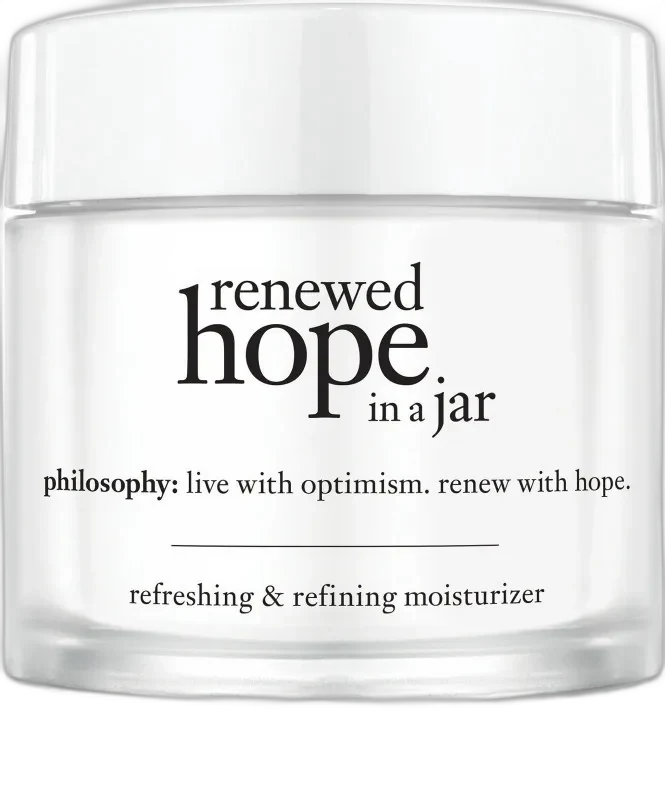
Renewed Hope in a Jar Moisturizer
Dual-AHA Moisturizer Pick
 Verified reviewer
Pros & cons.
- +Dual-AHA combination of glycolic and mandelic for gentle exfoliation
- +Rich cream base with strong humectant hydration
- +Silicone-smoothing finish plays well under makeup
- +Cruelty-free with established department store availability
- +Classic Philosophy brand continuity with original Hope in a Jar
- +Adenosine adds modest anti-wrinkle support
- −Added fragrance with declared allergens increases irritation risk
- −Expensive at $47 for 60ml compared to similar actives
- −Not ideal for sensitive or rosacea-prone skin
- −Jar packaging is suboptimal for AHA and adenosine stability
- −Active concentrations are not disclosed
The full review.
Hope in a Jar launched in 1996 and defined department store skincare. It wasn’t a serum, treatment, or prescription-adjacent product—it was a single, well-packaged moisturizer with a name that acted as a tagline and promise. Cristina Carlino’s pitch worked. Hope in a Jar became a top prestige skincare launch of the 1990s, stayed in millions of bathrooms for twenty years, and anchored Philosophy’s brand identity through every expansion, acquisition, and reformulation. By 2015, the skincare landscape changed. The rise of The Ordinary, SkinCeuticals, Paula’s Choice, and serum-driven active routines made ‘plain moisturizer with a nice scent’ feel dated. Philosophy responded with Renewed Hope in a Jar—the same iconic pink-tinted jar and brand language, but a formula rebuilt with glycolic and mandelic acids. It is the 1996 classic with a 2015 active ingredient story.
The dual-AHA approach is interesting for formulation. Glycolic acid—the smallest AHA molecule—penetrates deeper and works faster, but it also irritates more reliably in a leave-on product. Mandelic acid is substantially larger, penetrates more slowly and gently, and produces less irritation at equivalent concentrations. Combining them provides meaningful exfoliation from the glycolic acid without needing the high concentrations that cause the flushing and tingling of a dedicated glycolic treatment. This mechanism is common in K-beauty exfoliant toners, and Philosophy uses it in a moisturizing cream format for daily use.
Glycolic acid is 7th on the ingredient list, indicating a meaningful concentration—likely 4-8% for a leave-on moisturizer, though the exact dose is undisclosed. Mandelic acid appears lower as a supporting exfoliant. Together, they provide daily mild exfoliation that improves texture visibly over two to three weeks of consistent use. Skin looks brighter, fine lines soften, and the AHA ‘glow’ effect appears. Over 8 to 12 weeks, skin shows improved evenness and surface smoothness, though the structural anti-aging effect is more modest than a retinoid routine.
Philosophy shows sensory expertise in the moisturizer base. It uses glycerin, cyclopentasiloxane, dimethicone, and stearic acid to create a thick cream that melts into a cushiony, smoothing finish. Hyaluronic acid at multiple positions and sodium hyaluronate provide the humectant hydration a leave-on AHA product needs—glycolic acid increases TEWL during the adjustment period, and without hydration, users experience dryness and flaking. Philosophy solved this. The texture works for daily use, the silicone finish sits well under makeup, and the moisturizing effect works alongside the exfoliating action.
The problem is the fragrance load, a common issue in Philosophy products. The ingredient list includes parfum, limonene (a declared EU fragrance allergen), and several aromatic compounds that create the Philosophy brand scent. For many, this is a feature—the scent provides continuity with the 1996 original Hope in a Jar. For users with fragrance sensitivity, reactive skin, rosacea, or contact dermatitis, combining fragrance allergens with glycolic and mandelic acids doubles the irritation risk. This product can feel fine for weeks before producing low-level sensitivity that is hard to trace to one cause. A fragrance-free version of this formula would be more recommendable.
Pricing is the other issue. At $47 for 60ml, you pay about $0.78 per milliliter for a moisturizer with an active ingredient story available for less elsewhere. The Ordinary’s Glycolic Acid 7% Toning Solution has a higher labeled concentration for about $12. Paula’s Choice 8% AHA Gel costs about $33 for a dedicated AHA treatment. Both beat Philosophy on active transparency and per-milliliter value, though neither has the thick cream texture or brand continuity of Renewed Hope in a Jar. You pay a premium for the Philosophy brand identity, the pink jar, and the sensory experience—not for a formula more advanced than cheaper competitors.
Who should buy it
existing Philosophy brand loyalists who love the original Hope in a Jar aesthetic, users with normal or combination skin wanting a moderate daily AHA in a moisturizer, and anyone prioritizing a thick sensory experience over pure active delivery.
Who should skip it
sensitive or rosacea-prone users, shoppers focused on per-dollar active content, and anyone building a routine for maximum clinical efficacy. This is a comfortable, pleasant, reasonably effective prestige moisturizer with real flaws and a real legacy. Both are true.
Ingredient analysis.
Full INCI list
Aqua/Water/Eau, Cyclopentasiloxane, Stearic Acid, Glycerin, Butylene Glycol, C12-15 Alkyl Benzoate, Glycolic Acid, Dimethicone, Polyacrylamide, Cetearyl Alcohol, Phenoxyethanol, Sodium Hydroxide, C13-14 Isoparaffin, Dimethicone Crosspolymer, Ceteareth-20, Ammonium Acryloyldimethyltaurate/VP Copolymer, Polysilicone-11, Acrylates/C10-30 Alkyl Acrylate Crosspolymer, Laureth-7, Citric Acid, Chlorphenesin, Mandelic Acid, Tocopheryl Acetate, Synthetic Fluorphlogopite, Ethylhexyl Palmitate, Propanediol, Parfum/Fragrance, Disodium EDTA, Adenosine, Evodia Rutaecarpa Fruit Extract, Limonene, Faex/Yeast Extract, Magnesium Stearate, Opuntia Coccinellifera Flower Extract, Silica Dimethyl Silylate, Caprylyl Glycol, BHT, Ethylhexylglycerin, Hyaluronic Acid, Silanetriol, Sodium Hyaluronate, Sorbic Acid, Hexylene Glycol, Bismuth Oxychloride
Skin match.
The science.
The Science
Alpha hydroxy acids — especially glycolic acid — are some of the most studied topical actives in dermatology. A 1996 study in Dermatologic Surgery (Ditre et al.) shows that 20-25% topical glycolic acid over 6 months improves photodamaged skin, reducing fine lines, improving texture, and increasing dermal thickness. Lower concentrations of glycolic acid in leave-on products yield subtle, cumulative improvements via the same mechanisms: enhanced epidermal turnover, improved ceramide synthesis, and gradual stratum corneum reorganization. Mandelic acid, derived from bitter almonds, has a larger molecular size. This slows penetration and makes it less irritating than glycolic acid. A 2011 paper in the Journal of Cosmetic Dermatology compared mandelic acid chemical peels to salicylic acid; it found comparable efficacy for acne and pigmentation with less irritation, making it a gentler AHA alternative. Combining glycolic and mandelic acids in a leave-on moisturizer — as in this product — makes sense: mandelic acid provides gentle baseline exfoliation while glycolic acid delivers deeper activity. Together, they produce cumulative improvement without the intensity of high-dose glycolic acid alone. Research shows adenosine can improve periorbital fine lines, though its role here is supportive. The main scientific limitation is the fragrance load, which adds known sensitizers to a product containing acid actives and increases irritation risk.
References
- Effects of alpha-hydroxy acids on photoaged skin: A pilot clinical, histologic, and ultrastructural study — Journal of the American Academy of Dermatology (1996)
Dermatologist Perspective
Dermatologists often recommend low-concentration AHAs in leave-on products for patients wanting gentle daily exfoliation and improvements in texture, dullness, and mild photoaging. Board-certified dermatologists note glycolic acid is a top-tier studied topical active for surface renewal. Combining it with mandelic acid produces meaningful effects with less irritation than glycolic acid alone. Clinical guidance emphasizes daily broad-spectrum sunscreen use with any AHA product, because glycolic acid increases UV sensitivity during and after treatment. The main dermatological reservation for this specific product is the fragrance profile — patients with sensitive skin, rosacea, or contact dermatitis history generally prefer a fragrance-free AHA alternative.
Guidance
Where it fits in your routine.
Apply after cleansing and serums as your last hydration step. A pea-sized amount covers the full face and neck — warm it between clean fingers and press into skin. Use once daily for the first two weeks to check tolerance, then use twice daily if your skin is comfortable. Always follow with broad-spectrum SPF in the morning — AHAs increase UV sensitivity. Do not use with retinoids, dedicated AHA or BHA treatments, or benzoyl peroxide in the same routine.
At $47 for 60ml, this costs as much as department-store prestige products. A typical twice-daily application lasts two to three months, making the monthly cost $16-24. The math is simple: The Ordinary ($12), Paula's Choice ($33), and Naturium ($17) offer fragrance-free AHA products with higher labeled concentrations and more transparent active dosing for less. With Philosophy, you pay more for the thick moisturizing cream format, Philosophy brand continuity, the sensory experience, and the pink-tinted jar. These factors matter to some users, but they do not improve skin results. This product is hard to recommend for pure value per active dollar. For users invested in the Philosophy experience, the premium is defensible.
Existing Philosophy loyalists who like the brand's sensory feel and want a daily AHA moisturizer in a thick cream format. It also works for normal or combination skin users new to AHAs who prefer a moisturizer-based active over a dedicated treatment step.
Skip this if you have sensitive skin, rosacea, or fragrance sensitivity; the fragrance load and acid actives increase irritation risk. Skip this if you want value, as cheaper dedicated AHA products have more transparent active dosing. Skip this if your routine already includes a retinoid or a dedicated AHA treatment.
Product details.
Rich cream that smooths into a cushiony, silicone-supported finish
Distinctive Philosophy floral fragrance with a touch of powdery sweetness
Classic pink-tinted glass jar with screw lid — the same iconic packaging as the original Hope in a Jar
The first application feels thick but absorbs into a soft, cushiony finish. A slight tingle from the glycolic acid is normal during the first week of skin adjustment. Visible brightness and smoothness improvements appear within 2-3 weeks of consistent use. The fragrance is noticeable during application and lasts for several minutes.
2-3 months with twice-daily face application
6 months
All Year
The backstory.
The original Hope in a Jar launched in 1996 as Philosophy's flagship moisturizer and became one of the best-known department store skincare products of the late 1990s and 2000s. Renewed Hope in a Jar arrived in 2015 as a modernized formulation that added glycolic and mandelic acids to the familiar rich cream base, giving the franchise a more active-forward identity to compete with the rise of serum-driven skincare brands.
About Philosophy
Established Brand (5–20 years)Philosophy launched in 1996. Hope in a Jar is its flagship moisturizer and defined the brand for two decades. Renewed Hope in a Jar arrived in 2015, adding glycolic and mandelic acids. Philosophy is an established brand owned by Coty and sells widely at Sephora and Ulta.
Common myths.
AHA moisturizers cause photosensitivity that lasts for weeks after you stop using them.
AHA-related photosensitivity lasts about one week after you stop use, not weeks. The main precaution for any AHA product is daily sunscreen use, not long-term avoidance afterward.
Don't use AHAs in the morning; sunlight breaks them down.
Glycolic and mandelic acids are stable in leave-on moisturizers. They work in morning routines if you use broad-spectrum sunscreen. Using sunscreen is the requirement, not the time of day.
FAQ.
How is Renewed Hope in a Jar different from the original?
The original Hope in a Jar is a thick moisturizer without exfoliating acids; it focuses on hydration and a smooth finish. Renewed Hope in a Jar adds glycolic and mandelic acids to that same thick base, adding the gentle daily exfoliation the original lacks. Choose the original for plain moisturization or Renewed Hope for mild active work.
Can I use it every day?
The dual-AHA approach is gentle enough for daily use for most users with normal or combination skin. Use it once a day for the first two weeks to test tolerance, then move to twice daily if your skin stays comfortable. Use it less if you see persistent redness or peeling.
Do I need sunscreen with it?
Yes. Glycolic and mandelic acids increase UV sensitivity. Daily broad-spectrum SPF is required whenever you use any AHA product, even on cloudy days.
Can I layer it with retinol?
Yes, but not in the same routine. Using an AHA moisturizer and a retinoid in one evening routine increases the risk of barrier disruption. Alternate nights, or use this in the morning and your retinoid at night.
Is it safe for sensitive skin?
This is not ideal. The glycolic acid, mandelic acid, and added fragrance (including limonene) make this product risky for sensitive or rosacea-prone skin. Reactive skin types seeking AHA benefits should choose a fragrance-free alternative with a lower concentration.
Is it safe during pregnancy?
Low-concentration AHAs in leave-on moisturizers are generally safe during pregnancy, but individual tolerance varies. Ask your OB about specific concerns and check the fragrance profile.
How does it compare to Paula's Choice 8% AHA Gel?
Paula's Choice is a fragrance-free gel with a high, labeled glycolic acid concentration for AHA treatment. Philosophy uses a lower-concentration AHA in a thick moisturizing cream with fragrance. Paula's Choice provides targeted exfoliation and clear active dosing; Philosophy works as a comfortable moisturizer if you skip a dedicated treatment step.
What the community says.
"Visible glow after a few weeks"
"Improved skin texture"
"Pleasant Philosophy scent"
"Smooth silicone finish"
"Added fragrance is strong"
"Expensive for the active content"
"Can cause sensitivity with daily use"
"Jar packaging"