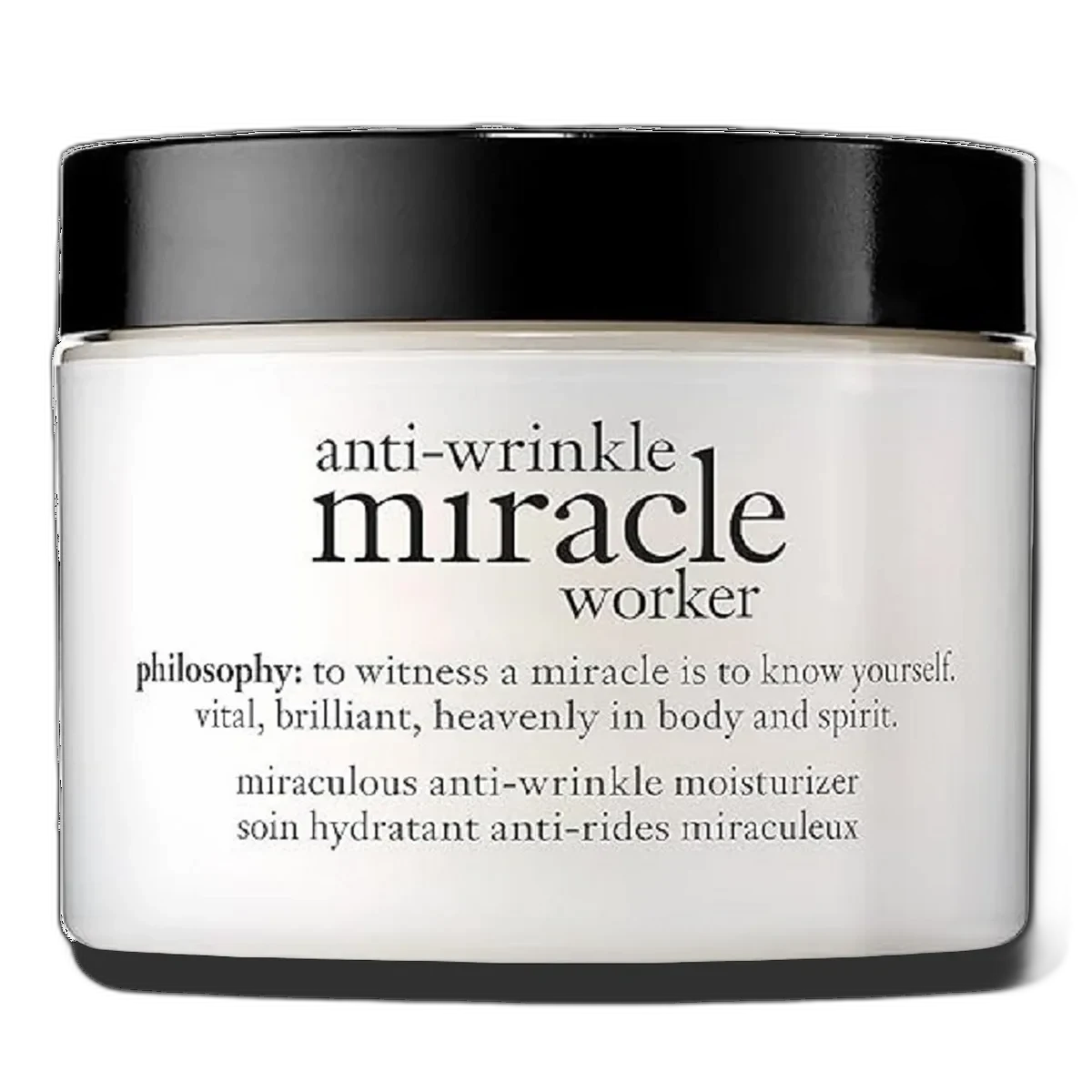
Anti-Wrinkle Miracle Worker+ Line-Correcting Moisturizer
Vitamin C Moisturizer Pick
 Verified reviewer
Pros & cons.
- +Multi-form vitamin C approach with four derivatives
- +Matrixyl 3000 peptide complex with reasonable evidence base
- +Resveratrol adds lipid-soluble antioxidant activity
- +Silicone base provides immediate smoothing and primer effect
- +Cruelty-free with an established department store presence
- +Layers well under sunscreen and makeup
- −Very expensive at $76 for 60ml
- −Added fragrance including multiple declared allergens
- −Silicone-heavy base does most of the immediate cosmetic work
- −Jar packaging is poor for vitamin C stability
- −No retinol despite the 'anti-wrinkle' positioning
The full review.
The name sets a specific expectation. Anti-Wrinkle Miracle Worker sounds like a retinol cream. For twenty years, “anti-wrinkle” skincare usually meant a retinoid in a moisturizer, sold at department stores as an OTC alternative to prescription tretinoin. It is surprising to find that Philosophy’s Miracle Worker+ Line-Correcting Moisturizer contains no retinol, no retinyl palmitate, and no hydroxypinacolone retinoate. The anti-aging mechanism relies on vitamin C, polyphenol antioxidants, and peptides instead.
This is a less obvious strategy for an anti-wrinkle claim. Retinoids have the strongest clinical data for wrinkle reduction. Positioning a product as “anti-wrinkle” without them bets that antioxidants and peptides can work well enough alone. Philosophy uses four vitamin C forms: ascorbyl glucoside is high on the list, 3-O-ethyl ascorbic acid is lower, ascorbyl palmitate is further down, and trace pure ascorbic acid is included. Each form has different stability, penetration, and delivery. Layering them should provide more comprehensive antioxidant activity than one form. In practice, unknown concentrations make evaluating real efficacy difficult.
The supporting ingredients look good on paper. Resveratrol, a polyphenol antioxidant from red wine, adds a lipid-soluble antioxidant and has evidence for free-radical scavenging and collagen preservation. Palmitoyl tripeptide-1 and palmitoyl tetrapeptide-7, marketed as Matrixyl 3000, are well-studied cosmetic peptides that support collagen and elastin synthesis. Hyaluronic acid provides surface plumping. Swertia chirata extract and anogeissus leiocarpus bark extract are niche plant actives included to support brightness and elasticity.
The base is less interesting. The second ingredient is cyclopentasiloxane, a volatile silicone that creates a blurred, velvety feel. The fourth ingredient is cyclohexasiloxane. Together with dimethicone, PEG/PPG-18/18 dimethicone, and propanediol, these create a cosmetic “primer” effect. Skin looks smoother and more even immediately, lines appear softened, and makeup sits well on top. This is real and is what most users notice first. However, much of this “wow” factor is optical. The cyclomethicones evaporate, the blurring fades, and long-term results depend on what the vitamin C, resveratrol, and peptides actually deliver at their concentrations.
The fragrance is assertive. The list includes parfum, limonene, benzyl salicylate, and farnesol—all EU-declared fragrance allergens and common causes of contact dermatitis. For a daily product for aging skin, which is often thinner and more reactive, these allergens are a compromise. Philosophy’s brand identity relies on scent, but dermatologists would flag these formulation choices in a clinical review.
Results take time. Without a retinoid to drive cell turnover, antioxidant and peptide effects accumulate slowly. Most users see brightening at 4-6 weeks, and some see fine line softening at 8-12 weeks. Do not expect the dramatic results of prescription tretinoin or a well-formulated 0.3% retinol. This is a supportive product, not a transformative one.
At $76 for 60ml, this is a prestige product, making value difficult to calculate. Timeless 20% Vitamin C + E + Ferulic costs around $20 for 30ml and has a higher-concentration, more studied antioxidant profile. SkinCeuticals C E Ferulic is the prestige gold standard; it costs around $180 for 30ml and uses 15% pure ascorbic acid with vitamin E and ferulic acid. Philosophy’s Miracle Worker+ sits between them: more expensive than the value option, less clinically validated than the benchmark, and more moisturizing but with fewer concentrated actives. If you want the Philosophy sensory experience and a single-step antioxidant moisturizer, it is a reasonable pick. If you want the best active delivery per dollar, other choices are better.
Ingredient analysis.
Full INCI list
Aqua/Water/Eau, Cyclopentasiloxane, Glycerin, Cyclohexasiloxane, Propanediol, Ascorbyl Glucoside, Behenyl Alcohol, Dimethicone, PEG/PPG-18/18 Dimethicone, Phenoxyethanol, Borago Officinalis Seed Oil, Linum Usitatissimum (Linseed) Seed Oil, Helianthus Annuus (Sunflower) Seed Oil, Bisabolol, Sodium Hydroxide, Polysorbate 20, Butylene Glycol, Parfum/Fragrance, Isopropyl Palmitate, Ethylhexylglycerin, Disodium EDTA, PEG-8, Lecithin, Citrus Aurantium Dulcis (Orange) Fruit Extract, Tocopherol, Resveratrol, Limonene, 3-O-Ethyl Ascorbic Acid, Carbomer, Saponins, Benzyl Salicylate, Hyaluronic Acid, Silanetriol, Swertia Chirata Extract, Ascorbyl Palmitate, Citric Acid, Mineral Salts, Sorbic Acid, Anogeissus Leiocarpus Bark Extract, Ascorbic Acid, Farnesol, Olus/Vegetable Oil/Huile Vegetale, Palmitoyl Tripeptide-1, Palmitoyl Tetrapeptide-7
Skin match.
The science.
The Science
The anti-aging evidence for this moisturizer varies between well-established and preliminary research, depending on the active. Matrixyl 3000 — the combination of palmitoyl tripeptide-1 and palmitoyl tetrapeptide-7 — has clinical data for collagen stimulation and wrinkle reduction dating back to the early 2000s. A 2005 paper in the International Journal of Cosmetic Science shows Matrixyl 3000 signals the dermis to produce more collagen, elastin, and glycosaminoglycans, with visible results in clinical trials over 8-12 weeks. The vitamin C derivative data is more fragmented. Several studies show Ascorbyl glucoside converts to active ascorbic acid gradually on the skin for slow-release antioxidant activity, though its efficacy is moderate compared to pure L-ascorbic acid. 3-O-ethyl ascorbic acid has better stability and penetration than many C derivatives and shows antioxidant activity in vitro, but clinical data for real-world use is less extensive than for pure ascorbic acid. Multiple in-vitro and some in-vivo studies support Resveratrol's antioxidant and collagen-preserving effects, but translating these to real-world topical results at cosmetic concentrations is difficult. None of these actives individually has the depth of evidence that retinoids have for wrinkle reduction. The formula provides reasonable antioxidant-and-peptide support, but it is not a substitute for a dedicated retinoid treatment.
References
- Matrikines: Biologically active tripeptides — International Journal of Cosmetic Science (2005)
Dermatologist Perspective
Dermatologists view vitamin C derivatives like ascorbyl glucoside and 3-O-ethyl ascorbic acid as reasonable antioxidant additions to daytime routines, though most still consider pure L-ascorbic acid at 10-20% the gold standard if tolerated. Board-certified dermatologists note that peptide-based anti-wrinkle products offer gentle, incremental collagen support without retinoid irritation, which suits sensitive patients or those who cannot tolerate other anti-aging actives. The main dermatological reservation for this product is the fragrance profile — the inclusion of multiple declared fragrance allergens is a common contact-dermatitis concern, especially for the aging demographic this product targets.
Guidance
Where it fits in your routine.
Apply in the morning as the last step before sunscreen. A pea-sized amount covers the full face and neck — warm it between clean fingers and press into skin instead of rubbing. The silicone base smooths skin immediately, making it ideal under makeup. Always follow with broad-spectrum SPF. Use it at night too, though the vitamin C antioxidant activity works best during daytime UV exposure. Pair with a nighttime retinoid from another product for a complete anti-aging protocol.
At $76 for 60ml, this antioxidant moisturizer carries a prestige price. One morning application daily lasts two to three months, making the monthly cost $25-38. For better value, buy a more concentrated, clinically validated vitamin C serum from Timeless, Good Molecules, or The Ordinary for $15-30. Pair that with a plain fragrance-free moisturizer to get equal or better antioxidant effects at one-third the total cost. Philosophy is a well-established brand, and the Miracle Worker+ formulation works well, but the price reflects brand positioning and sensory experience rather than unique active efficacy. It is a defensible splurge but a hard rational choice.
Existing Philosophy brand loyalists who want a morning antioxidant moisturizer with a peptide component and enjoy the sensory experience. It also works for users with normal to dry aging skin who prefer a gentler antioxidant approach than a retinoid cream.
Skip this if you want value; cheaper dedicated vitamin C serums have higher active concentrations. Skip this if you have fragrance sensitivities, as the formula contains multiple declared allergens. Skip this if you expect retinoid-level wrinkle reduction, because there's no retinoid in this product.
Product details.
Distinct Philosophy fragrance with floral and slightly powdery notes
Glass jar with screw lid — repeated light exposure hurts vitamin C stability Finish velvetysatinnon-greasy What to Expect on First Use The silicone-rich base blurs fine lines immediately on first application. This is a cosmetic effect, not anti-aging action, but it looks striking. The fragrance is noticeable during application and lasts a few minutes. Over 4-6 weeks, skin looks brighter and more even as vitamin C derivatives build their antioxidant effect.
2-3 months with once-daily morning application
6 months
All Year
The backstory.
Philosophy launched the original Miracle Worker anti-aging line in the early 2000s, building on the success of the brand's Hope in a Jar cult classic. The Miracle Worker+ Line-Correcting Moisturizer is a newer evolution that emphasizes a multi-form vitamin C approach and was positioned as a daily anti-wrinkle moisturizer with measurable clinical-test results.
About Philosophy
Established Brand (5–20 years)Cristina Carlino founded Philosophy in 1996 in Phoenix, Arizona. Its beauty-meets-inspirational-branding ethos helped define modern mass-prestige skincare. Now owned by Coty, Philosophy sells in Sephora and many department stores using formulations that lean accessible rather than strictly clinical.
Common myths.
Multiple vitamin C forms in one product yield better results.
Multiple vitamin C derivatives provide layered antioxidant activity, but they don't stack linearly. Four forms at lower concentrations do not outperform one form at a higher concentration. In this product, the multi-C approach is a reasonable formulation choice, not a clear efficacy advantage.
Anti-aging moisturizers replace the need for retinoids.
Antioxidant moisturizers like this one complement retinoid treatments instead of replacing them. The strongest anti-aging protocols use a morning vitamin C and sunscreen with a nighttime retinoid — this product handles the morning half of that equation.
FAQ.
Does this contain retinol?
No. Despite the 'anti-wrinkle' name, this product uses vitamin C derivatives, resveratrol, and Matrixyl peptides — not retinol or retinoid esters. This is not a retinol moisturizer. It is a morning antioxidant moisturizer meant to pair with a nighttime retinoid from another product.
Is it safe to use in the morning under sunscreen?
Yes — this is actually the intended use case. Vitamin C in the morning provides antioxidant support against daily UV and pollution exposure, and it layers well under most sunscreens. Always use broad-spectrum SPF on top.
Can I use it while pregnant?
The vitamin C derivatives, resveratrol, peptides, and base ingredients are generally safe during pregnancy and breastfeeding. Ask your OB if you have concerns about the added fragrance.
How does it compare to SkinCeuticals C E Ferulic?
SkinCeuticals C E Ferulic is a vitamin C serum containing 15% L-ascorbic acid, vitamin E, and ferulic acid. It is the gold-standard antioxidant serum. Philosophy's version is a moisturizer, not a serum; it uses gentler vitamin C derivatives instead of pure ascorbic acid and has a lower dose. SkinCeuticals remains the benchmark for maximum evidence-based antioxidant effect at a comparable price. Philosophy offers a gentler, more moisturizing alternative with a better price-to-active ratio.
What are the fragrance allergens in the ingredients?
The product contains fragrance (parfum), limonene, benzyl salicylate, and farnesol — all EU-declared fragrance allergens. These cause contact dermatitis in a small percentage of users. If you have reacted to scented skincare before, avoid this.
Is it worth $76?
The multi-form vitamin C in a smoothing silicone base is a reasonable formulation. Compared to dedicated vitamin C serums priced between $20-40, the value-per-active is hard to justify. You pay for the Philosophy brand, the sensory experience, and department-store positioning, not for any advantage in active efficacy.
What the community says.
"Lightweight silicone finish"
"Brightening effect over time"
"Philosophy brand quality"
"Good under makeup"
"Very expensive for what it delivers"
"Added fragrance and fragrance allergens"
"Silicone-heavy formulation"
"Jar packaging for light-sensitive actives"