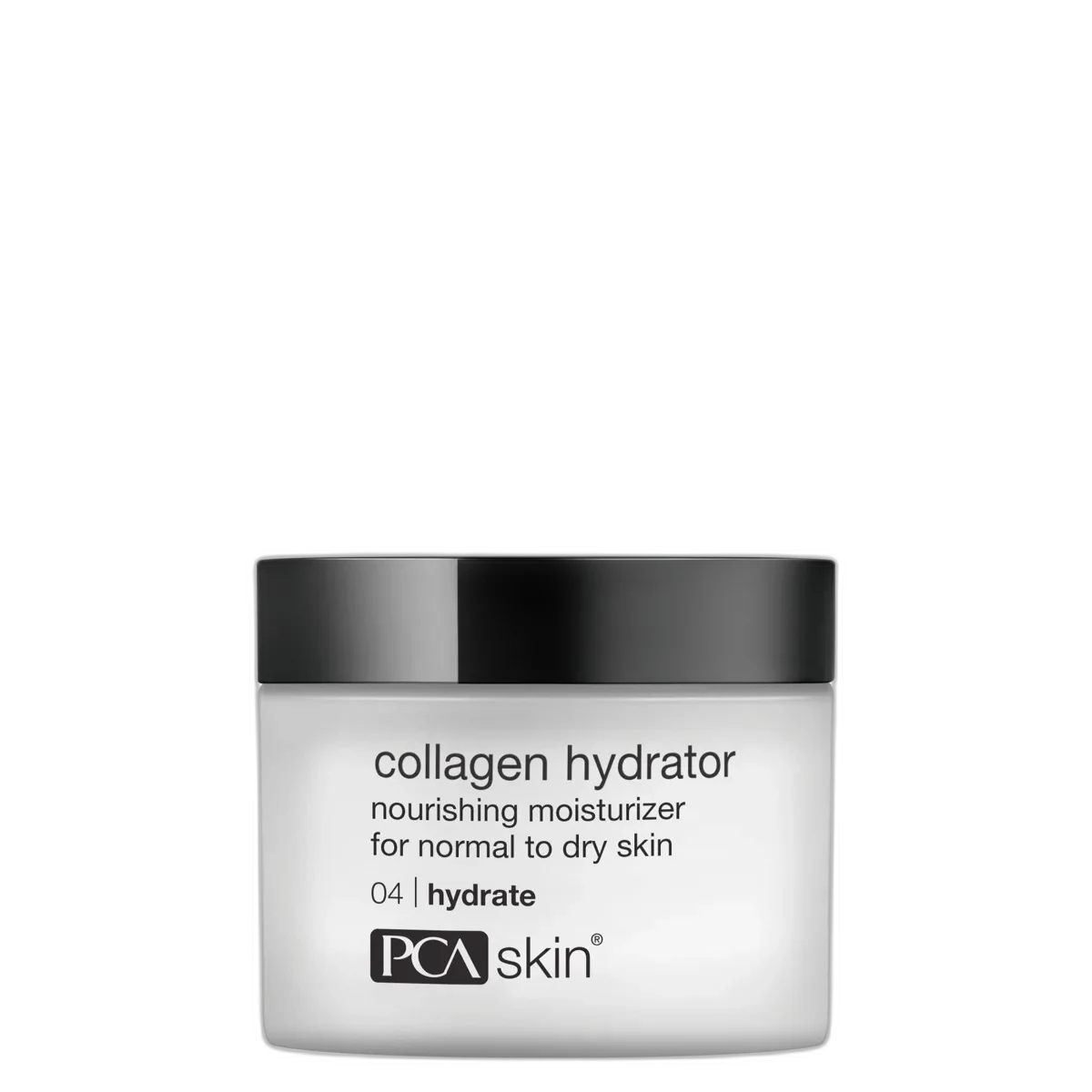
Collagen Hydrator
Dry Skin Comfort Cream
 Verified reviewer
Pros & cons.
- +Three-tier hydration strategy combines humectants emollients and occlusives for comprehensive moisture
- +Tetrahexyldecyl ascorbate provides stable oil-soluble vitamin C without pH-dependent irritation
- +Rich yet absorbs cleanly without leaving greasy or heavy residue
- +Fragrance-free and alcohol-free with calming chamomile aloe and allantoin
- +Excellent companion to retinoid treatments buffering dryness and irritation
- +Professional-grade formula originally designed for post-procedure skin recovery
- +Jar lasts 3-4 months with regular use keeping per-day cost reasonable
- −Too rich for oily or combination skin types especially in warmer weather
- −Contains isopropyl palmitate which has comedogenic potential for acne-prone skin
- −Jar packaging less hygienic than pump or tube alternatives
- −Product name implies collagen delivery which is not how the formula works
- −Contains silicones which some users prefer to avoid
The full review.
Every esthetician has a secret weapon for the moment after a chemical peel when a client’s skin is raw, tight, and desperate for moisture that won’t sting. For thousands of treatment professionals, that weapon has been PCA Skin’s Collagen Hydrator — a rich cream originally formulated to rescue freshly peeled skin that has quietly built one of the most devoted followings in professional skincare.
The name is slightly misleading, and it’s worth addressing upfront. Despite the word “collagen” on the label, this cream does not deliver collagen into your dermis. No topical product can — collagen molecules are far too large to penetrate the epidermis and integrate into the structural protein network beneath. What Collagen Hydrator actually does is provide the conditions for your skin to produce its own collagen more effectively, primarily through tetrahexyldecyl ascorbate, an oil-soluble vitamin C derivative that’s significantly more stable and less irritating than L-ascorbic acid. It’s an important distinction, and one that PCA Skin could communicate more clearly.
What this cream does brilliantly, however, is hydrate. The formula employs a three-tier moisture strategy that addresses dehydration from multiple angles. Glycerin, sodium hyaluronate, and sodium PCA work as humectants, actively drawing water into the upper layers of the epidermis. Shea butter, sweet almond oil, olive fruit oil, and sunflower seed oil provide emollient richness — essential fatty acids that soften and smooth rough, flaky texture. And dimethicone sits on top as an occlusive, creating a breathable barrier that prevents all that carefully delivered moisture from evaporating into thin air. This layered approach is what separates a genuinely hydrating cream from one that simply feels rich on application but doesn’t actually prevent transepidermal water loss.
The texture hits a satisfying sweet spot. It’s unmistakably rich — you feel the substance when you dip into the jar — but it melts on contact with warm skin and absorbs without leaving a heavy or greasy film. There’s a velvety, satin finish that works beautifully under makeup and feels comfortable even on the face, where overly occlusive products can feel suffocating. For a cream this rich, the absorption is impressively clean.
The botanical additions aren’t just window dressing. Chamomile extract and aloe vera provide genuine anti-inflammatory activity, which is why this cream works so well on post-procedure skin and why sensitive-dry skin types tolerate it. Allantoin promotes cell proliferation and wound healing, helping smooth the roughened texture that chronically dry skin develops. Cucumber extract adds a cooling, calming element. Together, these botanicals create a calming base that makes this cream feel therapeutic rather than just moisturizing.
For dry and mature skin, the performance is straightforward and reliable. Tightness disappears immediately on application. Within a week or two of consistent use, skin texture smooths noticeably, and the chronic flaking and rough patches that plague dry skin soften. Over longer use, the vitamin C derivative contributes a subtle brightening effect, though this isn’t a treatment product — don’t expect dramatic anti-aging transformation. This is maintenance hydration done exceptionally well.
The limitations are honest and predictable. If you have oily skin, this will be too rich. If you’re acne-prone, the isopropyl palmitate is a legitimate concern — it’s a known comedogenic ingredient. The jar packaging is functional but not ideal from a hygiene perspective. And while $61 for 1.7 oz is a fair price for the formula quality, it’s not exactly budget-friendly for a basic moisturizer, even one from a professional brand.
PCA Skin has been formulating professional skincare since 1990, and Collagen Hydrator reflects that experience in its restraint. There are no trendy actives, no buzzy ingredients, no over-the-top marketing claims. Just a well-engineered moisture delivery system designed for skin that needs serious hydration without drama. For dry and mature skin, that’s often exactly the right prescription.
Formula
Ingredient analysis.
Full INCI list
Water/Aqua/Eau, Glyceryl Stearate, Glycerin, C12-15 Alkyl Benzoate, Cetearyl Alcohol, Isopropyl Palmitate, Cyclopentasiloxane, Butyrospermum Parkii (Shea Butter), Dimethicone, Cetyl Alcohol, Polysorbate 60, Tetrahexyldecyl Ascorbate, Tocopherol, Hydrolyzed Wheat Protein, Chamomilla Recutita (Matricaria) Flower/Leaf Extract, Aloe Barbadensis Leaf Extract, Cucumis Sativus (Cucumber) Fruit Extract, Prunus Amygdalus Dulcis (Sweet Almond) Oil, Helianthus Annuus (Sunflower) Seed Oil, Olea Europaea (Olive) Fruit Oil, Sodium Hyaluronate, Sodium PCA, Allantoin, Potassium Cetyl Phosphate, Glycol Distearate, Xanthan Gum, Phenoxyethanol, Ethylhexylglycerin, Sodium Hydroxide, Carbomer, Tetrasodium EDTA
Skin match.
The science.
The Science
Collagen Hydrator uses a multi-lipid emollient approach based on established barrier repair science. Research in the Journal of Clinical Investigation shows optimal barrier repair needs a mixture of ceramides, cholesterol, and free fatty acids. While this formula lacks ceramides, the combination of shea butter (rich in stearic and oleic acids), olive oil, sunflower oil, and sweet almond oil provides fatty acids that support the lipid matrix between corneocytes.
Tetrahexyldecyl ascorbate, the vitamin C derivative in this formula, was studied in a 2003 paper in Skin Pharmacology and Physiology. This oil-soluble form penetrates skin better than L-ascorbic acid because it traverses the lipid-rich stratum corneum more effectively. Once absorbed, enzymes convert it to ascorbic acid within the skin, where it promotes collagen synthesis as a cofactor for prolyl and lysyl hydroxylase enzymes.
Sodium hyaluronate works as a documented humectant. Its small molecular weight lets it penetrate the upper epidermis and bind water at a ratio of up to 1000 times its weight. A 2011 study in the Journal of Clinical and Aesthetic Dermatology confirmed topical hyaluronic acid improves skin hydration and reduces wrinkles.
The FDA recognizes Allantoin as a skin protectant. Research shows it stimulates cell proliferation and promotes wound healing—properties useful for dry, mature skin with slow turnover rates.
References
- Influence of tetrahexyldecyl ascorbate on skin collagen synthesis — Skin Pharmacology and Physiology (2003)
- Hyaluronic acid: a key molecule in skin aging — Dermato-Endocrinology (2012)
Dermatologist Perspective
Dermatologists often recommend thick, occlusive moisturizers for chronically dry and mature skin, and Collagen Hydrator fits this recommendation. Board-certified dermatologists note that combining humectants, emollients, and occlusives mirrors the gold-standard approach to barrier repair in clinical dermatology. The tetrahexyldecyl ascorbate—a well-tolerated vitamin C derivative—adds antioxidant value without the irritation risk of pure ascorbic acid. This makes it appropriate for mature skin sensitized by retinoid use or environmental damage. However, dermatologists would caution acne-prone patients against this formula because of the isopropyl palmitate, and would advise patients to temper expectations about the "collagen" name—topical collagen delivery remains beyond current technology.
Where it fits in your routine.
Apply a dime-sized amount to clean, dry skin every morning and evening as your last skincare step. In the morning, follow with a broad-spectrum SPF 50. At night, apply this after any serums, retinoids, or treatment products. For very dry skin, apply to slightly damp skin after toner to lock in more moisture. Use clean hands or a spatula to keep the jar packaging hygienic.
At $61 for 1.7 oz, Collagen Hydrator costs a reasonable amount for a professional-grade moisturizer. Regular use lasts 3-4 months, making the daily cost $0.50-0.70. The formula uses a useful vitamin C derivative and a blend of botanical calmers with its moisture-delivery system. This makes it better than basic drugstore thick creams that use only petrolatum and glycerin. PCA Skin's clinical reputation and the product's history in professional treatment settings add credibility. Collagen Hydrator offers the best value for dry-skinned individuals needing reliable daily hydration and a formula designed for post-procedure skin tolerance.
Collagen Hydrator works for dry or mature skin needing more hydration than a basic lotion. It suits people using retinoids or undergoing professional treatments who need a gentle, restorative moisturizer to maintain their skin barrier.
Oily and acne-prone skin types should avoid this formula. The thick texture and isopropyl palmitate can cause congestion. This isn't the right fit if you want silicone-free formulas or a lightweight moisturizer for warm weather.
Product details.
Thick, velvety cream that feels substantial on application but absorbs without a heavy or greasy residue
Unscented — no detectable fragrance
Jar with screw-top lid
This thick, cushiony cream melts into skin on contact. It provides immediate relief from tightness and dryness. Users expect no adjustment period, tingling, or sensitivity. Dry skin types feel comfortably hydrated through the day from the first use.
3-4 months with twice-daily application of a dime-sized amount to face and neck
12 months
fall winter
The backstory.
PCA Skin developed Collagen Hydrator as part of their professional post-treatment care line, designed for clients whose skin needed intensive moisture repair after chemical peels and resurfacing procedures. The rich formulation was built to restore barrier function quickly in professionally treated skin, which is why it emphasizes calming botanicals alongside serious moisture delivery rather than additional active treatments.
About PCA Skin
Established Brand (5–20 years)An aesthetician founded PCA Skin in 1990, developing it with dermatologists. PCA Skin is the number-one professional chemical peel brand among estheticians, with over one million peels performed globally each year. PhD chemists develop its formulations in-house.
Common myths.
Collagen in moisturizers replaces the collagen your skin loses as you age.
Topically applied collagen molecules are too large to penetrate skin or integrate into dermal collagen networks. Collagen Hydrator's name refers to the hydrolyzed wheat protein that forms a film to retain surface moisture, not to delivering collagen into the dermis. The actual collagen-supporting ingredient is tetrahexyldecyl ascorbate, which promotes your skin's own collagen synthesis.
Rich moisturizers cause breakouts on every skin type.
Moisturizer breakouts depend on specific ingredients, not texture. Collagen Hydrator contains isopropyl palmitate, which has comedogenic potential and concerns acne-prone skin. But dry, non-breakout-prone skin types often need thick formulas like this.
FAQ.
Is PCA Skin Collagen Hydrator good for aging skin?
Yes — Collagen Hydrator targets dry and mature skin. It uses tetrahexyldecyl ascorbate, an oil-soluble vitamin C derivative, to support collagen production alongside intensive moisture. A blend of shea butter, plant oils, and hyaluronic acid treats dehydration and barrier weakness common in aging skin.
Does PCA Skin Collagen Hydrator actually contain collagen?
The formula uses hydrolyzed wheat protein instead of collagen. Topical collagen molecules do not penetrate deep enough to replace lost dermal collagen. tetrahexyldecyl ascorbate, a vitamin C derivative, provides the actual collagen support by promoting skin's own collagen synthesis from within.
Can I use PCA Skin Collagen Hydrator with retinol?
Collagen Hydrator works well with retinol or prescription retinoids. Its thick emollient formula buffers retinoid-induced dryness and irritation. Apply your retinoid first, let it absorb, then layer Collagen Hydrator on top to seal in moisture and reduce retinoid-related flaking.
Is PCA Skin Collagen Hydrator too heavy for summer?
Collagen Hydrator works year-round for dry skin types. For normal or combination skin, use it during fall and winter when low humidity and cold air increase moisture loss. The formula feels too thick in summer; switch to a lighter PCA Skin moisturizer during warmer months.
Will PCA Skin Collagen Hydrator break me out?
Oily or acne-prone skin faces a risk. The formula contains isopropyl palmitate, which is comedogenic, plus thick plant oils and shea butter. This moisturizer targets dry and mature skin types that do not experience congestion or breakouts.
What the community says.
"Rich but absorbs without feeling greasy or heavy"
"Locks in moisture all day with excellent hydration"
"A little goes a long way making the jar last"
"Skin feels noticeably softer and more supple"
"Works beautifully under makeup"
"Too rich for oily or acne-prone skin types"
"Jar packaging less hygienic than pump alternatives"
"Contains silicones which some users prefer to avoid"
"Despite the name no actual collagen penetrates the skin"