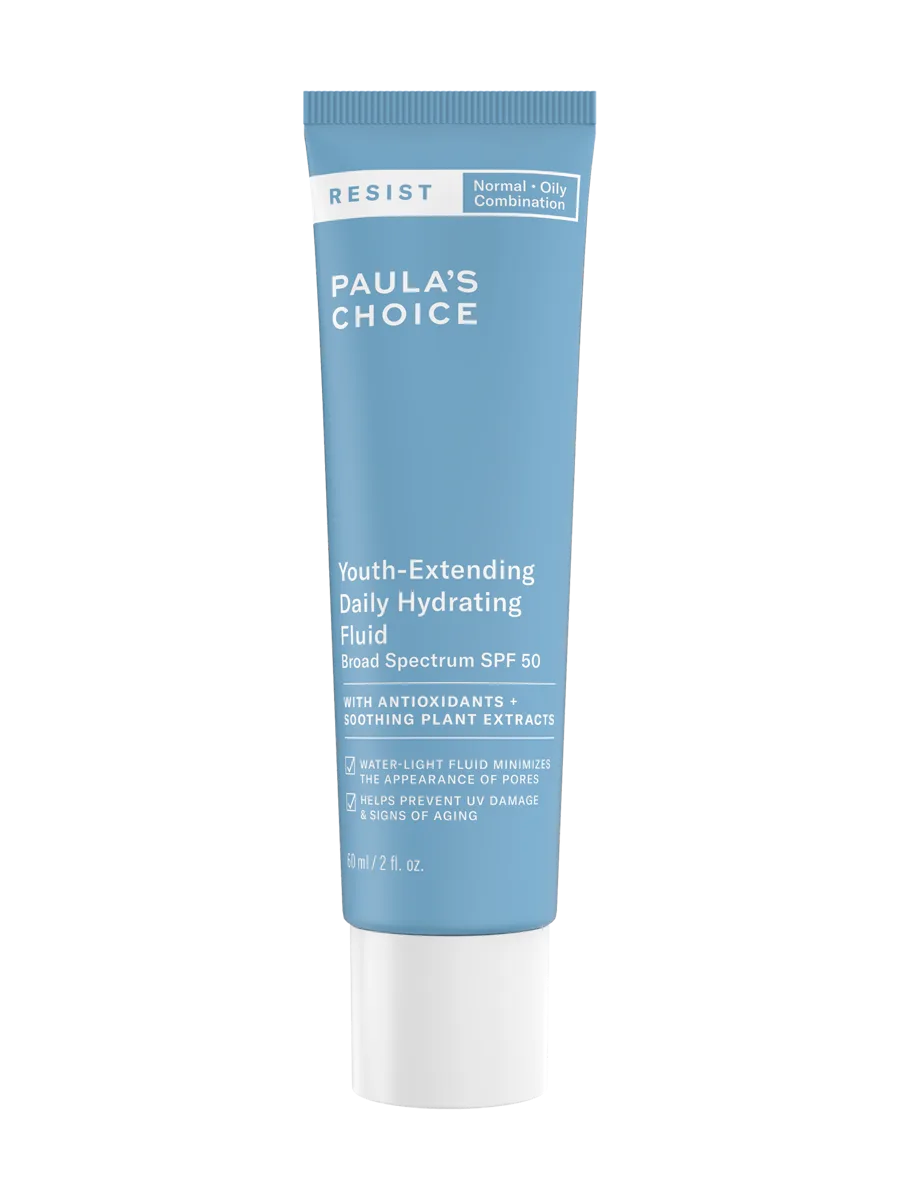
Youth-Extending Daily Hydrating Fluid SPF 50
Invisible Daily Shield
 Verified reviewer
Pros & cons.
- +Ultra-light fluid texture genuinely feels like wearing nothing — eliminating the compliance barrier
- +Zero white cast from the chemical UV filter system — invisible on all skin tones
- +Four-filter broad-spectrum system with avobenzone stabilizers for robust UV protection
- +Dense antioxidant payload (green tea, grape seed, pomegranate, vitamin E) provides secondary photoprotection
- +Satin-matte finish doubles as a makeup primer without chalkiness
- +Fragrance-free and oil-free — suitable for oily and acne-prone skin
- +Fungal-acne-safe formula with no known triggers
- −Premium price at $39 for 2 oz with daily use depleting it in 2-3 months
- −Contains octinoxate which pregnant individuals and environmentally concerned users may prefer to avoid
- −One independent UV test found lower-than-expected protection levels
- −Squeeze tube can dispense product too quickly requiring careful application
- −Contains silicones (dimethicone) which some users prefer to avoid
The full review.
Sunscreen compliance is a documented, frustrating problem. Dermatologists agree daily SPF is the most impactful anti-aging step, yet surveys show most people skip sunscreen, apply too little, or quit because of the texture. Paula’s Choice built this product on one thesis: if sunscreen doesn’t feel like sunscreen, people will wear it.
The texture proves the thesis. This is not a lotion or a cream. It is a fluid—a water-light liquid that vanishes into skin within fifteen to twenty seconds. There is no white cast, no greasy film, and no heavy sunscreen sensation on your face. Once absorbed, it feels like you are wearing nothing.
The UV protection system uses four chemical filters. Avobenzone at 2% handles UVA protection—the wavelength responsible for deep-tissue photoaging and DNA damage. Octinoxate at 7.5% provides primary UVB protection. Octisalate and octocrylene act as both UVB filters and avobenzone stabilizers, preventing the photodegradation that makes many avobenzone-only formulas lose effectiveness after one hour of sun exposure. This four-filter approach is more robust than the two-filter systems in many daily moisturizers with SPF.
The antioxidant payload goes beyond basic sunscreen. Two forms of green tea extract deliver EGCG—a potent topical antioxidant for photoprotection. Grape seed extract, pomegranate extract, elderberry, goji, and vitamin E create a multi-pathway antioxidant defense against free radicals that pass the UV filters. Research shows antioxidant-enriched sunscreens provide greater photoprotection than UV filters alone.
The finish is distinct. Silica and dimethicone crosspolymer create a satin-matte surface that controls shine without the chalky, dessicated look of other matte sunscreens. For oily and combination skin, this finish removes the need for a separate mattifying primer. Makeup applies smoothly, sits well, and does not pill. The mattifying effect looks natural, not artificially powdered.
Glycerin prevents the matte finish from causing dryness. This achieves a balance most matte sunscreens miss: mattifying enough to control shine, but hydrating enough for all-day comfort. Even dry skin types report this feels comfortable rather than parching, though they may want to layer it over a hydrating serum.
The conversation about UV filters is necessary. Laboratory studies show potential endocrine-disrupting effects for Octinoxate, and environmental concerns exist regarding coral reef impact. These are legitimate considerations for those who avoid this filter; pregnant individuals may want to discuss this with a healthcare provider. For others, the safety profile of topical octinoxate in sunscreen formulations is extensively studied. Dermatological organizations agree the proven harms of UV exposure outweigh the theoretical risks of chemical UV filters.
One independent UV testing source found lower-than-expected UVA and UVB reduction in a sample of this product. While a single test is not definitive—UV testing methodology varies and results differ between labs—it is worth noting. The product carries SPF 50 labeling from FDA-compliant testing, and the four-filter system with avobenzone stabilizers is a sound approach to broad-spectrum protection.
The price is a concern: thirty-nine dollars for two ounces of a product you must use daily and generously. Using the recommended amount (a nickel-sized amount for the face), the tube lasts roughly two to three months. That is a per-month cost of approximately thirteen to twenty dollars, which is premium. The mini size offers a lower-cost entry point to test the formula.
For a sunscreen you will actually wear every day to get the cumulative photoprotection that drives anti-aging, this is one of the most elegantly formulated options. It does not smell, feel, or look like sunscreen. It just protects like one.
Formula
Ingredient analysis.
Full INCI list
Active Ingredients: Avobenzone 2.0%, Octinoxate 7.50%, Octisalate 5.0%, Octocrylene 2.0%. Inactive Ingredients: Water (Aqua), Glycerin, Silica, Dimethicone, Tocopherol, Chamomilla Recutita (Matricaria) Flower Extract, Vitis Vinifera (Grape) Seed Extract, Camellia Sinensis (Green Tea) Leaf Extract, Camellia Oleifera (Green Tea) Leaf Extract, Peucedanum Graveolens (Dill) Extract, Sambucus Nigra (Black Elderberry) Fruit Extract, Avena Sativa (Oat) Bran Extract, Punica Granatum (Pomegranate) Extract, Lycium Barbarum (Goji) Fruit Extract, Hydrogenated Lecithin, Titanium Dioxide, Dimethicone/Vinyl Dimethicone Crosspolymer, Diethylhexyl Syringylidenemalonate, Hydroxyethyl Acrylate/Sodium Acryloyldimethyl Taurate Copolymer, Xanthan Gum, Sodium Carbomer, Benzyl Alcohol, Sodium Benzoate, Potassium Sorbate, Phenoxyethanol
Skin match.
The science.
The Science
The four-filter UV system in this formula uses best practices in sunscreen formulation chemistry. Avobenzone is the most effective UVA filter approved by the FDA, but its photolability—it degrades fast under UV exposure—requires stabilization. Wang et al. (2010) in Photodermatology, Photoimmunology & Photomedicine showed that octocrylene photostabilizes avobenzone by acting as a triplet-state quencher, which stops the Norrish type I photocleavage that degrades avobenzone's UVA-absorbing chromophore.
Research from Pinnell et al. and others shows that topical antioxidants enhance photoprotection beyond UV filters alone. Afaq et al. (2003) in Photochemistry and Photobiology showed that EGCG from green tea inhibited UVB-induced oxidative stress, inflammatory responses, and DNA damage in human skin cells. A 2011 review by Nichols and Katiyar in Archives of Dermatological Research confirmed that green tea polyphenols provide photoprotective benefits through antioxidant activity, anti-inflammatory effects, and DNA repair enhancement.
Combining chemical UV filters with botanical antioxidants uses a dual-defense strategy found in photoprotection research—UV filters prevent most UV-induced damage, while antioxidants neutralize residual oxidative stress from radiation that penetrates the filter system. This approach provides more complete protection than either strategy alone.
Dermatologist Perspective
Board-certified dermatologists rank daily broad-spectrum sunscreen as the most effective anti-aging intervention available. Dermatologists note that the lightweight, cosmetically elegant texture of modern chemical sunscreens like this one solves the main compliance barrier—patient dislike of heavy, greasy, white-cast-leaving formulas. Dermatologists recommend applying a nickel-sized amount to the face 15 minutes before sun exposure and reapplying every 2 hours during extended outdoor time. For patients who avoid chemical UV filters during pregnancy, dermatologists typically recommend mineral alternatives with zinc oxide as the active ingredient.
Where it fits in your routine.
Apply a nickel-sized amount to the face and a dime-sized amount to the neck. Use this as the final step of your morning routine, after moisturizer. Wait 2-3 minutes for full absorption before applying makeup. Reapply every 2 hours during extended sun exposure. One morning application works for typical indoor days, but midday reapplication is ideal. Apply this over vitamin C serum and lightweight moisturizer.
At $39 for 2 oz, this is a premium daily-use sunscreen. Proper application lasts 2-3 months, making the monthly cost about $13-$20. A 0.5 oz travel size exists for testing. The formula's antioxidant density, matte finish, and weightless texture justify the price over basic SPF 50 products. Budget-conscious consumers can find effective broad-spectrum chemical sunscreens for less — the question is if any feel this good to wear daily.
People who skip sunscreen because of the texture. Oily and combination skin types needing matte, non-greasy UV protection that works as a primer. Anti-aging-focused individuals wanting a sunscreen that provides antioxidant benefits and UV filtration.
Pregnant individuals avoiding octinoxate, those preferring mineral-only UV filters, and budget-conscious consumers who find $39 for a 2 oz sunscreen too expensive for daily use.
Product details.
Fragrance-free and has no discernible scent. It has no chemical sunscreen odor or botanical aroma—it is completely neutral.
White squeeze tube with blue-gray RESIST line branding. The 2 oz size is practical for travel. Some users find the tube dispenses product too fast and requires careful squeezing. A 0.5 oz mini is also available.
Most users find the first application surprising because the formula feels light. It vanishes into the skin within 15-20 seconds and leaves a soft, matte veil that looks and feels like bare skin. There is no white cast, no greasy film, and no heavy sunscreen feel. The experience is so subtle that some users question if they applied enough.
2-3 months with daily face-only application using recommended amount
12 months
All Year
The backstory.
Paula Begoun developed this sunscreen as part of the RESIST anti-aging line with a specific insight: the best sunscreen is the one you'll actually wear every day. By making the texture so light that users forget they're wearing sunscreen, the formula removes the compliance barrier that makes many people skip or under-apply their daily SPF.
About Paula's Choice
Legacy Brand (20+ years)Consumer advocate Paula Begoun, the 'Cosmetics Cop,' founded Paula's Choice in 1995. The brand builds its reputation on fragrance-free, evidence-based formulations. Paula's Choice is Leaping Bunny certified and dermatologists widely recommend it for its transparent, research-driven approach.
Common myths.
SPF 50 provides significantly more protection than SPF 30.
SPF 50 blocks about 98% of UVB rays, while SPF 30 blocks 97%. This difference is small, but SPF 50 offers a larger buffer for under-application. This matters because most people apply only 25-50% of the recommended amount.
Chemical sunscreens enter the bloodstream and are dangerous.
FDA studies show measurable levels of sunscreen chemicals in blood, but no study shows adverse health effects from topical sunscreen use. The known harm from UV exposure (skin cancer, photoaging) outweighs the theoretical risks of chemical UV filters. People concerned about octinoxate can use mineral alternatives.
FAQ.
Does this sunscreen leave a white cast?
No — this chemical sunscreen absorbs UV radiation instead of reflecting it, so it leaves zero white cast on any skin tone. The small amount of titanium dioxide in the inactive ingredients affects texture, not UV protection, and is not visible on application.
Is this sunscreen safe during pregnancy?
This sunscreen contains octinoxate (ethylhexyl methoxycinnamate). Some healthcare providers recommend avoiding this ingredient during pregnancy because laboratory studies show endocrine-disrupting effects. Pregnant individuals may prefer a mineral sunscreen using zinc oxide or titanium dioxide as the active UV filters. Consult your healthcare provider for personalized guidance.
Can I wear this under makeup?
Yes — the satin-matte finish and lightweight texture make this an excellent makeup primer. It smooths the skin surface, controls oil, and does not pill or interfere with foundation application. Wait 2-3 minutes for full absorption before applying makeup.
How often should I reapply this sunscreen?
Reapply every 2 hours during continuous sun exposure, and immediately after swimming, sweating, or towel-drying. For typical indoor/office environments with brief sun exposure during commuting, one morning application protects most people, though midday reapplication is ideal.
Is this a chemical or mineral sunscreen?
This is a chemical sunscreen using four UV-absorbing filters: avobenzone (UVA), octinoxate (UVB), octisalate (UVB), and octocrylene (UVB). A small amount of titanium dioxide is in the inactive ingredients for cosmetic purposes, but the chemical filters provide the UV protection.
Why does this sunscreen contain antioxidants?
UV filters prevent most, but not all, UV-induced damage. UV radiation that penetrates still generates free radicals that cause oxidative stress. The green tea, grape seed, pomegranate, and vitamin E in this formula neutralize those residual free radicals. This adds a secondary defense layer, making the overall photoprotection more complete than SPF alone.
What the community says.
"Featherlight texture that feels like nothing on the skin"
"No white cast whatsoever — completely invisible on all skin tones"
"Excellent as a makeup primer with a satin-matte finish"
"Mattifying without drying — controls oil while maintaining hydration"
"Fragrance-free formula that doesn't irritate sensitive skin"
"Long-term loyal users who have repurchased for 5+ years"
"Expensive at $39 for only 2 oz with daily use depleting it in 2-3 months"
"Contains octinoxate which some users prefer to avoid for environmental or health concerns"
"Squeeze tube can dispense too much product at once"
"One independent UV test found lower-than-expected UVA/UVB protection"
"Some users with very oily skin find it too moisturizing"
People also looked at.