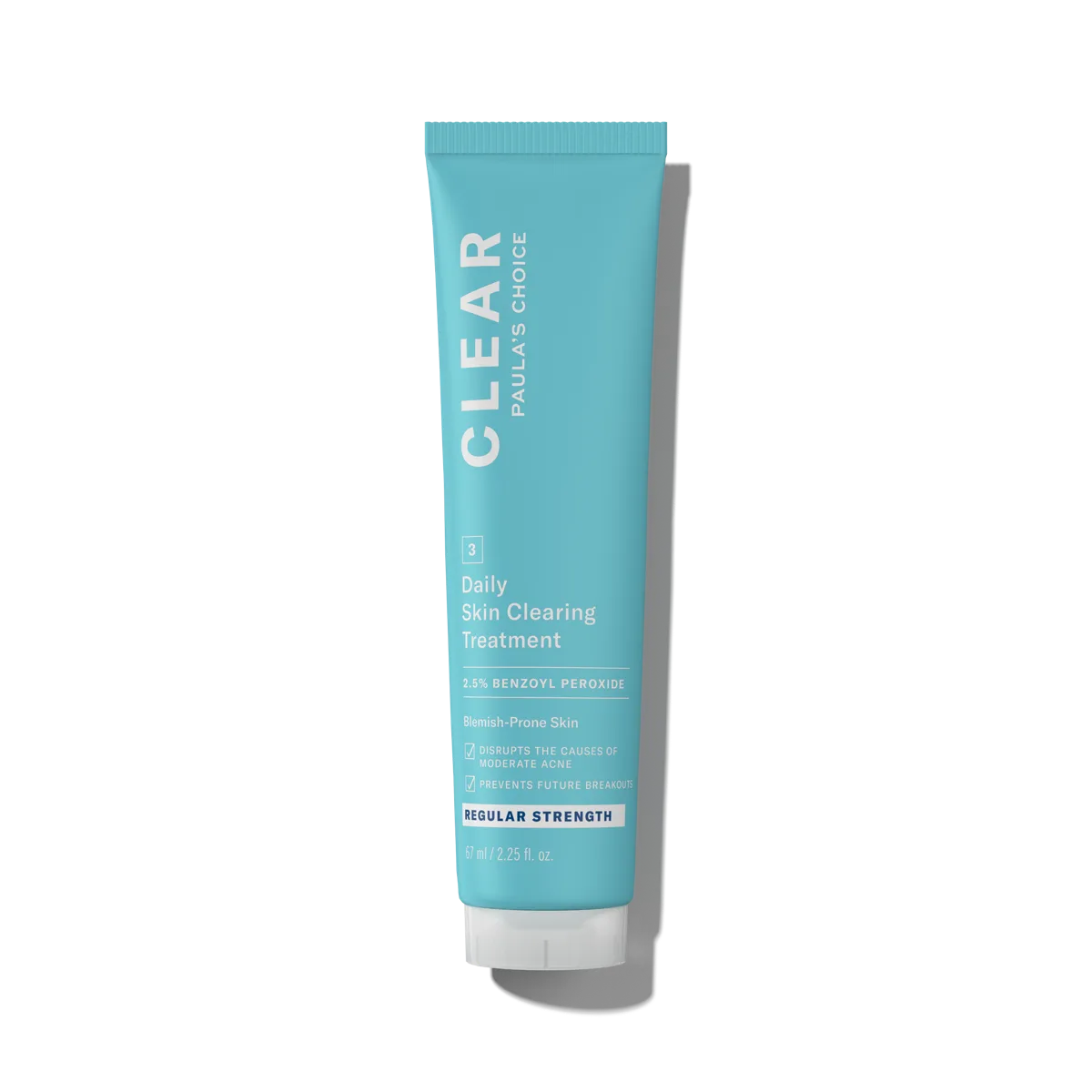
CLEAR Regular Strength Daily Skin Clearing Treatment 2.5% Benzoyl Peroxide
Evidence-Based Acne Essential
 Verified reviewer
Pros & cons.
- +Evidence-based 2.5% concentration matches higher-strength BP for antibacterial efficacy with less irritation
- +Minimal fragrance-free formula with only soothing additives and no unnecessary irritants
- +Bisabolol and allantoin meaningfully reduce drying and redness typical of BP products
- +Large 2.25 oz tube provides 3-4 months of daily use at an affordable $25 price point
- +Lightweight gel designed for full-face preventive application
- +Pregnancy-safe acne treatment at the gentlest effective concentration
- +Cruelty-free and vegan with a clean ingredient list
- −Still causes some dryness, tightness, and peeling during the adjustment period
- −Gel can feel slightly sticky or tight immediately after application
- −Bleaches towels, pillowcases, and clothing — an unavoidable BP property
- −May be insufficient for severe cystic or nodular acne
- −Not suitable for rosacea-prone skin
The full review.
Drugstore acne aisles stock 5%, 10%, and maximum-strength benzoyl peroxide spot treatments to kill pimples. Dermatologists know a different truth: 2.5% benzoyl peroxide kills acne-causing bacteria as effectively as higher concentrations but causes less irritation. Paula’s Choice built the CLEAR Daily Skin Clearing Treatment on this evidence; it works better because it is less aggressive.
The science is clear. A study comparing 2.5%, 5%, and 10% benzoyl peroxide showed all three concentrations reduced Cutibacterium acnes populations and acne lesion counts equally. The only real difference was side effects: higher concentrations caused more dryness, peeling, redness, and discomfort. The industry prefers 10% BP due to the psychology that stronger is better, not because of evidence. Paula Begoun has noted this for decades, and this product uses that philosophy.
The formula is spartan. It uses 2.5% benzoyl peroxide in a water-based gel vehicle, with bisabolol and allantoin to soothe and reduce inflammation. It has no fragrance, no dyes, and no unnecessary emollients that clog pores. This minimal ingredient list reduces potential reactions for irritated acne-prone skin.
Bisabolol is a smart addition. It is an effective botanical anti-inflammatory that reduces redness and calms irritated skin. In a benzoyl peroxide formula where irritation occurs, bisabolol reduces discomfort without lowering antibacterial efficacy. Allantoin adds moisture retention and skin-conditioning to offset the drying effects of BP.
The clear, lightweight gel spreads easily over the entire face—and full-face application is the goal. Dermatologists increasingly recommend applying benzoyl peroxide to the whole acne-prone zone rather than just spots. Acne bacteria distribute across the skin, and infections develop for weeks before a pimple appears. Treating the entire area is preventive; treating only visible spots is reactive.
Results follow the standard BP timeline. Active inflamed pimples respond within three to seven days. Consistent daily use for four to six weeks provides the main benefit: fewer new breakouts, less severe acne, and a calmer complexion. The 2.5% concentration allows for sustained daily use where higher concentrations cause irritation.
The downsides are honest: benzoyl peroxide causes drying, and this product is no exception. Even with bisabolol and allantoin, expect tightness and mild flaking during the first two weeks. Use a good oil-free moisturizer. The gel feels slightly sticky after application but settles within minutes.
Benzoyl peroxide also bleaches towels, pillowcases, and clothing. This is a chemical property of the molecule, not a flaw in the formula. Use white linens or accept bleach spots when using any BP product.
At $25 for 2.25 ounces, the value is high. One tube lasts three to four months of daily full-face use, costing six to eight dollars per month. This is an affordable, evidence-based, fragrance-free, professionally formulated benzoyl peroxide treatment.
This product is not glamorous. It won’t trend on social media, it doesn’t promise overnight miracles, and the packaging is not aesthetic. It puts the right concentration of the right active ingredient into a sensible, non-irritating vehicle. For mild to moderate acne, this works.
Ingredient analysis.
Full INCI list
Active Ingredient: Benzoyl Peroxide 2.5%. Inactive Ingredients: Water (Aqua), Propylene Glycol, Bisabolol, Allantoin, Acrylates/C10-30 Alkyl Acrylate Crosspolymer, Hydroxyethylcellulose, Sodium Citrate, Laureth-4, Caprylyl Glycol, Hexylene Glycol, Sodium Hydroxide, Disodium EDTA, Phenoxyethanol
Skin match.
The science.
The Science
Benzoyl peroxide has been a cornerstone of acne treatment for over 60 years, with a mechanism distinct from antibiotics: it generates free radicals that oxidize bacterial proteins, killing Cutibacterium acnes through a non-specific mechanism that bacteria cannot develop resistance to — a critical advantage over topical antibiotics like clindamycin, which have seen increasing resistance rates.
The foundational study supporting 2.5% was published by Mills et al. in the Journal of the American Academy of Dermatology, comparing 2.5%, 5%, and 10% BP and finding equivalent efficacy with significantly higher irritation at higher concentrations. This established 2.5% as the minimum effective concentration.
A 2019 evidence review published in the Journal of Drugs in Dermatology confirmed BP's role as a first-line acne treatment and highlighted its unique ability to prevent antibiotic resistance when used alongside topical antibiotics — making it not just an acne treatment but a resistance-prevention strategy.
The bisabolol has demonstrated anti-inflammatory activity in published research, reducing production of pro-inflammatory mediators including prostaglandin E2 and leukotriene B4 — directly addressing the irritation BP provokes.
Dermatologist Perspective
Dermatologists widely regard 2.5% benzoyl peroxide as the evidence-based first-line concentration for acne treatment. Board-certified dermatologists recommend starting at 2.5% and only escalating if needed, noting that patient compliance is better at lower concentrations. Dermatologists appreciate this formula's minimal ingredient list and soothing additions, and consistently recommend applying BP to the entire acne-prone area for preventive benefit. Benzoyl peroxide's inability to generate bacterial resistance makes it a cornerstone of long-term acne management.
Where it fits in your routine.
Apply a thin, even layer to the entire acne-prone area after cleansing and before moisturizer. Use once daily in the evening for 1-2 weeks, then increase to twice daily if needed. Wait 1-2 minutes for absorption before moisturizer. Always use sunscreen in the morning. Use white towels and pillowcases. Layer under makeup once the moisturizer absorbs.
At $25 for 2.25 fl oz, this clinical-grade BP treatment is competitively priced. One tube lasts 3-4 months with daily use, making the monthly cost $6-8. Generic 2.5% BP gels cost less, but the Paula's Choice formula includes bisabolol and allantoin, is fragrance-free, and uses quality control to justify a modest premium.
People with mild to moderate acne want an evidence-based daily treatment that prevents new breakouts without harsh side effects. This works for acne-prone oily and combination skin seeking a clean, fragrance-free formula.
People with rosacea, very sensitive skin, or severely dry skin. Those with severe cystic acne who need prescription-strength treatments. Anyone who wants to avoid the fabric-bleaching property of benzoyl peroxide.
Product details.
Clear, lightweight gel spreads easily and dries to a matte finish. It feels slightly tacky at first but settles within minutes.
No added fragrance — benzoyl peroxide has a faint medicinal scent that dissipates quickly
Opaque squeeze tube with flip-top cap — controls dispensing and protects BP from light degradation
Mild dryness and tightness occur during the first 1-2 weeks. bisabolol and allantoin minimize irritation, but some peeling around the nose and chin is normal. Use every other day if irritation is significant.
3-4 months with once or twice daily full-face application
12 months
All Year
The backstory.
Paula Begoun has long advocated for 2.5% benzoyl peroxide as the evidence-based sweet spot. This product was developed as part of the CLEAR acne system after Paula criticized the industry's tendency to market higher-concentration BP products that cause unnecessary irritation without meaningfully better antibacterial efficacy.
About Paula's Choice
Established Brand (5–20 years)Cosmetics industry critic Paula Begoun founded Paula's Choice in 1995. The CLEAR collection uses dermatologist-recommended active ingredients at clinically effective concentrations as an evidence-based acne treatment system.
Common myths.
Higher percentage benzoyl peroxide works better for acne.
Research comparing 2.5%, 5%, and 10% BP shows similar antibacterial efficacy at all concentrations, but higher percentages cause more irritation. This 2.5% has the same bacterial kill rate with less dryness, peeling, and redness.
Benzoyl peroxide should only be used as a spot treatment.
Dermatologists recommend applying BP to the entire acne-prone area. This reduces bacterial populations across the skin to prevent new breakouts. Spot treatment only addresses existing blemishes and does not prevent new ones.
FAQ.
Is 2.5% benzoyl peroxide strong enough for acne?
Yes — published research shows 2.5% BP kills Cutibacterium acnes as effectively as 5% and 10%. The main difference is less dryness, peeling, and irritation. For most mild to moderate acne, dermatologists recommend 2.5% as a starting point.
Can I use this with retinol?
Yes, but not simultaneously. BP degrades some retinol formulations on contact. Use benzoyl peroxide in the morning and retinol at night, or alternate nights between the two.
Will this bleach my towels and pillowcases?
Yes — benzoyl peroxide at any concentration bleaches fabric. Use white towels and pillowcases, or let the product fully absorb (3-5 minutes) and apply moisturizer before contact with fabric. This is an inherent chemical property of BP.
Can I use this if I have sensitive skin?
The 2.5% concentration and soothing ingredients make this a gentler BP option. Start every other day and build to daily use. Some sensitive skin types tolerate 2.5% well; others use BP only on targeted spots.
How long does benzoyl peroxide take to clear acne?
Active pimples often improve within 3-7 days. Consistent daily use shows preventive benefits — fewer new breakouts — at 4-6 weeks. BP works best for ongoing prevention, not as a rescue remedy for individual pimples.
Is this safe during pregnancy?
Most dermatologists consider Benzoyl peroxide safe during pregnancy because systemic absorption is minimal. This 2.5% concentration is the gentlest effective dose. Consult your OB-GYN before starting any new treatment during pregnancy.
What the community says.
"Effectively clears and prevents breakouts with consistent use"
"2.5% is less drying than higher-strength BP products"
"Fragrance-free and minimal ingredient list"
"Affordable at $25 for 2.25 oz"
"Large tube lasts several months"
"Still causes dryness and flaking during adjustment"
"Gel can feel slightly sticky once dried"
"Bleaches towels, pillowcases, and clothing"
"May be insufficient for severe cystic acne"
"Propylene glycol base can feel heavy"
People also looked at.