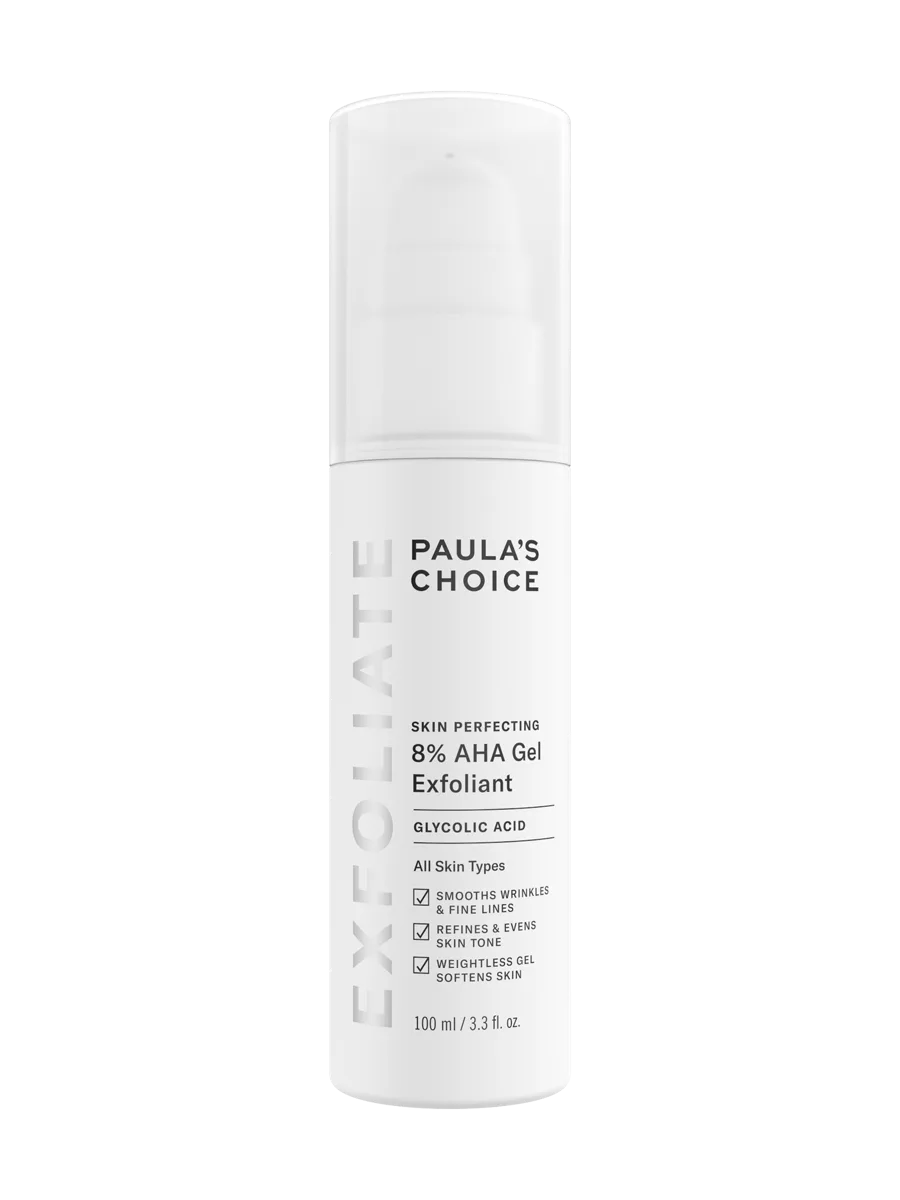
Skin Perfecting 8% AHA Gel Exfoliant
Surface Renewal Powerhouse
 Verified reviewer
Pros & cons.
- +8% glycolic acid delivers clinical-grade resurfacing for texture, dullness, and fine lines
- +Chamomile, aloe, and panthenol provide genuine soothing support for daily acid use
- +Sodium hyaluronate prevents the dryness and tightness typical of glycolic acid products
- +Gel format ensures even distribution and consistent results across the face
- +Visible brightness improvement from the very first application
- +Fragrance-free, alcohol-free, and cruelty-free formulation
- −Increases photosensitivity — requires strict daily sunscreen commitment
- −Not suitable for sensitive, rosacea-prone, or barrier-compromised skin
- −Stinging on first use can be off-putting for acid-exfoliant newcomers
- −Slight tackiness after application until moisturizer is layered on top
- −Some users experience flaking during the first week of adjustment
The full review.
Paula’s Choice excels at making potent actives feel unremarkable. Their 2% BHA Liquid Exfoliant became a legend through boring effectiveness, and this 8% AHA Gel Exfoliant uses the same strategy — a high concentration of glycolic acid paired with enough soothing ingredients to make daily use pleasant.
The formula centers on 8% glycolic acid, the smallest and most penetrating AHA. At this concentration, clinical studies show real results: it dissolves the intercellular glue between dead skin cells, stimulates fresh cell turnover, and — with sustained use — increases collagen synthesis. This is not a gentle cosmetic polish. It is a resurfacing treatment in an over-the-counter tube.
Formulation intelligence sets this apart from other glycolic acid products. Chamomile extract delivers bisabolol, an effective anti-inflammatory compound, to skin undergoing active exfoliation. Aloe vera juice provides immediate cooling and hydration. Sodium hyaluronate draws water into the newly revealed layers to prevent the dryness glycolic acid often causes. Panthenol — provitamin B5 — accelerates the skin’s natural repair process, helping the barrier recover from the controlled damage exfoliation inflicts.
The gel format works well. Unlike runny liquids or surface-sitting creams, a gel spreads evenly, stays in place, and deposits the acid in a thin, uniform layer. This ensures consistent results: every square centimeter of your face receives the same concentration. The gel absorbs within about a minute, leaving a thin film that vanishes once you apply moisturizer.
The experience matches the science. First-time users will feel a tingling sensation ranging from mild to unmistakable, depending on acid tolerance. It is not painful; it feels like a fizz that subsides within two minutes. The instant payoff is visible brightness the next morning. Skin looks polished and bright. Over weeks, this effect compounds: texture smooths, dark spots fade, and fine lines look less pronounced.
The limitations come from glycolic acid itself. It increases photosensitivity, so you must use sunscreen. It is not for sensitized, barrier-compromised, or rosacea-prone skin — the calming ingredients help, but they cannot neutralize 8% glycolic acid for reactive skin. While the pH of around 3.8 is appropriate for efficacy, this product carries a stinging potential that sensitive-skin users must respect.
The value is clear: $37 for 3.3 ounces. A pea-sized amount covers the full face, so a tube lasts three to four months of nightly use. This is competitive with salon-grade AHA products and cheaper than prescription retinoids for concerns like texture, brightness, and mild hyperpigmentation.
Paula’s Choice has refined this formula for over two decades. This product does not try to be revolutionary; it tries to be right. The glycolic acid delivers measurable resurfacing. The soothing complex makes that resurfacing sustainable. The gel vehicle distributes everything evenly and disappears. Sometimes the most impressive thing a product does is make a potent active feel effortless.
Ingredient analysis.
Full INCI list · pH 3.8
Water (Aqua), Glycolic Acid, Sodium Hydroxide, Chamomilla Recutita (Matricaria) Flower Extract, Aloe Barbadensis Leaf Juice, Camellia Oleifera (Green Tea) Leaf Extract, Sodium Hyaluronate, Panthenol, Sodium PCA, Propylene Glycol, Butylene Glycol, Hydroxyethylcellulose, Polyquaternium-10, Phenoxyethanol, Sodium Benzoate
Skin match.
The science.
The Science
Dermatology well-documents glycolic acid's efficacy for skin renewal. It works by disrupting ionic bonds between corneocytes in the stratum corneum, which accelerates desquamation and promotes fresh cell proliferation from the basal layer. A 1996 double-blind study in the Journal of the American Academy of Dermatology shows AHA treatment produced an approximately 25% increase in epidermal thickness, improved elastic fiber quality, and increased dermal collagen density.
This formula uses an 8% concentration at a pH near 3.8 to deliver a substantial amount of free (un-neutralized) glycolic acid—the form that penetrates the stratum corneum effectively. Research in Dermatologic Surgery shows glycolic acid concentrations between 5-10% at appropriate pH levels produce clinical improvement in photodamaged skin, including reduced rough texture, decreased fine wrinkling, and more even pigmentation.
A 2021 study in the Journal of Cosmetic Dermatology found that glycolic acid adjusted to pH 4 stimulated collagen production and epidermal renewal in human skin explants without increasing pro-inflammatory TNF-alpha levels. This shows well-formulated AHA products deliver anti-aging benefits without triggering chronic inflammation. The chamomile extract in this formula supports this inflammation-management approach through its bisabolol content.
The sodium hyaluronate in the formula addresses a known glycolic acid limitation: its tendency to compromise the skin's moisture barrier with sustained use. This humectant draws water into the epidermis to partially compensate for the barrier disruption inherent to AHA exfoliation, allowing more consistent daily use.
References
- Effects of alpha-hydroxy acids on photoaged skin: a pilot clinical, histologic, and ultrastructural study — Journal of the American Academy of Dermatology (1996)
- Glycolic acid adjusted to pH 4 stimulates collagen production and epidermal renewal without affecting levels of proinflammatory TNF-alpha in human skin explants — Journal of Cosmetic Dermatology (2021)
Dermatologist Perspective
Dermatologists view glycolic acid as a top over-the-counter option for photoaging, uneven texture, and mild hyperpigmentation. Board-certified dermatologists often recommend AHA products at 5-10% concentration to complement—or sometimes replace—prescription retinoids for patients who cannot tolerate retinol. This formula includes chamomile, panthenol, and hyaluronic acid, which follows dermatological guidance to pair exfoliating actives with anti-inflammatory and hydrating support. Dermatologists emphasize that daily broad-spectrum sunscreen is mandatory when using any AHA product, because glycolic acid increases UV sensitivity by thinning the protective dead cell layer.
Where it fits in your routine.
Apply a small amount to clean, dry skin at night. Spread it evenly over the face, but avoid the immediate eye area. Do not rinse. Wait about one minute for absorption, then use serums and moisturizer. Use every other night for the first two weeks, then use nightly as tolerated. Apply broad-spectrum SPF 30+ every morning without exception.
At $37 for 3.3 ounces, this provides clinical-grade glycolic acid exfoliation for much less than in-office chemical peel costs. One tube lasts 3-4 months with nightly use. This makes the per-use cost about $0.35—good value for a product that treats texture, dullness, fine lines, and hyperpigmentation at once. A travel size exists for testing tolerance before buying a full tube.
This works for dull, rough, or uneven-textured skin, early signs of aging, sun damage, or mild hyperpigmentation. It suits normal, combination, and dry skin types wanting a daily-use AHA that does not strip the skin.
Use this for sensitive skin, active rosacea, eczema, or a compromised skin barrier. Avoid this if you do not use daily sunscreen, as glycolic acid increases photosensitivity.
Product details.
This clear, lightweight gel spreads easily and absorbs in 30-60 seconds. It leaves a slight tackiness that disappears after applying moisturizer.
Fragrance-free. The glycolic acid has a faint, barely perceptible chemical scent that dissipates immediately.
Squeeze tube with a screw cap. Allows controlled dispensing and is more hygienic than jar packaging. The opaque tube protects the formula from light degradation.
Expect mild tingling during the first application. The glycolic acid causes this, and it subsides within 1-2 minutes. Some users see an immediate glow after the first use. Mild flaking may occur during the first week as dead skin sheds; this resolves as skin adjusts to the exfoliation schedule.
3-4 months with nightly face application
12 months
All Year
The backstory.
Paula's Choice developed this as the AHA counterpart to their legendary BHA exfoliant. Where the BHA targets oily, acne-prone skin, this gel was designed for the texture, dullness, and fine line concerns that AHAs address best. The inclusion of soothing botanicals and humectants reflects lessons learned from years of customer feedback about acid tolerance.
About Paula's Choice
Established Brand (5–20 years)Paula Begoun founded Paula's Choice in 1995. She built her reputation on research-backed formulations and ingredient transparency. Unilever acquired the brand in 2021, but Paula's Choice remains a science-first skincare benchmark.
Common myths.
AHA exfoliants thin the skin
Glycolic acid removes dead surface cells, but clinical studies show it stimulates collagen production and increases epidermal thickness over time. A 1996 study in the Journal of the American Academy of Dermatology found that AHA treatment increased skin thickness by approximately 25%.
You can't use AHA and BHA together
Using this and the 2% BHA in one routine can be too much for some. Many users alternate: BHA in the morning for pore clarity and AHA in the evening for surface renewal. Build tolerance gradually.
FAQ.
What's the difference between this AHA and Paula's Choice 2% BHA?
They target different concerns. The 2% BHA (salicylic acid) is oil-soluble and works inside pores to clear blackheads and acne. This 8% AHA (glycolic acid) works on the skin's surface to dissolve dead cells, improve texture, fade dark spots, and reduce fine lines. Many users alternate both for comprehensive exfoliation.
Can I use this AHA with retinol?
Yes, but use caution. Both glycolic acid and retinol increase cell turnover, so combining them causes dryness or irritation. Alternate nights—use this AHA one night and retinol the next. Layer them in the same routine only after your skin builds tolerance to each individually.
Do I need to wear sunscreen when using this product?
Glycolic acid increases photosensitivity by removing the protective dead cell layer. Use broad-spectrum SPF 30 or higher daily when using any AHA product, even on cloudy days. Apply this product at night and sunscreen every morning.
Is 8% glycolic acid too strong for beginners?
Skin type matters. For normal to combination skin, 8% works without irritation because this formula has chamomile and aloe. Use it every other night, then move to nightly use. If you have very sensitive skin, start with a lower-concentration AHA first.
How long before I see results from glycolic acid?
Most users see smoother, brighter skin after 3-5 applications. Uneven skin tone and dark spots improve at 4-6 weeks. Fine line reduction and texture improvement show after 8-12 weeks of consistent nightly use.
Community
What the community says.
"Dramatically improves skin texture and brightness"
"Gel format is pleasant and easy to use"
"Visible results within the first week"
"Gentle enough for daily use with proper moisturizing"
"Can cause stinging on first use or if skin is compromised"
"Not suitable for very sensitive skin types"
"Some users experience flaking during adjustment period"
"Requires disciplined sunscreen use"
People also looked at.