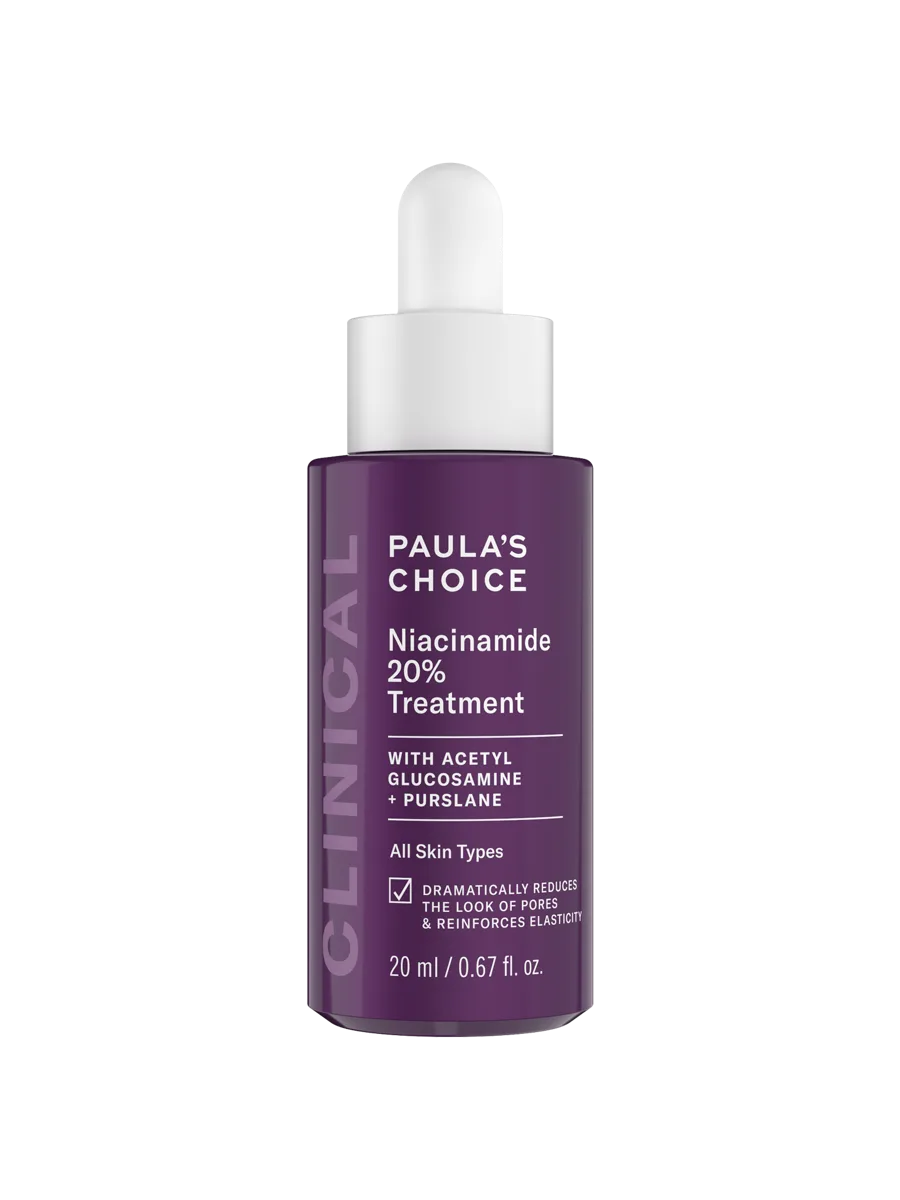
20% Niacinamide Treatment
Maximum Strength Pore Treatment
 Verified reviewer
Pros & cons.
- +Highest commercially available niacinamide concentration from a major evidence-based brand
- +Gel texture with pullulan provides immediate pore-blurring alongside long-term active benefits
- +Meadowsweet extract uniquely targets MMP-driven collagen degradation around pore structures
- +Completely fragrance-free, silicone-free, and paraben-free with a clean ingredient list
- +Pregnancy-safe at any niacinamide concentration — rare for high-strength treatments
- +Effective oil control and matte finish particularly suited for oily skin types
- +Multi-pathway brightening with acetyl glucosamine, vitamin C derivative, and licorice extract
- −Clinical evidence specifically supporting 20% over 10% niacinamide is limited
- −More frequent temporary flushing compared to lower-concentration niacinamide products
- −Expensive for a small 0.67 oz bottle with a narrower use case than the 10% Booster
- −Gel texture may feel slightly drying for non-oily skin types with prolonged use
- −Not as versatile as the 10% Booster — designed for targeted application rather than mixing
The full review.
When a brand that built its reputation on scientific rigor decides to release a product at double the concentration anyone else offers, it’s worth asking whether they’re following the evidence or chasing a bigger number for the label. With the Clinical 20% Niacinamide Treatment, Paula’s Choice appears to be doing a bit of both — and the result is a product that’s genuinely useful for a specific audience, even if that audience is smaller than the marketing might suggest.
The context matters. Paula’s Choice already had the 10% Niacinamide Booster, one of the best-regarded niacinamide products on the market. This 20% Treatment wasn’t created to replace it — it was created for the people who used the 10% faithfully and still couldn’t get their pores to cooperate. That’s a real population. Enlarged pores, particularly on the nose and inner cheeks, are stubbornly resistant to topical treatment, and some skin simply seems to need a higher dose before niacinamide’s sebum-regulating and pore-tightening effects kick in.
The formula isn’t just twice the niacinamide — it’s a fundamentally different product from the 10% Booster. The gel texture replaces the liquid format, designed for targeted application to problem areas rather than mixing into other products. The botanical supporting cast includes meadowsweet extract, which brings natural salicylate derivatives and MMP-inhibiting activity to address the collagen degradation around pore openings that makes them look stretched. Purslane extract adds anti-inflammatory heft to help manage the increased flushing potential that comes with doubling the niacinamide concentration. And pullulan — a clever addition — provides an immediate tightening film that blurs pore appearance on contact while the actives work on longer-term structural improvements.
The acetyl glucosamine and ascorbyl glucoside carry over from the 10% formula, maintaining the multi-pathway brightening approach. Licorice root, allantoin, panthenol, and green tea catechins round out a supporting cast that reads like a soothing ingredients encyclopedia — necessary, because at 20%, the formula needs all the calming support it can get.
Texture
The gel texture deserves comment. It’s lightweight, absorbs cleanly, and sits well under moisturizer without pilling. There’s a subtle matte quality from the silica that makes it particularly pleasant for oily skin, and it doesn’t leave the slight tackiness that some gel formulations suffer from. It’s clearly designed for application to the T-zone and pore-prone areas rather than full-face slathering, which is the right approach for a concentration this high.
Packaging
The opaque tube packaging protects the formula adequately and allows controlled dispensing.
Works for
Those with genuinely stubborn enlarged pores — particularly oily-skinned individuals who found the 10% Booster helpful but insufficient — report measurable improvement with the 20%.
Not ideal for
For everyone else — and that’s most people — the 10% Niacinamide Booster remains the smarter, more versatile choice.
Ingredient analysis.
Full INCI list
Water (Aqua), Niacinamide, Pentylene Glycol, Butylene Glycol, Glycerin, Acetyl Glucosamine, Ascorbyl Glucoside, Glycyrrhiza Glabra (Licorice) Root Extract, Spiraea Ulmaria (Meadowsweet) Extract, Portulaca Oleracea (Purslane) Extract, Camellia Japonica Flower Extract, Epigallocatechin Gallate, Boerhavia Diffusa Root Extract, Camellia Sinensis (Green Tea) Leaf Extract, Allantoin, Lecithin, Pullulan, Panthenol, Silica, Xanthan Gum, Sclerotium Gum, Propanediol, Sodium Phytate, Phenoxyethanol, Ethylhexylglycerin
Skin match.
The science.
The Science
Niacinamide has an extensive evidence base, but limited clinical data shows if 20% performs better than 10%. Most landmark niacinamide studies, such as the Bissett et al. work in Dermatologic Surgery (2005), tested 5% concentrations. A 2021 review in Antioxidants (MDPI) confirms niacinamide boosts NAD+ biosynthesis, increases ceramide and free fatty acid production in the stratum corneum, and inhibits melanosome transfer. These mechanisms theoretically benefit from higher concentrations until a saturation point, though no one has definitively established that point.
The meadowsweet extract (Spiraea ulmaria) in this formula uses a different mechanism than niacinamide alone. Published research shows plant-derived salicylate compounds and tannins inhibit matrix metalloproteinases (MMPs), the enzymes that degrade collagen and elastin near pore structures. This MMP inhibition may explain why some users see pore improvements with this formula that niacinamide-only products did not provide.
Research shows Purslane extract (Portulaca oleracea) has anti-inflammatory properties and can reduce pro-inflammatory cytokine production. In a high-concentration niacinamide formula where temporary vasodilation-induced flushing occurs more often, this anti-inflammatory support aids both tolerability and skin health, as chronic low-grade inflammation contributes to pore enlargement and skin aging.
The acetyl glucosamine and niacinamide combination shows synergistic hyperpigmentation reduction in Kimball et al. research. Higher niacinamide concentrations may amplify this effect, though no one has studied this specific interaction at the 20% level.
References
- Niacinamide: A B vitamin that improves aging facial skin appearance — Dermatologic Surgery (2005)
- Mechanistic Basis and Clinical Evidence for the Applications of Nicotinamide (Niacinamide) to Control Skin Aging and Pigmentation — Antioxidants (MDPI) (2021)
Dermatologist Perspective
Dermatologists call niacinamide one of the safest and most versatile topical actives, but many question the clinical necessity of a 20% concentration. Board-certified dermatologists note that published evidence supports niacinamide benefits at 2-10%, and controlled studies have not established the incremental benefit of doubling beyond 10%. However, dermatologists recognize that individual patient response varies, and some patients with stubborn pore concerns may benefit from higher concentrations if lower ones fail. Dermatologists appreciate the clean, fragrance-free formula and pregnancy-safe profile.
Where it fits in your routine.
Apply a thin layer of the gel to clean, dry skin on areas of concern—usually the T-zone, nose, and inner cheeks where pores show most. Let it absorb for 1-2 minutes before applying moisturizer. Use it morning and evening. In the morning, follow with sunscreen. If you experience flushing, start with once-daily evening use and increase frequency as tolerance builds. The gel goes under or over lighter serums but goes on before moisturizer.
At $54 for 0.67 fl oz, the price matches the Paula's Choice 10% Niacinamide Booster but the use case is narrower. Targeted application means the bottle lasts longer than the 10% Booster used twice daily on the full face — likely 3-4 months of T-zone application. The premium over simpler niacinamide products is justified only if lower concentrations failed you. This is an escalation product; it is worth the investment only if you have exhausted more affordable first-line options.
Oily to combination skin with persistent enlarged pores, stubborn texture, or clogged bumps that do not respond to standard 5-10% niacinamide products. This works well for users of the 10% Booster who want more aggressive pore treatment without adding retinoids or acids.
If 10% niacinamide manages your pore and texture concerns, you do not need 20%. The high concentration and gel texture may cause dryness or flushing in dry and sensitive skin types. Budget-conscious consumers can try the 10% Booster first.
Product details.
Lightweight gel has a smooth, non-sticky consistency. It is slightly thicker than the 10% Booster's liquid format and works for targeted application to pore-prone areas.
No added fragrance — neutral scent
An opaque tube with a controlled dispensing tip protects the formula from light and air. This design allows precise application to targeted areas.
The pullulan causes an immediate, subtle tightening sensation as it absorbs quickly. Some users feel mild, temporary flushing — more common at this 20% concentration than with lower-strength niacinamide products. This harmless vasodilation response typically subsides within 15-20 minutes and diminishes with continued use.
2-3 months with once or twice daily targeted application
12 months
All Year
The backstory.
Paula's Choice developed this as an escalation product for customers whose pore and texture concerns didn't fully respond to the 10% Booster. The 20% concentration was a calculated risk — no major brand had gone this high before — driven by customer feedback requesting stronger niacinamide options for persistent enlarged pores and stubborn clogged bumps that standard concentrations couldn't address.
About Paula's Choice
Established Brand (5–20 years)Paula Begoun, a cosmetics industry critic, founded Paula's Choice in 1995. She built the brand on evidence-based formulation and ingredient transparency. Skincare enthusiasts and dermatologists trust the brand's research-driven approach, and independent sources have reviewed it throughout its nearly three-decade history.
Common myths.
Double the niacinamide percentage means double the results.
Niacinamide concentration and efficacy do not have a linear relationship. Most clinical studies showing significant benefits use 2-5% niacinamide. 20% niacinamide can work faster but also causes temporary flushing. This product targets stubborn concerns that fail to respond to lower concentrations, rather than acting as a first-line treatment for everyone.
High-concentration niacinamide can damage the skin barrier.
Niacinamide strengthens the skin barrier by boosting ceramide production, even at 20%, unlike high-concentration acids or retinoids. Temporary flushing in some users is a vasodilation response, not barrier damage. Allantoin, panthenol, and botanical extracts in the formula provide more barrier support.
FAQ.
Is 20% niacinamide better than 10%?
Not necessarily. Most clinical research shows significant benefits at 2-5% niacinamide. The 20% concentration targets stubborn pores and texture concerns that fail to respond to lower concentrations. If the 10% Booster or similar products work well for you, do not upgrade. This is an escalation product for persistent concerns, not a universally better option.
Will 20% niacinamide cause flushing?
20% concentrations cause more temporary flushing than lower concentrations. This harmless vasodilation response is not an allergic reaction or sign of damage. It usually subsides within 15-20 minutes and often diminishes with continued use. The formula's allantoin, panthenol, and purslane extract help minimize this response.
Can I use this on my whole face or just problem areas?
Paula's Choice recommends applying this to specific areas like the T-zone, nose, and cheeks where pores show most. You can use it on the full face, but the 20% concentration and gel texture target stubborn pore areas instead of all-over application.
How is this different from the Paula's Choice 10% Niacinamide Booster?
The 20% Treatment differs from the 10% Booster in concentration and texture, using a gel instead of a liquid. The 20% Treatment targets specific pores rather than all-over brightening. It contains meadowsweet to inhibit MMP and pullulan for immediate pore-blurring. The 10% Booster works better for general brightening and evening skin tone; the 20% Treatment targets stubborn pores and bumps.
Is Paula's Choice 20% Niacinamide Treatment safe during pregnancy?
Yes — niacinamide is safe during pregnancy and breastfeeding at any concentration. This formula has no retinoids, no high-concentration acids, and no ingredients flagged for pregnancy concerns. It is one of the few high-strength treatments pregnant individuals can use freely.
What the community says.
"Visible pore refinement with consistent use"
"Excellent oil control throughout the day"
"Smooth gel texture absorbs cleanly without tackiness"
"Noticeable improvement in skin texture and brightness"
"Fragrance-free and gentle despite the high concentration"
"Temporary flushing occurs more frequently than with 10% products"
"Expensive for the small bottle size"
"Some users see no additional benefit over the 10% Booster"
"Gel texture can feel slightly drying for non-oily skin types"
"Strong concentration may not be necessary for most users"
People also looked at.