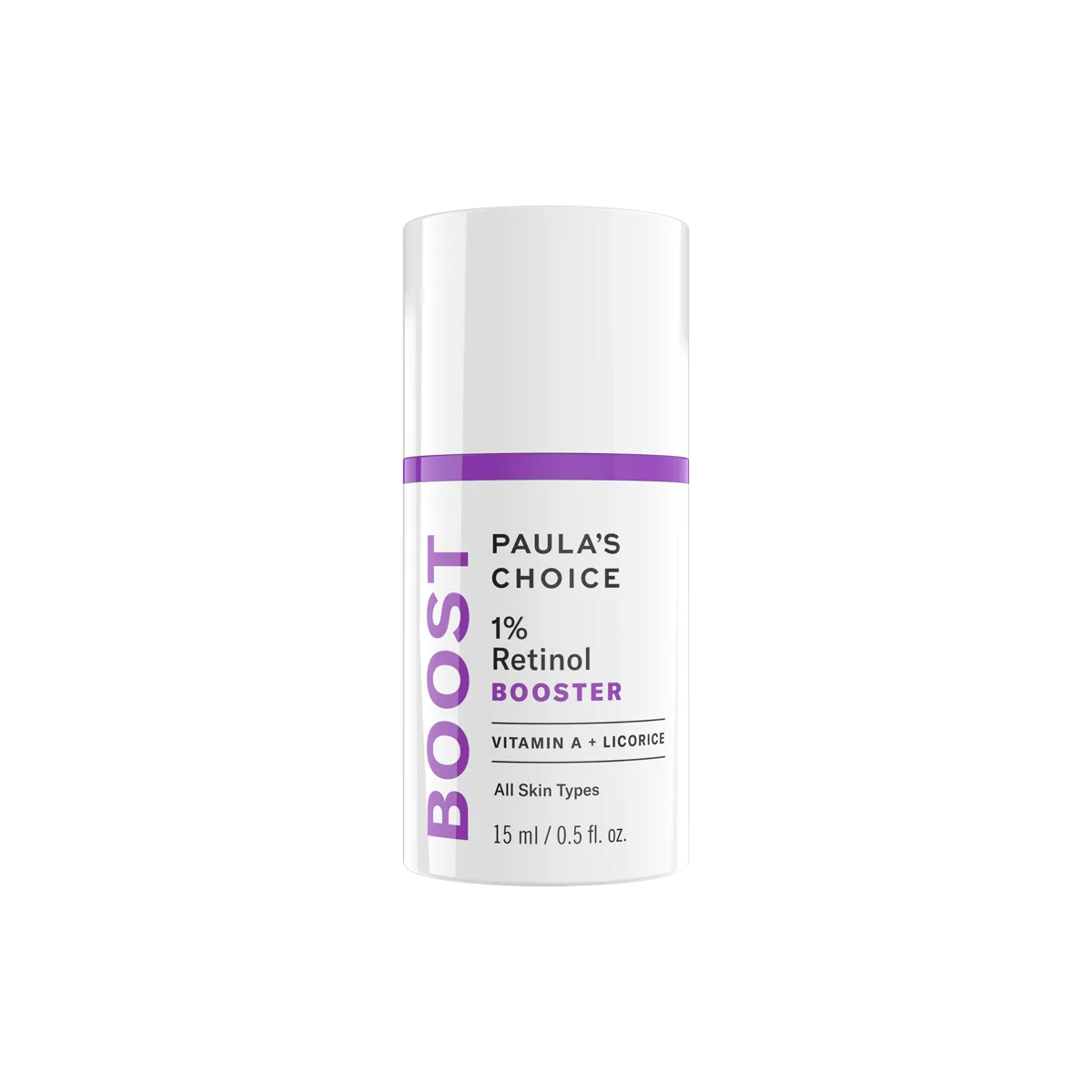
1% Retinol Booster
High-Strength Retinol Standard
 Verified reviewer
Pros & cons.
- +Full 1% retinol concentration — among the strongest available without a prescription
- +Booster format allows customizable intensity by controlling drops and mixing ratio
- +Encapsulated retinol delivery reduces irritation spike compared to free retinol at the same concentration
- +Ceramide, peptide, and botanical soothing agents designed specifically to buffer retinol irritation
- +Completely fragrance-free, dye-free, and silicone-free with a minimal clean ingredient list
- +Opaque squeeze tube packaging protects light-sensitive retinol from degradation
- +Cruelty-free and vegan certified
- −At $55 for 0.5 fl oz, the per-ounce cost is steep even for a concentrated formula
- −The 1% concentration causes significant retinization — peeling, redness, and tightness — during the adjustment period
- −Too strong for sensitive skin, rosacea, eczema, or compromised barriers even with the soothing ingredients
- −Small bottle size can feel psychologically unsatisfying despite lasting 2-3 months
- −Not pregnancy-safe due to retinol content
The full review.
Most retinol products give you a fixed dose and wish you luck. Paula’s Choice had a different idea: what if the consumer could control the intensity? The 1% Retinol Booster launched as a category outlier — not a cream, not a serum in the traditional sense, but a concentrated fluid designed to be mixed into whatever you’re already using. It’s a small design decision that solves a real problem, because the gap between ‘my skin can handle retinol’ and ‘my skin is on fire’ is often just a few percentage points.
The concept is elegant. Two drops mixed into a rich night cream delivers a gentle retinol experience. Three drops applied directly to bare skin delivers something considerably more assertive. This means a single product can serve you from your first tentative retinol experience through years of tolerance building — which, given the price, is a genuine value proposition even if the sticker shock of $55 for half an ounce hits hard.
Let’s talk about what’s inside. The 1% retinol concentration places this firmly in the high-strength OTC category. For context, most drugstore retinol products hover around 0.1-0.3%, and even many prestige serums top out at 0.5%. One percent is the ceiling for what most people can tolerate without a prescription, and Paula’s Choice formulates accordingly — the retinol is encapsulated in safflower oleosomes, which creates a time-release effect that reduces the intensity spike responsible for much of the redness and flaking associated with strong retinol products.
The supporting formula reads like a checklist of everything a high-strength retinol needs. Ceramide 3 shores up the barrier that retinol can compromise. Licorice root extract and oat kernel extract provide anti-inflammatory and soothing properties that directly counter retinol irritation. Palmitoyl tripeptide-1 adds a second pathway for collagen stimulation. Even the vitamin C derivative tucked into the formula — bis-glyceryl ascorbate — provides complementary brightening without the pH conflicts of L-ascorbic acid. This isn’t a formula where they threw retinol into a generic base and called it a day.
The texture is thin and fluid with a faintly oily quality from the oleosomes. It absorbs quickly, doesn’t pill, and blends invisibly into other products — which is exactly what a booster needs to do. There’s no fragrance, no dyes, no unnecessary additives. Paula Begoun built her career on calling out the skincare industry’s BS, and this product embodies that philosophy: nothing in here that doesn’t serve a purpose.
Results are real but require the patience that all retinol demands. The first two to four weeks bring retinization — mild peeling, tightness, possible redness. This is normal, expected, and temporary. By week four to six, texture improvements become visible: smoother skin, more even tone, a clarity that wasn’t there before. The meaningful wrinkle reduction and hyperpigmentation fading that justifies the price typically emerges at the eight to twelve week mark. This is not a quick fix. It’s an investment in your skin’s long game.
The honest limitations: the price is hard to defend on a per-ounce basis. $55 for 0.5 ounces makes this one of the more expensive retinol options per unit volume, even if the concentrated format means it lasts two to three months. The 1% concentration, while effective, is genuinely too strong for anyone with reactive skin, rosacea, or a compromised barrier — the soothing ingredients help but can’t entirely negate the intensity. And if you’re pregnant or planning to become pregnant, retinol at any concentration is off the table.
There’s also the question of whether the booster format, clever as it is, creates a false sense of security. Mixing two drops into moisturizer does dilute the product, but it doesn’t change the fact that retinol is retinol — even diluted, it’s still driving cell turnover and can still cause irritation if your skin isn’t ready. The flexibility is real, but it’s not a free pass to skip the adjustment period.
The packaging deserves credit. An opaque squeeze tube with a small dispensing tip protects the retinol from the light and air degradation that plagues jar-packaged retinol products. You get precise, drop-by-drop control, and the product stays fresh until the last squeeze. It’s a small detail that makes a real difference when the active ingredient is as light-sensitive as retinol.
Paula’s Choice positions this as the thinking person’s retinol, and that’s fair. The formula is smarter than most. The delivery system is well-considered. The results, for those with the patience and the skin tolerance to get there, are genuine. Whether it’s worth the premium over less expensive retinol options depends on how much you value the booster format’s flexibility and the exceptionally clean supporting ingredient list.
Formula
Texture
The texture is thin and fluid with a faintly oily quality from the oleosomes. It absorbs quickly, doesn’t pill, and blends invisibly into other products — which is exactly what a booster needs to do.
Scent
There’s no fragrance, no dyes, no unnecessary additives. Paula Begoun built her career on calling out the skincare industry’s BS, and this product embodies that philosophy: nothing in here that doesn’t serve a purpose.
Best for
Results are real but require the patience that all retinol demands. The first two to four weeks bring retinization — mild peeling, tightness, possible redness. This is normal, expected, and temporary. By week four to six, texture improvements become visible: smoother skin, more even tone, a clarity that wasn’t there before. The meaningful wrinkle reduction and hyperpigmentation fading that justifies the price typically emerges at the eight to twelve week mark. This is not a quick fix. It’s an investment in your skin’s long game.
Not ideal for
The honest limitations: the price is hard to defend on a per-ounce basis. $55 for 0.5 ounces makes this one of the more expensive retinol options per unit volume, even if the concentrated format means it lasts two to three months. The 1% concentration, while effective, is genuinely too strong for anyone with reactive skin, rosacea, or a compromised barrier — the soothing ingredients help but can’t entirely negate the intensity. And if you’re pregnant or planning to become pregnant, retinol at any concentration is off the table.
How to Use
There’s also the question of whether the booster format, clever as it is, creates a false sense of security. Mixing two drops into moisturizer does dilute the product, but it doesn’t change the fact that retinol is retinol — even diluted, it’s still driving cell turnover and can still cause irritation if your skin isn’t ready. The flexibility is real, but it’s not a free pass to skip the adjustment period.
Packaging
The packaging deserves credit. An opaque squeeze tube with a small dispensing tip protects the retinol from the light and air degradation that plagues jar-packaged retinol products. You get precise, drop-by-drop control, and the product stays fresh until the last squeeze. It’s a small detail that makes a real difference when the active ingredient is as light-sensitive as retinol.
Ingredient analysis.
Full INCI list
Water (Aqua), Glycereth-7 Triacetate, Glycerin, Carthamus Tinctorius Oleosomes, Isopentyldiol, Polyglyceryl-10 Behenate/Eicosadioate, Butylene Glycol, Pyrus Malus Fruit Extract, Polysorbate 20, Retinol, Glycyrrhiza Glabra Root Extract, Ceramide 3, Palmitoyl Tripeptide-1, Avena Sativa Kernel Extract, Epilobium Angustifolium Flower/Leaf/Stem Extract, Arctium Lappa Root Extract, Salix Alba Bark Extract, Allantoin, Dipotassium Glycyrrhizate, Caprylyl Glycol, Polyglyceryl-10 Laurate, Dipentaerythrityl Tri-Polyhydroxystearate, Ethylhexyl Methoxycrylene, Hydrogenated Lecithin, Bis-Glyceryl Ascorbate, Disodium EDTA, Sorbic Acid, Xanthan Gum, Phenoxyethanol
Skin match.
The science.
The Science
Retinol is the most studied over-the-counter anti-aging ingredient. At 1% concentration, this booster delivers a clinically significant dose. A 2007 study in the Archives of Dermatology by Kafi et al. shows that topical retinol application to naturally aged skin increases glycosaminoglycan expression and procollagen I immunostaining—the structural proteins for skin firmness and resilience. After 24 weeks, retinol-treated skin showed statistically significant improvement in fine wrinkling compared to vehicle-treated control skin.
A 2015 double-blind, vehicle-controlled trial in the Journal of Drugs in Dermatology evaluated stabilized retinol over 52 weeks. It found significant improvements in crow's feet fine lines (44% reduction) and mottled pigmentation (84% reduction). Histological analysis confirmed increased epidermal thickness and better collagen fiber organization.
The safflower oleosomes encapsulation technology works for more than marketing. By slowing retinol release into the skin, it reduces the peak concentration reaching the epidermis at any moment. This does not reduce total retinol delivery over time, but it reduces the inflammatory spike that causes the irritation, redness, and peeling common with high-strength retinol products.
Ceramide 3 is relevant for a high-strength retinol formula. Retinol accelerates cell turnover, which can temporarily compromise the stratum corneum's lipid barrier. Ceramide 3 replenishes the intercellular lipid matrix, helping maintain barrier integrity during the retinization period. The licorice root extract (glycyrrhiza glabra) provides glabridin, which inhibits tyrosinase activity—complementing retinol's melanin-regulating effects through a separate biochemical pathway.
References
- Improvement of naturally aged skin with vitamin A (retinol) — Archives of Dermatology (2007)
- One-year topical stabilized retinol treatment improves photodamaged skin in a double-blind, vehicle-controlled trial — Journal of Drugs in Dermatology (2015)
- Retinoids in the treatment of skin aging: an overview of clinical efficacy and safety — Clinical Interventions in Aging (2006)
Dermatologist Perspective
Dermatologists view 1% retinol as the upper limit most patients tolerate without a prescription retinoid. Board-certified dermatologists often recommend Paula's Choice retinol products to patients seeking anti-aging results who do not want or cannot use prescription tretinoin. The formula's ceramide and anti-inflammatory botanicals follow dermatological guidance to pair retinol with barrier-supporting ingredients. Dermatologists advise starting any retinol product—especially at this concentration—with every-other-night use and a gradual increase. They also emphasize that daily broad-spectrum sunscreen is non-negotiable when using retinol.
Where it fits in your routine.
Mix 2 drops into your evening moisturizer every other night for the first 2-4 weeks. If you have good tolerance (minimal redness, no persistent peeling), use it nightly. Gradually increase to 2-3 drops directly on clean, dry skin before moisturizer for maximum potency. Always apply to dry skin; dampness increases retinol penetration and irritation. Follow with a thick moisturizer. Apply broad-spectrum SPF 30+ every morning because retinol increases photosensitivity.
At $55 for 0.5 fl oz, the price is premium. But the concentrated booster format uses only 2-3 drops per use, so the bottle lasts 2-3 months. This makes the effective monthly cost roughly $18-27. The 1% retinol concentration, encapsulated delivery, ceramide, peptide, and soothing botanicals make this a sophisticated formula that justifies a premium over simpler retinol products. The question is if the booster format's flexibility justifies the markup over Paula's Choice's Clinical 1% Retinol Treatment, which has double the volume at a similar price and a thicker texture.
Experienced retinol users can fine-tune this high-strength formula to their skin's tolerance. Motivated beginners who understand the adjustment period can also use it to transition from cautious introduction to full-strength nightly use.
The 1% concentration is too aggressive for anyone with sensitive skin, active rosacea, eczema, or a compromised skin barrier, despite the soothing support ingredients. Pregnant or nursing individuals must avoid this product entirely. Complete retinol beginners can use a 0.3% retinol product as a less intense starting point.
Product details.
Thin, lightweight fluid feels slightly oily due to safflower oleosomes. It absorbs fast and layers well under moisturizer or mixed into other products.
No added fragrance — minimal raw ingredient scent
An opaque squeeze tube with a small dispensing tip protects retinol from light and air degradation and allows precise drop-by-drop dispensing.
Expect mild tingling or warmth on first application, especially on bare skin. Retinization—mild flaking, tightness, and possible redness—usually starts within the first week and lasts 2-4 weeks. This is normal and does not mean skin damage. Use every other night and buffer with moisturizer to manage the adjustment.
2-3 months with nightly use of 2-3 drops
12 months
All Year
The backstory.
Paula Begoun built her brand on calling out skincare industry BS, and this product reflects that ethos — no fragrance, no dyes, no filler ingredients, just a high-concentration retinol in a formula engineered to manage the irritation that comes with it. The booster format was a category innovation when it launched, letting users customize their retinol strength by controlling how many drops they mixed in.
About Paula's Choice
Established Brand (5–20 years)Paula Begoun, a cosmetics industry critic, founded Paula's Choice in 1995. She built the brand on evidence-based formulation and ingredient transparency. Skincare enthusiasts and dermatologists trust the brand's research-driven approach, and independent sources have reviewed it throughout its nearly three-decade history.
Common myths.
Start with lower retinol percentages before using 1% retinol.
Gradual introduction works best, but the booster format allows built-in titration. Mix one drop into a generous amount of moisturizer to dilute the concentration. Increase the ratio as tolerance builds. This makes the product flexible for different experience levels.
Retinol thins the skin over time.
This is backwards. Retinol increases epidermal thickness by stimulating cell proliferation and collagen production. Initial flaking creates the impression of thinning, but the long-term effect is thicker, more resilient skin with increased collagen density.
FAQ.
Can I use the 1% Retinol Booster with vitamin C?
Yes, but use them at different times. Apply vitamin C serum in the morning for antioxidant protection, and use this retinol booster at night. The formula contains bis-glyceryl ascorbate, a stable vitamin C derivative, which provides brightening without the pH conflict of layering L-ascorbic acid directly with retinol.
How is the Retinol Booster different from Paula's Choice Clinical 1% Retinol Treatment?
Both contain 1% retinol. The Booster has a thin fluid texture to mix into other products, which works for oily and combination skin. The Clinical Treatment has a thick lotion texture for standalone use, better for normal to dry skin types. The Booster comes in a 0.5 oz size, while the Clinical Treatment is 1 oz.
Why is the bottle so small for the price?
The 0.5 fl oz bottle looks small, but one application uses only 2-3 drops. A full bottle lasts 2-3 months with nightly use. This concentrated format keeps the formula stable. Retinol degrades when exposed to air, so a smaller bottle that empties faster ensures fresher product.
Can I use this retinol booster every night?
Yes, eventually—but build up slowly. For the first 2-4 weeks, use it every other night mixed into moisturizer. If your skin tolerates it without irritation, use it nightly. Users with sensitive or dry skin often find every-other-night use works best long-term and still delivers anti-aging results.
What the community says.
"Noticeable improvement in skin texture and radiance within weeks"
"Fluid texture mixes easily into other products"
"Fragrance-free and minimal unnecessary additives"
"Effective at reducing hyperpigmentation and fine lines"
"Packaging protects the retinol from degradation"
"Significant irritation and peeling during the adjustment period"
"Very small bottle for the price — 0.5 oz feels expensive"
"Too strong for retinol beginners without careful titration"
"Some users report persistent dryness even after building tolerance"
People also looked at.