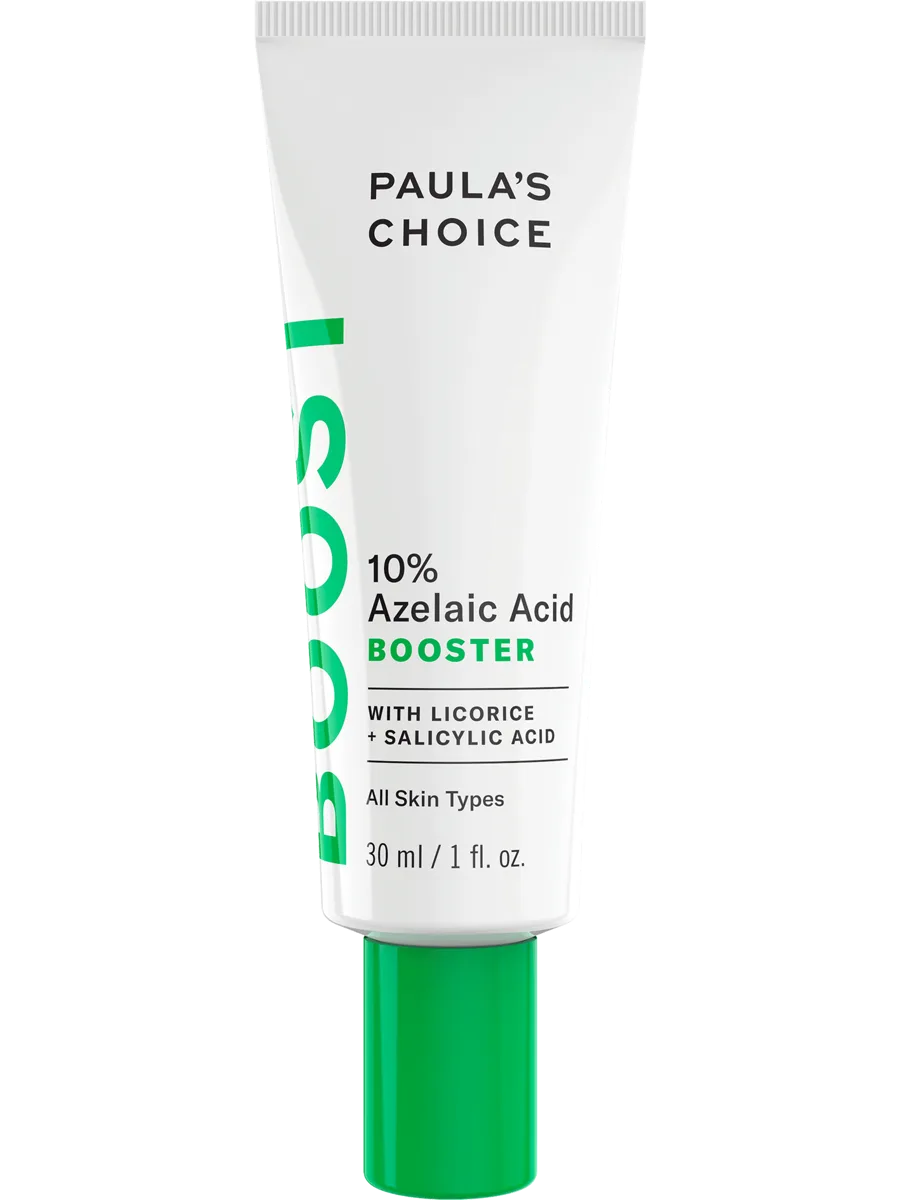
10% Azelaic Acid Booster
Rosacea & Dark Spot MVP
 Verified reviewer
Pros & cons.
- +10% azelaic acid at the highest OTC concentration with synergistic supporting ingredients
- +Fragrance-free cruelty-free and vegan with a minimal clean ingredient list
- +Versatile booster format allows use as full-face treatment spot treatment or mixed in
- +Pregnancy-safe making it one of few effective actives available during pregnancy
- +Licorice root and salicylic acid amplify the brightening and pore-clearing effects
- +Matte non-greasy finish layers invisibly under makeup and sunscreen
- +Addresses three major conditions — rosacea acne and hyperpigmentation — in one product
- −$39 for 1 oz is a significant investment especially for a treatment requiring months of use
- −Tingling or stinging on initial application can be uncomfortable for some users
- −Not moisturizing on its own requiring a separate moisturizer to prevent dryness
- −Faint grittiness from undissolved azelaic acid particles is noticeable to some users
- −Results require 4-12 weeks of consistent use which tests patience
- −OTC 10% concentration may be insufficient for severe rosacea or deep hyperpigmentation
The full review.
There is a peculiar injustice in the skincare world that azelaic acid does not get the attention it deserves. Here is an ingredient that is FDA-approved for rosacea, clinically proven to reduce acne, documented to fade hyperpigmentation, and considered safe during pregnancy — a resume that should make it the most talked-about active in anyone’s medicine cabinet. Instead, it plays second fiddle to retinol and vitamin C in the cultural conversation, quietly doing excellent work for the people who have discovered it while the rest of the skincare world scrolls past.
Paula’s Choice has been one of the most consistent advocates for azelaic acid’s versatility, and this 10% Booster represents their best expression of the ingredient. The formula is not just azelaic acid in a tube — it is azelaic acid with a supporting cast selected specifically to amplify its effects. Salicylic acid at half a percent provides gentle BHA exfoliation that clears the pathway for deeper azelaic acid penetration. Licorice root extract attacks pigmentation through its own tyrosinase-inhibiting mechanism, creating a two-pronged brightening approach. Adenosine adds anti-aging collagen support. Allantoin and bisabolol — derived from chamomile — provide the soothing foundation that keeps the formula gentle enough for sensitive skin to tolerate.
The gel-cream texture is what elevates this from a clinical product to one that people actually enjoy using. Many azelaic acid formulations on the market feel pharmaceutical — heavy, greasy, or unpleasantly gritty. This one has a lightweight slip that absorbs quickly into a matte, non-greasy finish. There is a very faint grittiness that some users notice, a consequence of azelaic acid particles that do not fully dissolve in the vehicle, but it is subtle enough that most users adapt within the first few applications. Under makeup and sunscreen, it disappears.
The ‘booster’ concept itself is clever. Paula’s Choice designed this to be modular — you can apply it as a standalone treatment across the full face, use it as a targeted spot treatment on stubborn dark marks or rosacea patches, or mix it into your existing moisturizer for a gentler delivery. This flexibility means you control the intensity, which is particularly valuable for a product that can cause tingling on initial use.
That tingling deserves a frank discussion. Azelaic acid is an acid, and at ten percent in an effective vehicle, it makes its presence known. Most users experience a mild warming or prickling sensation for the first few minutes of application, particularly during the first week or two. For the majority, this is brief and tolerable — the skin acclimates. For some, especially those with a compromised barrier, the tingling can be intense enough to require dilution or reduced frequency. The allantoin and bisabolol in the formula work to mitigate this, but they cannot eliminate it entirely.
Results follow the patient timeline that characterizes well-formulated active treatments. Mild redness reduction — the kind that makes rosacea sufferers notice their cheeks calming down — can appear within one to two weeks. Post-acne marks begin to lighten at four to six weeks. The full brightening and texture-smoothing effects require two to three months of consistent use. This is not a product for the instant-gratification crowd, and setting realistic expectations is important for maintaining the consistency that delivers results.
The ingredient profile is remarkably clean. Fragrance-free. Paraben-free. Oil-free. Cruelty-free and vegan. The preservative system is a single ingredient — phenoxyethanol — which is about as minimal as responsible preservation gets. For a product targeting rosacea and sensitive skin conditions, this restraint is not just good marketing, it is good formulation science.
The pregnancy safety angle is worth emphasizing because it is genuinely rare. Azelaic acid is one of the very few topical actives that is FDA Pregnancy Category B, meaning it has shown no evidence of harm in animal studies and is widely considered safe by dermatologists and OBGYNs. For pregnant individuals dealing with melasma, pregnancy acne, or general hyperpigmentation — conditions that pregnancy notoriously worsens — the options are painfully limited. Retinol is off the table. Hydroquinone is off the table. High-concentration salicylic acid is off the table. Azelaic acid is one of the few actives that remains available, and this formulation delivers it well.
The price is the unavoidable sticking point. Thirty-nine dollars for one ounce of product is a meaningful investment, particularly for a treatment that needs two to three months to demonstrate its full effects. With twice-daily full-face use, a tube lasts approximately six to eight weeks, making the effective monthly cost around twenty to twenty-five dollars. Used as a spot treatment, it stretches considerably further. The mini size offers a lower-commitment entry point for those wanting to test tolerability before investing in the full tube.
Paula’s Choice built its reputation on the idea that good skincare should be boring — no marketing gimmicks, no exotic ingredient theater, just well-studied actives in well-designed vehicles at effective concentrations. The 10% Azelaic Acid Booster is perhaps the purest expression of that philosophy. It is not exciting. It is not glamorous. It will never go viral. But it is one of the most thoughtfully formulated treatments for rosacea, hyperpigmentation, and acne available without a prescription, and the people who discover it tend to keep repurchasing it for years.
Ingredient analysis.
Full INCI list
Water, Azelaic Acid, C12-15 Alkyl Benzoate, Caprylic/Capric Triglyceride, Methyl Glucose Sesquistearate, Glycerin, Cetearyl Alcohol, Glyceryl Stearate, Dimethicone, Salicylic Acid, Adenosine, Glycyrrhiza Glabra (Licorice) Root Extract, Boerhavia Diffusa Root Extract, Allantoin, Bisabolol, Cyclopentasiloxane, Xanthan Gum, Sclerotium Gum, Propanediol, Butylene Glycol, Phenoxyethanol
Skin match.
The science.
The Science
Azelaic acid is versatile because it modulates multiple pathological pathways at once. As a competitive inhibitor of tyrosinase, it reduces melanin production by interfering with the enzyme that catalyzes the rate-limiting step in melanogenesis. A landmark 1991 study by Balina and Graupe in the International Journal of Dermatology showed that 20% azelaic acid cream improved melasma after 24 weeks. Its efficacy matches 2% hydroquinone but lacks the risk of ochronosis or rebound hyperpigmentation (International Journal of Dermatology, 1991).
For rosacea, azelaic acid uses anti-inflammatory mechanisms: it suppresses reactive oxygen species production, inhibits kallikrein 5 (the protease that activates cathelicidin, a peptide implicated in rosacea inflammation), and reduces neutrophil migration. A 2009 Cochrane Database systematic review confirmed 15% azelaic acid gel works for papulopustular rosacea and has a favorable safety profile for long-term use.
The salicylic acid in this formulation works well with azelaic acid. Salicylic acid is oil-soluble, so it penetrates the lipid-rich pore environment to clear sebaceous obstructions that could block azelaic acid absorption. At 0.5%, the BHA concentration is too low for aggressive exfoliation but provides enough pore-clearing support.
Glycyrrhiza glabra (licorice) root extract brightens skin via glabridin, which inhibits tyrosinase activity at a different binding site than azelaic acid. This dual-pathway approach to pigmentation reduction mirrors niacinamide-glucosamine combinations, though the mechanisms differ. A 1998 study in the Journal of Agricultural and Food Chemistry showed that glabridin inhibits melanogenesis without cytotoxicity to melanocytes.
References
- Treatment of melasma with azelaic acid versus hydroquinone — International Journal of Dermatology (1991)
Dermatologist Perspective
Dermatologists see azelaic acid as an underutilized topical active in consumer skincare. Board-certified dermatologists often recommend this specific product for patients with rosacea, post-inflammatory hyperpigmentation, and hormonal acne because it treats multiple pathologies with low irritation risk. Its pregnancy-safe profile makes it a first-line recommendation for pregnant patients with acne or melasma. Dermatologists note that while 10% is below the 15-20% prescription concentrations, the supporting ingredients—salicylic acid and licorice root—make this formula more comprehensive than the concentration alone. For patients who cannot access or afford prescription azelaic acid, dermatologists point to this product as the best OTC alternative.
Where it fits in your routine.
Apply a thin, even layer to clean skin after water-based serums and before moisturizer. Use once or twice daily. For sensitive skin, start once daily (PM) and increase to twice daily as tolerated. Mix it into moisturizer for gentler delivery, or apply as a targeted spot treatment on hyperpigmented patches or breakouts. Always follow with sunscreen SPF 30+ in the morning. Wait one to two minutes for absorption before layering other products. If tingling is intense during the first week, use it every other day.
At $39 for 1 oz, this OTC treatment has a premium price. Value depends on how you use it. As a spot treatment, the tube lasts three to four months, costing roughly $10-13 per month. As a twice-daily full-face treatment, it lasts six to eight weeks, raising the monthly cost to $20-25. The 5 mL mini offers a low-risk way to test it. This $39 OTC alternative costs much less than prescription azelaic acid (Finacea 15% gel, which can cost $200+ without insurance) and has reasonable efficacy for mild to moderate concerns. The cruelty-free, vegan, fragrance-free formulation adds value for consumers who prioritize these attributes.
This azelaic acid OTC treatment works for rosacea redness, post-acne marks, or stubborn hyperpigmentation. It is useful for pregnant or nursing individuals with few active ingredient options. It also suits those seeking a cruelty-free, vegan, fragrance-free formula that treats multiple conditions at once.
Monthly costs add up for those on a tight budget needing long-term treatment. Users with very severe rosacea or deep melasma may need prescription-strength 15-20% formulations for results. The bisabolol in this formula triggers reactions in people with known allergies to chamomile or Asteraceae family plants.
Product details.
Lightweight gel-cream with a slightly thick, spreadable consistency. Some users feel faint grittiness from the azelaic acid particles. It feels velvety once fully absorbed.
Fragrance-free and has no detectable scent — it lacks a medicinal smell despite the active acid content.
An opaque white squeeze tube with a green cap protects light-sensitive ingredients. The design allows hygienic dispensing without jar dipping or finger contamination. The packaging is recyclable.
A mild tingling or warm sensation is normal at first application and usually subsides within a few minutes. Skin may look slightly flushed initially but calms quickly. This is a slow-build treatment with no immediate effects; results emerge over weeks.
6-8 weeks with twice-daily full-face use; longer when used as spot treatment
12 months
All Year
The backstory.
Paula's Choice introduced this booster as part of their modular 'booster' concept — concentrated treatments designed to be added to any routine rather than replacing existing steps. The 10% azelaic acid concentration sits at the highest level available without a prescription in many markets, and the 'booster' format gives users flexibility in how they deploy it — full face, spot treatment, or mixed into other products.
About Paula's Choice
Established Brand (5–20 years)Paula Begoun founded Paula's Choice in 1995. She is known as 'The Cosmetics Cop' for her ingredient transparency advocacy. The brand led the way in online-first, evidence-based skincare before Unilever acquired it in 2021. Dermatologists widely recommend its products, which have consistent published research references.
Common myths.
Azelaic acid is only for acne and nothing else.
Azelaic acid is a highly versatile topical active. Beyond acne, evidence shows it treats rosacea (it is FDA-approved for rosacea at prescription concentrations), reduces hyperpigmentation, inhibits melanin production, and smooths keratosis pilaris. It treats more conditions than most single active ingredients.
10% azelaic acid lacks the strength for real results; use prescription-strength 15-20%.
Prescription concentrations (15% gel, 20% cream) are stronger, but 10% azelaic acid shows efficacy in studies for mild to moderate concerns. The supporting ingredients — salicylic acid, licorice root — amplify the azelaic acid's effects and close the gap with higher-concentration products.
What the community says.
"Effectively reduces redness and calms rosacea with consistent use"
"Lightweight non-greasy gel-cream texture absorbs quickly"
"Visibly fades post-acne marks and dark spots over time"
"Fragrance-free and gentle enough for sensitive skin types"
"Versatile application as spot treatment or mixed into moisturizer"
"Smooths bumpy texture and rough patches notably well"
"Oil-free finish works seamlessly under makeup and sunscreen"
"Can cause tingling or stinging on initial application especially on compromised skin"
"Not moisturizing on its own and some users experience flakiness"
"Small 30 mL tube at $39 runs out quickly with daily full-face use"
"Some users see no noticeable improvement after weeks of consistent use"
"Slightly gritty texture from azelaic acid particles not fully dissolving"
"Results require 4-12 weeks of patience before becoming clearly visible"
People also looked at.