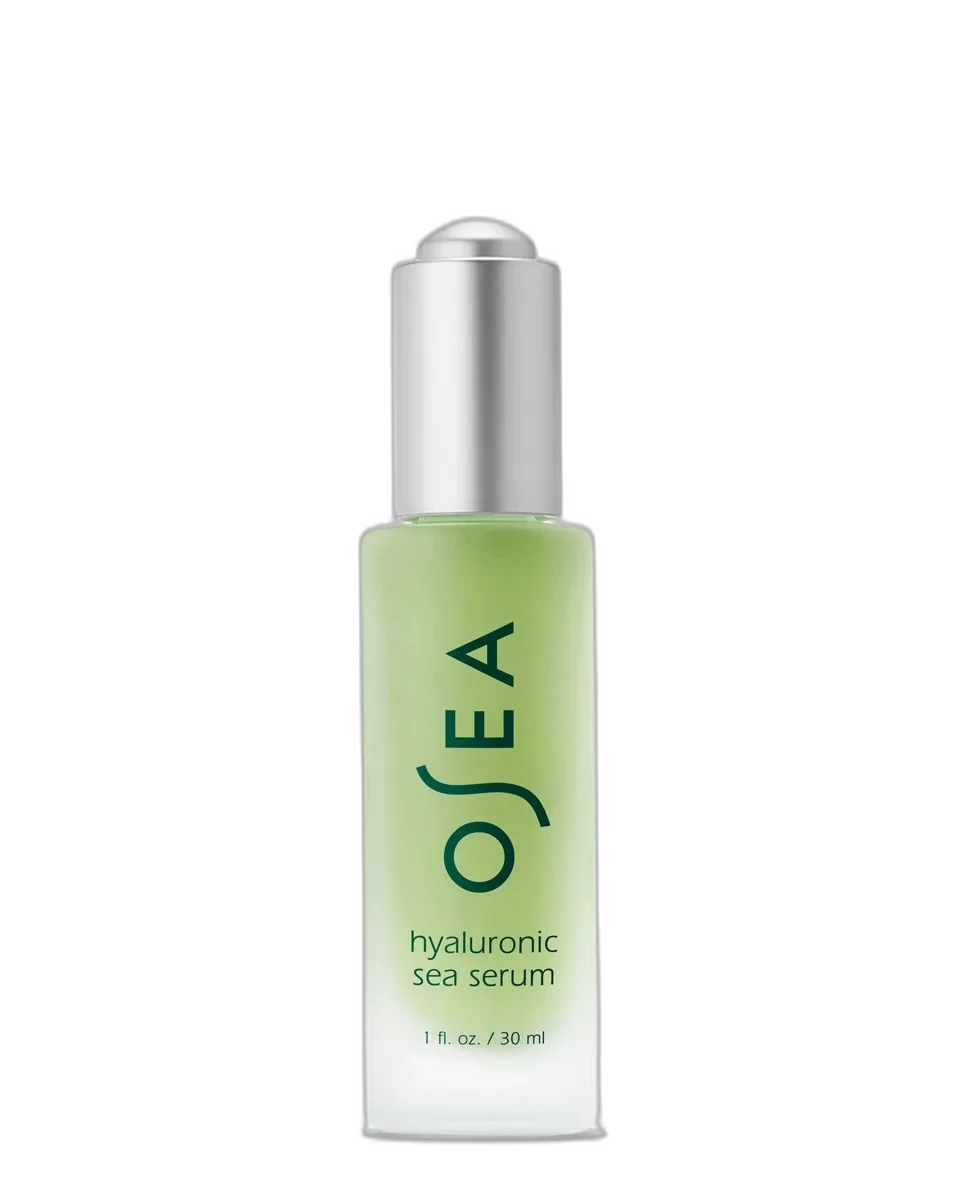
Hyaluronic Sea Serum
Sensitive Skin Safe Pick
 Verified reviewer
Pros & cons.
- +Triple-hydration system with dual-weight HA, seaweed polysaccharides, and snow mushroom
- +Exceptionally clean 14-ingredient formula with zero known irritants
- +Fragrance-free, oil-free, silicone-free — safe for ultra-sensitive and reactive skin
- +Water-thin texture absorbs instantly with no stickiness, tackiness, or residue
- +Betaine osmolyte protects against the HA dehydration risk in dry climates
- +Fungal acne safe due to the absence of oils, fatty acids, and fermented lipids
- −Very expensive at $88 for just 1 ounce — roughly $500-760 annually
- −Small bottle size means frequent repurchasing with twice-daily use
- −Some users detect a marine scent that may be off-putting despite fragrance-free labeling
- −No additional actives beyond hydration — no vitamin C, niacinamide, or peptides
- −Comparable HA hydration can be achieved at significantly lower price points
The full review.
Hyaluronic acid serums are the standard recommendation for dry skin. While hyaluronic acid is an effective humectant, most hyaluronic acid serums are one-dimensional. They pull water to the skin surface, but it evaporates within hours, losing the initial plumpness by lunchtime. The issue is not hyaluronic acid; most formulations fail to build a moisture system that holds water in the skin over time.
OSEA’s Hyaluronic Sea Serum uses a triple-layer hydration strategy. The foundation is dual-weight hyaluronic acid: standard sodium hyaluronate for surface-level water binding and hydrolyzed hyaluronic acid for deeper epidermal penetration. This outperforms single-molecular-weight hyaluronic acid serums. The other key ingredients are not hyaluronic acid.
Codium fragile is the second ingredient after water. This green seaweed is rare in skincare. Its polysaccharide content provides marine-derived hydration that works differently than hyaluronic acid. The sulfated polysaccharides form a flexible, breathable film on the skin to prevent transepidermal water loss without the heaviness of oils or silicones. This ingredient gives the serum its oceanic heritage and separates it from hyaluronic acid serums that are just hyaluronic acid in water with preservatives.
Tremella fuciformis — snow mushroom — adds a third hydration pathway. This fungal polysaccharide has high water-binding capacity. Some research suggests it rivals or exceeds hyaluronic acid molecule-for-molecule, and its smaller molecular size allows better skin penetration. In this formula, the snow mushroom creates a moisture reservoir beneath the hyaluronic acid surface layer to reduce the evaporation seen in simple hyaluronic acid serums.
Betaine, a natural osmolyte from sugar beets, completes the hydration. Osmolytes help cells maintain water content under stress, such as low humidity. This addresses the risk of hyaluronic acid drawing moisture from the skin in dry climates; betaine counterbalances that tendency.
Texture
The texture differs from the thick, gel-like hyaluronic acid serums common in the market. This serum is almost water-thin with minimal viscosity. It absorbs in seconds on damp skin—which is essential for any hyaluronic acid product—leaving no residue, stickiness, or tackiness. You can layer moisturizer immediately after. This immediate, invisible absorption prevents the pilling or tacky film common with other hyaluronic acid serums.
Scent
The ingredient list is notable for what it lacks. It contains only fourteen ingredients. There are no essential oils, fragrance, silicones, alcohols, niacinamide, or vitamin C to irritate reactive skin. This purity makes the serum suitable for post-procedure skin, rosacea-prone skin, eczema-prone skin, or any compromised skin barrier needing safe hydration.
Common Praise
The clinical results OSEA cites — improved elasticity and reduced fine lines — match expectations for a well-formulated multi-weight hyaluronic acid serum with supporting hydration agents. The effects are real: skin looks plumper and more luminous with consistent use, and fine dehydration lines smooth out within the first few days.
Common Complaints
The price is high. At $88 for one ounce, this is one of the most expensive hyaluronic acid serums on the market. A dropper bottle this size lasts approximately six to eight weeks when used twice daily. This makes the annual cost roughly $500-760. This is a premium for a fourteen-ingredient serum where the primary active — hyaluronic acid — is available in cheaper, effective formulations. You pay for the proprietary Codium fragile seaweed extract, the snow mushroom, the clean ingredient list, and OSEA’s nearly three decades of marine skincare expertise. Whether this justifies the price depends on your preference for ingredient minimalism and ocean-derived formulation.
Best for
The value may be higher for sensitive and reactive skin types. Finding a hydrating serum with this level of ingredient purity that works is difficult. A fourteen-ingredient formula with no known irritants provides tangible value for people whose skin reacts to everything.
Ingredient analysis.
Full INCI list
Water/Aqua/Eau, Codium Fragile Extract, Betaine, Sodium Hyaluronate, Tremella Fuciformis Sporocarp Extract, Bacillus Ferment, Hydrolyzed Hyaluronic Acid, Glycerin, Sodium Benzoate, Potassium Sorbate, Citric Acid, Lonicera Japonica (Honeysuckle) Flower Extract, Lonicera Caprifolium (Honeysuckle) Flower Extract, Sodium Copper Chlorophyllin
Skin match.
The science.
The Science
This serum uses a dual-weight hyaluronic acid approach based on size-dependent penetration. Standard sodium hyaluronate (molecular weight typically >1,000 kDa) stays mostly on the skin surface, forming a moisture-retaining film and plumping the skin immediately. Hydrolyzed hyaluronic acid (typically 50-200 kDa) penetrates the outer epidermis to hydrate deeper layers. A 2012 study in the Journal of Drugs in Dermatology by Pavicic et al. shows that low-molecular-weight HA fragments penetrate deeper into the epidermis and improve skin hydration and elasticity more than high-molecular-weight HA alone.
Tremella fuciformis polysaccharides are glucurono-xylomannan polymers with high water-binding capacity. Research in the International Journal of Biological Macromolecules shows these polysaccharides have higher moisture absorption and retention rates per unit weight than standard hyaluronic acid because their branched polysaccharide structure provides more binding sites per molecule.
Codium fragile is a green seaweed with sulfated polysaccharides studied for antioxidant and moisture-retaining properties. Research in Marine Drugs documents the biological activities of Codium species extracts, including how they form hydrating films on biological surfaces.
Betaine is a compatible osmolyte—a small organic molecule that stabilizes cellular structures and maintains cell hydration under osmotic stress. Clinical studies show topical betaine reduces transepidermal water loss and improves stratum corneum hydration, which retains moisture independently of HA humectant properties.
References
- Efficacy of cream-based novel formulations of hyaluronic acid of different molecular weights in anti-wrinkle treatment — Journal of Drugs in Dermatology (2011)
Dermatologist Perspective
Dermatologists recognize hyaluronic acid as a safe, effective humectant for topical hydration. Board-certified dermatologists note the dual-weight approach in this serum matches current knowledge of HA penetration dynamics and uses a more sophisticated formulation strategy than single-weight alternatives. The clean ingredient list makes this a strong recommendation for post-procedure hydration, compromised barrier states, and patients with multiple contact sensitivities. However, dermatologists note that effective HA hydration is available at lower price points; the premium reflects ingredient sourcing and brand positioning rather than superior clinical performance.
Guidance
Where it fits in your routine.
Apply 3-5 drops to damp skin right after cleansing and toning; dampness is critical for HA absorption. Press the liquid gently into the face and neck instead of rubbing. Layer this morning and evening before your moisturizer, which seals in the hydration. In very dry climates or during winter, mist the face with water before application and follow with a heavier, occlusive moisturizer.
At $88 for 1 ounce, this is one of the most expensive HA serums. Using it twice daily lasts 6-8 weeks, costing about $500-760 annually. The price covers marine-derived ingredients (specifically Codium fragile), snow mushroom, the clean formulation, and OSEA brand heritage. For comparison, excellent dual-weight HA serums from brands like The Ordinary or COSRX cost $7-20, but usually lack seaweed and snow mushroom. The premium makes sense for ultra-sensitive skin types who cannot tolerate ingredients in cheaper formulations.
This works for sensitive, reactive, or compromised skin needing pure hydration without irritation. It suits post-procedure recovery, rosacea-prone skin, and users who react to HA serums with fragrances, essential oils, or other additives. It also suits minimalists who prefer the shortest ingredient list.
Budget-conscious shoppers find effective dual-weight HA hydration for much less. Anyone seeking a multi-functional serum (with vitamin C, niacinamide, or peptides alongside HA) should look elsewhere; this is a pure hydration product without additional actives.
Product details.
All Year Certifications Cruelty-FreeVegan
The backstory.
The Hyaluronic Sea Serum represents OSEA's answer to the HA serum boom — taking the industry's most popular hydrating ingredient and combining it with the brand's signature marine expertise. Rather than just offering another hyaluronic acid serum, OSEA paired the HA with Codium fragile (a green seaweed not commonly used in skincare) and snow mushroom to create a hydration story that reflects the brand's ocean-centric identity.
About Osea
Legacy Brand (20+ years)Jenefer Palmer founded OSEA in 1996 in Malibu, California, using three generations of women's knowledge of sea-based healing. Co-founder and CEO Melissa Palmer now leads the brand. OSEA has nearly 30 years of seaweed-centric formulation expertise and received a strategic investment from General Atlantic to expand globally.
FAQ.
Can I use Osea Hyaluronic Sea Serum on sensitive skin?
This is one of the safest serums for sensitive skin. It has only 14 ingredients, no fragrance, no essential oils, no silicones, and no known irritants. It works for reactive skin types, including post-procedure and rosacea-prone skin.
Is Osea Hyaluronic Sea Serum fungal acne safe?
Yes — the formula is oil-free, lacks fatty acids or esters, and avoids fermented lipids that trigger Malassezia (fungal acne). The bacillus ferment in the formula is a bacterial ferment, not a yeast-based ingredient.
Should I apply Osea Hyaluronic Sea Serum to damp or dry skin?
Apply to damp skin always. Hyaluronic acid is a humectant that draws water to itself. When applied to damp skin, it pulls surface water into the skin. On dry skin in a dry environment, it draws moisture from deeper skin layers instead. Mist your face with water before applying if your skin dried after cleansing.
What does the snow mushroom do in Osea Hyaluronic Sea Serum?
Tremella fuciformis (snow mushroom) produces polysaccharides with exceptional water-binding capacity — some research suggests comparable to or exceeding hyaluronic acid per unit weight. Its smaller molecular size allows better skin penetration than standard HA, creating an additional layer of deep hydration that supplements the dual-weight HA in the formula.
Community
What the community says.
"Incredibly lightweight and fast-absorbing without stickiness"
"Visible plumping and hydration improvement from first application"
"Suitable for even the most sensitive and reactive skin types"
"Layers beautifully under any moisturizer without pilling"
"Very expensive at $88 for just 1 ounce"
"Some users detect an unusual seaweed scent despite fragrance-free labeling"
"Results may not justify the price premium over more affordable HA serums"
"Small bottle size runs out quickly with twice-daily use"
Featured in.
People also looked at.