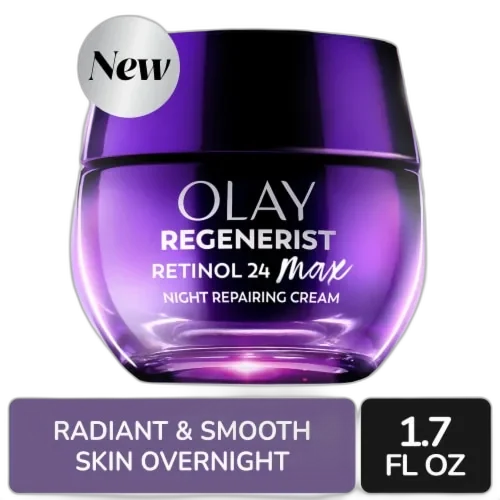
Regenerist Retinol 24 MAX Night Moisturizer
Gentle Retinol Gateway
 Verified reviewer
Pros & cons.
- +Dual retinoid system (retinol + retinyl propionate) designed for extended 24-hour activity with minimal irritation
- +Includes Palmitoyl Pentapeptide-4 (Matrixyl), a clinically backed peptide rarely found at this price point
- +Double the niacinamide of standard Retinol 24 for enhanced barrier support and brightening
- +96% zero-irritation rate in clinical testing makes it suitable for retinol beginners
- +Lightweight, fast-absorbing silky texture that sets to a non-greasy matte finish
- +Fragrance-free, paraben-free formulation
- +Exceptional value at roughly $29 for a multi-active retinol moisturizer
- −Contains DMDM Hydantoin, a formaldehyde-releasing preservative that concerns some consumers
- −Retinyl propionate has limited independent research outside of Olay's proprietary studies
- −Jar packaging exposes retinol to air with each use, potentially degrading the active over time
- −May not be moisturizing enough for very dry skin types without additional hydration layers
- −Not safe for use during pregnancy or breastfeeding due to retinoid content
The full review.
Most retinol stories begin the same way: someone reads about the gold standard of anti-aging, buys a product, uses it for a few nights, wakes up looking like they’ve been lightly sandpapered, and shoves the jar to the back of the medicine cabinet. It’s a cycle that has played out millions of times across bathrooms worldwide, and it’s the exact problem Olay set out to solve with Retinol 24.
The MAX version of this formula represents Olay’s refined answer to a question that’s both scientific and behavioral: how do you deliver meaningful retinoid activity while keeping irritation low enough that people actually stick with the product? Their approach involves a dual-retinoid system combining pure retinol with retinyl propionate, an ester that converts to retinol more slowly. The idea is to extend the window of retinoid activity across a full 24-hour period — pure retinol provides the initial burst of activity while the propionate ester feeds in gradually, like a time-release mechanism.
It’s a clever formulation strategy, though it comes with a caveat worth acknowledging. Retinyl propionate, while structurally a retinoid, has significantly less independent research behind it compared to retinol itself. The conversion pathway from propionate ester to biologically active retinoic acid involves two enzymatic steps rather than one, and the efficiency of that conversion in real-world skin conditions is not as well documented. Olay’s proprietary clinical data supports the combination’s efficacy, but outside of their own studies, retinyl propionate remains a “promising” rather than “well-established” ingredient.
What is well-established is the supporting cast. Niacinamide appears at a notably elevated concentration in the MAX formula — double what you’d find in the standard Retinol 24. This isn’t just a marketing upgrade. Niacinamide is arguably the ingredient that makes this retinol formula work for 96% of users without irritation. It strengthens the skin barrier, reduces transepidermal water loss, calms inflammation, and provides its own anti-aging benefits through boosting ceramide and collagen production. It’s the safety net under the retinol tightrope.
The inclusion of Palmitoyl Pentapeptide-4 (Matrixyl) is a genuinely surprising bonus at this price point. Most drugstore retinol moisturizers are straightforward retinol-in-a-vehicle formulas. Adding a peptide with peer-reviewed collagen-stimulating evidence creates a third anti-aging pathway — retinol works through gene expression and cell turnover, niacinamide works through barrier enhancement and ceramide production, and Matrixyl works through fibroblast signaling. Three mechanisms, one jar, under thirty dollars.
The texture is pleasantly lightweight for a night cream. The dimethicone-based vehicle gives it a silky, almost primer-like slip that absorbs quickly without the heavy or greasy feel that many nighttime moisturizers carry. It sets to a velvety matte finish within about a minute. For those who dislike the feeling of product on their skin at night, this disappearing act is appealing. The trade-off is that very dry skin types may find it insufficiently moisturizing on its own — a richer cream or a few drops of facial oil underneath may be needed in winter.
In practice, the product delivers on its most immediate promises quickly. Skin genuinely looks smoother and brighter the morning after the first application — likely the combined effect of glycerin hydration and the optical smoothing from polymethylsilsesquioxane and titanium dioxide. Over the first week, texture improvement becomes noticeable. By four weeks, the cumulative retinoid effect on cell turnover starts to show in reduced dullness and more even skin tone.
The deeper anti-aging claims — wrinkle reduction, firming, dark spot fading — require the patience that all retinoid products demand. Eight to twelve weeks of consistent nightly use is realistic for seeing meaningful structural improvement. These results will be subtler than what prescription tretinoin delivers, but they arrive without the peeling, flaking, and redness that make prescription retinoids a dermatological rite of passage.
The ingredient list does carry one point of friction: DMDM Hydantoin, a formaldehyde-releasing preservative. It’s FDA-approved and present at safe concentrations, and the actual formaldehyde release is trace-level. But it has become a lightning rod for consumer concern, and its presence in a 2021 launch feels like an unnecessary friction point when other preservation systems are available. It’s the one element of this formula that feels behind the times.
The jar packaging is the other practical drawback. Retinol degrades with exposure to light and air — two things that a twist-off jar introduces every time you open it. The opaque purple container helps with light, but a pump or airless bottle would better protect the actives. It’s a packaging choice driven by the Regenerist brand identity rather than optimal formulation science.
At approximately $29 for 1.7 ounces, this represents strong value for a multi-active retinol moisturizer. A jar lasts two to three months with nightly use, bringing the monthly cost to roughly $10-15. Prestige retinol moisturizers with comparable ingredient profiles routinely cost three to five times as much. For someone looking to start a retinol routine without committing significant budget or risking significant irritation, this is one of the most sensible entry points available at the drugstore.
Formula
Texture
The texture is pleasantly lightweight for a night cream. The dimethicone-based vehicle gives it a silky, almost primer-like slip that absorbs quickly without the heavy or greasy feel that many nighttime moisturizers carry. It sets to a velvety matte finish within about a minute. For those who dislike the feeling of product on their skin at night, this disappearing act is appealing. The trade-off is that very dry skin types may find it insufficiently moisturizing on its own — a richer cream or a few drops of facial oil underneath may be needed in winter.
Best for
For someone looking to start a retinol routine without committing significant budget or risking significant irritation, this is one of the most sensible entry points available at the drugstore.
Ingredient analysis.
Full INCI list
Water, Dimethicone, Glycerin, Tapioca Starch, Dimethicone Crosspolymer, Retinol, Retinyl Propionate, Niacinamide, Tropaeolum Majus Flower/Leaf/Stem Extract, Palmitoyl Pentapeptide-4, Dimethiconol, Laureth-4, Polysorbate 20, Laureth-7, Disodium EDTA, Polyacrylamide, Acrylates/C10-30 Alkyl Acrylate Crosspolymer, Aminomethyl Propanol, Polymethylsilsesquioxane, Titanium Dioxide, C13-14 Isoparaffin, DMDM Hydantoin, Iodopropynyl Butylcarbamate.
Skin match.
The science.
The Science
Retinol is dermatology's most studied topical anti-aging ingredient, with decades of evidence. A 2006 review in Clinical Interventions in Aging shows topical retinol stimulates collagen, speeds epidermal turnover, and reduces fine lines, wrinkles, and hyperpigmentation via retinoic acid receptors (RARs) and retinoid X receptors (RXRs).
Olay uses a dual-retinoid approach to manage the bioavailability curve. Pure retinol converts to retinoic acid in one oxidation step, acting quickly but briefly. Retinyl propionate needs two enzymatic conversions (propionate → retinol → retinoic acid) for a delayed-release profile. The theory for extended-release retinoid delivery is sound, but independent peer-reviewed evidence for retinyl propionate's topical efficacy is limited. Kim et al. studied retinyl propionate in the Journal of Cosmetic Dermatology (2008) and found measurable wrinkle improvements, though the research base is thinner than for retinol.
Niacinamide does more than support the barrier. Bissett et al. showed in a 2005 Journal of Cosmetic Dermatology study that topical niacinamide significantly reduces fine lines, wrinkles, hyperpigmentation, and sallowness. For a retinol product, niacinamide increases ceramide and free fatty acid levels in the stratum corneum, which counteracts retinoid-induced barrier disruption.
Palmitoyl Pentapeptide-4 adds a complementary anti-aging mechanism. Retinol works through gene expression modulation via nuclear receptors, but this peptide mimics type I procollagen fragments to stimulate fibroblast activity. This combination targets collagen through two independent pathways. This strategy may yield additive benefits, though no studies examine this specific combination.
References
- Retinoids in the treatment of skin aging: an overview of clinical efficacy and safety — Clinical Interventions in Aging (2006)
- Topical palmitoyl pentapeptide provides improvement in photoaged human facial skin — International Journal of Cosmetic Science (2005)
Dermatologist Perspective
Board-certified dermatologists often see Olay Retinol 24 MAX as a good starting point for patients new to retinoids who avoid prescription tretinoin. Dermatologists note the formula prioritizes tolerability—using low-dose retinol, niacinamide buffering, and a silicone-based vehicle—to prevent the irritation that causes patients to stop retinoid therapy. While results won't match prescription-strength retinoids, dermatologists agree consistent use of a gentle over-the-counter retinol provides meaningful anti-aging benefits and acts as a bridge to stronger retinoids. Some dermatologists call the inclusion of DMDM Hydantoin a suboptimal preservative choice, but they note the concentrations stay within FDA-established safety limits.
Where it fits in your routine.
Apply to clean, dry skin as the final nighttime step, after cleansing and water-based serums. Use a nickel-sized amount for the face and neck. Retinol beginners should apply every-other-night for the first two weeks to test tolerance. Avoid the eye area if you feel sensitivity — use a dedicated eye cream instead. Apply SPF 30+ sunscreen the next morning, because retinol increases photosensitivity.
At about $28.99 for 1.7 oz, this retinol moisturizer offers high value based on its ingredient profile. It contains retinol, retinyl propionate, therapeutic niacinamide, and Matrixyl peptide—a blend that costs $60-90 in prestige packaging. One jar lasts 2-3 months, making the monthly cost $10-15. This price reduces financial risk for retinol beginners. A 0.5 oz trial size is also available for testing before buying the full jar.
This works for retinol beginners seeking anti-aging benefits without an intimidating adjustment period. It also suits budget-conscious skincare enthusiasts wanting a multi-active retinol formula at drugstore prices, and anyone who stopped using stronger retinol products due to irritation.
Skip this if you have very sensitive, rosacea-prone, or eczema-affected skin, because even gentle retinol triggers flares. Do not use this if you are pregnant or breastfeeding, or if you avoid formaldehyde-releasing preservatives. If you use prescription tretinoin, this product has less potency.
Product details.
Lightweight, silky cream with a subtle whipped texture. It glides on with a silicone-based slip and absorbs within a minute. It leaves a soft matte finish without tackiness.
Fragrance-free with no detectable scent.
An opaque purple jar with a twist-off lid follows the Olay Regenerist Retinol 24 design. Opaque packaging protects retinol stability, but a pump better shields the formula from light and air.
Most users report smooth, hydrated skin the morning after first use without irritation. The formula targets retinol beginners; the low concentration and niacinamide buffering make typical retinol 'uglies' (peeling, redness, purging) rare. If you experience mild dryness, apply every-other-night for the first two weeks.
2-3 months with nightly full-face application
12 months
All Year
The backstory.
Olay's Retinol 24 line launched in 2019 with a bold claim: retinol benefits with virtually zero irritation. The formula was born from Olay's observation that most consumers abandon retinol products within weeks due to peeling and redness. By combining a low-dose retinol with the gentler retinyl propionate ester and generous niacinamide buffering, Olay created a formula that 96% of test subjects used without irritation — a compliance rate that prescription retinoids can only dream of.
About Olay
Legacy Brand (20+ years)Procter & Gamble owns Olay, which launched in 1952. The Regenerist line debuted in 2004 and is a top-selling global mass-market anti-aging range. The Retinol 24 collection uses extensive clinical testing; 96% of users report zero irritation.
Common myths.
More potent retinol always means better anti-aging results.
Using a lower-concentration retinol every night works better than a high-potency retinol that sits in your cabinet because it causes skin peeling. This formula prioritizes daily compliance over peak potency. For most users, this trade-off delivers better long-term results.
Retinol and niacinamide cancel each other out; do not use them together.
This myth stems from outdated pH concerns that do not apply to modern formulations. Niacinamide improves retinol tolerability by strengthening the skin barrier and reducing inflammation. Olay formulates them together for this synergistic effect.
FAQ.
Is Olay Retinol 24 MAX strong enough to make a difference?
The exact retinol concentration is undisclosed, but clinical testing shows visible wrinkle improvement within 1 week and dark spot reduction within 4 weeks. The dual-retinoid approach (retinol + retinyl propionate) extends the active window. Matrixyl peptide and niacinamide add anti-aging activity through different pathways.
Will Olay Retinol 24 MAX cause peeling or purging?
Olay claims 96% of users experience zero irritation with this formula. The low retinol concentration, niacinamide buffering, and silicone-based vehicle minimize the peeling, redness, and purging common with retinol products. If you experience sensitivity, use it every-other-night.
Can I use Olay Retinol 24 MAX during pregnancy?
No — this product contains retinol and retinyl propionate. Both are retinoids to avoid during pregnancy and breastfeeding. Ask your OB-GYN for pregnancy-safe anti-aging alternatives like products with niacinamide, peptides, or vitamin C.
What is the difference between Olay Retinol 24 and Retinol 24 MAX?
The MAX version has 20% more retinol/retinyl propionate complex and twice the niacinamide of the standard Retinol 24. If the standard version does not cause irritation and you want better results, the MAX is the logical step before prescription retinoids.
Do I need sunscreen when using this product?
Sunscreen is non-negotiable when using any retinoid product. Retinol increases photosensitivity because it accelerates cell turnover and exposes newer, more vulnerable skin cells. Apply a broad-spectrum SPF 30+ every morning, even on cloudy days, to protect against UV damage and get the full benefit of your nighttime retinol.
Does Olay Retinol 24 MAX contain DMDM Hydantoin?
Yes, this formula contains DMDM Hydantoin, a preservative that releases trace amounts of formaldehyde. The FDA approves this ingredient at safe concentrations, but it causes consumer concern. If you avoid formaldehyde-releasing preservatives, this product is not for you.
What the community says.
"Noticeably smoother, brighter skin after the first few uses"
"No irritation or peeling even for retinol beginners"
"Lightweight texture that absorbs quickly without greasiness"
"Affordable entry point for retinol without prescription"
"Contains DMDM Hydantoin, a formaldehyde-releasing preservative"
"Some users find it not potent enough compared to prescription retinoids"
"Can feel slightly silicone-heavy on oily skin"
"Retinyl propionate has limited independent research supporting its efficacy"
People also looked at.