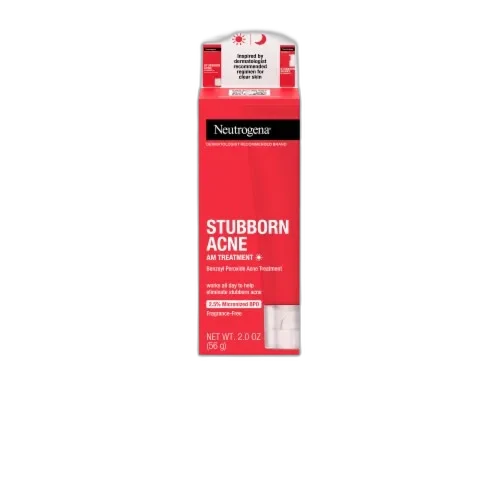
Stubborn Acne AM Treatment 2.5% Benzoyl Peroxide
Dermatologist-Backed Daily Fighter
 Verified reviewer
Pros & cons.
- +Micronized 2.5% benzoyl peroxide delivers proven acne-fighting efficacy with less irritation than higher concentrations
- +Truly invisible finish makes it practical for daytime wear under sunscreen and makeup
- +Ultra-minimal formula with only eight inactive ingredients minimizes sensitivity risks
- +Fragrance-free, oil-free, paraben-free, and phthalate-free formulation
- +Affordable drugstore pricing at roughly $13 for a 6-8 week supply
- +FSA and HSA eligible, reducing out-of-pocket cost for qualifying users
- +Backed by Neutrogena's legacy as the #1 dermatologist-recommended acne brand
- +Clinically proven to reduce pimple size and redness within hours of application
- −Benzoyl peroxide will bleach colored fabrics, towels, and pillowcases on contact
- −Initial dryness and flaking during the first one to two weeks of use is common
- −No complementary actives like niacinamide or hyaluronic acid — strictly a BP delivery vehicle
- −Two-ounce tube depletes relatively quickly with daily full-face application
- −Not suitable for users with very dry, sensitive, or rosacea-prone skin
The full review.
There’s a stubborn myth in acne treatment that more is always better. Stronger concentrations, harsher ingredients, scorched-earth approaches to skin that’s already inflamed and struggling. Neutrogena’s Stubborn Acne AM Treatment quietly argues the opposite case, and it has decades of clinical research in its corner.
The star of this formula is micronized benzoyl peroxide at 2.5% — a concentration that might look modest next to the 10% products crowding pharmacy shelves. But here’s what most people don’t realize: a study published in the International Journal of Dermatology demonstrated that 2.5% benzoyl peroxide reduces inflammatory acne lesions just as effectively as 5% and 10% concentrations. The difference? Dramatically less irritation. Less peeling. Less of that telltale red, angry skin that announces to the world that you’re treating your acne.
The micronized technology takes this a step further. Standard benzoyl peroxide particles sit largely on the skin surface, doing their work from the outside in. Micronized particles are ground finer, distributing more evenly and penetrating deeper into the pore where Cutibacterium acnes actually lives. It’s the difference between shouting at a locked door and having the key.
What immediately stands out about this product is its restraint. The inactive ingredient list reads like a minimalist manifesto: water, a gel-forming polymer, a couple of preservatives, and a chelating agent. That’s it. No botanical extracts with unproven claims, no fragrance to make it smell like a spa experience, no unnecessary emollients that could undermine the oil-free promise. For a category littered with overformulated products that try to be acne treatment, moisturizer, and sensory experience all at once, this stripped-back approach is refreshing.
The texture is a transparent, lightweight gel that genuinely vanishes into the skin within thirty seconds. This matters more than it might seem. A daytime acne treatment that leaves a white cast or chalky residue is a daytime acne treatment that people stop using. Compliance is everything in acne management, and Neutrogena clearly understood that a product designed for morning use needed to disappear under sunscreen and makeup without negotiation.
In practical use, the claims about reducing redness and pimple size within hours hold up. Active, inflamed breakouts visibly calm within the first day of use. Over a week or two of consistent application, new breakouts become less frequent and less severe. By the eight-week mark — the timeline dermatologists consider meaningful — the cumulative effect is genuinely noticeable. This isn’t a miracle product that eliminates acne overnight, but it’s a steady, reliable workhorse that earns its keep through daily consistency.
The trade-offs are predictable and manageable. Benzoyl peroxide, even at 2.5%, is a drying ingredient. Users with dry or combination skin will need a solid moisturizer as a chaser. The first week may bring some flaking and tightness, particularly around the nose and chin — this is normal adjustment, not a reason to abandon ship. And the eternal benzoyl peroxide caveat applies: this product will bleach anything it touches. Towels, pillowcases, that one dark shirt you forgot about. It’s the price of admission with BP, and no formulation trick can eliminate it.
The formula is also, by design, a one-trick pony. There’s no niacinamide to address post-inflammatory hyperpigmentation, no hyaluronic acid to soften the drying effect, no salicylic acid for additional pore clearing. Whether this is a limitation or a strength depends entirely on your philosophy of skincare. If you believe in targeted products that do one thing well and layer accordingly, this is ideal. If you want a Swiss Army knife product, look elsewhere.
At roughly thirteen dollars for two ounces, the value proposition is strong. This is clinical-grade acne treatment at drugstore prices, from a brand that dermatologists have trusted for decades. The tube lasts about six to eight weeks with daily full-face application — not extravagant, but reasonable for a treatment product. It’s also FSA and HSA eligible, which is a nice practical touch for something you’ll repurchase consistently.
Neutrogena designed this product as the morning half of an AM/PM acne system, pairing it with their Stubborn Marks PM Treatment. That’s sensible marketing, but it works perfectly well as a standalone morning treatment in any acne-focused routine. Pair it with a gentle cleanser, follow with a ceramide-based moisturizer, and cap with sunscreen. Simple, effective, evidence-based.
This isn’t the most exciting product on the shelf. It won’t go viral on social media for its aesthetic packaging or its ingredient list that reads like a botanical garden tour. But it might be one of the most honestly formulated acne treatments available at this price point — a product that respects both the science of what works and the reality of what people will actually use every morning.
Formula
Texture
The texture is a transparent, lightweight gel that genuinely vanishes into the skin within thirty seconds. This matters more than it might seem. A daytime acne treatment that leaves a white cast or chalky residue is a daytime acne treatment that people stop using. Compliance is everything in acne management, and Neutrogena clearly understood that a product designed for morning use needed to disappear under sunscreen and makeup without negotiation.
Scent
No mention of scent in the provided text.
Common Praise
In practical use, the claims about reducing redness and pimple size within hours hold up. Active, inflamed breakouts visibly calm within the first day of use. Over a week or two of consistent application, new breakouts become less frequent and less severe. By the eight-week mark — the timeline dermatologists consider meaningful — the cumulative effect is genuinely noticeable. This isn’t a miracle product that eliminates acne overnight, but it’s a steady, reliable workhorse that earns its keep through daily consistency.
Common Complaints
The trade-offs are predictable and manageable. Benzoyl peroxide, even at 2.5%, is a drying ingredient. Users with dry or combination skin will need a solid moisturizer as a chaser. The first week may bring some flaking and tightness, particularly around the nose and chin — this is normal adjustment, not a reason to abandon ship. And the eternal benzoyl peroxide caveat applies: this product will bleach anything it touches. Towels, pillowcases, that one dark shirt you forgot about. It’s the price of admission with BP, and no formulation trick can eliminate it.
Pairs Well With
Neutrogena designed this product as the morning half of an AM/PM acne system, pairing it with their Stubborn Marks PM Treatment. That’s sensible marketing, but it works perfectly well as a standalone morning treatment in any acne-focused routine. Pair it with a gentle cleanser, follow with a ceramide-based moisturizer, and cap with sunscreen. Simple, effective, evidence-based.
Works for
No specific “Works for” information in the provided text, but the product is designed for acne treatment.
Not ideal for
No specific “Not ideal for” information in the provided text.
AM routine
Neutrogena designed this product as the morning half of an AM/PM acne system, pairing it with their Stubborn Marks PM Treatment. That’s sensible marketing, but it works perfectly well as a standalone morning treatment in any acne-focused routine. Pair it with a gentle cleanser, follow with a ceramide-based moisturizer, and cap with sunscreen. Simple, effective, evidence-based.
Ingredient analysis.
Full INCI list
Active Ingredient: Benzoyl Peroxide 2.5%. Inactive Ingredients: Water, Carbomer Homopolymer Type B, Ethylhexylglycerin, Sodium Hydroxide, Chlorphenesin, Disodium EDTA, Laureth-4, Hydroxypropyl Methylcellulose.
Skin match.
The science.
The Science
Benzoyl peroxide is one of the most studied topical acne treatments in dermatology, with over four decades of clinical validation. Its mechanism is simple: BP generates reactive oxygen species in the anaerobic environment of clogged pores to kill Cutibacterium acnes bacteria. Unlike topical antibiotics, no bacterial resistance to benzoyl peroxide has ever been documented—a key advantage for long-term acne management.
Mills et al. settled the concentration debate in a 1986 study in the International Journal of Dermatology, comparing 2.5%, 5%, and 10% benzoyl peroxide formulations. All three concentrations reduced inflammatory acne lesions equally, but the 2.5% group had significantly less desquamation, erythema, and burning. Subsequent research, including a dose-justification study by Kawashima et al. in the Journal of Dermatology (2011), reinforces this finding.
The micronized particle technology in this formulation fixes a standard BP limitation: uneven surface distribution. Micronized particles provide more uniform coverage and better follicular penetration, which improves efficacy at lower concentrations. A 2022 study in Clinical, Cosmetic and Investigational Dermatology examined contact time for various BP concentrations and found 2.5% BP needs about 15 minutes of contact to kill bacteria—well within the timeframe of a leave-on treatment like this product.
The minimal inactive ingredient list lets the active work without interference. A carbomer gel matrix keeps the micronized particles in stable suspension for consistent BP delivery, while the lack of occlusive emollients lets the benzoyl peroxide penetrate freely into the follicular unit where acne-causing bacteria live.
References
- Comparing 2.5%, 5%, and 10% benzoyl peroxide on inflammatory acne vulgaris — International Journal of Dermatology (1986)
- Minimum Contact Time of 1.25%, 2.5%, 5%, and 10% Benzoyl Peroxide for a Bactericidal Effect Against Cutibacterium acnes — Clinical, Cosmetic and Investigational Dermatology (2022)
- Topical dose justification: benzoyl peroxide concentrations — Journal of Dermatology (2011)
Dermatologist Perspective
Dermatologists view benzoyl peroxide as a cornerstone of acne treatment. The 2.5% concentration in this product follows clinical guidelines that favor lower concentrations for equivalent efficacy and better tolerability. Board-certified dermatologists often recommend starting acne patients on 2.5% BP before using higher concentrations, especially for sensitive or combination skin. The micronized formulation is useful in dermatological practice because it solves the particle distribution issues of standard BP preparations. Dermatologists also note that because benzoyl peroxide does not cause bacterial resistance, it is essential for long-term acne management—unlike topical antibiotics like clindamycin, which must be paired with BP to prevent resistance.
Where it fits in your routine.
Apply a thin, even layer to clean, dry skin every morning. Use it every other day during the first week so your skin acclimates, then use it daily. Wait 1-2 minutes for the gel to absorb before you apply moisturizer and sunscreen. Use a pea-sized amount for each facial zone (forehead, each cheek, nose, chin) — micronized particles mean a little goes a long way. Avoid the eye area and lips. If skin gets too dry, buffer by applying a lightweight moisturizer first, then the treatment on top.
At about $12.99 for 2 oz, this product offers strong value for a clinically validated acne treatment from a legacy dermatologist-recommended brand. Full-face daily use costs roughly $0.20-0.30 per application, matching drugstore and prescription benzoyl peroxide prices. FSA/HSA eligibility provides a financial advantage many shoppers overlook. For micronized benzoyl peroxide in a clean, fragrance-free vehicle from a brand with nearly a century of dermatological credibility, the price is fair. It costs three to four times less than boutique acne brands with comparable or weaker formulations.
This product works for mild to moderate inflammatory acne. It is a reliable, no-frills morning treatment that does not interfere with other steps. It suits oily and combination skin, daily makeup or sunscreen users, and people who find higher BP concentrations too harsh.
Skip this if you have very dry, eczema-prone, or rosacea-affected skin; benzoyl peroxide at 2.5% can aggravate these conditions. This formula focuses strictly on acne, so it is not the right pick for anti-aging or brightening benefits.
Product details.
This clear, lightweight gel absorbs fast and leaves no visible residue or white cast.
Fragrance-free with no detectable scent.
White squeeze tube has an orange accent cap and Stubborn Acne branding. The pharmacy-style packaging clearly labels the 2.5% benzoyl peroxide active ingredient.
New users may feel mild tingling that fades within minutes. Some dryness, flaking, or mild peeling is normal during the first 1-2 weeks as the skin adjusts to benzoyl peroxide. Applying it every-other-day minimizes this adjustment period. Benzoyl peroxide does not cause purging—if breakouts worsen significantly, you have a sensitivity reaction.
6-8 weeks with once-daily full-face application
12 months
All Year
The backstory.
Neutrogena launched the Stubborn Acne line in 2020 as a targeted AM/PM treatment system, recognizing that most acne sufferers were either over-treating with harsh products or under-treating with gentler alternatives. The AM formula was designed specifically to be invisible under sunscreen and makeup — a gap that heavier BP creams couldn't fill.
About Neutrogena
Legacy Brand (20+ years)Neutrogena launched in 1930 and has been the #1 dermatologist-recommended skincare brand in the United States for decades. Kenvue (formerly Johnson & Johnson Consumer Health) owns the brand, and clinical testing backs its acne treatment lines.
Common myths.
Benzoyl peroxide concentrations of 5% or 10% work better than 2.5%.
A 1986 study in the International Journal of Dermatology shows 2.5% benzoyl peroxide reduces inflammatory acne lesions as well as 5% and 10% concentrations. It causes less irritation, dryness, and peeling.
Benzoyl peroxide thins the skin over time with daily use.
Benzoyl peroxide does not thin the skin. Unlike topical corticosteroids, BP generates oxygen in pores to kill anaerobic bacteria. It causes surface dryness and peeling, which people often mistake for skin thinning, but the skin's structural integrity remains intact.
FAQ.
Can I use Neutrogena Stubborn Acne AM Treatment every day?
Yes, use this treatment every morning. If your skin feels too dry during the first week, apply it every other day. Increase to daily use once your skin adjusts to the 2.5% benzoyl peroxide.
Does this product bleach clothes and towels?
Yes — benzoyl peroxide bleaches fabrics at any concentration. Let the product absorb and dry fully before it touches colored towels, pillowcases, or clothing. Use white towels for your face and let the product set for a few minutes before dressing to prevent staining.
Can I use this with retinol or retinoids?
Do not layer this product directly with retinoids. This combination causes excessive irritation and dryness. Use this benzoyl peroxide treatment in the morning and your retinoid at night. Dermatologists recommend this AM/PM split to combine these actives.
Is 2.5% benzoyl peroxide strong enough to treat acne?
Clinical research shows 2.5% benzoyl peroxide reduces inflammatory acne lesions as well as 5% and 10% concentrations. This product uses micronized particles to penetrate pores better, increasing the efficacy of the lower concentration while causing less irritation.
Should I apply moisturizer before or after this treatment?
Apply this treatment to clean, dry skin first. Wait 1-2 minutes for absorption, then use your moisturizer and sunscreen. Applying the treatment directly to skin ensures benzoyl peroxide penetrates pores fully.
Is Neutrogena Stubborn Acne AM Treatment safe during pregnancy?
Most dermatologists consider benzoyl peroxide safe for use during pregnancy. Only about 5% of topically applied benzoyl peroxide absorbs through the skin, and the body metabolizes it rapidly. Always confirm with your OB-GYN before starting any new skincare active during pregnancy.
What is the difference between micronized and regular benzoyl peroxide?
Micronized benzoyl peroxide uses smaller particles than standard formulations. These particles distribute more evenly across the skin and penetrate pores better. This allows the 2.5% concentration in this product to match results from higher-concentration standard BP formulas while causing less surface irritation.
What the community says.
"Reduces redness and pimple size quickly"
"Lightweight vanishing formula works well under makeup"
"Fragrance-free and non-irritating at 2.5%"
"Affordable and widely available"
"Can cause dryness and peeling during initial use"
"Bleaches towels, pillowcases, and dark clothing"
"Simple formula — some users want additional active ingredients"
"2 oz tube runs out quickly with full-face application"
People also looked at.