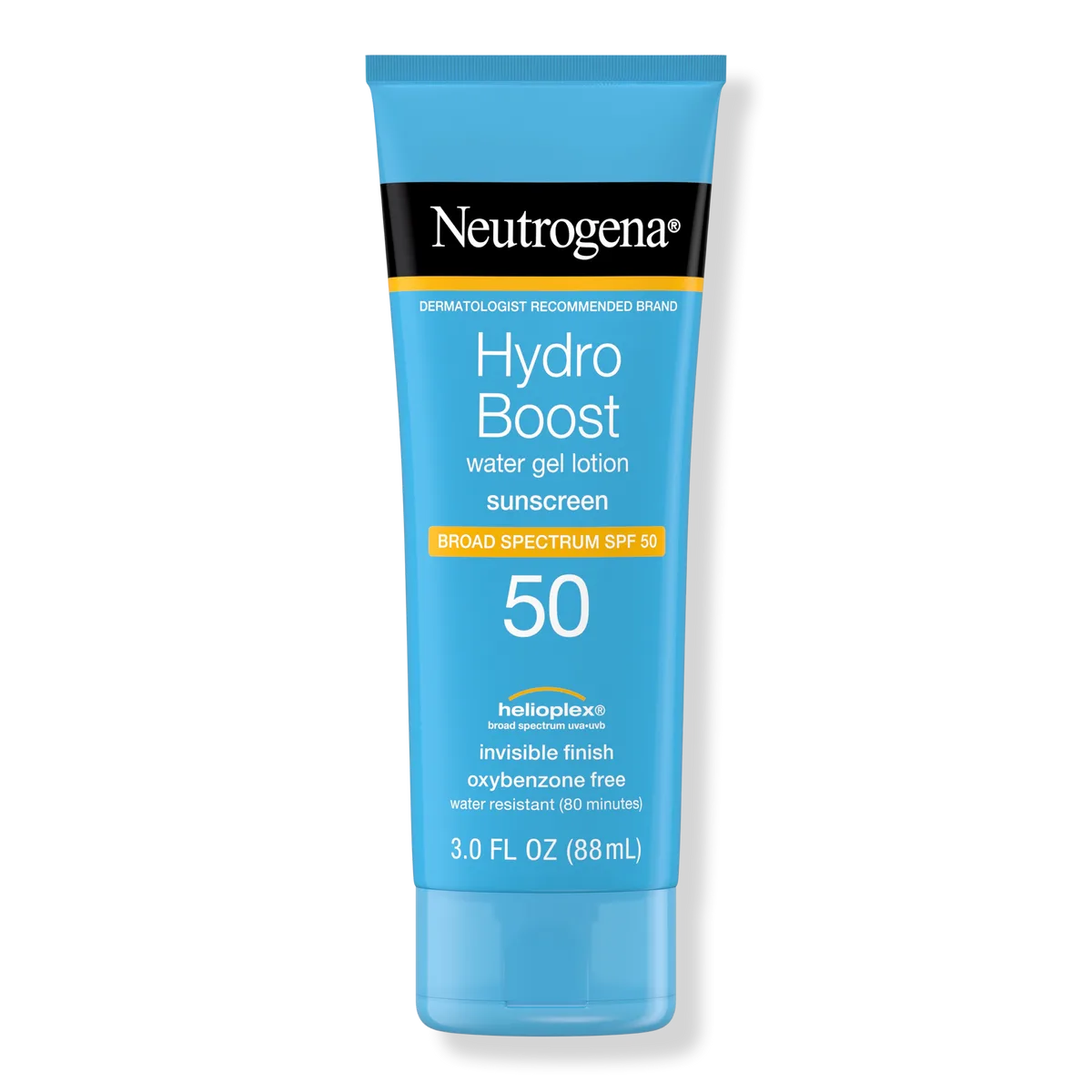
Hydro Boost Water Gel Sunscreen SPF 50
Hydrating Drugstore SPF Pick
 Verified reviewer
Pros & cons.
- +Water-gel texture absorbs quickly and feels like a lightweight moisturizer, not a sunscreen
- +Broad-spectrum SPF 50 with four chemical filters and photostabilized avobenzone
- +No white cast whatsoever, works beautifully on all skin tones
- +Hydrolyzed hyaluronic acid provides measurable hydration benefit from the sunscreen step
- +Layers seamlessly under makeup without pilling, balling, or disrupting foundation
- +Oil-free formula controls shine effectively for normal and oily skin types
- +Affordable drugstore pricing with wide retail availability
- +Reformulated to remove oxybenzone, addressing environmental and health concerns
- −Stings and burns eyes significantly when product migrates during sweating
- −Contains alcohol denat. high in the ingredient list, potentially drying for dry or compromised skin
- −Fragrance and menthyl lactate make it unsuitable for truly sensitive skin
- −Only available in one size — no travel mini or value-size option
- −Can appear shiny or greasy in very humid conditions with heavy application
- −Chemical filters may concern pregnant users or those avoiding systemic absorption
The full review.
In 2015, Neutrogena bet on the Korean beauty wave and the rising popularity of hyaluronic acid. The Hydro Boost line launched as an accessible drugstore entry into the HA craze. When the sunscreen extension arrived two years later, it promised a hydrating sunscreen.
The pitch worked. The Hydro Boost Water Gel Sunscreen SPF 50 has a loyal following among people tired of thick, greasy sunscreen. The water-gel texture delivers: it melts into skin like a lightweight moisturizer, absorbs in under two minutes, and leaves a dewy-healthy finish rather than a greasy one. This texture works well for oily and combination skin types.
The four-filter chemical system uses avobenzone at 3%, homosalate at 15%, octisalate at 5%, and octocrylene at 10% for broad-spectrum protection. The octocrylene acts as a UVB filter and a photostabilizer for the avobenzone, which breaks down under UV exposure. Research in AAPS PharmSciTech confirms octocrylene reduces avobenzone’s light-induced decomposition, making the broad-spectrum claim credible for a full day.
The signature hydrolyzed hyaluronic acid is a smaller molecular weight HA. Research shows it penetrates the stratum corneum instead of sitting on top of the skin. A 2016 study in Skin Research and Technology used Raman spectroscopy to confirm low molecular weight HA reaches deeper skin layers than standard HA. With glycerin high in the ingredient list, the formula provides genuine humectant activity.
However, alcohol denat is listed fourth in the ingredient list. This is not a trace amount. Denatured alcohol creates the quick-drying, weightless feel, but it makes the formula difficult for dry, sensitive, or barrier-compromised skin. The formula provides hydrolyzed HA and glycerin but also uses alcohol, which can disrupt the skin barrier. This tradeoff works for oily skin but is a gamble for dry or reactive skin.
The product also contains fragrance. In a daily facial sunscreen, synthetic fragrance is polarizing. The light, clean scent is inoffensive to many, but it is a dealbreaker for fragrance-free consumers. Menthyl lactate, a cooling agent, can also sting sensitized skin. These factors explain why reviews are extreme.
A common complaint is that this sunscreen stings eyes. Many reviewers report burning and watering eyes, especially when sweating. Use caution if using this for outdoor workouts or beach days where the product might migrate. This is a limitation for a product marketed for active use.
Neutrogena reformulated this product around 2023 to remove oxybenzone. This move addressed environmental concerns after Hawaii banned oxybenzone in reef-adjacent waters in 2021, and health concerns following a 2020 JAMA study showing chemical UV filters exceeding FDA systemic absorption thresholds. The reformulation keeps the SPF 50 rating, though some users prefer the original formula.
The packaging is functional Hydro Boost blue. At 3 fl oz, it is compact for travel but lasts only one to two months with daily face application at the recommended amount. At roughly seventeen dollars, the per-ounce cost is reasonable for a branded SPF 50, though cheaper protection exists if hydration is not a priority.
The question is whether the hydration—which is partly a gimmick due to the HA concentration and the alcohol—justifies choosing this over other chemical SPF 50 options. For normal-to-oily skin types wanting one-step moisture and protection, it does. The texture is pleasant for this price point. For sensitive or dry skin, the fragrance, alcohol, and chemical filters create too many friction points.
Neutrogena is the number one dermatologist-recommended suncare brand. This is not an untested formula. Nearly a decade of use across millions of consumers has stress-tested this product. It is not perfect or for everyone, but for the right skin type, it makes daily sunscreen application easier.
Ingredient analysis.
Full INCI list
Active Ingredients: Avobenzone 3%, Homosalate 15%, Octisalate 5%, Octocrylene 10%. Inactive Ingredients: Water, Butyloctyl Salicylate, Glycerin, Alcohol Denat., Silica, Caprylyl Methicone, Aluminum Starch Octenylsuccinate, Dimethicone, Polyurethane-62, Phenoxyethanol, Pentylene Glycol, Styrene/Acrylates Copolymer, Sodium Acryloyldimethyltaurate/VP Crosspolymer, Acrylates/Dimethicone Copolymer, Fragrance, Glyceryl Stearate, Chlorphenesin, Menthyl Lactate, Tocopheryl Acetate, Disodium EDTA, Trideceth-6, Hydrolyzed Hyaluronic Acid, Sodium Hydroxide, Blue 1
Skin match.
The science.
The Science
This sunscreen uses a four-filter system based on a known photochemical strategy. Avobenzone provides UVA coverage, but it is inherently unstable; UV light triggers keto-enol tautomerization and degrades its protection. Adding 10% octocrylene fixes this. A 2009 study in AAPS PharmSciTech shows that co-formulating octocrylene with avobenzone reduced light-induced decomposition from 28.6% to 21.5%. A 2015 patent review in Recent Patents on Drug Delivery & Formulation lists this as the most common commercial photostabilization approach.
The 15% homosalate reaches the FDA's maximum allowable concentration. A 2020 JAMA randomized clinical trial by FDA researchers found all tested chemical UV filters, including homosalate, exceeded the 0.5 ng/mL systemic absorption threshold under maximal application. The study authors noted this does not prove harm, only the need for more study. A 2025 review in the Journal of the American Academy of Dermatology affirms the dermatological consensus that sunscreen benefits outweigh theoretical absorption risks.
The hydrolyzed hyaluronic acid supports the hydration claim. Unlike standard high molecular weight HA (1000-1400 kDa), hydrolyzed HA penetrates the stratum corneum. A 2016 study in Skin Research and Technology used Raman micro-imaging on human skin to confirm low molecular weight HA (20-300 kDa) penetrates the stratum corneum while larger HA does not. A 2024 double-blind randomized controlled trial in Archives of Dermatological Research validated that low molecular weight HA produced significantly greater skin hydration than high molecular weight HA after four weeks of daily application. The hydrolyzed HA and glycerin work as a dual-humectant system, but the alcohol denat. in the formula may partially undermine hydration by disrupting the lipid barrier.
References
- Incorporation in lipid microparticles of the UVA filter, butyl methoxydibenzoylmethane combined with the UVB filter, octocrylene: effect on photostability — AAPS PharmSciTech (2009)
- Effect of Sunscreen Application on Plasma Concentration of Sunscreen Active Ingredients: A Randomized Clinical Trial — JAMA (2020)
- Human skin penetration of hyaluronic acid of different molecular weights as probed by Raman spectroscopy — Skin Research and Technology (2016)
- Effectiveness of topical hyaluronic acid of different molecular weights in xerosis cutis treatment in elderly: a double-blind, randomized controlled trial — Archives of Dermatological Research (2024)
- Sunscreens part 2: Regulation and safety — Journal of the American Academy of Dermatology (2025)
Dermatologist Perspective
Dermatologists often recommend the Hydro Boost Water Gel Sunscreen to patients who avoid sunscreen due to texture. Board-certified dermatologists note the lightweight, hydrating formula solves a common barrier to daily SPF use: the heavy, greasy feel that causes skipping or under-application. The broad-spectrum SPF 50 rating with photostabilized avobenzone meets AAD recommendations for daily use. However, dermatologists typically advise patients with rosacea, eczema, or compromised barriers to use fragrance-free mineral alternatives, as the alcohol denat. and chemical filters in this formula may irritate reactive skin.
Where it fits in your routine.
Apply liberally to face and neck fifteen minutes before sun exposure. Use this as the last step in your morning skincare routine, before makeup. Use about a nickel-sized amount for the face alone. Reapply every two hours during direct sun exposure or immediately after eighty minutes of swimming or heavy sweating. For daily indoor use, apply in the morning and reapply before heading outdoors. Apply over a moisturizer for dry skin or directly on clean skin for oily types.
At roughly seventeen dollars for a 3 fl oz tube, this sits in the mid-range of drugstore sunscreens — not the cheapest option, but competitive for a branded SPF 50 with hydrating benefits. A tube lasts one to two months with daily face application. The lack of size options is a miss — there's no mini for trial and no larger tube for better per-ounce value. Neutrogena's legacy and the genuine hydration technology justify the price over generic chemical SPFs, but the fragrance, alcohol, and eye-stinging issues mean you're paying for a formula that's optimized for a specific skin type rather than universally appealing.
Normal, combination, and oily skin types want a lightweight daily SPF 50 that hydrates and layers well under makeup. It works for anyone skipping sunscreen to avoid the greasy feel of traditional formulas.
This works for sensitive skin, rosacea, or eczema, fragrance-averse users, and people needing sunscreen for sweaty activities where eye migration is a concern. Pregnant users may choose mineral sunscreen alternatives instead.
Product details.
This lightweight water-gel turns into a thin, fluid consistency on contact with skin. It is a gel-lotion hybrid, not a true gel, that spreads easily and absorbs quickly without dragging.
Light, clean fragrance with a subtle floral-fresh note. It is noticeable on application but dissipates within a few minutes. It is not overwhelming, but fragrance-averse users will notice it.
A compact blue squeeze tube uses a flip-top cap and matches the Hydro Boost line's signature blue branding. The 3 fl oz size is travel-friendly. It is functional, not thick.
Menthyl lactate provides a subtle cooling sensation upon application. It absorbs within one to two minutes, leaving a lightweight, slightly dewy finish. It feels faintly tacky for a moment before it sets. No adjustment period is needed — day one results are consistent.
1-2 months with daily face-only application at recommended amount
12 months
spring summer
The backstory.
The Hydro Boost line launched in 2015 as Neutrogena's answer to the Korean beauty hydration trend, centering everything on hyaluronic acid. The sunscreen extension arrived in 2017, filling a gap for consumers who wanted lightweight, hydrating sun protection without the greasy feel of traditional formulas. A reformulation around 2023 removed oxybenzone, reflecting the broader industry shift away from the controversial UV filter.
About Neutrogena
Legacy Brand (20+ years)Neutrogena launched in 1930 and rebranded in 1962, growing its reputation through direct dermatologist relationships. Kenvue (formerly Johnson & Johnson Consumer Health) now operates the brand. It is the #1 dermatologist-recommended suncare brand in the United States and has decades of formulation research.
Common myths.
Water gel sunscreens offer less protection than thick, traditional sunscreens
SPF testing is identical regardless of texture. This product's SPF 50 provides the same measured protection as any thick cream-based SPF 50 when applied at the recommended 2mg per square centimeter.
The hyaluronic acid in this sunscreen removes the need for a separate moisturizer
hydrolyzed HA adds hydration, but it sits near the end of the ingredient list and alcohol denat. may offset some benefits. Dry skin types still need a dedicated moisturizer underneath.
FAQ.
Does Neutrogena Hydro Boost Sunscreen leave a white cast?
No. This chemical sunscreen uses organic UV filters — avobenzone, homosalate, octisalate, and octocrylene — that absorb into skin without visible residue. It works on all skin tones without a white cast, a primary selling point.
Is Neutrogena Hydro Boost Sunscreen reef safe?
The reformulated version removes oxybenzone and octinoxate, the two UV filters most linked to coral reef damage. It still contains octocrylene, which some emerging research says may also affect marine life. No third-party organization certifies it reef-safe.
Can I use Neutrogena Hydro Boost Sunscreen during pregnancy?
This product uses chemical UV filters. Some dermatologists recommend avoiding these during pregnancy because systemic absorption data is limited. A 2020 JAMA study shows these filters exceed FDA absorption thresholds under maximal use. Consult your healthcare provider — many recommend switching to a mineral sunscreen with zinc oxide or titanium dioxide.
Does Neutrogena Hydro Boost Sunscreen have alcohol in it?
Yes — the formula contains alcohol denat. (denatured alcohol) to create a lightweight, fast-absorbing water-gel texture. This makes the product feel refreshing and non-greasy, but it can dry or irritate sensitive, eczema-prone, or very dry skin.
How often should I reapply Neutrogena Hydro Boost Sunscreen?
Reapply every two hours during direct sun exposure, or right after 80 minutes of swimming or heavy sweating. For typical indoor days with minimal sun exposure, apply once in the morning, but reapply before spending significant time outdoors.
Is this the same as Neutrogena Hydro Boost Moisturizer SPF 50?
No — these products differ. The Water Gel Sunscreen SPF 50 is a 3 fl oz tube sunscreen for face and body. The Hydro Boost Moisturizer SPF 50 is a 1.7 fl oz jar facial moisturizer with sun protection; it has a different ingredient list and is fragrance-free.
What the community says.
"Lightweight water-gel texture feels nothing like traditional sunscreen"
"Layers beautifully under makeup without pilling or balling"
"No white cast on any skin tone"
"Provides noticeable hydration while protecting from UV"
"Oil-free formula controls shine for most of the day"
"Affordable drugstore price point for SPF 50 protection"
"Burns and stings eyes severely when sweating"
"Fragrance and alcohol bother sensitive skin users"
"Can feel greasy or shiny in high humidity"
"Some users report breakouts after extended use"
"Texture and performance changed with reformulation"
Featured in.
People also looked at.