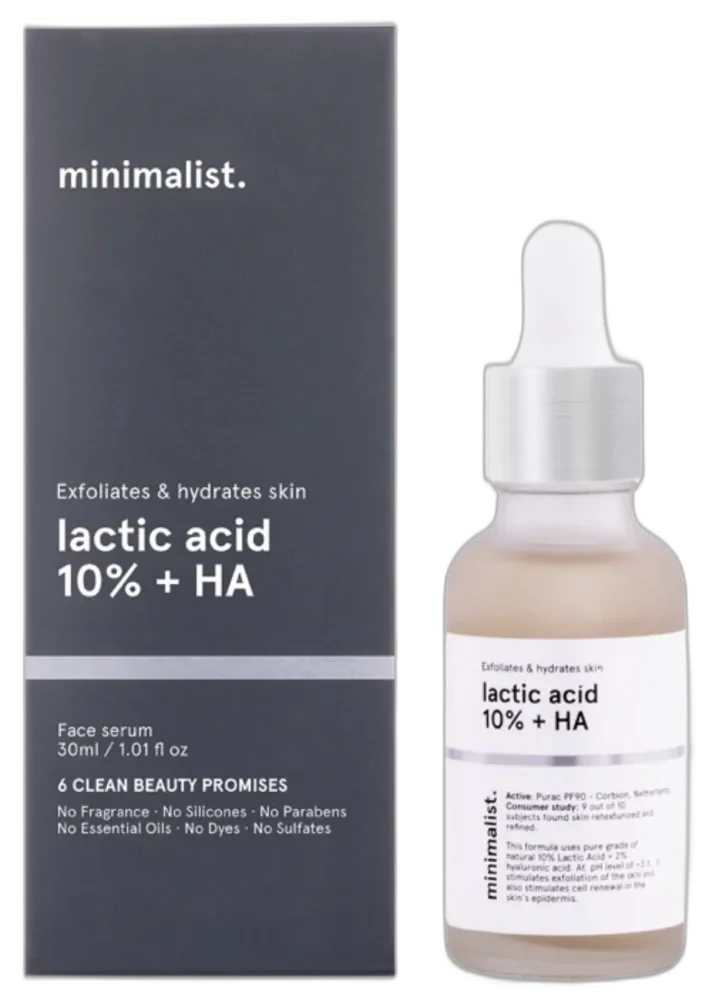
5% Lactic Acid + HA Exfoliating Face Serum
Gentle Beginner AHA
 Verified reviewer
Pros & cons.
- +5% lactic acid at beginner-friendly concentration
- +1% hyaluronic acid and aloe vera base buffer dryness
- +Disclosed pH 3.8 for active, skin-compatible formulation
- +Fragrance-free, alcohol-free, vegan formula
- +One of the cheapest credible beginner AHAs on the market
- +Brand ingredient transparency with full INCI disclosure
- +Gentle enough for dry and sensitive skin
- −Too gentle for experienced acid users
- −Requires strict daily SPF compliance the next morning
- −Not pregnancy-compatible as a leave-on treatment
- −Mild flaking possible in the first 1-2 weeks of use
- −Newer SKU with less independent review history than the 10% version
The full review.
For an honest first AHA serum recommendation, start with 5% lactic acid. Avoid glycolic acid, which penetrates deeper and stings more. Avoid mandelic acid, as serums usually exceed 10%. Avoid multi-acid blends, which overwhelm beginners. Use plain lactic acid at a beginner concentration in a well-buffered base. Lactic acid has a larger molecule than glycolic acid, so it stays more superficial. This results in lower irritation and a gentler introduction to acid use. At 5%, it is mild—it provides surface exfoliation and mild pigmentation improvement with minimal risk to the skin barrier in the first week. For new exfoliation routines, this is the right category, and Minimalist’s 5% version is a top affordable pick in the Indian market. The brand has been ingredient-transparent since its 2020 launch. The box prints pH 3.8, discloses the raw material source, and lists the full INCI in order. The formula uses 5% L-lactic acid and 1% sodium hyaluronate for hydration, using an aloe vera juice base instead of plain water. This aloe choice matters. Most budget AHA serums use water as the base to save money, but water provides no support for the acid. Aloe adds a mild soothing and humectant layer that buffers early stinging and keeps skin comfortable during the first weeks of adjustment. Glycerin, propanediol, and pullulan extend the hydration layer. Turmeric extract appears near the end as a brand-signature antioxidant nod to Ayurvedic tradition; it provides modest support rather than acting as a primary active. Application causes a slight cool tingle that fades within 30 to 60 seconds. This confirms the acid is active at this pH—if a leave-on AHA feels like nothing, the pH is likely too high and the formula is ineffective. During the first week, some users see very mild flaking around the nose and chin as the acid lifts dead cells. This is not purging (a BHA phenomenon involving closed comedones); it is normal early-stage exfoliation that resolves by week two. After four weeks of consistent 3-to-5-nights-a-week use, skin feels smoother, tone looks brighter, and makeup sits better. Over eight to twelve weeks, superficial hyperpigmentation and post-acne marks fade gradually, which is why most beginners use an AHA. Calibrate expectations. This is a 5% beginner AHA, not a professional peel. You will not see dramatic transformation in a week, and acid-adapted skin will likely find this concentration too gentle. Experienced users should pick the Minimalist 10% version. The 5% version is the correct entry point for first-time users, teenagers, dry or sensitive skin, and those who reacted poorly to stronger acids. Limitations: do not use leave-on AHAs during pregnancy out of caution, even at 5%. Do not combine this in the same session with retinoids, salicylic acid, pure vitamin C, or glycolic acid; this combined load causes barrier damage. Always wear SPF 30 or higher the next morning, as AHAs increase photosensitivity for up to a week. Stop use if you develop persistent redness, burning, or itching, and wait several days before reintroducing at a lower frequency. Value is excellent. At approximately ₹499-599 ($6) for 30ml, this is one of the cheapest credible beginner AHA serums available. The Ordinary 5% Lactic Acid + 2% HA is the closest global comparable at around $8-10 for 30ml; it has higher HA content but lacks the aloe base. Both are reasonable picks depending on market availability. For Indian-market buyers, the Minimalist version is the easier recommendation: it is locally available, comes from a science-forward brand, and is priced at a risk-free level.
Ingredient analysis.
Full INCI list · pH 3.8
Aloe Barbadensis Leaf Juice, L-Lactic Acid, Dimethyl Isosorbide, Sodium Hyaluronate, Propanediol, Ethoxydiglycol, Glycerin, Pullulan, Phenoxyethanol, Ethylhexylglycerin, Curcuma Longa (Turmeric) Root Extract, Xanthan Gum, Hydroxyethylcellulose, Sclerotium Gum, Sodium Hydroxide, Trisodium Ethylenediamine Disuccinate, Lecithin.
Skin match.
The science.
The Science
Lactic acid is an alpha-hydroxy acid found in fermented milk and produced by the body during anaerobic metabolism. It is one of the most studied AHAs, with a publication history dating to the 1990s. Clinical trials show topical lactic acid at 5% concentrations improves skin hydration, increases ceramide synthesis in the stratum corneum, and promotes mild desquamation of surface corneocytes over 4-12 weeks. Lactic acid has a larger molecular size (90 daltons vs 76 daltons) than glycolic acid. This causes slower, shallower penetration, making it better tolerated and the standard first-line AHA for dry, sensitive, or acid-naive skin. A 1996 study in the Journal of the American Academy of Dermatology showed topical lactic acid provides both exfoliation and humectant effects, proving its dual role as an exfoliant and a barrier-supporting hydrator. The formula's pH of 3.8 is in the optimal range for free acid activity while remaining skin-compatible; above pH 4.0, deprotonation of lactic acid reduces its exfoliating action. The 1% sodium hyaluronate in the formula adds a humectant layer to offset the mild drying effect of the acid, and the aloe vera juice base adds hydration and trace anti-inflammatory compounds. Turmeric extract at the end of the INCI adds a small antioxidant layer and reflects the brand's Indian-market positioning, though the concentration is too low to claim anti-inflammatory benefit alone. Independent clinical testing on the specific Minimalist 5% formulation is not published, but the individual actives have strong evidence bases. The formulation approach — 5% free acid at pH 3.8 with a HA and aloe buffer — matches published literature on beginner AHA tolerance.
Dermatologist Perspective
Dermatologists often recommend 5% lactic acid as the first AHA for patients starting an exfoliation routine, especially those with dry, sensitive, or acid-naive skin. Board-certified dermatologists note that lactic acid's larger molecular size and shallower penetration make it better tolerated than glycolic acid at comparable concentrations. They also note the added humectant effect of lactic acid is a benefit higher-molecular-weight AHAs do not share. Clinical settings typically recommend starting 2-3 nights a week for the first 2-4 weeks, then titrating up to 4-5 nights a week if tolerance holds. Clinicians also emphasize daily SPF compliance with any leave-on AHA routine, as photosensitivity increases for up to a week after application and drives post-AHA pigmentation problems. For pregnant patients or those with rosacea, compromised barriers, or active eczema, clinicians typically recommend wash-off alternatives or substitutions like azelaic acid.
Where it fits in your routine.
Apply at night only, after cleansing and toning. Use 2 nights a week for the first 2 weeks. Put 3-4 drops on clean fingertips and pat onto the face, avoiding the eye area and the corners of the mouth. Wait 60 seconds to absorb, then apply a hydrating moisturizer. If your skin tolerates it, use 3-5 nights a week. Do not use with retinoids, salicylic acid, glycolic acid, or pure vitamin C in the same session. Always wear broad-spectrum SPF 30 or higher the next morning, and reapply during direct sun exposure. Stop use if you get persistent redness, burning, or flaking. Consult a dermatologist if irritation does not resolve within a few days.
At approximately ₹499-599 ($6) for 30ml, this is one of the most affordable credible beginner AHA serums in India or globally. The Ordinary 5% Lactic Acid + 2% HA costs roughly $8-10 for 30ml and is the closest global comparison. Both are reasonable picks; the Minimalist formulation uses an aloe vera base to offset slightly lower HA content. For first-time AHA buyers testing if leave-on acid exfoliation works before buying expensive products, this serum is risk-free for the price. Experienced acid users get more value from the 10% version at a similar price.
First-time AHA users, teenagers starting a routine, and dry or sensitive skin types seeking gentle surface exfoliation. It suits Indian-market buyers wanting a well-formulated, low-price entry-level acid, and anyone who reacted badly to stronger exfoliants before. It also works as a reasonable refresher for buyers returning to skincare after a break.
The Minimalist 10% version works better for experienced acid users plateaued at 5% concentrations. Skip use during pregnancy, active rosacea flares, eczema, or compromised barriers, and if you cannot use daily SPF the next morning.
Product details.
All Year
The backstory.
Minimalist launched its first lactic acid serum at 10% in 2020 as part of the brand's opening SKU set. As the brand's audience expanded beyond acid-experienced users to include teenagers and first-time skincare buyers, Minimalist developed lower-concentration beginner variants of several of its core actives. The 5% lactic acid version is positioned as the entry point into the brand's AHA range and is often recommended by the brand's own customer support for users who have never used a leave-on exfoliant before.
About Minimalist
Emerging Brand (2–5 years)Minimalist (Be Minimalist) is an Indian D2C skincare brand founded in 2020 in Jaipur by Mohit and Rahul Yadav. Hindustan Unilever acquired the brand in 2024. Minimalist (Be Minimalist) publishes pH, raw material sources, and full INCI for every product, a practice rare in the Indian affordable skincare market.
Common myths.
Lactic acid works less effectively than glycolic acid, so beginner versions waste time.
Lactic acid has a larger molecular size than glycolic acid and penetrates less deeply. This makes it milder and better tolerated. For first-time acid users and dry or sensitive skin, 5% lactic acid exfoliates the surface with less irritation risk than glycolic acid at the same concentration.
You need to use an AHA every night for it to work.
Most skin types can sustain a leave-on AHA 3-4 nights a week. Overuse causes most acid-induced barrier damage. Aim for consistent application over months rather than maximum frequency in one week.
FAQ.
What is the difference between Minimalist 5% and 10% Lactic Acid serums?
The 5% version has half the acid concentration. It works for first-time AHA users and sensitive or dry skin. The 10% version is a stronger formulation for experienced acid users wanting aggressive exfoliation. Both use pharmaceutical-grade raw material from Corbion and DSM and have a pH of 3.5-4.0.
Can I use this serum if I have sensitive skin?
Yes — 5% lactic acid is a top starting AHA for sensitive skin. The aloe vera base and 1% hyaluronic acid in this formula increase tolerance. Use it 2 nights a week. If you have reacted to an acid before, patch test on the inner forearm for 3 nights first.
Is this serum safe during pregnancy?
Leave-on 5% lactic acid is low-risk during pregnancy because systemic absorption is minimal. However, most dermatologists still recommend caution with any leave-on AHA during pregnancy and breastfeeding. Pregnant buyers can choose safer alternatives like azelaic acid, niacinamide, or wash-off AHA cleansers.
How often should I use this lactic acid serum?
Use this 2 nights a week for the first 2 weeks to test tolerance. If your skin shows no flaking, redness, or tightness, increase to 3-5 nights a week. Most users find 3-4 nights a week sustainable long-term; overuse causes most AHA-induced barrier damage.
Can I combine this with my vitamin C serum?
Do not use these in the same application window. Lactic acid and pure ascorbic acid both work at low pH; layering them causes stinging and excessive exfoliation. Most skin types do well using vitamin C in the morning and lactic acid at night. If you use both at night, alternate nights instead of layering.
Is this serum effective for acne scars?
Yes, slightly, for superficial post-inflammatory hyperpigmentation and uneven texture. True indented acne scars are structural and do not respond to topical AHA — those require in-office procedures like microneedling, subcision, or fractional laser. For flat pigmentation marks from healed acne, 5% lactic acid with daily sunscreen and niacinamide fades them in 8-12 weeks.
What the community says.
"gentle enough for sensitive skin"
"visible glow within 2 weeks"
"not drying despite the acid"
"affordable beginner entry point"
"fragrance-free and clean base"
"slight tingle on first use"
"less powerful than the 10% version"
"dropper occasionally drips"
"not enough for advanced users"
People also looked at.