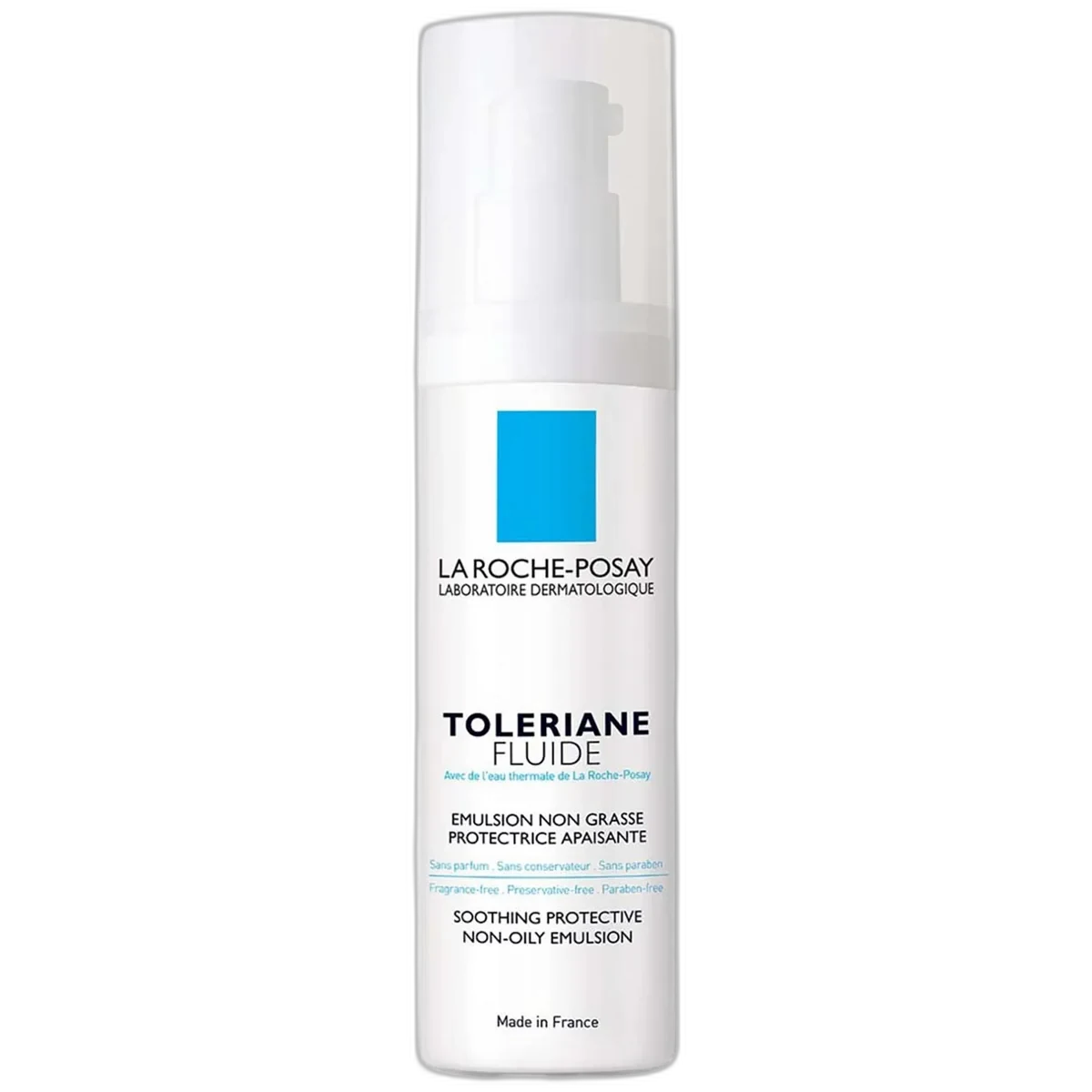
Toleriane Sensitive Fluide
Sensitive Skin MVP
 Verified reviewer
Pros & cons.
- +Ultra-minimal 10-ingredient formula eliminates nearly all potential irritation triggers
- +Niacinamide actively repairs the skin barrier by stimulating ceramide biosynthesis
- +Fungal acne safe with anti-malassezia caprylic acid — a rare combination
- +Matte, weightless finish absorbs in seconds and layers flawlessly under sunscreen and makeup
- +Prebiotic thermal spring water targets microbiome imbalance at the root of sensitivity
- +Alternative preservation system avoids traditional preservatives that trigger reactive skin
- +Pregnancy safe with no flagged ingredients — one of the safest moisturizers for expecting mothers
- +Allergy UK certified — independently validated for use on allergy-prone skin
- −Not hydrating enough as a standalone moisturizer for dry or very dehydrated skin
- −40ml tube lasts only 4-6 weeks — rapid repurchase cycle at this price point
- −High price-per-ounce relative to the simplicity of the 10-ingredient formula
- −Only available in one size with no larger, better-value option
- −Small percentage of users sensitive to niacinamide may experience flushing or bumps
The full review.
There is a particular kind of skincare desperation that only people with truly reactive skin understand. You have tried the gentle cleansers, the fragrance-free creams, the products with calming botanical illustrations on the packaging. And still, your face burns. Your cheeks flush. You start reading ingredient lists like a detective scanning for suspects, and every product seems to contain at least one thing that might be the culprit.
La Roche-Posay built the Toleriane Sensitive Fluide for exactly this moment. Not as a product that tries to do everything, but as one that refuses to do anything unnecessary.
The INCI list reads like a haiku: ten ingredients, each with a clear purpose, no filler, no fragrance, no hedge bets. Aqua, caprylic/capric triglyceride, glycerin, propanediol, pentylene glycol, niacinamide, ammonium polyacryloyldimethyl taurate, caprylyl glycol, citric acid, xanthan gum. That is the entire formula. You could memorize it during your morning commute.
This radical minimalism did not happen by accident. La Roche-Posay spent five years studying the skin microbiome before launching the prebiotic Toleriane line, conducting thirteen clinical studies that revealed something counterintuitive about sensitive skin: the problem often is not just a damaged physical barrier. It is a disrupted microbial ecosystem. Skin with reduced bacterial diversity tends to be more reactive, more prone to flares, more difficult to calm. The thermal spring water from the town of La Roche-Posay — the same water that has been used to treat skin conditions since the Middle Ages — was shown in published research to increase microbial diversity and shift the skin’s bacterial balance toward a healthier profile.
So while the ingredient list looks deceptively simple, there is genuine science underneath the simplicity. The niacinamide does not just sit there looking respectable on the label. It actively stimulates ceramide biosynthesis — a fancy way of saying it helps your skin build its own protective lipid layers from the inside out. Published research in the British Journal of Dermatology showed that nicotinamide increased ceramide production by four to five fold in skin cells. That is your skin repairing itself, not just being temporarily soothed.
Texture
The texture is immediately lovely. It sits somewhere between a gel and a lotion — fluid enough to spread without resistance, substantial enough to feel like it is doing something. It absorbs in seconds, genuinely seconds, leaving behind a matte finish that feels like nothing at all. If you are the kind of person who hates the sensation of product sitting on your face, this will feel like relief. Under sunscreen, under makeup, it layers without protest. It does not pill. It does not shift. It simply disappears.
Scent
There is no scent. Not a mild scent, not a fresh scent, not a slightly clinical scent — no scent whatsoever. For anyone who has developed an almost Pavlovian flinch at the first whiff of fragrance in a skincare product, this absence is its own kind of luxury.
Packaging
The preservation system deserves a mention because it represents a genuine formulation innovation. Instead of traditional preservatives like parabens or phenoxyethanol — both of which can trigger reactions in sensitive skin — the Toleriane Sensitive Fluide uses pentylene glycol and caprylyl glycol as antimicrobial agents. This is not the same as being truly preservative-free in the sense of having no antimicrobial protection. The product has a standard twelve-month shelf life after opening. But for skin that has developed sensitivities to conventional preservative systems, this alternative approach can make the difference between a product that works and one that burns.
Best for
Another quiet triumph of this formula is its fungal acne compatibility. The caprylic/capric triglyceride that provides the emollient base is not merely safe for malassezia-prone skin — caprylic acid has genuine antifungal properties. Finding a moisturizer that is simultaneously fragrance-free, oil-free, silicone-free, and actively anti-fungal is harder than it sounds. Most products tick three of those boxes and miss the fourth.
Not ideal for
Now for the honest limitations. This is not a product for dry skin. If your skin drinks moisturizer like desert sand drinks rain, the Toleriane Sensitive Fluide will leave you wanting. It was designed for combination-to-oily sensitive skin, and its lightweight emulsion reflects that. Dry skin types can absolutely use it — but as a layer in a routine, not as the final destination. You will want something richer on top.
The size is the other sticking point. Forty milliliters. That is all you get. With twice-daily application to face and neck, expect four to six weeks of use before the tube is empty. At thirty-one dollars, that translates to roughly twenty-three dollars per ounce, which is a lot for a ten-ingredient moisturizer — even one backed by five years of microbiome research and made in France from thermal spring water. The value equation asks you to weigh pharmaceutical-grade formulation precision against the simplicity of what is actually in the tube.
Common Praise
For what it is worth, the people who love this product love it fiercely. Browse the reviews and you will find stories of rosacea finally calming down, of post-procedure skin that stopped protesting, of months-long reactive episodes that broke when everything else had failed. With over two thousand reviews across retailers and a consistent four-and-a-half star average, the praise is not anecdotal noise — it is a pattern.
The Toleriane Sensitive Fluide will not transform your skin. It will not make you glow. It will not generate before-and-after photos worthy of a social media carousel. What it will do is stop making things worse — and for genuinely reactive skin, that restraint is the most transformative thing a moisturizer can offer.
Ingredient analysis.
Full INCI list
Aqua/Water/Eau, Caprylic/Capric Triglyceride, Glycerin, Propanediol, Pentylene Glycol, Niacinamide, Ammonium Polyacryloyldimethyl Taurate, Caprylyl Glycol, Citric Acid, Xanthan Gum
Skin match.
The science.
The Science
The Toleriane Sensitive Fluide uses two strategies for sensitive skin: niacinamide repairs the physical barrier, and prebiotic thermal spring water supports the microbial barrier.
Niacinamide does more than smooth the skin. A study in the British Journal of Dermatology (Tanno et al., 2000) shows that nicotinamide increases ceramide biosynthesis by 4.1 to 5.5 fold in keratinocytes and boosts glucosylceramide and sphingomyelin production. This repairs the barrier by making the skin produce more of its own protective lipids instead of relying on external ones. A randomized controlled study in Cutis (Draelos et al., 2005) shows that a niacinamide-containing moisturizer improves stratum corneum barrier function and hydration in rosacea subjects after four weeks of twice-daily use.
The microbiome focus is La Roche-Posay's distinct scientific contribution. Research in the Journal of Drugs in Dermatology (Zeichner and Seité, 2018) examined how the brand's thermal spring water affects skin microbial communities. The study found that La Roche-Posay Thermal Spring Water increases Gram-negative bacterial diversity and reduces Gram-positive dominance—a shift linked to healthier, less reactive skin. This is important because atopic dermatitis, rosacea, and general sensitivity link to reduced microbial diversity on the skin surface.
This formula is unusual because it combines both strategies in a minimalist vehicle. Most sensitive-skin moisturizers use many soothing botanicals. The Toleriane Sensitive Fluide is more targeted: it rebuilds the physical barrier with niacinamide, rebalances the microbial barrier with prebiotic thermal water, and removes everything else that might interfere.
References
- Nicotinamide increases biosynthesis of ceramides as well as other stratum corneum lipids to improve the epidermal permeability barrier — British Journal of Dermatology (2000)
- From Probiotic to Prebiotic Using Thermal Spring Water — Journal of Drugs in Dermatology (2018)
- Niacinamide-containing facial moisturizer improves skin barrier and benefits subjects with rosacea — Cutis (2005)
Dermatologist Perspective
Dermatologists often recommend the Toleriane Sensitive Fluide as a first-line moisturizer for reactive skin, especially rosacea and contact dermatitis. Board-certified dermatologists note the 10-ingredient formula helps identify irritant triggers; when patients react to many products, this minimal formula establishes a stable baseline. Doctors also recommend the product post-procedure when chemical peels, laser treatments, or microneedling temporarily compromise the skin barrier. Allergy UK certification and dermatological testing on infants from three months support its safety for sensitive populations.
Where it fits in your routine.
Apply a pea-sized amount to clean, dry skin every morning and evening. Spread it gently over the face and neck with light, upward strokes; do not rub vigorously. Use sunscreen in the morning. At night, apply after treatment serums and let each layer absorb before adding the next. If you use retinoids, apply the retinoid first, wait a few minutes, then layer the Toleriane Sensitive Fluide on top to buffer irritation and seal in moisture.
At $30.99 for 40ml, the Toleriane Sensitive Fluide costs about $23 per ounce. This price is premium for a moisturizer with only 10 ingredients. No larger sizes exist to lower the per-unit cost, so you must repurchase every four to six weeks. You pay for La Roche-Posay's pharmaceutical-grade formulation precision, French manufacturing, and sourced thermal spring water, not exotic actives. For people with genuinely reactive skin who spent more on products that caused irritation, the reliability justifies the price. For those with mild sensitivity who tolerate more products, the value is harder to defend.
This works for reactive, rosacea-prone, or chronically sensitive skin that flares with other moisturizers. It also fits those needing a fungal acne-safe or pregnancy-safe option with minimal ingredients.
This lightweight fluide lacks enough moisture for dry or very dehydrated skin seeking a thick, deeply nourishing moisturizer. Skip this if you prefer products with visible anti-aging actives like peptides or retinol.
Product details.
This lightweight, fluid emulsion sits between a gel and a lotion. It is thinner than a cream, has a slightly gel-like consistency, glides on easily, and absorbs within seconds. It is not sticky or tacky.
Unscented — no detectable smell. This fragrance-free formulation uses no masking agents.
Compact white squeeze tube with screw cap. Hygienic tube format prevents contamination. Standard La Roche-Posay pharmacy-style packaging — functional and travel-friendly rather than luxurious.
The first application feels cooling and soothing, not tingling or stinging. The fluide vanishes into skin within seconds and leaves a matte, barely-there feel. There is no adjustment period or purging. Users with severely compromised barriers may feel very mild tingling on first use that subsides within minutes.
4-6 weeks with twice-daily face and neck application
12 months
All Year
The backstory.
La Roche-Posay spent five years researching the skin microbiome and conducted 13 clinical studies before launching the prebiotic Toleriane line. The insight was that sensitive skin correlates with reduced microbial diversity — a disrupted microbiome — rather than just barrier damage alone. The Fluide launched in 2018 as the lightweight, oil-free version specifically targeting combination-to-oily sensitive skin that needed barrier repair without heaviness.
About La Roche-Posay
Legacy Brand (20+ years)La Roche-Posay launched in 1975 near the Vienne department thermal spring in France. Dermatologists have recommended it for nearly five decades. The brand develops formulations with over 25,000 dermatologists worldwide and uses extensive clinical research.
Common myths.
A 'preservative-free' moisturizer lacks antimicrobial protection and spoils quickly.
The Toleriane Sensitive Fluide uses pentylene glycol and caprylyl glycol as antimicrobial agents. These work like preservatives but are not classified as traditional preservatives. The product has a 12-month period after opening.
The short ingredient list means the product does little for your skin.
Each of the 10 ingredients has a specific function. Niacinamide stimulates ceramide biosynthesis to repair the barrier. This minimalism is the feature — it reduces irritation risk and delivers clinically validated barrier-building benefits.
Oil-free moisturizers can't properly hydrate skin.
This formula uses glycerin as a humectant and caprylic/capric triglyceride as a lightweight emollient to hydrate without traditional oils. Clinical testing shows 48-hour hydration and a 28% reduction in dryness after four weeks.
FAQ.
Is La Roche-Posay Toleriane Sensitive Fluide good for rosacea?
Yes — niacinamide reduces redness and strengthens the skin barrier. This 10-ingredient formula is one of the safest moisturizers for rosacea-prone skin. It is fragrance-free, alcohol-free, and silicone-free, so it lacks common rosacea triggers. The prebiotic thermal spring water also targets microbiome imbalance, which research links to rosacea flares.
Is this moisturizer enough for dry skin?
On its own, the Toleriane Sensitive Fluide may not provide sufficient hydration for dry skin — its lightweight, oil-free emulsion was designed for combination-to-oily sensitive skin. If you have dry skin, layer it over a hydrating serum and consider following with a richer occlusive cream at night for adequate moisture retention.
Can I use this with retinol?
The Toleriane Sensitive Fluide works well with retinol and retinoid treatments. Its niacinamide buffers irritation, and the barrier-repairing formula supports skin adjusting to retinoid use. Apply your retinoid first, wait a few minutes, then layer the Toleriane Sensitive Fluide on top to lock in moisture and calm reactivity.
Is La Roche-Posay Toleriane Sensitive Fluide fungal acne safe?
Yes — with 10 ingredients and zero malassezia triggers, this is one of the safest moisturizers for fungal acne-prone skin. The caprylic/capric triglyceride in the formula has antifungal properties against malassezia yeast, so it works actively rather than just avoiding triggers.
What's the difference between Toleriane Sensitive Fluide and Toleriane Sensitive Crème?
Both use the same minimalist, prebiotic approach, but the Fluide is the lighter version for combination-to-oily skin. It has a matte, non-greasy finish and absorbs almost instantly. The Crème is thicker and more emollient, better for normal-to-dry sensitive skin that needs more moisture.
Is this product safe during pregnancy?
Yes — the Toleriane Sensitive Fluide scores high on pregnancy safety assessments. It has no retinoids, salicylic acid, or ingredients flagged as pregnancy concerns. Its 10-ingredient formula makes it one of the safest moisturizer choices for expecting mothers with sensitive skin.
Why does this product only have 10 ingredients?
The ultra-short ingredient list is intentional. La Roche-Posay stripped the formula to essentials after years of microbiome research showed fewer ingredients mean fewer potential triggers for reactive skin. Each ingredient has a clear purpose. The preservation system uses pentylene glycol instead of traditional preservatives to reduce irritation risk.
What the community says.
"Absorbs instantly with zero greasiness"
"Genuinely calms reactive and rosacea-prone skin"
"Truly fragrance-free with no detectable scent"
"Works beautifully under makeup and sunscreen"
"Minimal ingredient list minimizes risk of irritation"
"Soothing effect felt immediately on first application"
"Not moisturizing enough as a standalone for dry skin"
"40ml tube feels small for the price — runs out quickly"
"Occasional reports of niacinamide sensitivity causing bumps or flushing"
"Price-per-ounce is high relative to the simple formula"