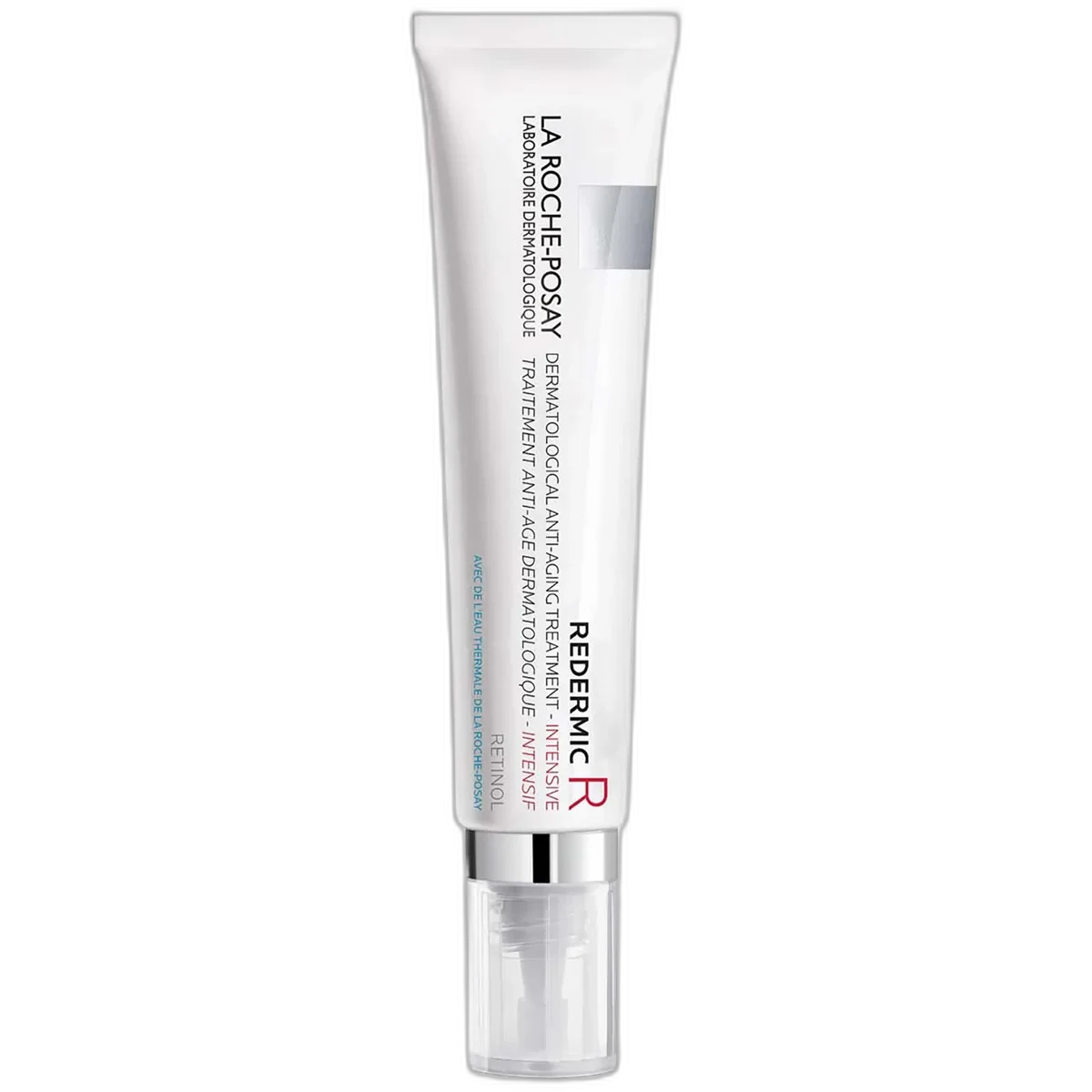
Redermic R Retinol Cream
Beginner Retinol Pick
 Verified reviewer
Pros & cons.
- +Dual-retinoid system extends anti-aging activity beyond standard single-retinol formulas
- +LHA provides gentle exfoliation that complements retinol without compounding irritation
- +Needle-nose dispensing tip prevents over-application and limits air exposure to retinol
- +Emollient base meaningfully buffers retinol irritation during the adjustment period
- +Adenosine adds a second anti-wrinkle mechanism through a separate biochemical pathway
- +Elegant velvety texture absorbs cleanly without greasy or tacky residue
- +Over a decade of market history with consistent positive dermatologist endorsement
- −Contains fragrance despite being positioned for sensitive skin — an unnecessary sensitization risk
- −Premium pricing for a 0.1% retinol concentration that competitors match at lower cost
- −Small 30ml tube depletes quickly with nightly use, lasting only 6-8 weeks
- −Not suitable for pregnancy or breastfeeding due to retinoid content
- −May be too gentle for users already experienced with higher-strength retinol products
The full review.
There is a very specific kind of skincare consumer who has been staring at retinol products for years, reading the studies about collagen stimulation and cell turnover, desperately wanting to start — and then putting the product back on the shelf because their skin once reacted badly to a fragrance sample at a department store. La Roche-Posay built the Redermic R for exactly that person, and it has been quietly converting retinol skeptics since 2012.
The formula takes a dual-retinoid approach that you do not often see at this price tier. Pure retinol at 0.1% handles the heavy lifting — stimulating cell turnover, boosting collagen synthesis, and gradually evening out tone. But the clever addition of retinyl linoleate, a retinoid ester, extends the formula’s activity window. Think of it as a time-release mechanism: the pure retinol acts relatively quickly, while the retinyl linoleate provides a slower, sustained retinoid effect. The result is longer exposure to retinoid activity without simply cranking up the concentration and inviting irritation.
Then there is LHA — capryloyl salicylic acid — La Roche-Posay’s patented lipophilic cousin of salicylic acid. Where standard BHA charges in and can leave sensitive skin feeling stripped, LHA penetrates more slowly and uniformly. In this context, it gently enhances the exfoliation that retinol initiates without doubling the irritation load. It is a small ingredient detail that reveals how much thought went into this formula’s tolerance profile.
Adenosine rounds out the active roster. While it does not get the breathless attention that retinol receives, adenosine stimulates collagen and elastin through a different biochemical pathway. Having two distinct mechanisms working on the same problem — fine lines and loss of firmness — is a formulation strategy that suggests genuine dermatological intent rather than a marketing department picking trendy ingredients.
The texture is genuinely pleasant. A velvety cream that absorbs cleanly without leaving a greasy film or the tacky residue that plagues many retinol products. The needle-nose tip on the tube is a surprisingly practical touch — retinol products should be dispensed in small, controlled amounts, and this packaging actually encourages proper use rather than leaving you guessing with a wide-mouth tube. It is the kind of detail that suggests the product team consulted with people who actually use retinol nightly, not just people who formulate it.
Now, the elephant in the ingredient list: fragrance. For a brand that has built its entire identity around sensitive skin and dermatological authority, the inclusion of parfum in a retinol product is genuinely puzzling. Retinol already challenges the skin’s tolerance — adding a known sensitizer on top of that is like installing a smoke detector and then lighting a candle next to it. Yes, the fragrance is subtle, dissipating within minutes of application. But for the truly reactive skin types this product claims to serve, it is an unnecessary risk that competitors have avoided.
Let us talk about what this cream actually does on your face. During the first two weeks, expect the classic retinol adjustment: mild dryness, perhaps some light flaking, occasionally a bit of tightness by morning. This is normal and expected at 0.1% retinol. The emollient base — rich in glycerin, soybean oil, and occlusive agents — does meaningfully buffer these effects compared to water-based retinol serums that leave your skin exposed. By week three or four, most users report that the adjustment phase has passed. By week six, texture improvements become hard to ignore: smoother surface, more even tone, a certain luminosity that was not there before. Fine line reduction follows over the next several weeks, with the most dramatic improvements typically visible around the three-month mark.
The 0.1% concentration places this firmly in beginner-to-intermediate territory. Users already experienced with retinol may find it too gentle to deliver noticeable improvement beyond what they have already achieved. This is not a criticism — it is a feature for its intended audience. But it does make the pricing conversation more complicated. At $54.99 for a single ounce, you are paying a meaningful premium for a concentration that several pharmacy-brand competitors match or exceed at lower price points. What you are paying for, arguably, is the formulation intelligence — the dual retinoid system, the LHA, the adenosine, the tolerance-focused delivery. Whether that justifies the premium depends on how much you value sleeping through the retinol adjustment period without incident.
The sodium hyaluronate inclusion provides hydration insurance during that adjustment period. In this emollient base, it draws moisture into the skin while the heavier lipid components lock it in — a sensible approach that reduces the flaking and tightness that drive many first-time retinol users to quit before they see results.
For its intended audience — the retinol-curious with reactive skin, the forty-something who has never used an anti-aging active, the person whose dermatologist recommended starting retinol gently — Redermic R remains a credible recommendation despite the fragrance issue. It is effective without being aggressive, elegant without being frivolous, and backed by a brand with genuine dermatological authority. Just know that you are paying for the gentleness, and if your skin can handle a more potent retinol, your wallet might prefer you looked elsewhere.
Formula
Texture
The texture is genuinely pleasant. A velvety cream that absorbs cleanly without leaving a greasy film or the tacky residue that plagues many retinol products. The needle-nose tip on the tube is a surprisingly practical touch — retinol products should be dispensed in small, controlled amounts, and this packaging actually encourages proper use rather than leaving you guessing with a wide-mouth tube. It is the kind of detail that suggests the product team consulted with people who actually use retinol nightly, not just people who formulate it.
Scent
Now, the elephant in the ingredient list: fragrance. For a brand that has built its entire identity around sensitive skin and dermatological authority, the inclusion of parfum in a retinol product is genuinely puzzling. Retinol already challenges the skin’s tolerance — adding a known sensitizer on top of that is like installing a smoke detector and then lighting a candle next to it. Yes, the fragrance is subtle, dissipating within minutes of application. But for the truly reactive skin types this product claims to serve, it is an unnecessary risk that competitors have avoided.
Works for
Let us talk about what this cream actually does on your face. During the first two weeks, expect the classic retinol adjustment: mild dryness, perhaps some light flaking, occasionally a bit of tightness by morning. This is normal and expected at 0.1% retinol. The emollient base — rich in glycerin, soybean oil, and occlusive agents — does meaningfully buffer these effects compared to water-based retinol serums that leave your skin exposed. By week three or four, most users report that the adjustment phase has passed. By week six, texture improvements become hard to ignore: smoother surface, more even tone, a certain luminosity that was not there before. Fine line reduction follows over the next several weeks, with the most dramatic improvements typically visible around the three-month mark.
Best for
The 0.1% concentration places this firmly in beginner-to-intermediate territory. Users already experienced with retinol may find it too gentle to deliver noticeable improvement beyond what they have already achieved. This is not a criticism — it is a feature for its intended audience. But it does make the pricing conversation more complicated. At $54.99 for a single ounce, you are paying a meaningful premium for a concentration that several pharmacy-brand competitors match or exceed at lower price points. What you are paying for, arguably, is the formulation intelligence — the dual retinoid system, the LHA, the adenosine, the tolerance-focused delivery. Whether that justifies the premium depends on how much you value sleeping through the retinol adjustment period without incident.
Pairs Well With
The sodium hyaluronate inclusion provides hydration insurance during that adjustment period. In this emollient base, it draws moisture into the skin while the heavier lipid components lock it in — a sensible approach that reduces the flaking and tightness that drive many first-time retinol users to quit before they see results.
Who Should Buy
For its intended audience — the retinol-curious with reactive skin, the forty-something who has never used an anti-aging active, the person whose dermatologist recommended starting retinol gently — Redermic R remains a credible recommendation despite the fragrance issue. It is effective without being aggressive, elegant without being frivolous, and backed by a brand with genuine dermatological authority. Just know that you are paying for the gentleness, and if your skin can handle a more potent retinol, your wallet might prefer you looked elsewhere.
Ingredient analysis.
Full INCI list
Aqua/Water, Isostearyl Neopentanoate, Glycerin, Octyldodecanol, Propylene Glycol, Pentylene Glycol, Acrylamide/Sodium Acryloyldimethyltaurate Copolymer, Cetearyl Alcohol, Glycine Soja Oil/Soybean Oil, Triethanolamine, Isohexadecane, Sodium Hyaluronate, Retinol, Retinyl Linoleate, Adenosine, Capryloyl Salicylic Acid, Caprylyl Glycol, Polysorbate 80, Phenoxyethanol, Parfum/Fragrance
Skin match.
The science.
The Science
Decades of research support Retinol's anti-aging efficacy. A landmark study in the Archives of Dermatology (Kang et al., 2005) shows that topical retinol at 0.1% concentrations increases collagen production in photoaged human skin, proving the concentration used in Redermic R works. After seven days of treatment, the study found increased procollagen type I expression and reduced matrix metalloproteinase expression.
The formula uses a dual-retinoid approach with retinyl linoleate as a complementary retinoid ester. Retinyl linoleate converts to retinol and then to retinoic acid to become biologically active. This conversion is slower than pure retinol, which provides extended retinoid activity. A study in the Journal of Investigative Dermatology (Antille et al., 2004) shows retinoid esters provide sustained biological activity and less irritation than pure retinol alone.
La Roche-Posay's proprietary molecule, LHA (capryloyl salicylic acid), has a unique penetration profile. Its lipophilic nature lets it integrate into the stratum corneum lipid layers more slowly and evenly than free salicylic acid. Research in the Journal of the European Academy of Dermatology and Venereology (Saint-Leger et al., 2007) shows LHA promotes desquamation with less surface irritation than conventional hydroxy acids.
Adenosine's anti-wrinkle properties are well-documented. Studies show it stimulates fibroblast proliferation and collagen synthesis through a mechanism independent of retinoid receptor activation. Redermic R attacks wrinkle formation through two distinct molecular pathways at once: retinoid-mediated gene transcription and adenosine-mediated cellular stimulation. This strategy produces more comprehensive results than either approach alone.
References
- Topical retinol attenuates photoaging-associated collagen deficiency in naturally aged human skin in vivo — Archives of Dermatology (2005)
- Topical retinaldehyde on human skin: biologic effects and tolerance — Journal of Investigative Dermatology (2004)
- Clinical assessment of the efficacy and tolerance of a capryloyl salicylic acid preparation — Journal of the European Academy of Dermatology and Venereology (2007)
Dermatologist Perspective
Dermatologists often recommend Redermic R as a first retinol for patients sensitive to retinoids. Board-certified dermatologists say the 0.1% concentration is the sweet spot for retinol initiation. It is potent enough to deliver measurable collagen stimulation per published research, but tolerable enough that most patients finish the adjustment period. The dual-retinoid delivery system extends retinoid activity without increasing peak irritation. However, dermatologists specializing in sensitive skin note the fragrance inclusion contradicts the product's positioning. They may recommend fragrance-free retinol alternatives for patients with diagnosed rosacea or contact dermatitis.
Where it fits in your routine.
Apply a pea-sized amount to clean, dry skin at night. Damp skin increases retinol penetration and irritation risk. Use the needle-nose tip to dispense a controlled line onto your fingertip. Spread gently over the face, avoiding the eye area, lips, and broken skin. Use it every other night for the first 2-3 weeks, then use nightly as tolerated. Follow with a ceramide-based moisturizer to reinforce the skin barrier. Apply broad-spectrum SPF 30 or higher the next morning because retinol increases photosensitivity.
At $54.99 for 1.0 fl oz, Redermic R is a high-priced pharmacy retinol. The per-ounce cost is high for a 0.1% retinol formula, but the dual-retinoid system, LHA, and adenosine add formulation sophistication beyond simple retinol-in-a-cream products. Only one size exists, so there is no larger option for better per-unit value. The tube lasts about 6-8 weeks with nightly use, costing roughly $7-9 per week of retinol treatment. For a legacy pharmacy brand with decades of dermatological research, the premium reflects proven formulation expertise — but the price-to-concentration ratio matters for budget-conscious consumers.
First-time retinol users with normal to combination skin seeking a well-formulated retinoid anti-aging introduction. People in their late thirties to fifties wanting a gentle, effective way to treat fine lines, texture, and dullness. Those who value pharmacy-brand dermatological credibility and find other retinol products too harsh.
People with fragrance sensitivity or diagnosed rosacea face unnecessary risk from the included parfum. Pregnant or breastfeeding individuals must avoid all retinoid products. Budget-conscious shoppers who tolerate a straightforward retinol formula can get equivalent results for less. Experienced retinol users need a higher concentration for continued progress.
Product details.
Thick, fast-absorbing cream with a velvety finish that feels neither heavy nor greasy.
Light fragrance — noticeable upon application but dissipates within minutes
An aluminum tube with a needle-nose tip allows controlled dispensing and comes in a cardboard box. The precision tip prevents over-application and limits air exposure to protect the retinol from degradation.
Expect mild tingling during the first application; it subsides within minutes. Some dryness and light flaking occur during the first 1-2 weeks as skin adjusts to retinol. These effects resolve by week 3-4 with consistent use. If irritation persists, use it every third night.
6-8 weeks with nightly face-only application using a pea-sized amount
12 months
All Year
The backstory.
La Roche-Posay developed the Redermic R line in 2012 as part of its mission to make clinically effective anti-aging ingredients accessible to sensitive skin types that might otherwise avoid retinol. The formula emerged from the brand's dermatological research partnerships and was designed to deliver meaningful retinol results while minimizing the notorious adjustment period that causes many users to abandon retinol altogether.
About La Roche-Posay
Legacy Brand (20+ years)La Roche-Posay launched in 1975 near its namesake thermal spring in France. Dermatologists have recommended its products for nearly five decades. The brand develops formulations with over 90,000 dermatologists worldwide and uses extensive clinical research.
Common myths.
Higher retinol concentrations do not always yield better anti-aging results.
This formula uses 0.1% retinol and retinyl linoleate. This moderate, well-formulated concentration delivers results with less irritation. Research shows consistent use of a tolerable retinol concentration outperforms sporadic use of a higher one.
You can't use retinol if you have sensitive skin.
This product targets sensitive skin. The emollient base, hydrating sodium hyaluronate, and gentle LHA exfoliant instead of aggressive acids make retinol tolerable for reactive skin types, but the added fragrance is an unfortunate inclusion for truly sensitive individuals.
FAQ.
What percentage of retinol is in La Roche-Posay Redermic R?
Redermic R uses 0.1% pure retinol and retinyl linoleate as a secondary retinoid booster. This dual-retinoid system provides sustained activity beyond 0.1% retinol alone, so it works for most skin types while remaining tolerable.
Can I use La Roche-Posay Redermic R every night?
Use this every other night for the first 2-3 weeks to build tolerance. Increase to nightly use once your skin adjusts without significant irritation. The emollient base in this formula buffers the retinol, but patience during the adjustment period ensures long-term success.
Is La Roche-Posay Redermic R safe during pregnancy?
No. Redermic R contains retinol, a vitamin A form that dermatologists and obstetricians advise avoiding during pregnancy and breastfeeding. If you are pregnant or planning pregnancy, stop use and ask your healthcare provider for pregnancy-safe alternatives.
Does La Roche-Posay Redermic R contain fragrance?
This formula contains parfum/fragrance, even though the brand focuses on sensitive-skin formulations. The scent is subtle and fades fast, but people with fragrance sensitivities or reactive skin conditions like rosacea should note this before purchasing.
How long does it take to see results from Redermic R?
Most users see better skin texture and brightness within 4-6 weeks of consistent use. Fine line and wrinkle reduction shows after 8-12 weeks. Full anti-aging benefits, including improved tone and firmness, take 3-6 months of nightly application.
Can I use vitamin C with La Roche-Posay Redermic R?
Yes, but not simultaneously. Use vitamin C serum in the morning and apply Redermic R at night. This method lets each active work at its optimal pH without competing for absorption or increasing irritation risk. Combining morning antioxidant protection with nighttime retinol repair is a dermatologist-endorsed anti-aging strategy.
What is LHA in Redermic R and why is it included?
LHA (capryloyl salicylic acid) is La Roche-Posay's patented lipophilic salicylic acid derivative. Unlike standard BHA, LHA (capryloyl salicylic acid) penetrates more slowly and evenly. This provides gentle exfoliation that boosts retinol's cell turnover effects without increasing irritation. It also has mild antibacterial properties for pore clarity.
What the community says.
"Noticeable reduction in fine lines within weeks"
"Less irritating than many retinol products"
"Elegant texture that absorbs well"
"Controlled dispensing with needle-nose tip"
"Contains fragrance despite being marketed for sensitive skin"
"Expensive for a 0.1% retinol concentration"
"Small tube runs out quickly with nightly use"
"Some users experience prolonged flaking"
Featured in.
People also looked at.