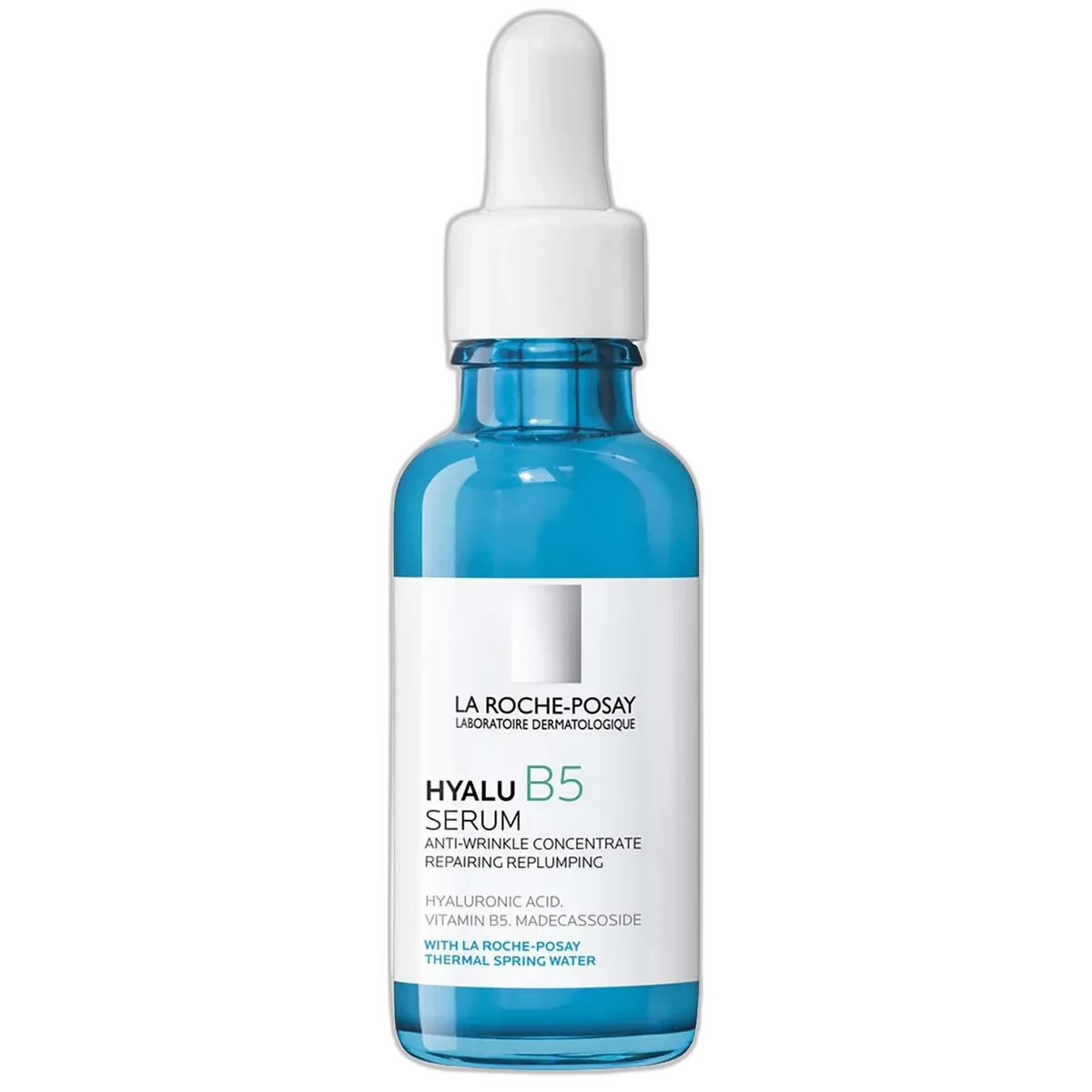
Hyalu B5 Pure Hyaluronic Acid Serum
Hydration Power Serum
 Verified reviewer
Pros & cons.
- +Dual-molecular-weight hyaluronic acid hydrates at surface and deeper skin levels simultaneously
- +Madecassoside adds genuine anti-inflammatory and collagen-stimulating repair beyond basic hydration
- +Panthenol strengthens barrier to lock in moisture long-term
- +Silky, non-sticky texture absorbs quickly and layers perfectly under other products
- +Over 7,000 reviews averaging 4.4 stars across major retailers validates real-world efficacy
- +Available in two sizes with better per-ounce value in the larger format
- −Contains alcohol denat. which can cause cumulative dehydration with long-term use
- −Contains fragrance — unnecessary in a clinical-grade serum for potentially sensitized skin
- −Premium pricing at $40 for 1 oz in a category with many cheaper HA alternatives
- −30 ml bottle depletes in 6-8 weeks with recommended twice-daily use
- −Some users find it insufficiently hydrating for very dry skin without a rich moisturizer on top
The full review.
About La Roche-Posay
Hyaluronic acid serums have become the bottled water of skincare — everywhere, essentially similar, and often overpriced for what they deliver. When every brand from luxury to drugstore offers some version of HA in a dropper bottle, the question becomes: what justifies paying $40 for one? La Roche-Posay’s answer with the Hyalu B5 is to make the serum do more than just hydrate.
Reality
The formula starts with hyaluronic acid, as you’d expect, but deploys it at two molecular weights. Sodium hyaluronate — the larger, full-weight molecule — sits on the skin surface and forms a moisture-binding film that reduces transepidermal water loss. It’s the instant gratification layer: you apply the serum and skin immediately feels plumper, dewier, more alive. Hydrolyzed hyaluronic acid, the smaller fragment, penetrates past the stratum corneum into deeper skin layers where it delivers moisture directly to the site where fine lines originate. This two-depth approach is clinically logical — surface hydration makes skin look better immediately, but the deeper delivery is what creates the more lasting plumping effect on wrinkles.
But the ingredient that genuinely separates the Hyalu B5 from its sea of competitors is madecassoside. This is a purified compound from Centella asiatica — not the generic cica extract that shows up in a thousand Korean beauty products, but a specific, isolated molecule with documented anti-inflammatory and tissue-repair properties. Research has demonstrated that madecassoside stimulates type I collagen synthesis, which directly addresses the collagen loss that underlies skin aging. It also calms the chronic low-grade inflammation — what dermatological literature calls inflammaging — that accelerates skin breakdown. Including it in a hydrating serum transforms the product from a moisture delivery vehicle into something with genuine repair capabilities.
Panthenol, vitamin B5, completes the active trio. Its role here is both functional and strategic: it strengthens the skin barrier, reducing transepidermal water loss so that the moisture the HA delivers actually stays in the skin rather than evaporating. Without adequate barrier function, hyaluronic acid can become a revolving door — pulling water in and then losing it just as quickly. Panthenol closes that door.
Texture
The texture is one of the formula’s clear strengths. It’s a clear, silky gel that spreads effortlessly and absorbs within 30-60 seconds without the tacky, film-like residue that plagues many HA serums. On the skin, it leaves a subtle dewy finish that’s visible but not shiny — enough glow to look healthy, not enough to look greasy. It layers beautifully under every moisturizer and sunscreen tested with it, and doesn’t pill, ball up, or create texture issues when combined with other products.
Common Praise
The clinical backing is unusually strong for a serum in this category. La Roche-Posay’s own studies report that 87% of users had more elastic and even skin after one month, and 71% observed reduced wrinkle appearance. These are brand-funded studies, so take them with appropriate context, but the user review data — over 7,000 reviews averaging 4.4 stars across major retailers — provides independent validation that the formula delivers noticeable results.
Common Complaints
Now, the frustration. This formula contains alcohol denat. and fragrance. In a serum designed for daily use, potentially twice daily, on aging skin that may already have compromised barrier function, both ingredients are questionable. Alcohol denat. can cause cumulative dehydration and barrier damage with long-term use — precisely the opposite of what a hydrating serum should do. The fragrance, while subtle, is a known sensitizer that serves no functional purpose. La Roche-Posay makes many fragrance-free, alcohol-free products, which makes these inclusions feel like a formulation choice for cosmetic elegance rather than clinical necessity.
It’s an odd dissonance: the active ingredients are chosen with pharmaceutical precision, but the vehicle includes components a purist dermatological formulation would avoid. The 7,000+ positive reviews suggest that most users tolerate both ingredients fine, but for the fragrance-sensitive or the ingredient-conscious, these are legitimate concerns.
Pricing
Pricing is where the HA serum category gets contentious. At $39.99 for one ounce, the Hyalu B5 costs significantly more than basic HA serums that deliver the same humectant function. What you’re paying for beyond the HA is the madecassoside, the panthenol, and the dual-molecular-weight delivery — ingredients and technology that basic HA serums don’t include. Whether that justifies a $25-30 premium over a simple HA product depends on whether you value the repair and barrier-support functions or just want moisture. The 50 ml size at approximately $54 offers better per-ounce value and is the smarter buy for committed users.
Best for
For anyone who’s tried a basic hyaluronic acid serum and thought ‘this is fine, but I expected more,’ the Hyalu B5 provides that more. The dual HA delivers hydration at two levels, the madecassoside adds clinical-grade repair, and the panthenol ensures the moisture stays put. It’s a genuinely thoughtful formula undermined by two ingredients it didn’t need — but even with those asterisks, it outperforms the commodity HA serums it competes with.
Ingredient analysis.
Full INCI list
Aqua/Water, Glycerin, Alcohol Denat., Propylene Glycol, Panthenol, Pentylene Glycol, Dimethicone, PEG-6 Caprylic/Capric Glycerides, PPG-6-Decyltetradeceth-30, Glyceryl Isostearate, Madecassoside, Sodium Hyaluronate, Ammonium Polyacryloyldimethyl Taurate, Disodium EDTA, Hydrolyzed Hyaluronic Acid, Caprylyl Glycol, Citric Acid, Xanthan Gum, Butylene Glycol, Tocopherol, Phenoxyethanol, Parfum/Fragrance
Skin match.
The science.
The Science
Research in the Journal of Clinical and Aesthetic Dermatology shows that dual-molecular-weight hyaluronic acid formulations provide better hydration and anti-wrinkle effects than single-weight HA products. Full-molecular-weight sodium hyaluronate (>1000 kDa) forms a hygroscopic film on the skin surface and reduces transepidermal water loss by up to 25%. Hydrolyzed hyaluronic acid (<50 kDa) penetrates the upper dermis to increase tissue hydration and plump skin from within.
Madecassoside, a triterpene glycoside isolated from Centella asiatica, has extensive research on its wound-healing and anti-aging properties. The Journal of Ethnopharmacology shows that madecassoside stimulates type I collagen synthesis in human dermal fibroblasts and inhibits inflammatory mediators that drive chronic skin aging. A Phytomedicine study confirmed that madecassoside reduces MMP-1 activity—the enzyme that primarily degrades collagen in aging skin—explaining its anti-wrinkle effects.
Dermatological literature documents panthenol's barrier-strengthening properties. When applied topically, panthenol converts to pantothenic acid (vitamin B5), which helps coenzyme A synthesis for lipid metabolism in the stratum corneum. Research in the Journal of Dermatological Treatment confirmed that 5% panthenol improves skin barrier function and reduces TEWL, which amplifies the hydration from hyaluronic acid by preventing moisture escape.
References
- Multi-molecular weight hyaluronic acid formulations for anti-aging skin care — Journal of Clinical and Aesthetic Dermatology (2019)
- Madecassoside stimulates collagen synthesis in human dermal fibroblasts — Journal of Ethnopharmacology (2012)
Dermatologist Perspective
Board-certified dermatologists often recommend the Hyalu B5 as a well-formulated hydrating serum that exceeds basic HA moisture delivery. Dermatologists say the dual-molecular-weight HA approach is scientifically sound and provides measurably better hydration than single-weight formulas. The madecassoside inclusion aligns with dermatological research on inflammaging and collagen support. However, some dermatologists note that the alcohol denat. and fragrance are suboptimal for a serum for sensitive and aging skin, and may recommend fragrance-free alternatives for patients with documented sensitivity.
Where it fits in your routine.
Apply 2-3 drops to damp skin morning and evening after cleansing. Press it into the face, neck, and under-eye area. Use damp skin for best HA efficacy — mist with thermal water or apply right after washing before skin dries. Follow immediately with moisturizer to seal in hydration. In the morning, finish with SPF 30+. This works with retinols, vitamin C, and niacinamide.
At $39.99 for 1 ounce, Hyalu B5 costs more than most pharmacy-brand serums. The triple-active formulation justifies the price over $10-15 HA serums — dual-weight HA, madecassoside, and panthenol do things simple HA products cannot. The 50 ml size costs approximately $54 and offers better per-ounce value for regular users. Using the smaller bottle twice daily lasts 6-8 weeks, making the monthly cost approximately $20-27. La Roche-Posay's clinical heritage and the multi-active formulation support this price, even if budget HA serums always have a lower cost-per-ounce.
This hydrating serum does more than provide basic moisture. It targets early aging signs, fine lines, and dehydration. The formula suits the 30+ demographic wanting hydration and anti-aging benefits in one product. It works well with retinol to offset dryness and irritation.
This formula contains fragrance and alcohol, so avoid it if you have sensitivities to either. Budget-conscious consumers can find HA serums for less if they only need basic hydration. The dewy finish looks too shiny on very oily skin without a mattifying follow-up.
Product details.
This clear, lightweight gel-serum has a slightly viscous consistency and spreads easily without dragging. It absorbs quickly into the skin and lacks the stickiness found in many HA serums. It leaves a smooth, slightly dewy base that layers well under moisturizer and makeup.
Light fragrance — subtle, clean, and barely noticeable. It dissipates seconds after application.
A glass dropper bottle with a white cap comes in 30 ml and 50 ml sizes. The dropper enables precise application; 2-3 drops cover the full face. The 50 ml size has better per-ounce value for regular users.
This clear, silky gel absorbs in 30-60 seconds. Skin feels more hydrated and bouncy immediately after the first application. Most users feel no tingling or stinging. The dewy finish shows an instant glow even before adding moisturizer.
6-8 weeks with twice-daily use (30 ml); 3-4 months (50 ml)
12 months
All Year
The backstory.
The Hyalu B5 launched as La Roche-Posay's answer to the hyaluronic acid serum boom, applying the brand's pharmaceutical approach to an ingredient category that was becoming commoditized. Rather than simply joining the HA gold rush, they developed a formula that combined proven hydration science with their expertise in sensitive skin repair — adding madecassoside and panthenol to create a serum with genuine clinical depth.
About La Roche-Posay
Legacy Brand (20+ years)La Roche-Posay launched in 1975 near central France's thermal springs. Dermatologists have recommended the brand for nearly five decades. Dermatologists develop its formulations, and the Hyalu B5 line shows the brand's anti-aging approach using hydration science.
Common myths.
All hyaluronic acid serums are essentially the same.
HA molecular weight determines its site of action. This serum uses two sizes: full-weight sodium hyaluronate for surface hydration and hydrolyzed HA for deeper penetration. Madecassoside and panthenol distinguish this from HA-only formulas by adding repair and barrier-support functions.
Hyaluronic acid dries skin in low-humidity environments.
HA pulls moisture from any available source. In dry climates, apply HA to damp skin and seal with a moisturizer to stop HA from pulling water from deeper skin layers. This formula's panthenol also reduces transepidermal water loss, making it more humidity-independent than pure HA products.
FAQ.
How should I apply this serum for best results?
How to Use
Apply 2-3 drops to damp skin. Do this right after cleansing or after misting with thermal water. The hyaluronic acid pulls moisture from the water to maximize hydration. Apply moisturizer immediately to seal it in. Use morning and evening.
Pairs Well With
Yes — this serum pairs well with retinol. Apply retinol first, let it absorb, then layer this serum on top. The hyaluronic acid and panthenol buffer retinol's drying effects, while madecassoside soothes retinol-induced inflammation. Many dermatologists recommend this combination.
Best for
Is the 50 ml size better value?
Yes — the 50 ml (1.69 oz) size at approximately $54 has better per-ounce value than the 30 ml (1 oz) at $40. For consistent serum use, the larger size costs less and lasts 3-4 months with twice-daily use.
Common Complaints ---
Why does this serum contain alcohol and fragrance?
alcohol denat. acts as a solvent and texture enhancer so the serum absorbs fast without stickiness. The fragrance level is low for a subtle scent. Users with sensitive skin often criticize both ingredients in this otherwise excellent formula. If these ingredients concern you, use an alcohol-free, fragrance-free HA alternative.
Works for ---
What does madecassoside do in this serum?
Madecassoside is a purified Centella asiatica compound with anti-inflammatory and wound-healing properties. In this formula, it supports collagen synthesis and calms the chronic micro-inflammation (inflammaging) that drives skin aging. This adds a repair component that distinguishes this serum from simple HA-only products.
What the community says.
"Visibly plumps fine lines within days of use"
"Lightweight texture absorbs quickly without stickiness"
"Noticeable improvement in skin hydration and glow"
"Works well under all moisturizers and makeup"
"87% of users reported more elastic, even skin after one month"
"Contains alcohol denat. and fragrance unnecessarily"
"Expensive for a hyaluronic acid serum at $40+"
"Small 1 oz bottle depletes quickly with twice-daily use"
"Some users find it not hydrating enough for very dry skin"
"Can feel slightly tacky in humid conditions"
Featured in.
People also looked at.