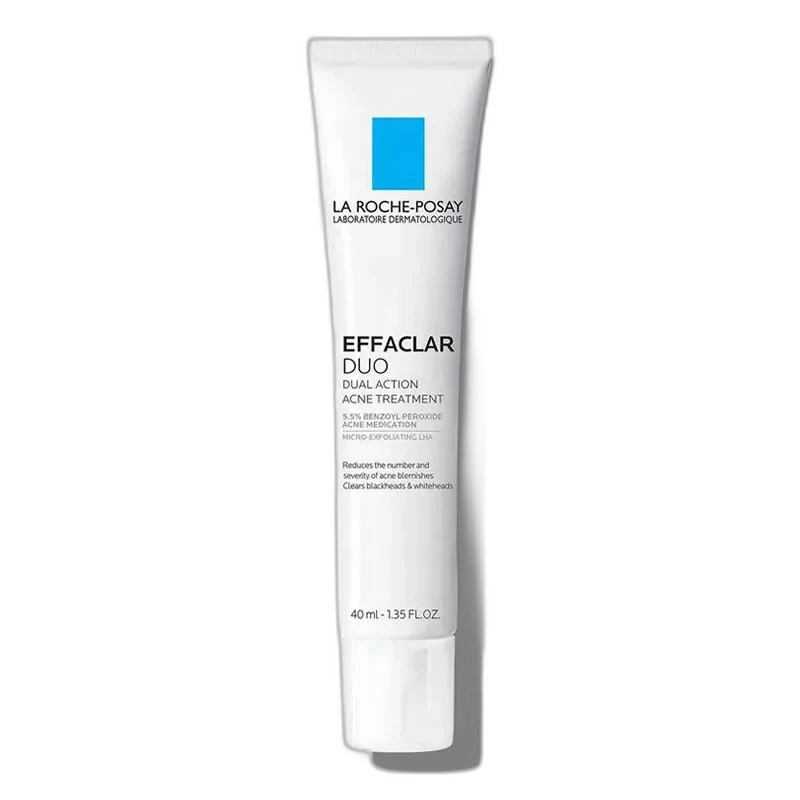
Effaclar Duo Dual Action Acne Treatment
Breakout Emergency Kit
 Verified reviewer
Pros & cons.
- +Dual-action formula addresses both bacterial and comedonal components of acne simultaneously
- +Micronized benzoyl peroxide penetrates pores more effectively than standard BP formulations
- +Proprietary LHA exfoliates pore linings with less irritation than standard salicylic acid
- +Clean 13-ingredient formula with no fragrance, oil, or silicone
- +Fast-acting on inflammatory pimples — visible flattening within 2-5 days
- +Reasonable price at $20.99 for a treatment-grade acne product
- −Benzoyl peroxide bleaches fabrics — dark towels and pillowcases will be damaged
- −Dryness, peeling, and redness are common during the first 2 weeks of use
- −5.5% BP concentration may be too aggressive for sensitive or dry skin types
- −Small tube depletes quickly when used as an all-over treatment
- −Can pill when layered under certain silicone-heavy moisturizers
The full review.
Benzoyl peroxide works with brutal efficiency. It enters clogged, bacteria-filled pores, generates oxygen radicals, and kills anaerobic C. acnes bacteria that cannot survive in oxygen-rich environments. This mechanism has worked since the 1960s; no influencer-endorsed clean beauty replicates what BP does. The Effaclar Duo Dual Action Acne Treatment uses this proven mechanism and adds a second dimension most benzoyl peroxide products lack.
The dual action combines 5.5% micronized benzoyl peroxide with capryloyl salicylic acid—La Roche-Posay’s proprietary Lipo-Hydroxy Acid, or LHA. While benzoyl peroxide handles acne’s bacterial component, LHA addresses the structural component: the buildup of dead skin cells and sebum that creates the clog. Standard salicylic acid works similarly, but LHA has a fatty acid chain that makes it more lipophilic. It penetrates the pore lining more gradually and deeply, dissolving the keratin plugs that form comedones with less surface irritation than its parent compound.
Micronized benzoyl peroxide matters, even if marketing copy ignores this technical detail. Standard BP particles are relatively large and sit on the skin surface, killing bacteria but struggling to reach the deeper pore sections where clogs originate. Micronized BP—milled to a uniformly small particle size—penetrates the follicular canal more effectively, delivering antibacterial action where it is needed. Particle size directly affects both efficacy and tolerability.
The vehicle is clean. It has thirteen ingredients, no fragrance, no oil, and no silicone. Glycerin provides hydration to counterbalance BP’s drying effect. Silica absorbs excess oil and creates a matte finish. Epilobium angustifolium (willowherb) extract offers mild anti-inflammatory properties to temper BP-induced redness. Tocopheryl acetate provides antioxidant support. Every ingredient has a functional purpose to support or moderate the two actives.
On the skin, the product applies as a lightweight white cream that absorbs quickly to a matte, non-greasy finish. The texture works well for acne-prone skin—no heaviness, no pore-clogging residue, and no shiny film. It layers under moisturizer and sunscreen, though some users report occasional pilling with certain silicone-heavy products. The pointed tube applicator allows precise spot treatment, but also works as an all-over treatment for widespread breakouts.
Results come in phases. Active inflammatory pimples—the red, angry ones—respond within 2-5 days of targeted application. BP’s bactericidal action is fast; breakouts flatten and redness reduces quickly. The comedonal side—blackheads, closed comedones, and textural bumps—takes longer, as LHA needs 4-8 weeks to dissolve embedded clogs. Full results at the 8-12 week mark show fewer active breakouts and smoother texture.
The adjustment period is inescapable. Benzoyl peroxide at 5.5% causes dryness, flaking, and redness, especially in the first two weeks. This is an inherent property of the active ingredient, not a product defect. Glycerin and willowherb extract moderate these effects but do not eliminate them. Starting with once-daily application and a strong moisturizer (ceramide-based is ideal) minimizes discomfort. For sensitive skin, the 5.5% concentration may be too aggressive; a lower-concentration BP product is a better starting point.
Benzoyl peroxide bleaches fabric. This is a certainty. Dark towels, colored pillowcases, and clothing contacting treated skin will develop bleach spots. This is the reality of using the most effective OTC antibacterial acne ingredient. White pillowcases, white towels, and waiting for full absorption before touching fabrics are non-negotiable.
At $20.99 for 1.35 ounces, the price is reasonable for a treatment-grade product from a dermatological brand. As a spot treatment, a tube lasts 3-4 months. Used all-over, it lasts roughly 6-8 weeks. The cost per use is modest, and the dual-action formulation replaces the need for two separate products (a BP treatment and a BHA exfoliant).
La Roche-Posay positioned the Effaclar Duo to simplify acne treatment by combining two mechanisms in one step, and the formulation delivers. It does not revolutionize acne treatment, as benzoyl peroxide and exfoliating acids have been the foundation of acne therapy for decades. However, it executes the combination thoughtfully in a vehicle that respects acne-prone skin’s sensitivities at a price that avoids a dermatology copay.
Formula
Texture
On the skin, the product applies as a lightweight white cream that absorbs quickly to a matte, non-greasy finish. The texture works well for acne-prone skin—no heaviness, no pore-clogging residue, and no shiny film. It layers under moisturizer and sunscreen, though some users report occasional pilling with certain silicone-heavy products. The pointed tube applicator allows precise spot treatment, but also works as an all-over treatment for widespread breakouts.
Best for
Active inflammatory pimples—the red, angry ones—respond within 2-5 days of targeted application. BP’s bactericidal action is fast; breakouts flatten and redness reduces quickly. The comedonal side—blackheads, closed comedones, and textural bumps—takes longer, as LHA needs 4-8 weeks to dissolve embedded clogs. Full results at the 8-12 week mark show fewer active breakouts and smoother texture.
Not ideal for
Benzoyl peroxide at 5.5% causes dryness, flaking, and redness, especially in the first two weeks. This is an inherent property of the active ingredient, not a product defect. Glycerin and willowherb extract moderate these effects but do not eliminate them. Starting with once-daily application and a strong moisturizer (ceramide-based is ideal) minimizes discomfort. For sensitive skin, the 5.5% concentration may be too aggressive; a lower-concentration BP product is a better starting point.
Common Complaints
Benzoyl peroxide bleaches fabric. This is a certainty. Dark towels, colored pillowcases, and clothing contacting treated skin will develop bleach spots. This is the reality of using the most effective OTC antibacterial acne ingredient. White pillowcases, white towels, and waiting for full absorption before touching fabrics are non-negotiable.
Works for
At $20.99 for 1.35 ounces, the price is reasonable for a treatment-grade product from a dermatological brand. As a spot treatment, a tube lasts 3-4 months. Used all-over, it lasts roughly 6-8 weeks. The cost per use is modest, and the dual-action formulation replaces the need for two separate products (a BP treatment and a BHA exfoliant).
Pairs Well With
La Roche-Posay positioned the Effaclar Duo to simplify acne treatment by combining two mechanisms in one step, and the formulation delivers. It does not revolutionize acne treatment, as benzoyl peroxide and exfoliating acids have been the foundation of acne therapy for decades. However, it executes the combination thoughtfully in a vehicle that respects acne-prone skin’s sensitivities at a price that avoids a dermatology copay.
Ingredient analysis.
Full INCI list
Active Ingredient: Benzoyl Peroxide 5.5%. Inactive Ingredients: Water, Isostearyl Alcohol, Glycerin, Pentylene Glycol, Silica, Carbomer, Capryloyl Salicylic Acid, Potassium Hydroxide, Tocopheryl Acetate, Acrylates/C10-30 Alkyl Acrylate Crosspolymer, Disodium EDTA, Epilobium Angustifolium Flower/Leaf/Stem Extract
Skin match.
The science.
The Science
Benzoyl peroxide has treated acne since the 1960s using a mechanism different from all other topical acne treatments. BP generates reactive oxygen species (free radicals) that kill Cutibacterium acnes, an obligate anaerobe that cannot survive in oxygen-rich environments. No bacterial resistance to benzoyl peroxide has ever been documented, unlike antibiotics which face mounting resistance problems. A pivotal study in the Journal of the American Academy of Dermatology shows 5% BP is nearly as effective as 10% BP at reducing inflammatory lesion counts with significantly less irritation, which supports the 5.5% concentration in this formula.
Capryloyl salicylic acid (LHA) is La Roche-Posay's patented ingredient and a structural modification of salicylic acid. Adding a fatty acid chain (capryloyl) increases the molecule's lipophilicity, which improves its affinity for the lipid-rich environment inside the sebaceous follicle. Research in the Journal of the European Academy of Dermatology and Venereology shows LHA provides keratolytic and comedolytic effects with better tolerability than standard salicylic acid because it penetrates the stratum corneum more slowly and with more control.
Combining an antibacterial (BP) and a keratolytic (LHA) addresses both primary acne drivers: bacterial proliferation and follicular hyperkeratinization. Clinical dermatology guidelines from the American Academy of Dermatology consistently recommend combination therapy over monotherapy for most acne presentations because addressing multiple pathogenic mechanisms produces superior outcomes. This product uses that principle in one formulation.
References
- Benzoyl peroxide concentration comparison in acne treatment — Journal of the American Academy of Dermatology (1999)
- Lipo-hydroxy acid as a new comedolytic agent — Journal of the European Academy of Dermatology and Venereology (2009)
Dermatologist Perspective
Board-certified dermatologists view benzoyl peroxide as a first-line acne treatment and frequently recommend the Effaclar Duo for its combination approach. Dermatologists note that adding LHA to the formula fills a gap most OTC BP products miss: the keratolytic component that prevents new comedone formation. For patients on a comprehensive acne protocol, dermatologists often recommend using this BP treatment in the morning with an adapalene retinoid at night to attack acne's antibacterial, keratolytic, and cell-turnover pathways.
Where it fits in your routine.
Apply a thin layer to the entire acne-prone area after cleansing, or use it as a spot treatment on individual breakouts. Start with once daily (preferably morning) and move to twice daily if your skin tolerates it. Apply before moisturizer and sunscreen. Let it absorb fully before touching dark fabrics. Use white or light-colored towels and pillowcases to prevent bleaching. Use a gentle, non-foaming cleanser and an oil-free moisturizer to manage dryness.
At $20.99 for 1.35 ounces, the Effaclar Duo has a competitive price for pharmacy-brand acne treatments. The dual-action formulation combines a benzoyl peroxide treatment and a salicylic acid exfoliant into one step, saving money compared to buying two products. As a spot treatment, one tube lasts 3-4 months, making the monthly cost about $5-7. La Roche-Posay's dermatological heritage and the proprietary LHA ingredient offer more value than basic benzoyl peroxide-only products.
Use this for active inflammatory acne — red pimples, pustules — plus blackheads or closed comedones. It works for oily and combination skin types needing antibacterial and exfoliating action. It suits teens and adults with persistent mild to moderate acne who want one product to target both bacteria and pore clogging.
People with dry or sensitive skin who find benzoyl peroxide irritating at low concentrations. Anyone who wants to avoid using white towels and pillowcases. Users of multiple strong actives (retinoids + AHAs) who cannot add another potentially irritating treatment to their routine.
Product details.
This lightweight, white cream absorbs quickly to a matte, non-greasy finish. Silica in the formula absorbs oil to keep treated areas matte instead of shiny. It spreads easily without pulling or dragging across acne-prone skin.
Fragrance-free. The benzoyl peroxide has a faint medicinal scent that vanishes almost immediately after application.
Slim white squeeze tube has a pointed applicator tip for targeted spot treatment. The 1.35 oz size is standard for acne treatments. Effaclar line packaging is clean and clinical.
Applies smoothly and absorbs in 30-60 seconds. Benzoyl peroxide causes mild tingling or warmth on application. Expect dryness and peeling during the first 1-2 weeks as skin acclimates. Active pimples typically flatten within 2-3 days of targeted application.
2-4 months depending on whether used as spot treatment or all-over application
12 months
All Year
The backstory.
The Effaclar Duo represents La Roche-Posay's approach to combining two acne-fighting mechanisms in a single product. Traditional acne protocols often require separate products for antibacterial and exfoliating actions. By pairing micronized BP with their patented LHA in one tube, the brand created a simplified treatment that addresses both the bacterial and clogging components of acne — reducing the number of products needed and the potential for irritation from layering multiple actives.
About La Roche-Posay
Legacy Brand (20+ years)La Roche-Posay launched in 1975 near central France's thermal springs. Dermatologists have recommended the brand for nearly five decades. The Effaclar line is the brand's flagship acne care range; dermatologists developed it and recommend it widely in clinical settings.
Common myths.
Higher concentrations of benzoyl peroxide work better for acne.
Research shows 2.5% BP reduces acne lesions nearly as well as 10% BP but causes less irritation. The 5.5% in this formula provides a middle-ground concentration to balance efficacy and tolerability. Higher concentrations often increase dryness and redness without better acne clearance.
Benzoyl peroxide thins the skin like retinoids do.
BP works via a different mechanism than retinoids. It generates oxygen to kill anaerobic bacteria; it does not increase cell turnover or thin the epidermis. The dryness and peeling it causes are surface-level irritation, not structural skin thinning.
FAQ.
Can I use this with a retinoid?
Yes — use this benzoyl peroxide treatment in the morning and a retinoid (like adapalene) at night for the best results. This combination is a dermatologist-recommended first-line acne protocol that uses two different mechanisms to attack acne. Do not apply both at once, as this increases irritation.
Will this bleach my pillowcase?
Yes. Benzoyl peroxide is a bleaching agent. It discolors dark fabrics, towels, and pillowcases on contact. Use white or light-colored bedding and towels. Wait for the product to absorb fully before touching fabrics, and wash hands after application.
Should I use this as a spot treatment or all over?
Both methods work. For spot treatment, apply a thin layer to active breakouts to resolve them faster. For all-over treatment, apply a thin layer to the entire acne-prone area to prevent new breakouts. Use spot treatment first to test skin tolerance before all-over use.
What is LHA and how is it different from salicylic acid?
LHA (Lipo-Hydroxy Acid, or capryloyl salicylic acid) is La Roche-Posay's patented salicylic acid derivative. A fatty acid chain makes LHA more lipophilic (fat-soluble) than standard salicylic acid. This allows LHA to penetrate pores more gradually and with less surface irritation. It exfoliates the pore lining to unclog blockages but causes less dryness than regular salicylic acid.
Is this safe during pregnancy?
Topical benzoyl peroxide at standard concentrations is generally safe during pregnancy. The American College of Obstetricians and Gynecologists does not list topical BP as contraindicated. Always confirm with your healthcare provider before using acne treatments during pregnancy.
Community
What the community says.
"Visibly reduces active breakouts within days"
"Non-greasy texture that works under makeup"
"Dual-action formula addresses both bacteria and clogging"
"Fragrance-free and oil-free formulation"
"Effective as both spot treatment and all-over application"
"Bleaches towels, pillowcases, and dark clothing"
"Can cause dryness, peeling, and redness during initial use"
"5.5% BP may be too strong for sensitive skin"
"Small tube for the price"
"Some users report the product pilling under moisturizer"
People also looked at.