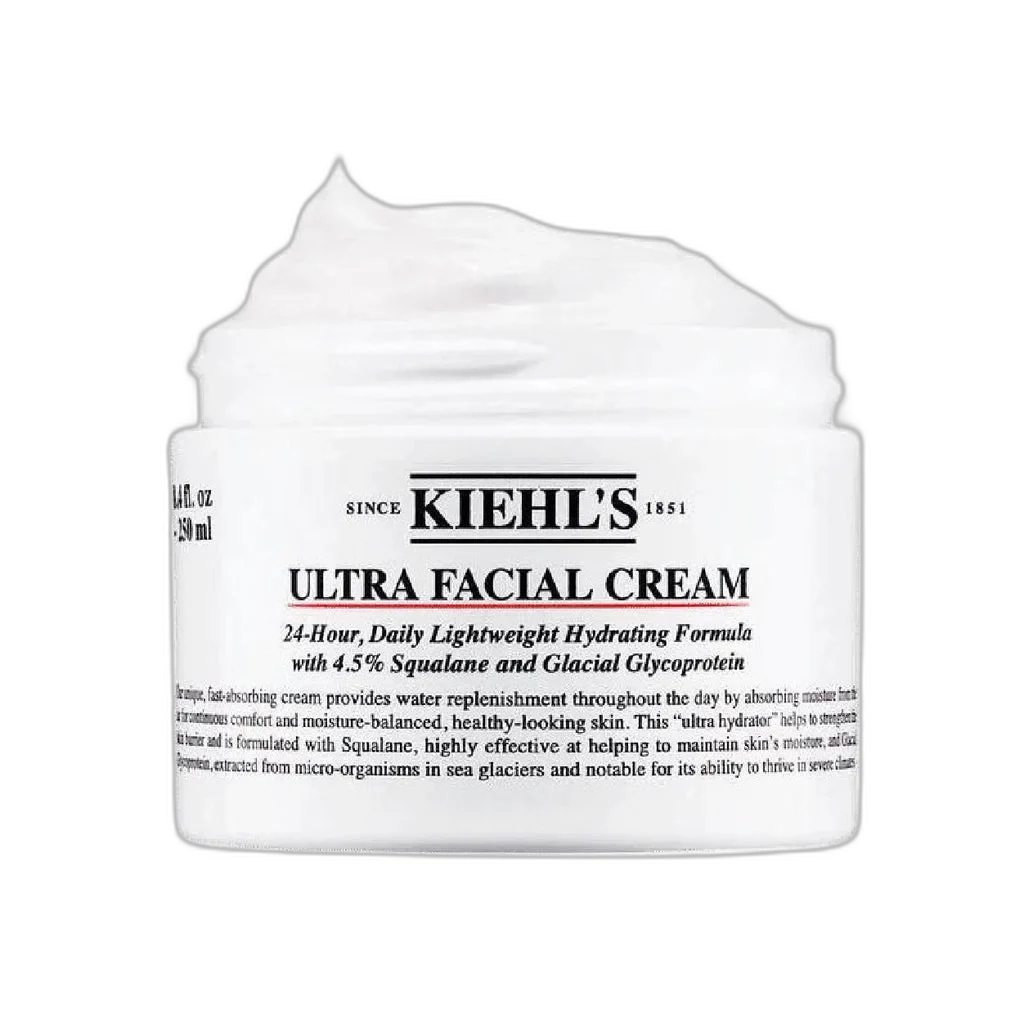
Ultra Facial Cream
Desert Island Moisturizer
 Verified reviewer
Pros & cons.
- +4.5% squalane concentration provides genuine, lasting barrier reinforcement
- +Fragrance-free and paraben-free with near-universal skin type tolerance
- +Lightweight texture absorbs in seconds and layers flawlessly under SPF and makeup
- +Pro-ceramide inclusion supports the skin's own barrier repair mechanisms
- +Glacial glycoprotein offers unique environmental stress protection
- +Over 12,000 reviews and Smithsonian recognition attest to real-world reliability
- +Available in multiple sizes including a refillable jar option
- −Jar packaging exposes product to air and potential contamination
- −May be too rich for very oily skin types in warm, humid climates
- −No anti-aging, brightening, or treatment actives beyond basic hydration
- −Price has increased over the years, reducing its value-for-money appeal
- −Myristyl myristate may be comedogenic for breakout-prone skin
The full review.
About Kiehl’s Ultra Facial Cream
There is a particular kind of immortality reserved for objects that become so embedded in daily life that they transcend their original category. The white porcelain mug. The moleskine notebook. The Kiehl’s Ultra Facial Cream. That last one might sound like a stretch, but this cream literally sits in the Smithsonian Museum’s collection alongside artifacts deemed culturally significant enough to preserve for future generations. Not bad for something you rub on your face before breakfast.
The Ultra Facial Cream’s journey to museum-worthy status began in the early 1970s, when the Ultra Facial Moisturizer first appeared on the shelves of Kiehl’s original Third Avenue pharmacy. The cream iteration followed decades later and quickly became the brand’s bestseller — a position it has held with remarkable consistency. The current formula, reformulated in 2019 to remove parabens and recentered around a 4.5% squalane concentration, represents the latest evolution of a product that has been quietly perfected over half a century.
Myth
What makes this cream exceptional isn’t any single breakthrough ingredient — it’s the disciplined simplicity of the approach. While the skincare industry races to pack formulas with the latest trending actives, Kiehl’s built this cream around the most fundamental question in moisturizer design: how do you get water into skin and keep it there? The answer, executed with almost textbook precision, is a three-layer hydration system.
Layer one: glycerin, the workhorse humectant, pulls water from the environment and deeper skin layers into the stratum corneum. Layer two: squalane at 4.5%, a concentration meaningful enough to list on the front of the jar, reinforces the lipid barrier to prevent that moisture from escaping. Layer three: dimethicone creates a breathable silicone film that adds an additional seal without the heavy, suffocating quality of traditional occlusives like petrolatum. The result is hydration that actually lasts — Kiehl’s claims 72 hours, which in clinical testing translates to measurably elevated skin moisture levels three days after a single application.
Reality
Then there’s the glacial glycoprotein, which sounds like something from a science fiction novel but is actually Pseudoalteromonas Ferment Extract, derived from bacteria that survive in Antarctic sea ice by producing antifreeze-like proteins. It’s a characteristically Kiehl’s ingredient — unusual provenance, genuine functional purpose, and just interesting enough to make you feel like you’re using something thoughtfully formulated without being gimmicky.
The pro-ceramide inclusion (Hydroxypalmitoyl Sphinganine) adds a barrier-repair dimension that elevates this beyond simple hydration. Rather than just applying ceramides to the skin surface, this precursor encourages the skin to produce its own ceramides, providing longer-lasting structural support to the moisture barrier. It’s a subtle but meaningful distinction that separates this from simpler glycerin-and-silicone moisturizers.
Texture
The texture is one of the cream’s genuine pleasures — rich enough to feel substantial but lightweight enough to absorb within seconds. It has the quality of melting into skin rather than sitting on top of it, and it leaves behind a satin-to-dewy finish that works equally well under a full face of makeup or on bare skin. There’s no pilling, no interference with SPF, no white cast, no residual stickiness. It simply disappears and starts working.
Scent
And the fact that it does all this while remaining completely fragrance-free deserves recognition. Many brands treat fragrance-free formulas as the spartan alternative — functional but joyless. Kiehl’s manages to make the Ultra Facial Cream feel luxurious and pleasant to use without any scent manipulation. The application experience is reward enough.
Works for
The near-universal tolerability of this cream is perhaps its most remarkable achievement. Browse through its 12,000+ reviews and you’ll find teenagers using it alongside their acne treatments, retirees using it as their sole moisturizer, retinol users buffering with it, and people with eczema applying it to calm flares. Very few products can credibly claim to work across such a wide demographic and dermatological spectrum.
Not ideal for
Where the Ultra Facial Cream may underwhelm is in the expectations department. If you’re looking for anti-aging actives, brightening agents, or targeted treatments, this cream doesn’t pretend to offer them. It’s a moisturizer — not a serum in disguise, not a treatment masquerading as a cream. Those who want their moisturizer to multi-task beyond hydration and barrier support will need to look elsewhere or add those actives as separate steps.
Packaging
The jar packaging remains the perennial complaint, and it’s a fair one. A pump or airless container would better protect the formula and improve hygiene. Kiehl’s has introduced a refillable jar option, which is a step in the sustainable direction, but doesn’t address the air-exposure concern. At this point, the jar is as iconic as the cream itself — for better or worse.
Common Complaints
Pricing has crept up over the years, and at $39 for 1.7 ounces, it’s no longer the accessible everyday moisturizer it once was. The 4.2-ounce size at $70 offers considerably better per-ounce value and is the recommended purchase for committed users. Even at the higher price, it remains significantly less expensive than luxury moisturizers that deliver comparable or lesser hydration performance.
Best for
The Kiehl’s Ultra Facial Cream earned its museum placement not by being revolutionary, but by being right. Right ingredients, right balance, right philosophy. In a market that constantly reinvents the wheel, sometimes the best product is the one that simply rolls forward, steadily and reliably, year after year.
Ingredient analysis.
Full INCI list
Aqua/Water, Glycerin, Dimethicone, Squalane, Bis-PEG-18 Methyl Ether Dimethyl Silane, Sucrose Stearate, Stearyl Alcohol, PEG-8 Stearate, Myristyl Myristate, Prunus Armeniaca Kernel Oil, Phenoxyethanol, Persea Gratissima Oil, Glyceryl Stearate, Cetyl Alcohol, Oryza Sativa Bran Oil, Olea Europaea Fruit Oil, Chlorphenesin, Stearic Acid, Palmitic Acid, Carbomer, Acrylates/C10-30 Alkyl Acrylate Crosspolymer, Trisodium Ethylenediamine Disuccinate, Prunus Amygdalus Dulcis Oil, Xanthan Gum, Ethylhexylglycerin, Sodium Hydroxide, Tocopherol, Glycine Soja Oil, Pseudoalteromonas Ferment Extract, Myristic Acid, Hydroxypalmitoyl Sphinganine, Salicylic Acid, Helianthus Annuus Seed Oil, Rosmarinus Officinalis Leaf Extract, Citric Acid
Skin match.
The science.
The Science
The formulation uses a layered hydration strategy based on dermatological science. Squalane, at a declared 4.5%, is a hydrogenated form of squalene—a natural component of human sebum that makes up about 12% of skin surface lipids. Research in the International Journal of Cosmetic Science (2009) shows topical squalane improves skin barrier function and reduces transepidermal water loss (TEWL), proving it does more than act as an emollient.
Glycerin is the formula's primary humectant and has a robust evidence base. A review in the British Journal of Dermatology shows glycerin penetrates the stratum corneum, attracts water, and improves skin hydration during both acute and sustained use. Glycerin and squalane work together: glycerin pulls moisture in while squalane prevents its escape.
Hydroxypalmitoyl Sphinganine is the pro-ceramide component. It belongs to the sphingoid base family—precursors to ceramides, which are essential structural components of the skin barrier. Studies show sphingoid bases stimulate endogenous ceramide synthesis, which provides more durable barrier repair than exogenously applied ceramides. This ingredient targets the structural lipid layer of the stratum corneum, complementing how squalane works on the sebaceous lipid layer.
Pseudoalteromonas Ferment Extract (glacial glycoprotein) comes from extremophile bacteria that produce antifreeze glycoproteins (AFGPs) to survive sub-zero Antarctic temperatures. While skincare-specific clinical evidence for this ingredient is more limited than the other actives, the glycoprotein's water-binding and cryoprotective properties have a mechanism to enhance skin hydration and environmental protection.
Dermatologist Perspective
Dermatologists view the Kiehl's Ultra Facial Cream as one of the most broadly recommendable moisturizers. Board-certified dermatologists often suggest it for patients with all skin types—from post-procedure recovery to daily maintenance for sensitive skin. Its fragrance-free, paraben-free formulation uses a meaningful squalane concentration and pro-ceramide support, matching current dermatological best practices for barrier repair. Dermatologists value its versatility as a vehicle for active ingredients; it pairs with retinoids, vitamin C, and chemical exfoliants without reducing their efficacy or causing extra irritation.
Where it fits in your routine.
Apply a pea-sized amount to clean skin morning and evening, after serums and treatments. Warm between fingertips and press into the face and neck with gentle upward motions. Wait 1-2 minutes to absorb before applying sunscreen (AM). Layer it over active treatments like retinol or vitamin C. Apply a thicker layer to extra-dry areas. In very cold or dry environments, layer over a hyaluronic acid serum for more moisture.
At $39 for 1.7 oz, the Ultra Facial Cream is now mid-premium, far from the accessible price that made it a cult favorite. The 4.2 oz size at $70 has better per-ounce economics and is the smarter buy if the product works for your skin. Kiehl's heritage and the formula's performance — 4.5% squalane, pro-ceramide, glacial glycoprotein — justify the premium over basic drugstore moisturizers. The refillable jar option discounts refills, which helps offset the price increase for long-term users.
Anyone seeking a reliable, unfussy daily moisturizer that delivers consistent hydration across seasons and skin conditions. It's particularly ideal for sensitive skin types who struggle to find fragrance-free options that feel luxurious, retinol users looking for a barrier-supportive buffer cream, and anyone who simply wants a moisturizer they never have to think about — the set-it-and-forget-it of skincare.
Very oily or acne-prone skin types may find the thick texture and myristyl myristate too heavy, especially in warm weather. Users seeking targeted anti-aging, brightening, or treatment benefits should use separate serums instead of expecting them from this cream. Budget-conscious shoppers can find comparable hydration from drugstore alternatives at a lower price.
Product details.
This lightweight, thick cream has a smooth, whipped consistency. It melts into skin on contact and absorbs within seconds. It leaves a soft, dewy-to-satin finish without greasy residue.
Fragrance-free. No detectable scent beyond a faint, neutral product smell.
Classic white jar with a screw-top lid comes in multiple sizes (0.95 oz, 1.7 oz, 4.2 oz, plus a refillable option). This jar format is Kiehl's signature presentation, but it exposes product to air every time you use it.
Skin feels softer and more comfortable from the first application. It has no tingling or adjustment period—only straightforward hydration. The cream absorbs so fast you may doubt its effect, but the lasting softness shows it works. Dry patches and tightness diminish noticeably within the first week.
2-3 months with twice-daily face application
12 months
All Year
The backstory.
The Ultra Facial line originated in the early 1970s with the Ultra Facial Moisturizer, making it one of Kiehl's oldest and most iconic product families. The cream version became so beloved that it was inducted into the Smithsonian Museum's collection as a culturally significant consumer product. Reformulated in 2019 to remove parabens and updated with a squalane-forward formula, it has maintained its position as Kiehl's number one seller for over a decade.
About Kiehl's
Legacy Brand (20+ years)Kiehl's started in 1851 as a New York City apothecary and has made skincare for over 170 years. L'Oréal acquired the brand in 2000, and the brand launched its Dermatologist Solutions line in 2005. The Ultra Facial line began in the early 1970s and is the brand's most recognized collection; the Ultra Facial Cream is even in the Smithsonian Museum's collection.
Common myths.
A simple moisturizer does not provide 72-hour hydration — that is marketing.
The 72-hour claim means clinical tests show measurable hydration improvements, not that you only moisturize every three days. The squalane-glycerin system creates a sustained hydration reservoir; glycerin draws in moisture while squalane and dimethicone prevent its escape. Your skin gets this extended hydration even during your normal routine.
This cream is too basic for the price — it contains only glycerin and squalane.
The formulation uses glacial glycoprotein (Pseudoalteromonas Ferment Extract), a pro-ceramide (Hydroxypalmitoyl Sphinganine), and a balanced multi-oil system. This simplicity is intentional. Every ingredient hydrates the skin. The formula's near-universal tolerability is an achievement that more complex products often miss.
FAQ.
Is Kiehl's Ultra Facial Cream worth the price?
At $39 for 1.7 oz, this is a mid-range investment, but the 4.2 oz size at $70 has better per-ounce value. The formula uses 4.5% squalane, glacial glycoprotein, and a pro-ceramide system to support the barrier better than most cheaper moisturizers. Using it twice daily lasts 2-3 months, so the 1.7 oz size costs about $13-20 per month.
Can I use Kiehl's Ultra Facial Cream on sensitive skin?
Yes — this is one of the most sensitive-skin-friendly moisturizers available. It is fragrance-free, paraben-free, and lacks common irritants. The squalane and pro-ceramide combination repairs the barrier, so it works for reactive skin. Dermatologists widely recommend it for sensitive skin patients.
Is Kiehl's Ultra Facial Cream good for oily skin?
It works for combination skin, but very oily skin types may find it too thick, especially in humid weather. Kiehl's offers the Ultra Facial Oil-Free Gel Cream as a lighter alternative for oily and acne-prone skin that keeps the Ultra Facial line's hydration philosophy.
What is glacial glycoprotein in Kiehl's Ultra Facial Cream?
Pseudoalteromonas Ferment Extract comes from bacteria in Antarctic sea ice. These bacteria produce antifreeze-like glycoproteins to survive extreme cold. In skincare, this extract adds a protective layer against environmental stress and maintains hydration in harsh conditions. This is why this cream works well in extreme weather.
Can I use Kiehl's Ultra Facial Cream with retinol?
The squalane and pro-ceramides in this barrier-supportive formula work well with retinol. Apply retinol first, wait a few minutes for absorption, then layer this cream on top. The occlusive properties seal in the retinol while the barrier-repairing ingredients reduce irritation.
Why is Kiehl's Ultra Facial Cream in the Smithsonian?
The Ultra Facial Cream was inducted into the Smithsonian Museum's collection as a culturally significant consumer product. Its inclusion reflects the product's impact on American skincare culture and its status as one of the most universally adopted moisturizers across demographics, skin types, and generations.
What the community says.
"Provides lasting hydration without feeling heavy or greasy"
"Works well for virtually all skin types including sensitive"
"Fragrance-free and doesn't irritate reactive skin"
"Absorbs quickly and layers beautifully under makeup and sunscreen"
"Jar packaging is less hygienic than a pump or tube"
"May be too rich for very oily skin in humid climates"
"Simple formula may feel underpowered for those wanting anti-aging actives"
"Price has increased over the years"