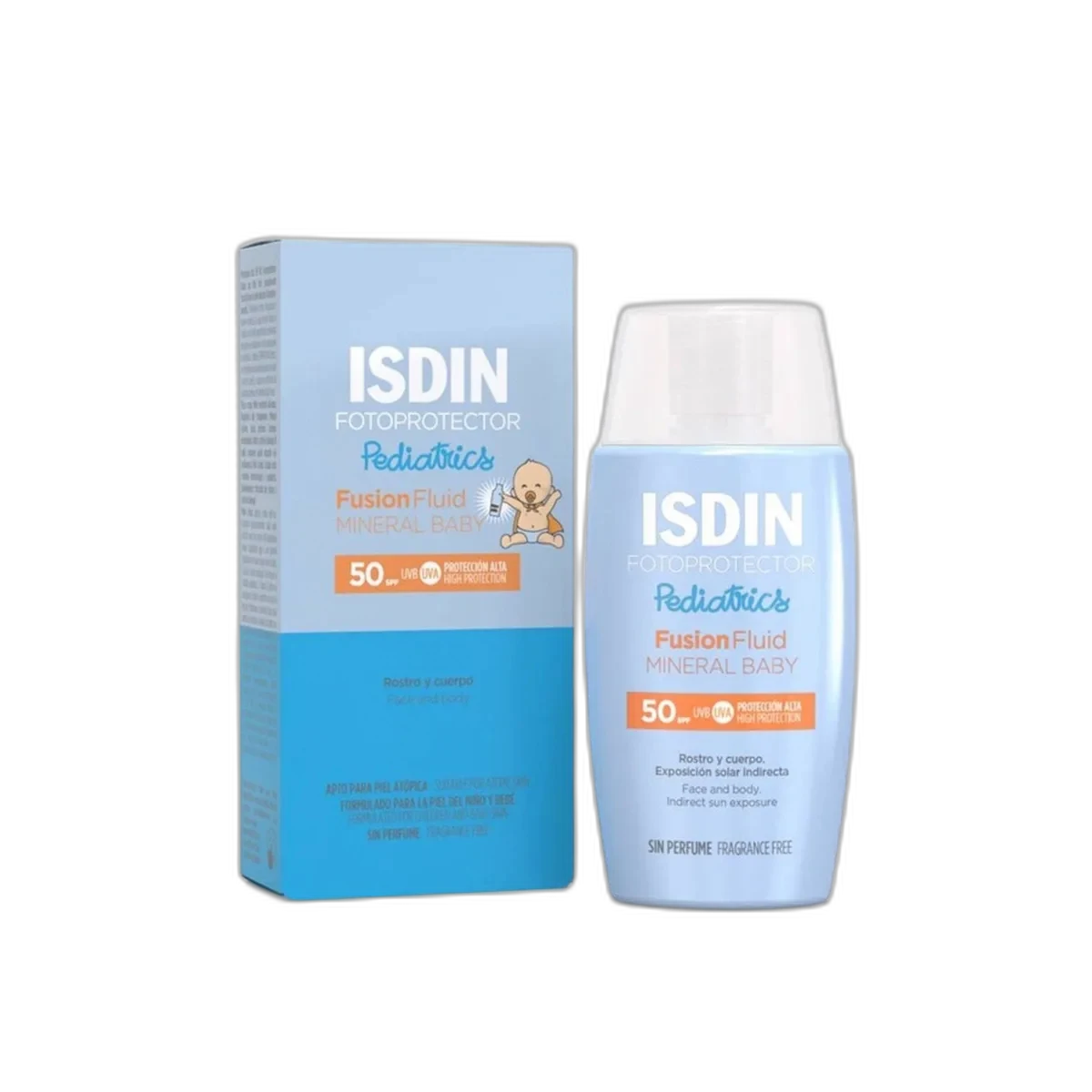
Fotoprotector Mineral Baby Pediatrics SPF 50
Pediatric Derm Pick
 Verified reviewer
Pros & cons.
- +100% mineral filters provide immediate UV protection with no absorption wait time
- +Fragrance-free formula specifically designed for atopic and sensitive baby skin
- +Fluid texture is dramatically easier to apply than traditional thick mineral baby creams
- +Panthenol and allantoin provide soothing barrier support for eczema-prone skin
- +80-minute water resistance rating suitable for outdoor and pool activities
- +Developed with pediatric dermatologists by Spain's leading dermatological brand
- +Nano-sized particles reduce white cast compared to non-nano mineral alternatives
- −Contains denatured alcohol as a solvent, which some parents prefer to avoid entirely
- −Small 50ml size depletes quickly with full-body baby application at the beach
- −Still leaves some visible white cast on medium to deeper skin tones
- −Premium pricing at approximately $33 makes frequent repurchasing costly
- −Contains cyclopentasiloxane, which faces environmental scrutiny in some markets
The full review.
Here is the fundamental problem with baby sunscreen: the products that parents feel best about buying — thick, mineral-only, fragrance-free, all-natural — are almost always the products they hate using. White zinc paste that takes five minutes to rub in while a toddler writhes like a greased eel. Residue that makes your child look like a Victorian ghost. A texture so dense it might as well be spackle. The result is predictable: parents apply it once in the morning, dread it all day, and never reapply. An SPF 50 that gets applied once and forgotten offers substantially less protection than an SPF 30 that gets faithfully reapplied every two hours.
ISDIN understood this equation. Their Pediatrics Fusion Fluid Mineral Baby was engineered to solve the compliance problem that undermines nearly every mineral baby sunscreen on the market. The formula uses nano-sized titanium dioxide and zinc oxide suspended in a fluid emulsion system that behaves nothing like the zinc paste parents expect. It pours. It spreads. It doesn’t require the kind of aggressive rubbing that turns sunscreen application into a wrestling match.
The UV protection is entirely mineral — no chemical filters. Titanium dioxide handles the broad-spectrum heavy lifting with particularly strong UVB absorption, while zinc oxide fills in the UVA coverage. Together, they achieve SPF 50 from the moment they touch skin, with no absorption wait time. This is a meaningful advantage for baby sunscreen specifically, because the window between application and a baby’s exposure to sun is often approximately zero seconds. You’re already outside when you realize you forgot sunscreen.
The 80-minute water resistance rating is solid for a mineral fluid, though it’s worth understanding what water resistance means in practice. It means the SPF decreases more slowly when wet, not that it’s waterproof. After pool time, bath time, or any enthusiastic puddle-stomping, reapplication is non-negotiable.
Formulation choices reflect genuine pediatric consideration, not just adult-sunscreen-in-a-pastel-bottle marketing. The fragrance-free formula removes the most common sensitizer found in cosmetic products. Panthenol and allantoin are included specifically for their soothing properties on irritated or atopic skin — these aren’t decorative ingredients but functional choices for babies with eczema or dermatitis who need sun protection without additional aggravation.
Sodium hyaluronate provides light hydration to offset the drying tendency of mineral films. The antioxidant system — tocopheryl acetate, tocopherol, and ascorbyl palmitate — adds free radical protection, which is thoughtful given how vulnerable young skin is to oxidative damage.
The honest concerns. This formula contains denatured alcohol as a solvent, which is how ISDIN achieves the fluid texture with such a high mineral load. It evaporates on application and is unlikely to cause issues for most babies, but some parents with extremely eczema-prone children may prefer to avoid it entirely. The presence of cyclopentasiloxane, a volatile silicone, also appears — it contributes to the smooth spreading but has faced some environmental scrutiny in European regulations.
White cast exists. It’s significantly less than traditional baby zinc creams — the nano particle size genuinely helps — but on medium to dark skin tones, a visible cast remains. This is the inherent trade-off of mineral-only sunscreens at SPF 50: the concentration of reflective particles needed for that protection level will leave some visible residue.
The 50ml bottle is the biggest practical limitation. On a baby’s face alone, 50ml lasts a reasonable time. But babies at the beach need sunscreen on their arms, legs, back, and feet — full-body application on even a small child will drain this bottle in a few outings. At roughly $33 per bottle, that cost accumulates fast during beach season.
ISDIN’s five decades of photoprotection expertise show in this formulation. The company was born in sun-drenched Barcelona and has been the leading dermatological brand in Spain for decades. Their pediatric line isn’t an afterthought or a brand extension — it’s a core product category developed with pediatric dermatologists who understand that baby skin has a thinner stratum corneum, less melanin, and a higher surface-area-to-body-weight ratio than adult skin. Those differences matter in sunscreen formulation.
The value assessment comes down to what you’re comparing against. Against drugstore baby zinc creams, it’s expensive for a small bottle. Against the cost of a pediatric dermatologist visit for a sunburn on atopic baby skin, it’s a bargain. The real value is in the texture: this is the mineral baby sunscreen you’ll actually reapply, and consistent reapplication is worth more than any SPF number.
Ingredient analysis.
Full INCI list
Aqua (Water), Dicaprylyl Carbonate, Diethylhexyl Carbonate, Cyclopentasiloxane, Dibutyl Adipate, Titanium Dioxide \[Nano\], Zinc Oxide \[Nano\], Alcohol Denat., Cyclohexasiloxane, Butylene Glycol, PEG-30 Dipolyhydroxystearate, Trimethylpentanediol/Adipic Acid/Glycerin Crosspolymer, Silica, Polyglyceryl-6 Polyricinoleate, Allantoin, Sodium Hyaluronate, Polyglyceryl-2 Isostearate, Panthenol, Tocopheryl Acetate, Magnesium Sulfate, Phenylpropanol, Disteardimonium Hectorite, Propanediol, Caprylyl Glycol, Triethoxycaprylylsilane, Glyceryl Stearate, PEG-8, Dimethicone Crosspolymer, Tocopherol, Ascorbyl Palmitate, Ascorbic Acid, Citric Acid
Skin match.
The science.
The Science
Research extensively evaluates the safety of nano-sized mineral UV filters for pediatric use. The European Commission's Scientific Committee on Consumer Safety (SCCS) published 2013 and 2014 opinions stating nano titanium dioxide is safe on healthy, intact, or sunburnt skin at concentrations up to 25%. The committee found no dermal penetration beyond the stratum corneum — the outermost layer of dead cells — even with repeated use. The SCCS reached similar conclusions for nano zinc oxide, noting in its 2012 opinion that zinc oxide nanoparticles do not penetrate viable skin cells.
Stamatas et al. published a 2009 study in the British Journal of Dermatology characterizing structural differences between infant and adult skin. They found infant skin has a thinner stratum corneum and higher transepidermal water loss. Despite these differences, subsequent research shows nano mineral filters do not penetrate differently on infant versus adult skin. The particles stay on the skin surface and work as a physical reflective barrier.
Titanium dioxide and zinc oxide provide complementary UV coverage. Titanium dioxide peaks in UVB absorption (290-320nm) with some UVA-II coverage, while zinc oxide provides broader UVA absorption into UVA-I (340-400nm). A study by Pinnell et al. in Dermatologic Surgery (2000) shows this mineral combination achieves broader, more uniform UV protection across the spectrum than either filter alone. This matters for pediatric skin, which is more susceptible to long-term UV damage.
References
- SCCS Opinion on Titanium Dioxide (nano form) as UV filter — European Commission Scientific Committee on Consumer Safety (2013)
- Infant skin microstructure assessed in vivo differs from adult skin — British Journal of Dermatology (2009)
- Microfine zinc oxide is a superior sunscreen ingredient to microfine titanium dioxide — Dermatologic Surgery (2000)
Dermatologist Perspective
Pediatric dermatologists widely recommend mineral-only sunscreens for babies and young children because mineral filters reflect and scatter UV rays on the surface without skin absorption. Board-certified pediatric dermatologists note this formula is an appropriate choice for babies with atopic dermatitis or sensitive skin because it lacks chemical UV filters, fragrance, and common sensitizers. Dermatologists emphasize that sun protection for babies should prioritize physical barriers (hats, clothing, shade) first, using sunscreen to complement exposed areas. The American Academy of Dermatology advises using sunscreen on babies from 6 months of age and prefers mineral formulations for this age group.
Where it fits in your routine.
Apply a thick layer to all exposed baby skin at least 15 minutes before going outdoors; mineral filters work immediately. Use about a teaspoon for the face and a tablespoon for the body. Reapply every two hours during sun exposure, and immediately after water exposure, towel-drying, or sweating. For babies with eczema, apply the usual emollient first and let it absorb before layering the sunscreen on top. Always use physical sun protection: hats, protective clothing, and shade during peak UV hours (10am-4pm).
At approximately $33 for 50ml, this sits at the premium end of the baby sunscreen market. The per-ounce cost is roughly double most drugstore mineral baby sunscreens. This price pays for ISDIN's fluid technology, which makes mineral sunscreen easier to apply, a soothing complex for atopic skin, and the backing of Europe's leading pediatric photoprotection brand. The formulation quality justifies the cost for parents of babies with eczema or extreme sensitivity. For parents needing an everyday baby sunscreen for children who tolerate standard formulas, the small bottle size makes the price premium harder to justify.
Parents of babies 6 months and older with sensitive, atopic, or eczema-prone skin who need a mineral-only SPF 50 that avoids irritation. Families seeking the most cosmetically elegant mineral baby sunscreen, and parents tired of reapplying thick zinc creams.
Parents comfortable with standard drugstore mineral baby sunscreens who do not require a premium fluid texture. Users who avoid alcohol or silicone in baby products. Families applying to large body areas often — the 50ml bottle will not last a beach vacation.
Product details.
No added fragrance. The base ingredients have a faint, neutral scent that is virtually undetectable.
The 50ml plastic squeeze bottle is compact. Its size fits airline carry-on rules and stays easy to hold with one hand while managing a squirming baby. ***
Parents will find the fluid consistency much thinner than most mineral baby sunscreens. It spreads easily and leaves less white cast than traditional baby zinc formulas, though some residual whiteness remains. It causes no stinging, has no fragrance, and babies do not fuss on first application.
2-4 weeks when applied to a baby's full body; 6-8 weeks when applied to face-and-hands-only.
12 months ***
All Year ***
The backstory.
Developed as part of ISDIN's dedicated Pediatrics line, this sunscreen was born from the recognition that parents in southern European climates needed mineral sun protection that they'd actually reapply on their children. Thick white paste that babies scream about and parents dread rubbing in doesn't get reapplied — so ISDIN engineered the most cosmetically elegant 100% mineral baby formula they could.
About ISDIN
Legacy Brand (20+ years)ISDIN launched in Barcelona in 1975 as a Puig and Esteve joint venture. These two Spanish cosmetics and pharmaceutical groups formed the brand. ISDIN is Spain's #1 dermatological skincare company. It has a long history in pediatric photoprotection and works with pediatric dermatologists across Europe.
Common myths.
Nano-sized mineral filters are unsafe for babies because they can penetrate the skin.
Extensive safety research, including a review by the European Commission's Scientific Committee on Consumer Safety (SCCS), shows nano titanium dioxide and zinc oxide do not penetrate intact skin past the outermost dead cell layers, even on baby skin. They stay on the surface to reflect and scatter UV rays.
All baby sunscreens are identical — just buy the cheapest mineral SPF 50.
Formulation matters. The vehicle, dispersants, soothing agents, and lack of irritants like fragrance vary between baby sunscreens. This formula includes panthenol and allantoin for atopic skin compatibility, which many generic baby SPFs lack.
What the community says.
"100% mineral filters give parents peace of mind"
"Fragrance-free formula suitable for atopic baby skin"
"Fluid texture absorbs better than typical mineral sunscreens"
"Water-resistant up to 80 minutes"
"Does not irritate sensitive or eczema-prone skin"
"Contains denatured alcohol which some parents prefer to avoid"
"Can leave a white cast especially on darker skin tones"
"Small 50ml size runs out quickly on whole-body baby application"
"Premium price for a small bottle"
Featured in.
People also looked at.