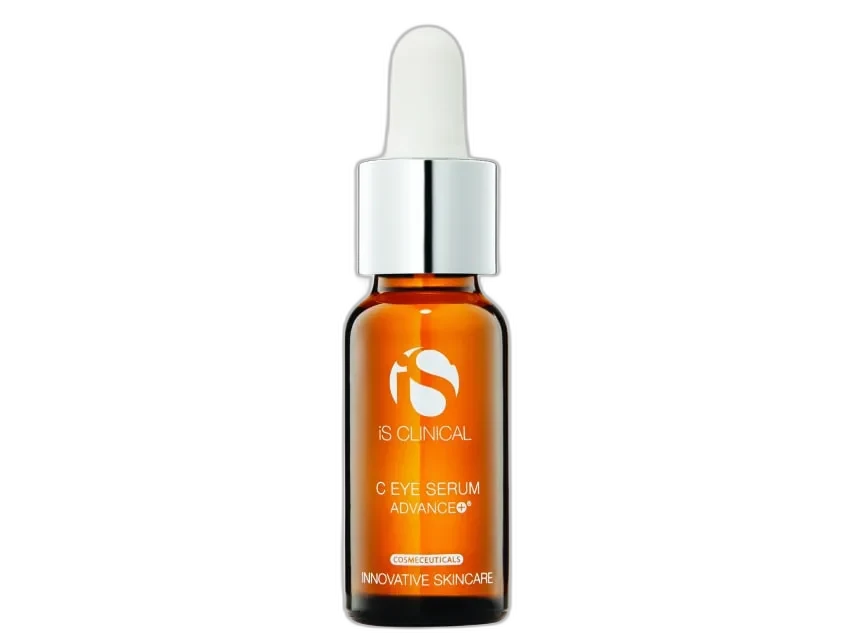
C Eye Serum Advance+
Minimalist Eye Essential
 Verified reviewer
Pros & cons.
- +Radically minimalist 10-ingredient formula eliminates unnecessary potential irritants around the eyes
- +One drop covers both eyes — a single bottle lasts 4-6 months of twice-daily use
- +Time-released 7.5% L-ascorbic acid calibrated specifically for the delicate periorbital area
- +Copper tripeptide-1 provides genuine collagen-stimulating benefits backed by research
- +Water-light texture absorbs instantly and works seamlessly under makeup or other products
- +Fragrance-free, oil-free, and silicone-free — ideal for reactive eye-area skin
- −Can sting if it migrates into the eyes — requires careful application technique
- −May be too drying for very dry skin types without an additional eye cream layer
- −L-ascorbic acid around the eyes can irritate very sensitive individuals
- −No occlusive ingredients — does not address dehydration through moisture locking
- −Results on deep-set wrinkles and structural dark circles are modest
The full review.
Skincare brands are often wordy. Eye product ingredient lists often hit 30 or 40 entries, filled with emollients, stabilizers, fragrance, and marketing ingredients. The iS Clinical C Eye Serum Advance+ uses only ten.
Ten ingredients. You can memorize this list: water, sodium hyaluronate, ascorbic acid, propylene glycol, zinc sulfate, dextrin, tripeptide-1, bioflavonoids, mushroom extract, phenoxyethanol. Every ingredient has a purpose. There are no decorative ingredients, no botanical extracts for label appeal, and no fragrance. This minimalism suits the delicate periorbital area—the thinnest, most reactive skin on the face.
The vitamin C strategy differs from most face serums. At 7.5%, the L-ascorbic acid concentration targets periorbital tolerance instead of maximum facial potency. The time-release mechanism delivers ascorbic acid benefits for brightening and collagen stimulation gradually to avoid irritation. For dark circles from melanin deposits—the brownish discoloration in deeper skin tones and sun-exposed skin—this sustained delivery inhibits tyrosinase activity over hours.
Tripeptide-1, or copper peptide GHK-Cu, is the second active. This is not a trend-driven peptide. Research shows GHK-Cu stimulates collagen synthesis, increases glycosaminoglycan production, and promotes tissue repair. In the eye area, where collagen loss causes crepiness, fine lines, and loss of firmness, this peptide addresses root causes.
Sodium hyaluronate is second on the list, indicating a high concentration. The eye area has fewer oil glands and prone to dehydration; this hyaluronic acid loading plumps the skin and softens fine dehydration lines immediately. Dextrin acts as a film-forming agent to create a mild tightening sensation and firming effect.
Zinc sulfate provides anti-inflammatory support and stabilizes the vitamin C, while bioflavonoids add antioxidant reinforcement. The mushroom extract (Polyporus umbellatus) adds brightening properties, the same ingredient used in iS Clinical’s Active Serum.
The texture is water-thin. One drop covers the entire orbital area of both eyes. This efficiency changes the value: at $75 for half an ounce, the price is standard, but a bottle lasts four to six months with twice-daily use. This brings the per-application cost to roughly 20 cents. This is high value for a professional-grade eye treatment.
Apply with a light hand. The fluid consistency can migrate if you use too much, and L-ascorbic acid in the eyes is unpleasant. Pat one drop gently along the orbital bone with the ring finger. The serum absorbs in seconds without film, tackiness, or interference with makeup or sunscreen.
The limitation is hydration. For oily and normal skin, the high hyaluronic acid content may provide enough moisture. For dry skin, this serum is a treatment layer that needs an eye cream on top. It is a serum—a delivery vehicle for actives, not a stand-alone moisturizer.
Some users report stinging from the pure ascorbic acid near sensitive skin. For most, this is brief. For very reactive skin, it may be a dealbreaker. Test one drop on the outer orbital bone for a few days before full use.
The C Eye Serum Advance+ shows the iS Clinical philosophy: clinical-grade actives, minimal formulation, and maximum function. It delivers vitamin C, copper peptide, and hyaluronic acid with precision. For most users, these three actives are enough.
Formula
Texture
The texture is water-thin. One drop covers the entire orbital area of both eyes. This efficiency changes the value: at $75 for half an ounce, the price is standard, but a bottle lasts four to six months with twice-daily use. This brings the per-application cost to roughly 20 cents. This is high value for a professional-grade eye treatment.
How to Use
Apply with a light hand. The fluid consistency can migrate if you use too much, and L-ascorbic acid in the eyes is unpleasant. Pat one drop gently along the orbital bone with the ring finger. The serum absorbs in seconds without film, tackiness, or interference with makeup or sunscreen.
Not ideal for
The limitation is hydration. For oily and normal skin, the high hyaluronic acid content may provide enough moisture. For dry skin, this serum is a treatment layer that needs an eye cream on top. It is a serum—a delivery vehicle for actives, not a stand-alone moisturizer.
Common Complaints
Some users report stinging from the pure ascorbic acid near sensitive skin. For most, this is brief. For very reactive skin, it may be a dealbreaker. Test one drop on the outer orbital bone for a few days before full use.
Ingredient analysis.
Full INCI list
Water/Aqua/Eau, Sodium Hyaluronate, Ascorbic Acid, Propylene Glycol, Zinc Sulfate, Dextrin, Tripeptide-1, Bioflavonoids, Polyporus Umbellatus (Mushroom) Extract, Phenoxyethanol
Skin match.
The science.
The Science
L-ascorbic acid at concentrations from 5% to 20% shows topical efficacy. Research in Dermatologic Surgery (2005) shows vitamin C stimulates collagen I and III synthesis and inhibits melanogenesis via tyrosinase inhibition. The 7.5% concentration in this eye serum stays within the effective range for the thinner, more permeable periorbital skin — which may reach comparable bioavailability to higher face-serum concentrations because of its reduced barrier thickness.
Tripeptide-1 (glycyl-L-histidyl-L-lysine, or GHK) is a naturally occurring copper-binding peptide studied for decades. Research in the Journal of Biomedicine and Biotechnology (2012) reviewed GHK-Cu's ability to stimulate collagen synthesis, glycosaminoglycan production, and tissue remodeling. The copper ion chelated by this tripeptide activates superoxide dismutase and acts as a cofactor for lysyl oxidase, an enzyme critical for collagen cross-linking. In the periorbital context, these mechanisms address the collagen loss and structural thinning that cause visible aging around the eyes.
Sodium hyaluronate, the sodium salt of hyaluronic acid, has a hygroscopic capacity of up to 1000 times its weight in water. Research in the Journal of Clinical and Aesthetic Dermatology (2012) confirmed topical hyaluronic acid improves skin hydration and elasticity. These effects are pronounced in thin skin areas where transepidermal water loss is elevated — a description that fits the periorbital zone.
Zinc sulfate provides anti-inflammatory activity by modulating pro-inflammatory cytokines. In the eye area, where puffiness often results from fluid accumulation and mild inflammation, zinc's anti-inflammatory properties complement the structural benefits of the peptide and vitamin C.
Dermatologist Perspective
Dermatologists favor the minimalist formulation for the periorbital area, where sensitization risk increases with more ingredients. Board-certified dermatologists note the 7.5% L-ascorbic acid concentration is appropriate for eye-area use — strong enough for efficacy but lower than face-serum concentrations to account for the thinner skin's increased permeability. The copper peptide (GHK-Cu) is one of the better-studied peptides in dermatological literature. Dermatologists typically recommend applying the serum to the orbital bone area rather than directly on the eyelid to minimize irritation risk, and suggest layering an occlusive eye cream on top for dry skin patients.
Where it fits in your routine.
Put one small drop on your ring finger tip. Pat — do not rub — along the orbital bone from the inner corner outward, covering the under-eye area and crow's feet zone. One drop covers both eyes. Apply morning and evening to clean skin before other eye products or moisturizer. In the AM, let it absorb before applying SPF. Do not apply to the eyelid or near the lash line to prevent migration into the eyes. If it stings, the product moved too close to the eye.
At $75 for 0.5 oz, the price is standard for professional eye treatments. Use shows the real value: one drop per application lasts 4-6 months with twice-daily use, making the per-use cost about $0.20-0.25. This makes it one of the most economical professional eye treatments per application in the category. The concentrated clinical actives — 7.5% vitamin C, copper peptide, high-concentration hyaluronic acid — provide more active ingredient per drop than most eye products provide per generous application. This is strong value for a professional-grade eye treatment.
This serum targets dark circles, fine lines, and early signs of aging around the eyes. It suits users who want minimalist formulations and clinical-grade actives without unnecessary additives. The lightweight texture works well for normal, combination, and oily skin types.
L-ascorbic acid may irritate sensitive or reactive eye-area skin. Very dry skin types needing intensive moisture must layer a thicker eye cream on top, as this serum alone lacks adequate hydration. Test carefully before use if you frequently have watering eyes or contact lens discomfort.
Product details.
This lightweight, watery serum absorbs almost instantly. The fluid consistency means one drop spreads easily across the entire orbital area.
None — completely unscented
Small frosted glass bottle with dropper in iS Clinical's clean white branding
One drop spreads easily across both eyes. It absorbs within seconds. The L-ascorbic acid causes a slight tingling for some users; this is normal and subsides quickly. If it migrates into the eyes, it stings temporarily. The high hyaluronic acid content provides an immediate plumping effect. It leaves no heaviness or residue.
4-6 months with twice-daily use (one drop per application)
12 months
All Year
The backstory.
iS Clinical's commitment to minimalist formulation philosophy shows nowhere more clearly than in this eye serum. Biochemist Bryan Johns applied the same less-is-more approach that made the Active Serum famous, recognizing that the delicate periorbital area needs fewer ingredients, not more. The 7.5% L-ascorbic acid concentration was specifically calibrated for the thinner eye-area skin — potent enough to work, gentle enough to use daily.
About iS Clinical
Established Brand (5–20 years)iS Clinical was co-founded in 2002 by biochemist Bryan Johns and Alec Call. The brand is rooted in pharmaceutical-grade formulation and is distributed through dermatologists, plastic surgeons, and medical spas in over 125 countries.
Common myths.
Pure L-ascorbic acid is too harsh for the eye area; use it only on the face.
Concentration matters more than form. At 7.5%, L-ascorbic acid stays within the tolerable range for periorbital skin, and the time-release mechanism reduces irritation. This is lower than the 10-20% concentrations used in face serums, calibrated specifically for the thinner eye-area skin.
Eye serums are unnecessary — use your face serum around your eyes instead.
The eye area has unique needs: thinner skin, fewer oil glands, constant blinking, and more visible vascular structures. This serum uses 7.5% vitamin C, copper peptide, and zinc sulfate dosed for periorbital use. Higher-concentration face serums cause irritation, milia, or watering when applied around the eyes.
FAQ.
How long does a bottle of iS Clinical C Eye Serum Advance+ last?
The concentrated formula requires only one drop per application for both eyes. Using it twice daily, a 0.5 oz bottle lasts 4-6 months. This makes it one of the most economical professional eye treatments per use despite the upfront price.
Can iS Clinical C Eye Serum Advance+ irritate sensitive eyes?
Some users report mild stinging during application, especially if the serum migrates near the eye. The 7.5% L-ascorbic acid is potent enough to irritate very sensitive individuals. Pat the serum carefully onto the orbital bone area and avoid the lash line.
***
Should I use an eye cream over the iS Clinical C Eye Serum?
The high hyaluronic acid content provides enough hydration for normal to oily skin. Dry skin types should layer a thicker eye cream on top because the lightweight serum formula lacks occlusion. The serum works as a treatment layer, not a standalone moisturizer.
What does the copper peptide in this eye serum do?
Tripeptide-1 (copper peptide GHK-Cu) stimulates collagen and glycosaminoglycan production in periorbital skin. It increases structural firmness, reduces fine lines, and has anti-inflammatory properties that reduce puffiness. The copper ion also aids wound healing and skin repair.
***
Can I use iS Clinical C Eye Serum in the morning and at night?
Yes — use the serum twice daily. In the morning, it provides antioxidant protection under SPF. At night, the vitamin C and copper peptide support natural skin repair. One drop per application covers both eyes each time.
***
Community
What the community says.
"Incredibly economical — one drop covers both eyes and bottle lasts months"
"Noticeable firming and brightening of the eye area"
"Clean minimalist formula inspires confidence"
"Lightweight and absorbs quickly under makeup"
"Helps lighten dark circles with consistent use"
"Can sting sensitive eyes upon application"
"Some users find it drying without a follow-up eye cream"
"Vitamin C can be irritating for very reactive eye area skin"
"Results on deep wrinkles are modest"
People also looked at.