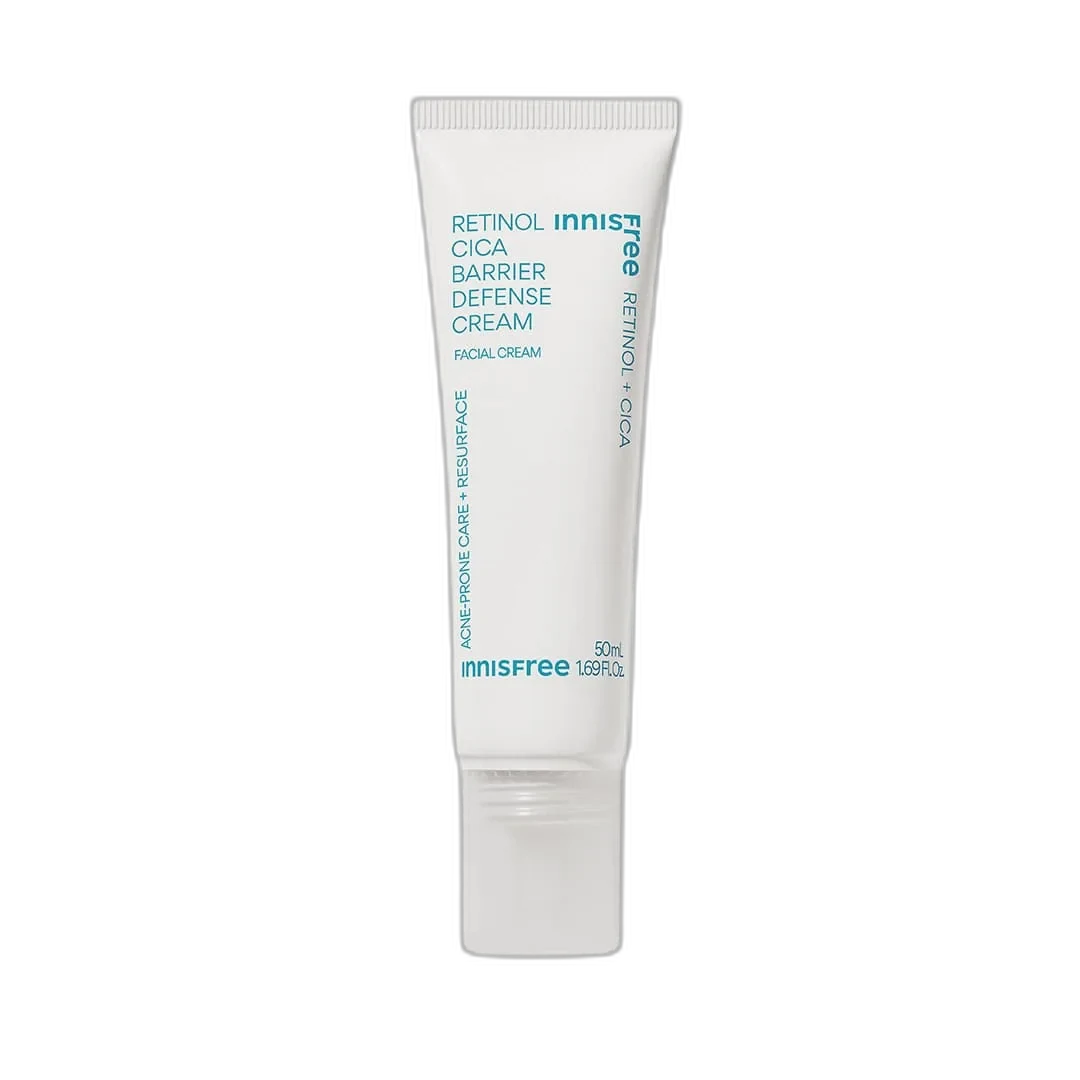
Retinol Cica Barrier Defense Cream
Sensitive Skin Retinol Pick
 Verified reviewer
Pros & cons.
- +Full centella triterpene complex actively soothes while retinol works on texture
- +Fragrance-free gel-cream formulation suitable for sensitive and rosacea-prone skin
- +No adjustment period — most users experience zero peeling, redness, or irritation
- +Niacinamide and panthenol provide additional barrier support and hydration
- +Vegan and cruelty-free with Innisfree's clean beauty standards
- +Lightweight texture layers well in multi-step K-beauty routines
- −Very low retinol concentration — experienced users won't see anti-aging results
- −Gel-cream texture may be insufficient for dry skin types in winter
- −Anti-aging benefits develop slowly due to gentle formulation approach
- −More expensive than drugstore beginner retinol alternatives
- −Retinol concentration (500 IU/g) not precisely translatable to a percentage
The full review.
The Western skincare world has a complicated relationship with retinol. On one hand, it’s the most evidence-backed anti-aging ingredient in existence. On the other hand, the first two weeks of retinol use have turned more people into skincare quitters than perhaps any other ingredient. The peeling. The redness. The unsettling feeling that your face is actively shedding. It’s effective, but it’s not what you’d call a pleasant experience.
Innisfree’s Retinol Cica Barrier Defense Cream looks at this problem through a distinctly Korean lens. Where Western retinol products tend to maximize potency and tell you to ‘push through’ the adjustment period, K-beauty asks: what if we just made the adjustment period not happen?
The strategy is elegant in its simplicity. Retinol at 500 IU/g sits at the lower end of clinical relevance — enough to stimulate measurable cell turnover, but far below the threshold that typically causes visible peeling or irritation. Then, instead of leaving the retinol to work alone, Innisfree surrounds it with a full-spectrum centella asiatica complex: asiaticoside, madecassic acid, asiatic acid, and madecassoside — the complete quartet of triterpenes that make cica one of K-beauty’s most trusted soothing ingredients. Panthenol deepens the calming effect, niacinamide supports barrier integrity, and allantoin smooths over any rough edges. It’s retinol with an entourage of bodyguards.
The gel-cream texture reinforces the gentle philosophy. It’s lightweight, water-based, and absorbs without any of the heaviness or greasiness that retinol creams sometimes carry. There’s no fragrance — a notable departure from some of Innisfree’s scented lines and a smart choice for a product targeting sensitive and barrier-compromised skin. The finish is comfortable and unobtrusive, sitting on skin like a breathable veil rather than an occlusive layer.
Using this cream nightly feels almost anticlimactic for anyone expecting the retinol initiation ritual. There’s no sting on application. No tightness as it absorbs. No peeling the next morning. For the first week, you might wonder if the retinol is doing anything at all. Patience reveals the answer: by weeks two through four, skin texture begins to noticeably smooth. The overall appearance becomes more refined, more even, subtly more luminous. These are real retinol benefits, delivered on a gentler timeline.
The centella complex earns its billing as a co-star rather than a supporting player. Users with redness-prone or rosacea-adjacent skin report genuine calming effects — the cream doesn’t just not-irritate, it actively soothes. This makes it a compelling choice not just for retinol beginners but for anyone whose skin is chronically reactive and has been excluded from the retinol conversation by stronger formulas.
Honest limitations: this is not a product for experienced retinol users seeking visible anti-aging results. The low retinol concentration means fine lines and wrinkles will improve very gradually, if at all. Sun damage, deep hyperpigmentation, and established signs of aging need more aggressive treatment. If you’ve been using 0.5-1% retinol without issues, stepping down to this formula would likely feel like going from espresso to decaf.
The peptide inclusion — decapeptide-4 — is an interesting addition with emerging evidence for supporting skin regeneration, though at an undisclosed concentration, it’s difficult to assess how much it contributes to the overall performance. Consider it a thoughtful bonus rather than a primary active.
At $31 for 50 mL, the pricing is reasonable for a K-beauty retinol product available at Sephora, though it faces competition from both cheaper drugstore beginner retinol options and more potent mid-range alternatives. The value proposition rests entirely on the cica-retinol synergy and the fragrance-free, sensitive-skin-friendly formulation — if those are your priorities, this cream justifies its price. If you want maximum retinol strength for your dollar, look elsewhere.
Innisfree has essentially created a gateway retinol — the product you use when every other retinol has told your skin it wasn’t welcome. It won’t transform your face overnight, but it won’t punish it either, and for a surprising number of people, that’s exactly the retinol experience they’ve been looking for.
Ingredient analysis.
Full INCI list
Water, Butylene Glycol, Glycerin, Caprylic/Capric Triglyceride, Niacinamide, Dicaprylyl Ether, Methyl Trimethicone, 1,2-Hexanediol, Panthenol, Diethoxyethyl Succinate, Diphenyl Dimethicone, Glyceryl Polymethacrylate, Cetearyl Olivate, Hydrogenated Lecithin, Polymethylsilsesquioxane, Sorbitan Olivate, Hydroxyethyl Acrylate/Sodium Acryloyldimethyl Taurate Copolymer, Acrylates/C10-30 Alkyl Acrylate Crosspolymer, Allantoin, Tromethamine, Glycine Soja (Soybean) Oil, Cetearyl Alcohol, Tocopherol, Tocopheryl Acetate, Dipotassium Glycyrrhizate, Glyceryl Caprylate, Phytosterols, Asiaticoside, Helianthus Annuus (Sunflower) Seed Oil, Madecassic Acid, Asiatic Acid, Disodium EDTA, Ethylhexylglycerin, Adenosine, Cetearyl Glucoside, Daucus Carota Sativa (Carrot) Root Extract, Sorbitan Isostearate, Retinol (500IU/G), Propanediol, Madecassoside, Beta-Carotene, Centella Asiatica Flower/Leaf/Stem Extract, Hydrogenated Phosphatidylcholine, Decapeptide-4, Sodium Oleate
Skin match.
The science.
The Science
This formula pairs centella asiatica and retinol based on evidence. Centella asiatica contains four key triterpenes — asiaticoside, madecassic acid, asiatic acid, and madecassoside — studied for wound-healing and anti-inflammatory properties. A systematic review in Planta Medica confirmed centella triterpenes stimulate collagen synthesis, increase fibroblast proliferation, and reduce inflammatory markers in skin tissue. These mechanisms complement retinol's cell-turnover acceleration, supporting skin repair while retinol drives renewal.
Retinol at 500 IU/g is a conservative, clinically relevant concentration. Research in the Journal of Cosmetic Dermatology shows retinol at concentrations above 0.025% induces cellular and molecular skin changes, including increased epidermal thickness and enhanced collagen deposition. Higher concentrations produce faster visible results, but lower doses reach the same endpoints over a longer timeline with fewer adverse effects.
Niacinamide works synergistically with both retinol and centella. A 2010 study in the International Journal of Dermatology showed combining niacinamide with retinol reduces retinoid-induced irritation without losing efficacy. Niacinamide strengthens the ceramide-based lipid barrier that retinol use can temporarily compromise, helping skin tolerate sustained retinol use.
Panthenol (provitamin B5) converts to pantothenic acid in the skin to support lipid synthesis and barrier recovery. Studies confirm panthenol reduces transepidermal water loss and improves skin hydration — both critical when using retinol, which can increase skin permeability and dryness.
Dermatologist Perspective
Dermatologists often see patients who want retinol but fear irritation from past experiences. Board-certified dermatologists would view this cream as an appropriate entry point for these patients — the low retinol dose and soothing agents like centella and panthenol create a formula unlikely to cause the redness and peeling that drive non-compliance. Dermatologists would note that while this product improves skin texture and provides mild anti-aging benefits over time, patients seeking meaningful wrinkle reduction or aggressive hyperpigmentation treatment will eventually need higher-strength retinol or prescription retinoids. As a step one for building retinol tolerance, this product follows the gradual introduction approach dermatologists commonly recommend.
Where it fits in your routine.
Apply an even layer to a clean, toned face and neck every evening. Use it nightly from the start; users with reactive skin can start every other night. Follow with an occlusive or sleeping mask for more moisture. Apply SPF 30+ the next morning because retinol increases sun sensitivity. Do not use with other retinol products, strong AHA/BHA exfoliants, or benzoyl peroxide in the same routine.
At $31 for 1.69 fl oz, this cream competes well in the K-beauty-at-Sephora category. The retinol, full-spectrum centella, niacinamide, panthenol, and a peptide mix makes a sophisticated formula for the price. Drugstore alternatives like CeraVe's retinol products cost less but lack the comprehensive cica soothing complex. For sensitive-skinned retinol beginners, the premium for this fragrance-free, gentle formulation is well-justified. Users wanting affordable retinol without sensitivity concerns have more economical options.
Retinol beginners wanting a gentle start without the usual adjustment period. Sensitive skin types who avoid retinol or react poorly to other retinol products. People with redness-prone, barrier-compromised, or rosacea-adjacent skin seeking a retinol that won't worsen their condition.
Experienced retinol users used to 0.5-1% concentrations seeking visible anti-aging results. People wanting aggressive treatment for deep wrinkles, significant hyperpigmentation, or established sun damage. Very dry skin types needing a thicker, more occlusive moisturizer format.
Product details.
Fragrance-free with no detectable scent
The squeeze tube format is hygienic and travel-friendly. Opaque packaging protects the retinol from light degradation. Finish lightweight, satin, non-greasy
The gel-cream feels cooling and soothing on first application; the centella complex and panthenol create a noticeable calming sensation. Retinol first-timers should expect no stinging, tingling, or peeling. The lightweight texture absorbs within a minute and leaves skin hydrated and comfortable. Unlike many retinol products, this formula has no adjustment period of dryness or flaking.
2-3 months with nightly face application
12 months
All Year
The backstory.
Innisfree developed the Retinol Cica line to address the tension between K-beauty's emphasis on gentle, barrier-respecting care and the Western skincare world's retinol obsession. The result is a line that treats retinol not as a standalone weapon but as one ingredient in a soothing ecosystem — a distinctly Korean approach to a traditionally aggressive active.
About Innisfree
Established Brand (5–20 years)Amorepacific, South Korea's largest cosmetics conglomerate since the 1930s, founded Innisfree in 2000. The brand led eco-conscious K-beauty using Jeju Island ingredients. It has over two decades of formulation experience and sells in both Asian and Western markets.
Common myths.
Retinol products cause peeling and irritation, especially during initial use.
Retinol irritation depends on the dose. This cream uses a low retinol concentration (500 IU/g) buffered by centella, panthenol, and niacinamide to minimize the adjustment period. Most users see no peeling, redness, or flaking at this gentle concentration.
Retinol products that do not cause peeling are not working.
Peeling is a side effect, not a sign of efficacy. Retinol stimulates cell turnover at concentrations far below the irritation threshold. A gentle retinol that avoids visible peeling still improves texture, fine lines, and tone over time — it just works more slowly.
FAQ.
Is Innisfree Retinol Cica cream good for beginners?
Yes — this formula targets retinol beginners. The low retinol concentration (500 IU/g) uses a full centella asiatica complex, panthenol, and niacinamide to create one of the gentlest retinol experiences available. Most first-time retinol users report no irritation, peeling, or adjustment period.
Can I use Innisfree Retinol Cica cream every night?
Yes. The gentle retinol concentration and soothing ingredients allow for nightly use from the start. Higher-concentration retinol products require gradual introduction, but this cream works daily without a build-up period.
Does Innisfree Retinol Cica cream help with acne?
The retinol promotes cell turnover to help prevent clogged pores, and niacinamide regulates oil production. It works for mild acne and texture concerns. However, benzoyl peroxide or prescription retinoids work better for active inflammatory acne.
Is Innisfree Retinol Cica cream moisturizing enough for dry skin?
The lightweight gel-cream texture hydrates normal-to-combination skin well but lacks the thickness for very dry skin. People with dry skin can layer a richer moisturizer or occlusive on top, or use a hydrating serum underneath for more moisture.
Can I use vitamin C with Innisfree Retinol Cica cream?
Yes, but apply them at different times. Use vitamin C in the morning for antioxidant protection and this retinol cream at night. This prevents interaction and gives each active its optimal working window.
What the community says.
"Gentle enough for retinol beginners with zero irritation"
"Noticeably soothes redness and calms irritated skin"
"Lightweight gel-cream texture works well in layered routines"
"Fragrance-free formula appreciated by sensitive skin users"
"Visible texture improvement within a few weeks"
"Retinol concentration is very low — experienced retinol users may not see results"
"Gel-cream texture may not be moisturizing enough for very dry skin"
"More expensive than drugstore beginner retinol options"
"Takes longer to show anti-aging results due to gentle concentration"