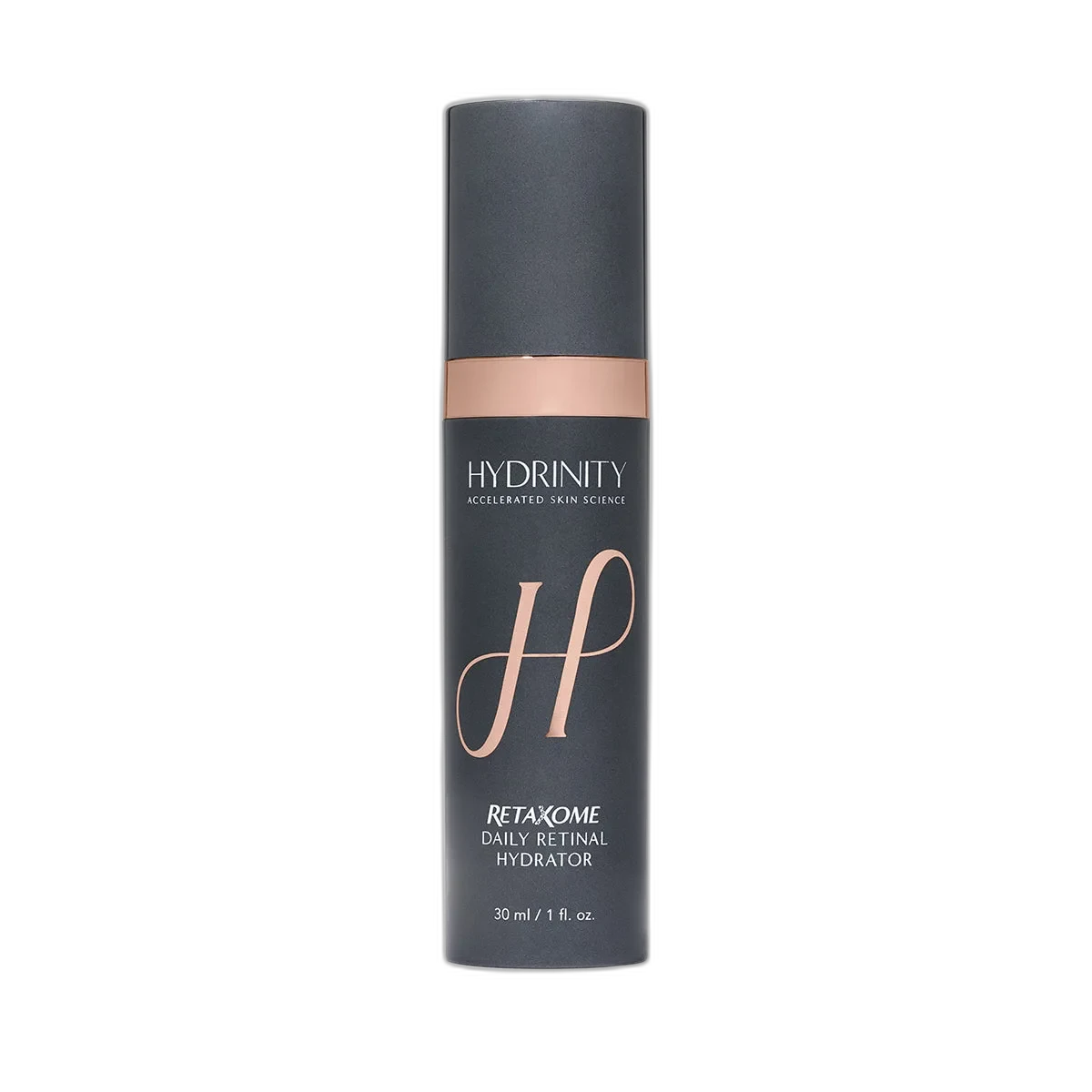
RetaXome Daily Retinal Hydrator
Luxury Retinal Hybrid
 Verified reviewer
Pros & cons.
- +Retinaldehyde for faster, stronger results than retinol at lower concentration
- +Full physiologic ceramide-cholesterol-phytosphingosine lipid matrix
- +Collapses retinoid and moisturizer into one nightly step
- +Ectoin and Matrixyl peptides reinforce tolerance and collagen work
- +Fragrance-free, thoughtfully engineered airless pump
- +Minimal adjustment period for most users
- +Suitable for dry and sensitive skin types that usually struggle with retinoids
- −Premium $145 price for an emerging brand without long clinical history
- −Only 1 oz per bottle with no larger-size option
- −Limited independent data as a 2025 launch
- −Distributed mostly through professional channels, not widely retail-available
- −Not suitable during pregnancy or breastfeeding
The full review.
About Hydrinity
Launched in 2020
Texture
Texture-wise, it doesn’t feel like a serum. It applies like a plush, emulsion-style moisturizer — the squalane, cetearyl alcohol, and dimethicone combination gives it a velvety, slightly cushioned slip that sits on the skin the way a midweight facial cream does. There’s no tingling, no acidic bite, no warming sensation. Most users report the first week of use feels surprisingly calm, and the retinoid adjustment arc — if it shows up at all — tends to be gentler and shorter than the usual retinol experience. A minority of very sensitive users still report a mild dryness window around week two, and rosacea-prone skin should still approach cautiously, but the tolerability story the brand is selling holds up reasonably well in early feedback.
Scent
No information in the provided text.
Packaging
No information in the provided text.
Best Season
No information in the provided text.
Common Praise
No information in the provided text.
Common Complaints
No information in the provided text.
Pairs Well With
No information in the provided text.
Conflicts With
No information in the provided text.
Best for
For the right user — someone who wants a retinoid but hates the multi-step layering routine, someone with dry or barrier-reactive skin who’s been priced out of daily retinoids, someone who appreciates ingredient architecture and is willing to pay for it — RetaXome is a genuinely interesting product.
Works for
No information in the provided text.
Not ideal for
No information in the provided text.
AM routine
No information in the provided text.
PM routine
No information in the provided text.
Ingredient analysis.
Full INCI list
Water/Aqua/Eau, Pentylene Glycol, Squalane, Glycerin, Isosorbide Dicaprylate, Cetearyl Alcohol, Glyceryl Stearate, Niacinamide, Stearyl Alcohol, Centella Asiatica Callus Conditioned Media, Retinal, Hyaluronic Acid, Polyglutamic Acid, Ceramide NP, Ceramide EOP, Ceramide AP, Cholesterol, Phytosphingosine, Sodium Retinoyl Hyaluronate, Tocopheryl Acetate, Bisabolol, Beta-Sitosterol, Palmitoyl Tripeptide-1, Palmitoyl Tetrapeptide-7, Hydroxymethoxyphenyl Decanone, Cordyceps Sinensis Extract, Grifola Frondosa Extract, Ganoderma Lucidum (Mushroom) Extract, Coprinus Comatus (Mushroom) Extract, Ectoin, Dimethicone, Caprylic/Capric Triglyceride, Phosphatidylcholine, Mannitol, Sodium Lactate, Sodium Stearoyl Glutamate, Sodium Lauroyl Lactylate, Polyacrylate Crosspolymer-6, Xanthan Gum, Carbomer, Polyglyceryl-10 Laurate, Sodium Phytate, Citric Acid, Caprylyl Glycol, Ethylhexylglycerin, Butylene Glycol, Hexylene Glycol, Polysorbate 20, Phenoxyethanol, t-Butyl Alcohol
Skin match.
The science.
The Science
Retinaldehyde works as a topical retinoid because of its metabolic position — it needs only one enzymatic oxidation step to become retinoic acid, while retinol needs two. Research in the British Journal of Dermatology shows 0.05% retinaldehyde improves photoaging metrics like 0.05% retinoic acid, but with better tolerability. Ceramide-based barrier repair is also well-supported: Journal of Investigative Dermatology studies show physiologic lipid mixtures with ceramides, cholesterol, and free fatty acids in appropriate ratios recover the barrier faster than any single lipid alone. RetaXome combines these two evidence bases in one vehicle — the ceramide matrix buffers the retinaldehyde's irritation so the active works nightly without acclimation. Ectoin adds more tolerability; Experimental Dermatology studies show ectoin reduces UV-induced inflammatory signaling and preserves barrier integrity under stress, both relevant to retinoid adjustment. Matrixyl 3000 — the combination of palmitoyl tripeptide-1 and palmitoyl tetrapeptide-7 — has International Journal of Cosmetic Science data showing measurable reductions in wrinkle depth after 8 weeks of use, providing a second pro-collagen mechanism that does not rely on retinoid receptor binding. These mechanisms are not novel individually; their architecture in a single daily retinoid product is unique.
Dermatologist Perspective
Dermatologists favor retinaldehyde as a bridge between over-the-counter retinol and prescription tretinoin for patients seeking stronger results without a prescription. The barrier-supported delivery in RetaXome aligns with dermatological principles for retinoid tolerability. Board-certified dermatologists typically recommend pairing any retinoid with a physiologic lipid-based moisturizer, which this product integrates by design. The main caution is the 2025 launch date and limited independent clinical data — dermatologists generally wait for longer real-world tracking before making a product a first-line recommendation, especially at the premium price point. Patients with rosacea, active dermatitis, or known retinoid intolerance should still approach cautiously regardless of the barrier-repair framing.
Where it fits in your routine.
Apply a pea-sized amount to clean, dry skin at night. Most skin types use this as both the retinoid step and the moisturizer; you usually do not need additional cream. Use nightly for normal to dry skin, or every other night for sensitive or retinoid-naive users. Use sunscreen every morning without exception because retinoids increase photosensitivity. Do not use AHA, BHA, benzoyl peroxide, and L-ascorbic acid on the same night. Stop use before facial procedures and during active skin infections or severe flares.
At $145 for 1 fl oz, this product costs more than most retinoids. Avène, Medik8, or SkinMedica retinals cost $60–110 for similar volumes. The price reflects the full ceramide matrix, the Matrixyl inclusion, and the airless pump engineering. Buying a high-end retinal and a high-end ceramide moisturizer separately costs $180–250. As a single-step product, $145 is reasonable. However, the brand is new, distribution is narrow, and real-world data is thin. Buyers pay a premium for an unproven execution of a sound concept. For heritage-comfortable shoppers, a legacy retinal from a derm-backed brand offers more certainty per dollar.
This retinoid works for users wanting minimal downtime and integrated formulations—specifically dry, normal, or barrier-reactive skin types that struggle with traditional retinol serums. It also fits people who want a single nightly bottle to simplify their routine.
Budget-conscious shoppers, people who layer a high-end retinal with a separate ceramide cream for flexibility, anyone pregnant or breastfeeding, and shoppers who want a long track record of independent clinical data at this price point.
Product details.
Plush emulsion cream that spreads like a light moisturizer
Fragrance-free, faint neutral base note
An airless opaque pump protects the retinaldehyde from light and oxygen degradation.
Applies smoothly without tingling, burning, or immediate retinoid bite. Most users report no classic retinization flaking during week one, though mild dryness or heightened sensitivity can occur around week two as the skin adjusts. If you reacted to retinol before, you may still feel a gentler version of that arc here.
2-3 months with nightly full-face use
6 months
All Year
The backstory.
Hydrinity launched in 2020 as a professional-channel brand focused on proprietary hyaluronic acid delivery (their PPM⁶ matrix). RetaXome arrived in 2025 as the brand's retinoid debut, positioning itself as an answer to the ongoing challenge of making prescription-level retinoids tolerable for daily use without the multi-week acclimation period retinol typically demands.
About Hydrinity
Emerging Brand (2–5 years)Hydrinity launched in 2020. It is a professional skincare brand sold mostly through dermatology and medspa channels. The brand uses hyaluronic acid delivery technology called PPM⁶. Hydrinity has a growing track record in aesthetic-professional settings, but it has less independent clinical validation than established medical-grade skincare.
Common myths.
Retinal and retinol are basically the same
Retinal converts to retinoic acid in one enzymatic step instead of retinol's two. This allows it to deliver comparable results at roughly 10x lower concentrations. In this formula, the ceramide matrix reduces the irritation that typically limits retinal use.
Strong retinoids require a separate moisturizer
This product does both. The ceramide-cholesterol-phytosphingosine matrix works as a full moisturizer, so the brand markets it as a 'hydrator' instead of a serum.
FAQ.
Do I still need a moisturizer on top?
For most skin types, no — the ceramide-cholesterol-phytosphingosine lipid blend in this formula is a complete moisturizer in its own right. Very dry skin types can layer a thin occlusive like aquaphor or a petrolatum balm on top in winter.
How does it compare to a prescription retinoid?
Retinal requires one enzymatic step to become retinoic acid, while retinol requires two. This makes Retinal closer to prescription strength than over-the-counter retinol. It is not tretinoin, but the gap is smaller than most assume and tolerability is better.
Is it safe during pregnancy?
No. Avoid all vitamin A derivatives, including retinaldehyde, during pregnancy and breastfeeding. Use peptide serums, niacinamide, or azelaic acid instead.
Can I use it with vitamin C in the morning?
Yes, that pairing works — use vitamin C in the AM for antioxidant and brightening support, and RetaXome at night for collagen and texture work. Do not use them together in the same evening.
Why is it so expensive?
The price covers retinaldehyde (which costs more to source and stabilize than retinol), the full ceramide-cholesterol-phytosphingosine matrix, Matrixyl peptides, ectoin, and the professional-channel distribution markup. Whether the cost is worth it depends on if you want a moisturizer-and-retinoid hybrid or separate products.
What the community says.
"Tolerability from night one"
"Noticeable radiance early"
"Moisturizer-plus-retinoid in one step"
"Non-irritating"
"Premium price for unproven brand"
"Only available through professional channels"
"Small 1 oz size"
Featured in.
People also looked at.