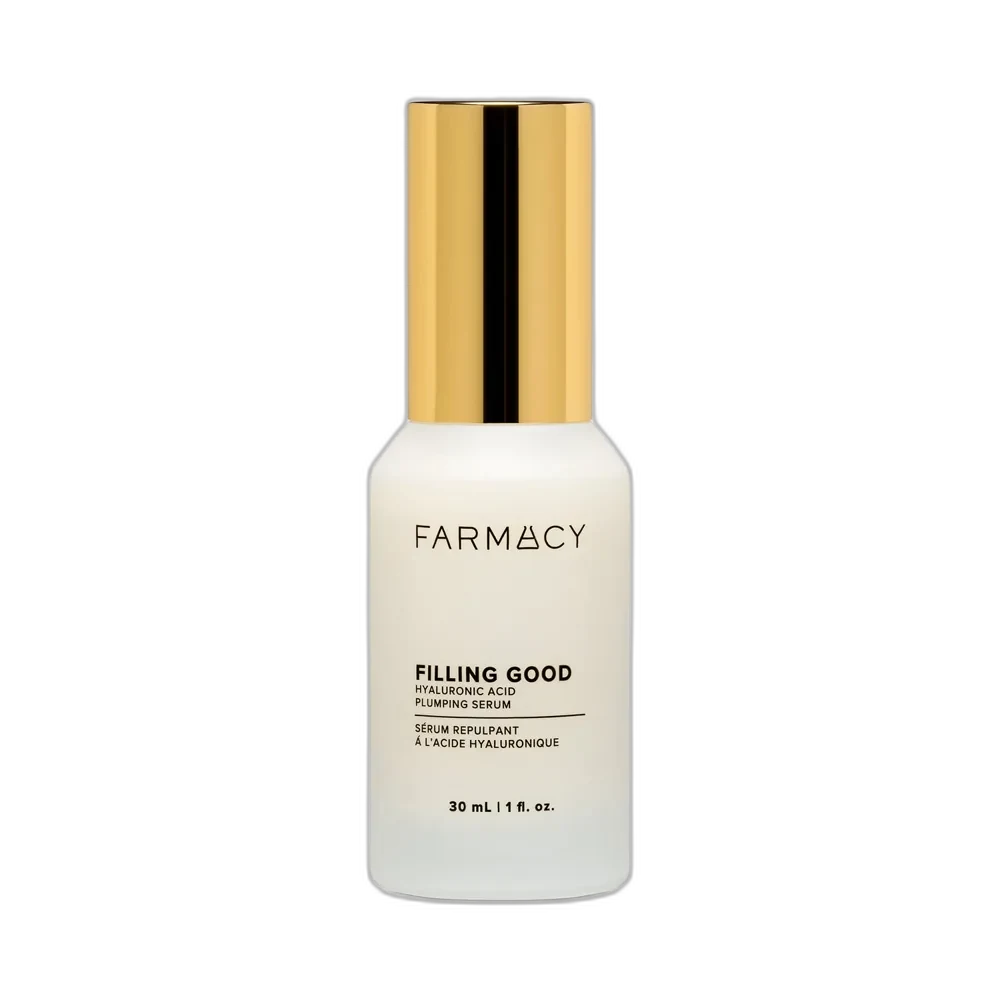
Filling Good Hyaluronic Acid Plumping Serum
Vegan Collagen Hydrator
 Verified reviewer
Pros & cons.
- +Multi-molecular-weight HA delivers immediate visible plumping and layered hydration
- +Vegan collagen peptide (SH-Polypeptide-123) is a genuine innovation over marine collagen
- +Triple honey complex adds antioxidant and soothing depth beyond standard HA serums
- +Rich, silky texture feels luxurious and absorbs without greasiness
- +Works well under makeup without pilling or interference
- +Silicone-free, paraben-free, vegan, cruelty-free, and Clean at Sephora certified
- +Encapsulated thyme extract provides targeted anti-aging with clinical backing
- −Premium $52 for 30ml in a category where excellent options exist at half the price
- −Contains Flavor/Aroma despite clean beauty positioning — not truly fragrance-free
- −Honey-thyme scent is polarizing and may trigger sensitivity in reactive skin
- −Anti-aging claims rely on emerging ingredients with limited independent clinical data
- −Benzyl alcohol preservative may sensitize very reactive skin types
The full review.
The hyaluronic acid serum category has a sameness problem. Nearly every brand offers one. They are usually watery, usually unscented, usually positioned as ‘the hydrating step,’ and usually distinguished only by their molecular weight claims and price point. Farmacy’s Filling Good serum walked into this crowded market and decided to be aggressively different — a thick, honey-scented, peptide-loaded formula that treats HA as a foundation rather than a finale.
The texture is the first departure from convention. Where most HA serums feel like slightly viscous water, Filling Good is genuinely rich — a honey-thick liquid that has real slip and body. It glides over the face with a silkiness that feels more serum-oil hybrid than standard hydrator. The consistency is designed for the formula’s ambition: this is not just trying to hydrate. It is trying to plump, firm, and signal for collagen production, and the vehicle needs to be substantial enough to carry those actives.
The hyaluronic acid component uses both pure HA and sodium hyaluronate at different molecular weights, which is standard practice in premium HA serums. What is not standard is everything else in the formula. SH-Polypeptide-123 — a vegan collagen peptide bioengineered to mimic human type I collagen — represents genuine formulation innovation. Most collagen in skincare is marine-derived, which creates ethical and efficacy questions. This bioengineered alternative structurally resembles the collagen your skin naturally produces, and while the evidence base for topical collagen peptides is still emerging, the signaling mechanism through which peptides stimulate fibroblast activity is well-supported in the literature.
The encapsulated thyme extract is another unusual choice. Thyme (Thymus vulgaris) is rich in thymol and carvacrol — compounds with antioxidant and anti-inflammatory properties that are often too volatile for effective topical delivery. The encapsulation technology protects these actives until they reach the skin, and Farmacy references a 60-day clinical study showing visible reduction in smile lines and crow’s feet. The study details are not independently published, which means taking them somewhat on faith — but the ingredient mechanism is scientifically plausible.
The honey blend — honey extract, propolis, and royal jelly — is where Farmacy’s identity comes through most clearly. These are the brand’s signature ingredients, and in this serum they serve a genuine purpose beyond branding. Honey is a natural humectant with osmotic properties that draw moisture into the skin. Propolis provides antimicrobial and anti-inflammatory compounds. Royal jelly contains peptides and fatty acids that nourish and condition. Together they create a hydration layer that is richer and more multidimensional than HA alone can provide.
The immediate effect is genuinely impressive. Within minutes of application, skin looks visibly plumper, smoother, and more luminous. Fine lines around the eyes and mouth appear softer — not because they have been structurally filled, but because fully hydrated skin reflects light differently and the swelling effect of HA in the stratum corneum temporarily smooths surface irregularities. This is honest, hydration-driven plumping, and it is real even if it is temporary without consistent use.
The scent is where things get polarizing. Filling Good smells noticeably of honey and thyme. Some users find this warm, comforting, and spa-like. Others find it cloying or artificial. The formula contains Flavor/Aroma as a listed ingredient, which is a curious choice for a brand that positions itself in the clean beauty space. It does not disqualify the product from any clean beauty standard — the ingredient is regulatory shorthand for a complex of aromatic compounds — but it does create a sensory experience that fragrance-sensitive users should be aware of.
The value question is the serum’s biggest vulnerability. At $52 for 30ml, it is priced at the upper end of the prestige HA serum market. Excellent HA serums with similar or superior hydration exist for $15-25. What you are paying for beyond basic hydration is the vegan collagen peptide, the encapsulated thyme technology, and the honey complex. Whether those ingredients deliver enough incremental benefit over a simpler HA serum to justify the $30+ premium is a question that will divide cost-conscious skincare consumers from ingredient enthusiasts.
The honest assessment is that Filling Good delivers on hydration and immediate plumping — it does these things very well. Its anti-aging claims are more speculative, resting on emerging ingredients with promising but limited clinical data. For users who want a HA serum that does more than hydrate, that feels luxurious in application, and that aligns with vegan and clean beauty values, it is a thoughtfully formulated product. For users who view HA serums primarily as a hydration step and want maximum value, simpler options exist at lower prices.
Formula
Texture
The texture is the first departure from convention. Where most HA serums feel like slightly viscous water, Filling Good is genuinely rich — a honey-thick liquid that has real slip and body. It glides over the face with a silkiness that feels more serum-oil hybrid than standard hydrator. The consistency is designed for the formula’s ambition: this is not just trying to hydrate. It is trying to plump, firm, and signal for collagen production, and the vehicle needs to be substantial enough to carry those actives.
Scent
The scent is where things get polarizing. Filling Good smells noticeably of honey and thyme. Some users find this warm, comforting, and spa-like. Others find it cloying or artificial. The formula contains Flavor/Aroma as a listed ingredient, which is a curious choice for a brand that positions itself in the clean beauty space. It does not disqualify the product from any clean beauty standard — the ingredient is regulatory shorthand for a complex of aromatic compounds — but it does create a sensory experience that fragrance-sensitive users should be aware of.
Common Praise
The immediate effect is genuinely impressive. Within minutes of application, skin looks visibly plumper, smoother, and more luminous. Fine lines around the eyes and mouth appear softer — not because they have been structurally filled, but because fully hydrated skin reflects light differently and the swelling effect of HA in the stratum corneum temporarily smooths surface irregularities. This is honest, hydration-driven plumping, and it is real even if it is temporary without consistent use.
Common Complaints
The value question is the serum’s biggest vulnerability. At $52 for 30ml, it is priced at the upper end of the prestige HA serum market. Excellent HA serums with similar or superior hydration exist for $15-25. What you are paying for beyond basic hydration is the vegan collagen peptide, the encapsulated thyme technology, and the honey complex. Whether those ingredients deliver enough incremental benefit over a simpler HA serum to justify the $30+ premium is a question that will divide cost-conscious skincare consumers from ingredient enthusiasts.
Best for
For users who want a HA serum that does more than hydrate, that feels luxurious in application, and that aligns with vegan and clean beauty values, it is a thoughtfully formulated product.
Not ideal for
For users who view HA serums primarily as a hydration step and want maximum value, simpler options exist at lower prices.
Ingredient analysis.
Full INCI list
Water/Aqua/Eau, C13-15 Alkane, 1,2-Hexanediol, Isopentyldiol, Inositol, Glycerin, Diisostearyl Malate, Dipalmitoyl Hydroxyproline, Inulin, Arginine, Hyaluronic Acid, Sodium Hyaluronate, Thymus Vulgaris (Thyme) Flower/Leaf Extract, Honey Extract, Propolis Extract, Royal Jelly Extract, SH-Polypeptide-123, Curcuma Longa (Turmeric) Root Extract, Maltooligosyl Glucoside, Propanediol, Bis-Diglyceryl Polyacyladipate-1, Hydrogenated Starch Hydrolysate, Glycogen, Ceratonia Siliqua (Carob) Gum, Melia Azadirachta Leaf Extract, Sodium Phytate, Melia Azadirachta Flower Extract, Corallina Officinalis Extract, Cellulose, Fructose, Glucose, Ocimum Basilicum (Basil) Flower/Leaf Extract, Ormenis Multicaulis Oil, Ocimum Sanctum Leaf Extract, Flavor/Aroma, Arachidyl Alcohol, Behenyl Alcohol, Sclerotium Gum, Arachidyl Glucoside, Cellulose Gum, Cetearyl Alcohol, Tocopherol, Lecithin, Palmitic Acid, Benzyl Alcohol, Potassium Sorbate, Xanthan Gum
Skin match.
The science.
The Science
Hyaluronic acid's hydrating mechanism is well-characterized in cosmetic science. Each HA molecule binds up to 1,000 times its weight in water. Using multiple molecular weights increases efficacy. Research in the Journal of Clinical and Aesthetic Dermatology (2014) shows multi-weight HA formulations retain more hydration than single-weight formulations; low-molecular-weight HA penetrates deeper into the stratum corneum, while high-molecular-weight HA forms a hydrating film at the surface.
SH-Polypeptide-123 is a newer class of bioengineered peptides that mimic human collagen structure. Topical collagen cannot penetrate deep enough to replace dermal collagen directly, but peptide fragments act as signaling molecules to stimulate fibroblast activity and collagen synthesis. Research on collagen-derived peptides in the Journal of Cosmetic Dermatology (2019) shows specific peptide sequences upregulate type I collagen expression in dermal fibroblasts — supporting the mechanism behind vegan collagen peptides.
Propolis and honey extracts have antioxidant and wound-healing properties. A review in Evidence-Based Complementary and Alternative Medicine (2017) confirms propolis has anti-inflammatory, antimicrobial, and antioxidant effects via its flavonoid and phenolic acid content. Laboratory studies show Royal jelly's bioactive peptides — specifically royalactin — promote cell proliferation, supporting the regenerative claims of honey-based skincare formulations.
Dipalmitoyl hydroxyproline is a lipid-conjugated form of hydroxyproline, the most abundant amino acid in collagen. Lipophilizing the amino acid enhances skin penetration compared to free hydroxyproline. Clinical data on this specific derivative is limited, but the biochemical rationale is sound: it provides building blocks for collagen synthesis in a form the skin absorbs and uses easily.
References
- Efficacy of a new topical nano-hyaluronic acid in humans — Journal of Clinical and Aesthetic Dermatology (2014)
Dermatologist Perspective
Dermatologists recognize hyaluronic acid as a universally recommended hydrating ingredient in topical skincare. Board-certified dermatologists note multi-molecular-weight HA formulations provide more comprehensive hydration than single-weight alternatives. The addition of vegan collagen peptides is an interesting formulation choice — while the evidence base for topical peptide signaling is still developing, the mechanism where short-chain peptides stimulate fibroblast activity is biologically plausible. Dermatologists would likely note that the anti-aging benefits of the encapsulated thyme extract and vegan collagen are incremental improvements over basic HA hydration rather than dramatic interventions. For patients seeking only hydration, a simpler HA serum may offer comparable results at a lower cost. For patients wanting a multi-active approach, this formula provides a reasonable combination of hydrating and anti-aging ingredients.
Where it fits in your routine.
Apply 3-4 drops to clean, slightly damp skin using your fingertips. Pat the liquid onto your face, neck, and eye area (avoid direct contact with eyes). Apply a moisturizer immediately to seal in hydration. This step is critical because HA without an occlusive layer draws moisture from the skin in dry environments. Use morning and evening. In the AM, follow with SPF. In the PM, layer under retinol or sleeping masks.
At $52 for 30ml, Filling Good is a high-priced HA serum at Sephora. Other multi-weight HA serums cost $15-25, so the price gap is large. The vegan collagen peptide, encapsulated thyme, and triple honey complex justify the markup; cheaper alternatives lack these. A 5ml travel size exists for trial. Using it twice daily for two to three months costs $17-26 per month. This is high for a hydrating serum, but reasonable if it acts as both a hydration and anti-aging treatment. For users wanting HA and anti-aging actives together, this replaces a separate peptide serum and offsets the cost.
Choose this vegan, clean-formulated serum for hydration and early anti-aging. It works for dry, normal, and combination skin types seeking more than basic HA hydration and a honey-thyme sensorial experience. It suits vegan consumers wanting a collagen-boosting serum without marine or animal-derived ingredients.
Fragrance-sensitive users should skip this; the honey and thyme scent is noticeable and the formula contains Flavor/Aroma. Skip this if you want maximum value from a simple HA serum, as simpler, equally effective HA serums cost much less. Users with very reactive skin should patch test because of the botanical extracts and benzyl alcohol.
Product details.
This thick, honey-like serum has a silky slip. It glides over skin and absorbs without grease or stickiness. It is thicker than typical watery HA serums.
Natural extracts and the Flavor/Aroma component create a noticeable honey and thyme aroma. It is not fragrance-free, which polarizes scent-sensitive users.
Farmacy's signature branding covers the pump bottle. A pump dispenser is more hygienic than a dropper for a viscous serum. A travel size (5ml) exists.
First application delivers immediate visible plumping; skin looks dewier and smoother within minutes. The thick texture feels better than standard HA serums. The honey-thyme scent is noticeable on application but dissipates within a few minutes. Most users feel no tingling or irritation.
2-3 months with twice-daily use of 3-4 drops
12 months
All Year
The backstory.
Farmacy developed Filling Good as part of its Honey Ritual collection, building on the brand's relationship with propolis and honey-derived ingredients. The name is a play on 'feeling good' and 'filling' fine lines — reflecting the product's dual promise of emotional satisfaction through self-care and physical plumping through its hyaluronic acid and peptide complex.
About Farmacy
Emerging Brand (2–5 years)Farmacy was founded in 2015 by David Chung and acquired by Procter & Gamble in 2021. The brand combines farm-sourced botanicals with clinically tested actives under Sephora Clean certification. While the Filling Good serum references 60-day clinical studies, independent validation of its specific proprietary ingredients remains limited.
Common myths.
Vegan collagen is a marketing gimmick — collagen requires animal sources to work.
SH-Polypeptide-123 is a bioengineered peptide that mimics human type I collagen structure. It does not replace the body's own collagen production, but it signals for increased collagen synthesis and provides structural support in the extracellular matrix — much like animal-derived collagen peptides work in topical application.
All hyaluronic acid serums are basically the same.
HA serums vary in molecular weight distribution, supporting ingredients, and delivery systems. This formula uses HA with vegan collagen peptides, encapsulated thyme extract, and a honey-propolis-royal jelly complex. This combination goes beyond basic HA hydration into anti-aging.
What the community says.
"Noticeably plumps and hydrates skin from the first application"
"Silky, rich texture absorbs quickly without sticky or greasy residue"
"Works beautifully under makeup without causing pilling or slippage"
"Soothing and calming for reactive or irritated skin"
"Vegan collagen peptide is a meaningful differentiator for ethical consumers"
"Strong thyme/honey scent is polarizing — pleasant for some, off-putting for others"
"Premium $52 price for a 30ml serum in a competitive HA market"
"Anti-aging claims may overstate what topical ingredients can achieve"
"Contains Flavor/Aroma despite clean beauty positioning"
People also looked at.