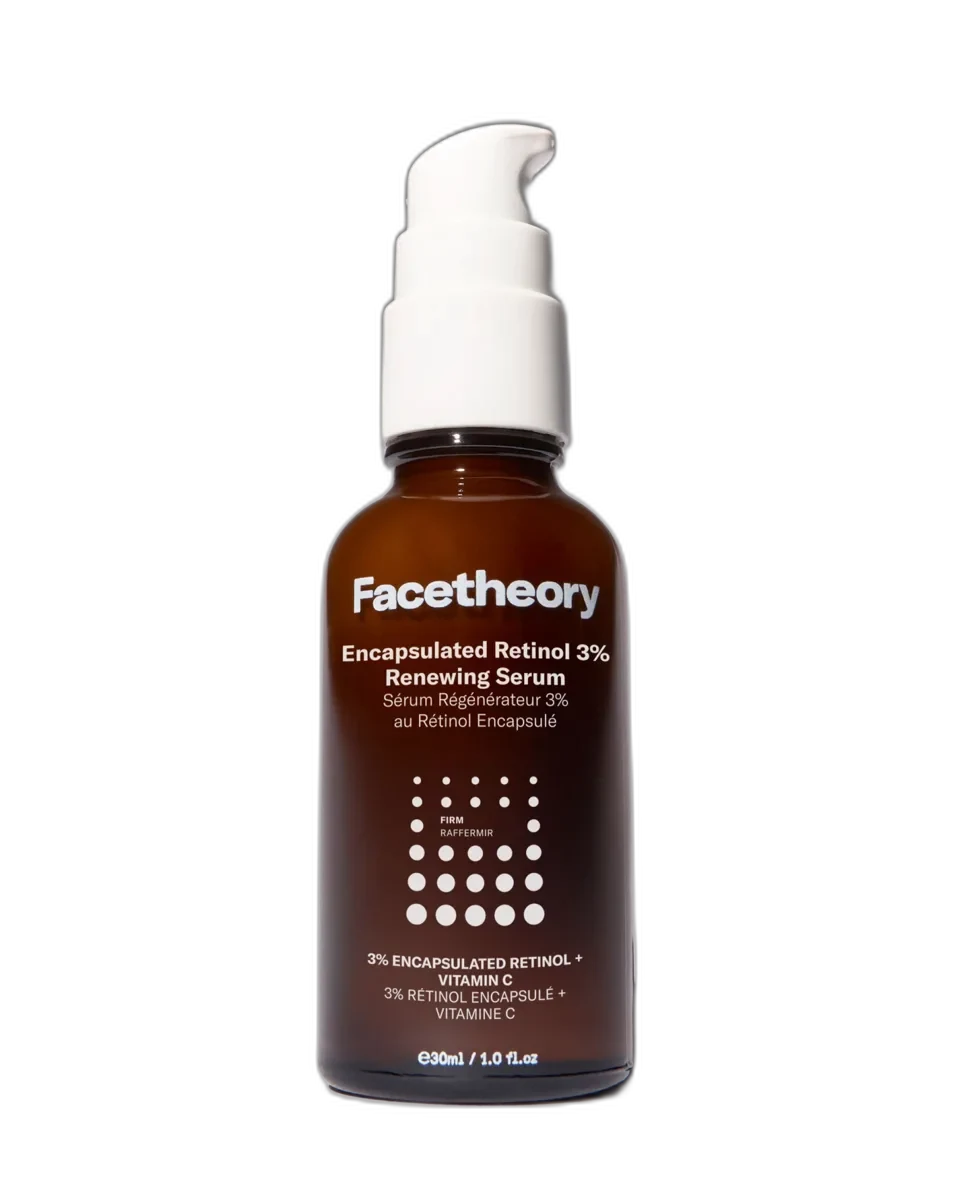
Regenacalm Retinol Serum S1 Pro
High-Dose Retinol Value Pick
 Verified reviewer
Pros & cons.
- +3% encapsulated retinol is an unusually high OTC dose
- +Phospholipid encapsulation genuinely improves tolerance
- +Calming licorice, dill, ferulic, and vitamin C buffer irritation
- +Fragrance-free, vegan, silicone-free formulation
- +Excellent value vs prestige retinol serums at 3-4x the price
- +Amber glass dropper packaging protects retinol from light
- +Works for texture, hyperpigmentation, acne, and fine lines
- −Too high a dose for first-time retinol users to start with
- −30ml bottle feels small for a nightly product
- −UK shipping adds cost for US buyers
- −Still requires careful titration even with encapsulation
- −Not pregnancy-compatible due to retinol content
The full review.
Most brands do not put three percent retinol on a bottle. Raw concentrations this high usually cause bright-red stinging and refunds within a week. Yet a £30 serum from a UK indie brand carries this label, and reviews show users apply it every other night without drama. The reason is “encapsulated” retinol. This makes the product a category of one: a high-dose retinol that tolerates well.
In cosmetic chemistry, encapsulation wraps an active ingredient in a lipid or phospholipid shell. This releases the active slowly instead of dumping it into the skin at contact. This matters for retinol. Retinol irritation depends on dose and concentration peaks. Skin burns from the maximum concentration hitting the stratum corneum in the first twenty minutes, not the total amount applied. Encapsulation flattens that peak, spreading the dose over hours. Consequently, 3% encapsulated retinol behaves like 1% unencapsulated retinol on most skin—effective but without drama. The capsule also stabilizes the retinol against oxidation, extending the product’s effective shelf life.
The rest of the formulation shows Facetheory knows the science. The “calm” half of Regenacalm uses calculated buffers. Licorice root extract provides glabridin, a pigment-inhibiting compound with anti-inflammatory activity that counters retinol-induced redness. Dill extract adds mild anti-inflammatory support and has in vitro data for elastin fiber support. Ferulic acid and sodium ascorbyl phosphate create an antioxidant layer that stabilizes the retinol and adds brightening, using Duke C-E-ferulic logic in an affordable derivative form. Salicylic acid is low in the INCI and acts as a preservative booster rather than a therapeutic BHA. The vehicle is a lightweight, quickly absorbed fluid instead of a thick cream, so the layered actives distribute evenly without a coated feeling.
How this serum works depends on your introduction method. First-time retinol users should not start here, regardless of marketing. Use a 0.25-0.5% unencapsulated serum for a few months to build tolerance first. This product is a graduation tool: if you have used lower-dose retinol for three to six months, your skin is ready for serious wrinkle remodeling, acne scar softening, and texture refinement. Improvements over 0.5% retinol typically appear in 8-12 weeks through better fine line softening, hyperpigmentation fade, and texture shifts.
The most important comparison is against prescription tretinoin, the gold standard for retinoid remodeling. Tretinoin at 0.025% or 0.05% outperforms any over-the-counter retinol on every dimension. This serum offers a non-prescription alternative that gets closer to prescription-level results than a standard 0.5% retinol. It is an honest step up the retinoid ladder for those without a dermatologist or those who find tretinoin too disruptive. If you tolerate tretinoin, use this as a complement, not a replacement.
Complaints are minor and predictable. The 30ml bottle feels small for nightly use; a 50ml size would help. UK shipping adds cost for US buyers, though the per-ml price beats US prestige retinol serums. The sunflower oil in the base leaves a slight, lightweight oily slip that combination and oily skin users may dislike. These do not change the serum’s efficacy.
As a value product, this is among the strongest over-the-counter retinol options. It outperforms most prestige retinol serums at 3-4x the price and beats most drugstore retinol serums in active content and sophistication. The brand lacks CeraVe’s clinical pedigree or La Roche-Posay’s pharmacy heritage, but the formulation speaks for itself. After eight years on the market and thousands of consistent reviews, it has earned the benefit of the doubt.
Ingredient analysis.
Full INCI list
Aqua, Propanediol, Glycerin, Polyglyceryl-6 Stearate, Caprylic/Capric Triglycerides, Sodium Ascorbyl Phosphate, Polyglyceryl-4 Oleate, Tocopherol, Sodium Anisate, Sodium Levulinate, Glyceryl Caprylate, Anethum Graveolens (Dill) Herb Extract, Glycyrrhiza Glabra (Liquorice) Root Extract, Cetyl Hydroxyethylcellulose, Polyglyceryl-6 Behenate, Lactic Acid, Retinol, Phospholipids, Ferulic Acid, Xanthan Gum, Salicylic Acid, Sodium Hyaluronate, Aloe Barbadensis (Aloe Vera) Leaf Juice, Sodium Phytate, Helianthus Annuus (Sunflower) Seed Oil, Citric Acid, Rosmarinus Officinalis (Rosemary) Leaf Extract, Potassium Sorbate
Skin match.
The science.
The Science
This serum relies on two proven pillars — retinol as a retinoid and vitamin C derivatives as antioxidants — plus the growing evidence for encapsulated delivery systems. Retinol has decades of clinical evidence for improving photoaging, fine lines, hyperpigmentation, and acne. It works by converting to retinoic acid in skin via a two-step enzymatic process. This makes it roughly 10-20x less potent than prescription tretinoin, but it remains therapeutically effective at adequate doses. For most users, the retinol dose-response relationship peaks around 0.5-1%; higher concentrations usually increase irritation faster than benefit — unless encapsulation flattens the concentration-over-time curve. Formulation research shows phospholipid encapsulation of retinol improves tolerance at higher nominal concentrations, making this serum's 3% figure one of the higher OTC doses. The vitamin C component uses sodium ascorbyl phosphate, a stable derivative that slowly hydrolyzes to ascorbic acid on skin and shows data for mild brightening and antioxidant effects at typical cosmetic concentrations. Ferulic acid stabilizes vitamin C and acts as an independent free-radical scavenger, following the synergy concept in photoprotection established by Duke C-E-ferulic research. Licorice root (glabridin) has clinical evidence for inhibiting tyrosinase and reducing post-inflammatory hyperpigmentation, which pairs well with retinol for pigmentation concerns. Dill extract has limited in vitro data for elastin support and acts as a supporting botanical rather than a primary active.
Dermatologist Perspective
Dermatologists view retinoids as the most evidence-supported anti-aging ingredient class outside of procedural interventions. They frequently recommend over-the-counter retinol serums like this one for patients who avoid prescriptions or cannot tolerate tretinoin. Board-certified dermatologists praise encapsulated retinol technology because it lets patients use higher effective concentrations without the dropout that stops retinoid adherence. The 3% figure alone is high, but the encapsulation, calming botanical buffers, and lack of other irritants make it a defensible choice for patients who already tolerate a lower-dose retinol. The main caveats are standard for retinoids: no use during pregnancy or breastfeeding, strict daily sunscreen, and gradual introduction to build tolerance. Patients with rosacea or eczema should generally avoid it.
Where it fits in your routine.
At night, cleanse dry skin, then press 3-4 drops from the palm into your face and neck. Use 2-3 nights per week for the first 2-3 weeks. If your skin tolerates it, use every other night, then use nightly after 6-8 weeks if no irritation occurs. Apply a hydrating moisturizer after. In the AM, always use broad-spectrum SPF 30+, because retinol increases sun sensitivity. Do not use with benzoyl peroxide or strong AHAs on the same day. If irritation occurs, use it less often instead of stopping. Store the amber dropper bottle away from heat and direct light.
At roughly $38 for 30ml, this serum offers high value in the OTC retinol category. Prestige retinol serums with half the active content and similar formulation quality usually cost $80-$150 for similar sizes. This makes the serum one of the best per-percent retinol values available. The 30ml bottle size is the main per-unit tradeoff; a larger size would improve the math. US buyers face friction from international shipping from the UK, but the total landed cost still beats prestige domestic alternatives. Facetheory is an established 8-year-old indie brand with a clean formulation philosophy, earning reasonable benefit of the doubt on pricing without the decades of clinical backing found in pharmacy brands.
Retinol users with built tolerance can use this to increase dosage without a dermatologist. It suits shoppers seeking high active concentrations at a low price without prestige premiums. This works for skin with photoaging, hyperpigmentation, persistent texture issues, and acne scarring, especially for users 30+ with resilient barriers.
New retinol users should start with a 0.25-0.5% lower-dose product first. Pregnant or breastfeeding users must avoid it. Rosacea, eczema, and chronically sensitized skin need peptide or bakuchiol alternatives. Users on tretinoin do not need this as an additional retinoid.
Product details.
Lightweight, slightly milky fluid that absorbs quickly with a soft finish
Essentially scentless with a faint botanical note
Amber glass bottle with dropper — appropriate for photosensitive retinol
The first few uses may cause mild tingling or warmth for 10-15 minutes. Introduce it gradually: use 2-3 times per week for the first 2-3 weeks, then increase frequency. First-time retinol users may experience mild dryness or light flaking around week 2-3.
2-3 months with nightly use
6 months
All Year
The backstory.
Facetheory built the Regenacalm line as a flagship DTC retinol product at a time when UK shoppers had limited access to high-percentage retinol outside prescription channels. The 'Pro' variant is the brand's strongest over-the-counter retinol and is positioned as the tier users graduate to after building tolerance on a lower-dose starter.
About Facetheory
Established Brand (5–20 years)Facetheory launched in the UK in 2014. This direct-to-consumer skincare brand focuses on formulation transparency and mid-priced actives. The Regenacalm line is one of the brand's most recognized products and has a loyal following in UK and European markets, even if the brand's clinical track record is shorter than legacy pharmacy brands.
Common myths.
A higher retinol percentage always means better results.
Retinol response plateaus below 3% for most users. Higher percentages without encapsulation increase irritation without adding proportional benefit. Sustained, tolerable use matters. This formula's encapsulation works because it makes the high dose tolerable, not because more is better.
Retinol and vitamin C can't be used in the same product.
L-ascorbic acid and retinol face pH-sensitive combination problems at certain pHs. Stable derivatives like sodium ascorbyl phosphate — used in this formula — coexist with retinol without degrading. This allows the serum to carry both actives in one bottle.
FAQ.
Can I use it every night?
Yes, eventually—but not immediately. Use it 2-3 nights per week for the first 2-3 weeks, then every other night for 2-3 more weeks. Only use it nightly if your skin tolerates it well. Sensitive users may use it every other night as their long-term pace.
Is it safe during pregnancy?
No. Retinol is a retinoid and is contraindicated during pregnancy and breastfeeding. Stop use when trying to conceive. Use pregnancy-safe alternatives like bakuchiol or a peptide serum instead.
Will it cause purging?
This happens, especially for acne-prone users. Purging—a temporary increase in breakouts as retinol accelerates skin turnover—usually ends within 4-8 weeks. If acne worsens at week 8, or breakouts appear in new areas instead of existing problem zones, it is likely irritation rather than purging.
Can I use it with my vitamin C serum?
Yes — this formula has sodium ascorbyl phosphate and ferulic acid. If your vitamin C is a standard L-ascorbic acid serum, use that in the morning and this in the PM. Avoid layering them together if your skin is reactive.
How does it compare to Facetheory's Retinal Supreme MultiCream?
The Retinal Supreme line uses retinaldehyde, which converts to retinoic acid one step faster than retinol. The Regenacalm S1 Pro uses retinol at a higher percentage alongside vitamin C and calming botanicals. Retinal works faster; this retinol has a higher dose but works slower. Both are valid choices based on your goal.
What the community says.
"Surprisingly tolerable for such a high retinol dose"
"Visible smoothing and brightening over weeks"
"Genuinely well-priced for its active content"
"Clean, fragrance-free formulation"
"Still too strong for very sensitive skin without titration"
"Shipping from UK adds cost for US buyers"
"30 ml bottle feels small for a daily product"
"Light sunflower oil feel not universally loved"
Featured in.
People also looked at.