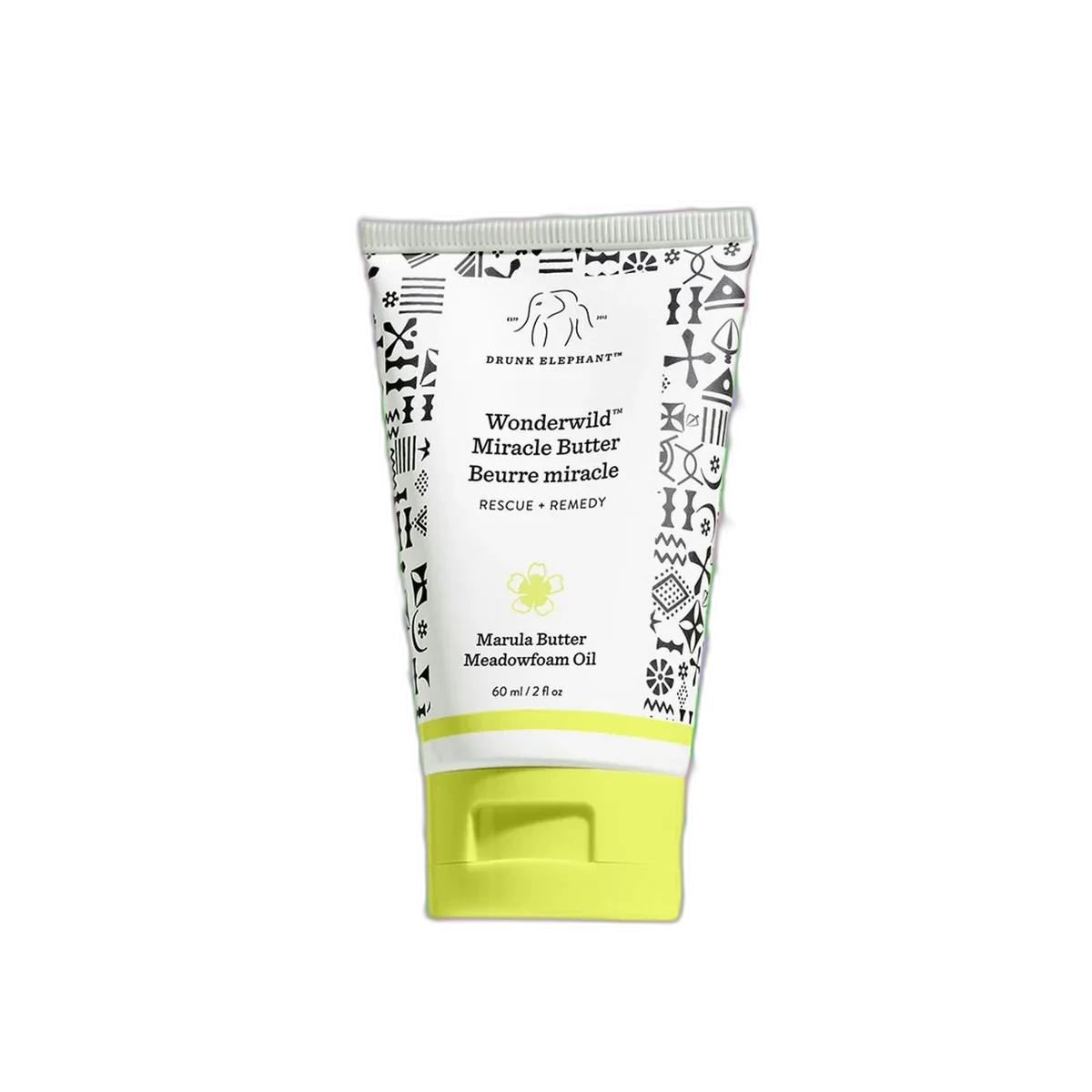
Wonderwild Miracle Butter
SOS Dry Skin Rescue
 Verified reviewer
Pros & cons.
- +Intense occlusive moisturization that provides immediate relief for severely dry skin
- +Anhydrous formula needs no preservatives resulting in a clean 17-ingredient list
- +Dual marula oil and butter delivery creates two-phase moisture system
- +Cupuacu butter adds unusual water-binding capacity for a waterless balm
- +Extremely concentrated so a small jar lasts months with targeted use
- +Versatile enough for lips, cuticles, elbows, and dry patches anywhere
- +Fragrance-free and vegan with no synthetic additives
- −Coconut oil as second ingredient carries high comedogenic risk for acne-prone skin
- −Too heavy and greasy for full-face use on most skin types
- −No humectants means it must be layered over hydrating products for best results
- −Not fungal acne safe due to multiple Malassezia-feeding oils and butters
- −Limited as a facial product despite being marketed as a versatile wonder balm
The full review.
The story behind Wonderwild begins not in a lab or a boardroom but with Tiffany Masterson’s mother. As the tale goes, a prototype of this balm helped heal her damaged skin — the kind of personal origin story that gives a product emotional weight before you even unscrew the lid. Whether you find that compelling or eye-roll-inducing probably depends on your general tolerance for founder mythology, but the product that emerged from that story is worth evaluating on its own merits.
And those merits are, in a word, specific. Wonderwild is not trying to be your daily moisturizer. It is trying to be the thing you reach for when your daily moisturizer is not enough — when your lips are cracked from winter wind, your cuticles look like they have been through a paper shredder, or that patch of eczema on your elbow is staging a revolt against everything else you have tried. It is a rescue product, and understanding that framing is essential to appreciating what it does well.
The formula is elegantly simple: 17 plant oils and butters, no water, no preservatives, no emulsifiers, no silicones. The complete absence of water (anhydrous formulation) means there is nothing here that bacteria want to grow in, which eliminates the need for preservatives — a genuinely clever design choice, not just clean-beauty theater. Marula oil leads the ingredient list in both oil and butter forms, providing Drunk Elephant’s signature emollient at two different textures and absorption rates. Shea butter follows for its documented anti-inflammatory properties — research in the International Journal of Molecular Sciences (2017) confirmed shea’s ability to inhibit the NF-kB inflammatory pathway, making it more than just a moisturizing agent. Cupuacu butter adds an intriguing twist: this Amazonian ingredient can hold up to 440% of its weight in water, giving the formula a water-binding dimension unusual for a completely waterless product.
The texture is undeniably thick. This is a dense, concentrated balm that requires warming between your fingertips before it will cooperate. Once body heat melts it, however, it transforms into a rich, spreadable oil that glides onto skin with surprising ease. A small amount — genuinely small, maybe half a fingertip’s worth — covers an impressive area. The finish is dewy and rich, with a glossy sheen that announces its presence. On lips, it feels like a luxury salve. On cuticles and elbows, it softens rough skin almost on contact. On dry patches, it creates a protective seal that you can feel working overnight.
On the full face, however, things get more complicated. The formula’s richness, which is its greatest strength on targeted areas, becomes a liability when spread across an entire face. Even dry skin types may find it too heavy for daytime wear unless they are experiencing severe barrier compromise. The coconut oil — second on the ingredient list — is the elephant in the room (pun intended, and possibly deserved). At a comedogenic rating of 4 out of 5, coconut oil is one of the more pore-clogging common ingredients in skincare. For the product’s intended audience of very dry, non-acne-prone skin, this is manageable. For anyone with oily tendencies or a history of comedonal acne, it is a genuine risk.
The absence of humectants is the other caveat worth understanding. This balm is pure occlusion and emolliency — it seals in moisture brilliantly, but it does not attract water to the skin the way hyaluronic acid or glycerin would. If you apply Wonderwild to dehydrated skin without a hydrating layer underneath, you are essentially putting a very expensive lid on an empty jar. The product works best as a final step over damp skin or a hydrating serum, where its occlusive properties can lock in the water that’s already there.
At $39 for 60 mL, the pricing is reasonable by Drunk Elephant standards — certainly more justifiable than the Virgin Marula Oil’s markup. The jar lasts impressively long with targeted use, potentially stretching to six months of consistent lip-and-cuticle duty. The ingredient list, while simple, features genuinely high-quality plant oils that serve distinct roles: marula for signature emolliency, shea for anti-inflammatory barrier repair, cupuacu for water retention, rosehip for linoleic acid balance, and meadowfoam for oxidative stability.
What Wonderwild does well, it does with quiet competence. It will not fix dehydration, it will not treat acne, and it will not replace a well-formulated daily moisturizer. But for the specific moments when skin needs intensive, protective, soothing relief — the cracked lip in February, the wind-burned cheek after a hike, the stubbornly dry patch that laughs at regular lotion — it earns its place in the medicine cabinet. Just know what you are buying: an excellent targeted balm, not the miracle it says on the label.
Ingredient analysis.
Full INCI list
Sclerocarya Birrea Seed Oil, Cocos Nucifera (Coconut) Oil, Hydrogenated Vegetable Oil, Cucurbita Pepo (Pumpkin) Seed Oil, Butyrospermum Parkii (Shea) Butter, Sclerocarya Birrea Seed Butter, Mangifera Indica (Mango) Seed Butter, Theobroma Grandiflorum Seed Butter, Camellia Sinensis Seed Oil, Rosa Canina Fruit Oil, Aleurites Moluccanus Seed Oil, Simmondsia Chinensis (Jojoba) Seed Oil, Limnanthes Alba (Meadowfoam) Seed Oil, Oryza Sativa (Rice) Bran Oil, Persea Gratissima (Avocado) Oil, Helianthus Annuus (Sunflower) Seed Wax, Vitis Vinifera (Grape) Seed Oil
Skin match.
The science.
The Science
Wonderwild's therapeutic credibility comes from its shea butter and cupuacu butter content. A 2017 review in the International Journal of Molecular Sciences (Lin et al.) confirmed shea butter inhibits the NF-kB pathway to provide anti-inflammatory effects, justifying its use on eczema-prone and compromised skin beyond simple moisturization. A 2025 in vitro study showed shea butter reduced transepidermal water loss (TEWL) by 37.8% after 24 hours and increased skin hydration by 58%.
Cupuacu butter (Theobroma grandiflorum) adds a unique property to this anhydrous formula. Research in The Journal of the American College of Clinical Wound Specialists (2014) documented cupuacu butter's capacity to bind 440% of its weight in water — a high water-binding ability for a lipid ingredient. In a clinical setting at a 127-bed long-term care facility, a cupuacu-based skincare regimen produced an 86% decrease in xerosis, a 55% decrease in skin tears, and a 45% decrease in physician-ordered treatment for denuded skin.
The marula oil base has a fatty acid profile dominated by approximately 69% oleic acid, as confirmed in the 2015 Journal of Ethnopharmacology study (Komane et al.) that showed marula oil is non-irritating and moisturizes xerotic skin. Rosehip fruit oil adds balance with 51% linoleic acid and a carotenoid-rich antioxidant profile — a 2024 comprehensive review in Frontiers in Pharmacology confirmed rosehip's efficacy for wound healing and skin regeneration.
The anhydrous design has formulation significance: without water, the product needs no preservatives, emulsifiers, or stabilizers, which removes potential sensitizers and extends shelf life via the natural oxidative stability of meadowfoam seed oil (95% long-chain fatty acids). The trade-off is no humectant activity — the formula occludes and emollifies but does not draw moisture to the skin, so it works best when applied over hydrated skin.
References
- Anti-Inflammatory and Skin Barrier Repair Effects of Topical Application of Some Plant Oils — International Journal of Molecular Sciences (2017)
- Advanced Skin Care — A Novel Ingredient (Cupuacu Butter) — The Journal of the American College of Clinical Wound Specialists (2014)
- Safety and efficacy of Sclerocarya birrea (A.Rich.) Hochst (Marula) oil: A clinical perspective — Journal of Ethnopharmacology (2015)
- Unveiling the mechanisms for the development of rosehip-based dermatological products: an updated review — Frontiers in Pharmacology (2024)
Dermatologist Perspective
Dermatologists view anhydrous balms like Wonderwild as effective occlusive agents for severely dry and compromised skin, especially in cold weather when transepidermal water loss accelerates. Board-certified dermatologists note the shea butter and plant oil combination provides a lipid-rich barrier repair strategy that matches the 'soak and seal' approach used for eczema management. However, dermatologists caution that coconut oil's comedogenic potential makes this product unsuitable for acne-prone areas, and they emphasize that occlusive-only products work best over hydrating layers to maximize moisture retention rather than as standalone moisturizers.
Where it fits in your routine.
Warm a small amount (about half a fingertip) between your palms until the balm melts into an oil. Press it gently into dry areas like lips, cuticles, elbows, knees, or rough patches. For facial use, apply it only to targeted dry areas or as an overnight occlusive seal over your regular moisturizer. Always layer it over damp skin or a hydrating serum to lock in moisture. Use it morning and night, though its thick finish works best for evening facial use.
At $39 for 60 mL, Wonderwild is priced reasonably for Drunk Elephant and competes in the luxury multipurpose balm category. The concentrated formula lasts a long time; users get four to six months from one jar, making the monthly cost $7-10. A 20 mL midi size costs $18 for testing. The ingredient list uses plant-derived oils and butters with specific functional roles. You pay more than for pharmacy-brand occlusive options like plain petrolatum, but the multi-butter formulation and cosmetic elegance offer a more refined experience.
Use this if you have chronically dry, cracked, or compromised skin and need a powerful occlusive. It works for winter skin emergencies, eczema-prone dry patches, chapped lips, and rough cuticles. It fits dry to normal skin types that prefer minimalist, plant-based formulations.
Oily and acne-prone skin types that cannot tolerate coconut oil, people with fungal acne, those wanting a lightweight daily facial moisturizer, and anyone needing humectant-driven hydration instead of occlusive sealing.
Product details.
Thick, dense, buttery balm with a concentrated, salve-like consistency. It melts with body heat and turns into a spreadable oil on skin. A small amount covers a large area.
No added fragrance. The unrefined plant oils blend has a faint, natural nutty-earthy aroma, but most users call it unscented.
A squat round jar uses Drunk Elephant's signature bright, playful lid design with whimsical icons. The 60 mL jar is compact and travel-friendly. A twist-off lid provides easy access to the thick balm.
The balm is denser than expected on first use; warm it between fingertips to melt it into a spreadable consistency. It provides immediate soothing relief and a dewy layer when applied to lips or dry patches. On the full face, the balm feels too heavy for anyone who isn't severely dry. Benefits are immediate with no adjustment period.
4-6 months if you use it on dry patches, lips, and cuticles; 2-3 months with more frequent application
12 months
fall winter
The backstory.
Wonderwild was inspired by Tiffany Masterson's mother, who reportedly used a prototype version to help heal damaged skin. Launched in March 2022, it represents Drunk Elephant's entry into the multipurpose balm category — a product designed to go anywhere skin is dry, cracked, or compromised, from lips to cuticles to windburned cheeks.
About Drunk Elephant
Established Brand (5–20 years)Tiffany Masterson founded Drunk Elephant in 2012, making it one of Sephora's fastest-growing brands. Shiseido acquired Drunk Elephant in 2019 for $845 million. The brand uses a 'Suspicious 6'-free philosophy and has Leaping Bunny certification, but its formulations use clean-beauty marketing instead of independent clinical research.
Common myths.
Anhydrous balms beat water-based moisturizers for dry skin.
Balms excel at occlusion—sealing in existing moisture—but they do not add water to the skin. For best results, apply this balm over a hydrating serum or damp skin to lock in moisture. Used alone on dehydrated skin, this balm feels moisturizing on the surface while the skin beneath remains water-starved.
Coconut oil is bad for all skin types
Coconut oil has a 4/5 comedogenic rating, which causes issues for acne-prone skin, but it has documented antimicrobial and anti-inflammatory properties. For dry, non-acne-prone skin — this balm's target audience — coconut oil works as an effective occlusive emollient.
FAQ.
Can I use Drunk Elephant Wonderwild on my face?
Yes, but with caveats. The formula uses coconut oil (comedogenic rating 4/5) and other heavy oils that clog pores on oily or acne-prone skin. It works well as an overnight face treatment or on targeted dry patches for dry and normal skin types. For most people, use it as a spot treatment instead of an all-over facial moisturizer.
Is Drunk Elephant Wonderwild good for eczema?
The shea butter in this formula inhibits the NF-kB pathway to reduce inflammation, while the anhydrous oil-and-butter base provides a strong occlusive barrier. It provides relief for eczema-prone dry skin that isn't triggered by coconut oil. However, it lacks the ceramides and humectants found in dedicated eczema treatments.
What's the difference between Wonderwild and regular Drunk Elephant moisturizers?
Wonderwild is an anhydrous balm. It contains no water, no emulsifiers, and no preservatives, using only plant oils and butters. Use it as a rescue product for severely dry or compromised skin rather than a daily facial moisturizer. Drunk Elephant's Protini or Lala Retro are water-based emulsions better for daily full-face use.
Should I apply Wonderwild to wet or dry skin?
Apply over slightly damp skin or a hydrating serum for best results. This anhydrous balm has no humectants; it seals in moisture but adds no water to the skin. Applying over damp skin provides moisture to lock in and maximizes the hydration benefit.
How long does the Wonderwild jar last?
The 60 mL jar lasts 4-6 months if you use it on dry patches, lips, and cuticles. The balm is concentrated; a small amount warmed between fingertips lasts a long time. Full-body application lasts 2-3 months.
What the community says.
"Provides intense moisture relief for extremely dry and chapped skin"
"Versatile multi-use on lips, cuticles, elbows, and dry patches anywhere"
"Clean short ingredient list of recognizable plant oils and butters"
"Rich balm texture melts into skin without excessive heavy residue"
"Fragrance-free and gentle enough for sensitive skin"
"Travel-friendly compact packaging"
"Too greasy and heavy for full-face application on most skin types"
"Can cause breakouts due to comedogenic coconut oil content"
"Price feels high for a plant oil and butter blend"
"Better as a spot treatment than the all-over moisturizer it's marketed as"
"Lacks humectants so must be layered over hydrating products for best results"