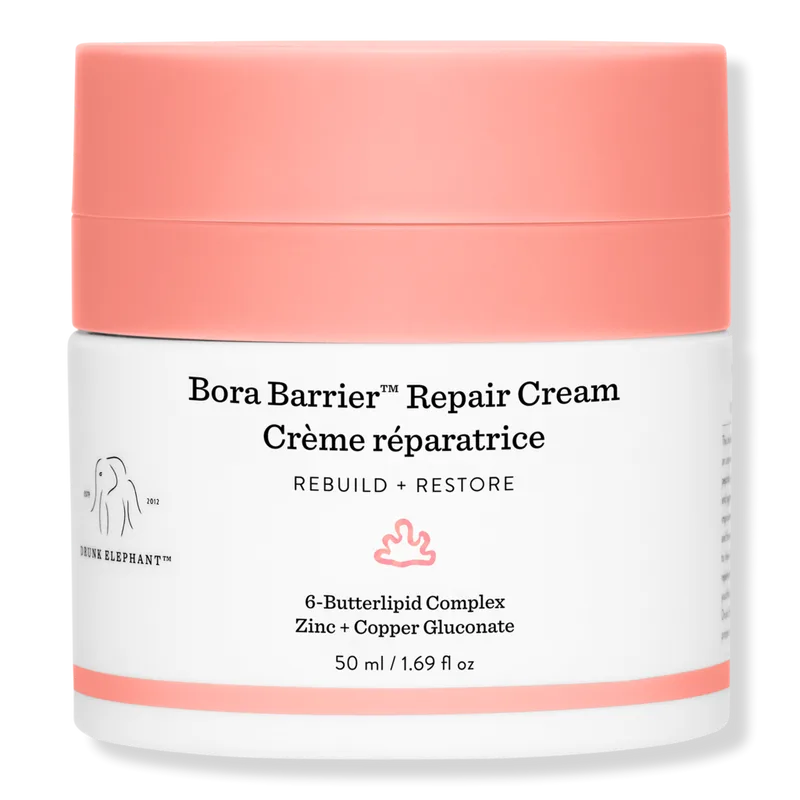
Bora Barrier Repair Cream
Barrier Repair Powerhouse
 Verified reviewer
Pros & cons.
- +Comprehensive 6-Butterlipid Complex with three ceramides plus cholesterol and phytosphingosine for proper barrier reconstruction
- +Matrixyl 3000 peptides add collagen-stimulating anti-aging benefits unusual in a barrier cream
- +Four-antioxidant system (astaxanthin, resveratrol, EGCG, quercetin) provides layered environmental defense
- +Six botanical oils deliver a balanced omega-3, -6, -9 fatty acid profile for deep nourishment
- +Fragrance-free, silicone-free, essential oil-free formula minimizes irritation risk
- +Refillable packaging with airless pump reduces waste by 85% and ensures hygienic dispensing
- +Allure Best of Beauty 2024 winner — validated by industry recognition in its debut year
- −Ultra-thick texture is too heavy for oily or combination skin and requires effort to spread
- −$74 for 50 mL is premium pricing even for a densely formulated barrier cream
- −Pilling occurs when layered with silicone-based products or certain sunscreens
- −Can cause eye irritation if applied too close to the orbital area
- −Too new (2024 launch) for extensive long-term user data on sustained barrier repair efficacy
The full review.
There’s a certain audacity to launching a moisturizer in 2024 that costs $74 and is so thick you need to work it into your skin like you’re kneading bread dough. In a market trending toward lightweight, watery textures and minimalist formulations, Drunk Elephant went the opposite direction with Bora and created something that feels like it belongs in a dermatologist’s prescription pad rather than a Sephora shelf.
The audacity paid off. Bora won Allure’s Best of Beauty award in its debut year, and the ingredient list explains why: this isn’t a moisturizer that does one thing. It’s a barrier repair cream, an anti-aging treatment, and an antioxidant serum compressed into a single, absurdly dense jar.
The 6-Butterlipid Complex is the foundation — three skin-identical ceramides (AP, NP, and EOP) plus glucosyl ceramide, glycosphingolipids, and beta-sitosterol. But what elevates this beyond a standard ceramide cream is the supporting architecture. Cholesterol and phytosphingosine complete the trinity of barrier lipids that the skin actually needs to rebuild its lamellar structure. Without these co-lipids, ceramides alone are like bricks without mortar — present but not functional. Bora includes the mortar.
Then there are the peptides. Matrixyl 3000 (palmitoyl tripeptide-1 and palmitoyl tetrapeptide-7) is a signaling peptide complex that tells fibroblasts to produce more collagen and elastin. You don’t typically find this in a barrier cream. Barrier creams usually focus on the surface — patch the lipids, lock in moisture, move on. Bora reaches deeper, addressing the dermal protein matrix that gives skin its bounce and resilience. It’s an ambitious formulation choice, and it makes the product genuinely multi-functional rather than just expensively moisturizing.
The antioxidant quartet deserves attention because it’s not the usual vitamin E afterthought. Astaxanthin — a carotenoid roughly 6,000 times more potent than vitamin C as a free radical scavenger according to published research — headlines a team that includes resveratrol, epigallocatechin gallate (EGCG from green tea), and quercetin. Each targets different oxidative stress pathways: astaxanthin quenches singlet oxygen, resveratrol inhibits UV-induced NF-kB signaling, EGCG reduces inflammatory mediators, and quercetin provides broad flavonoid protection. Two forms of vitamin C round out the antioxidant defense — magnesium ascorbyl phosphate for stability and tetrahexyldecyl ascorbate for lipid-layer penetration.
Six botanical oils provide the fatty acid diversity that compromised skin craves. Marula oil brings omega-9 oleic acid. Evening primrose delivers gamma-linolenic acid, one of the most effective barrier-supporting fatty acids available from plant sources. Rosehip oil contributes trans-retinoic acid and linoleic acid. Tamanu oil adds calophyllolide for anti-inflammatory support. Jojoba provides wax esters structurally similar to human sebum. Moringa rounds it out with additional oleic acid and antioxidant behenic acid. This isn’t a random oil salad — it’s a considered fatty acid portfolio.
The texture, though. You need to be ready for it. Bora is thick. Not “rich moisturizer” thick — more like “I need to warm this between my fingers before it will move” thick. One pump from the airless dispenser is genuinely enough for your entire face, but you’ll spend a good ten to fifteen seconds working it in. Once distributed, it absorbs surprisingly well for its density, settling into a satin finish that feels protective without feeling suffocating. But if you’ve spent years on lightweight gel creams and watery essences, the texture adjustment is real.
The pilling issue is the one functional complaint that has legitimate merit. When layered over certain serums — particularly silicone-based ones — or under makeup, Bora can ball up. The thick lipid-heavy formula doesn’t play well with ingredients that sit on the surface rather than absorbing. The solution is simple (apply over water-based products on slightly damp skin) but it requires some routine engineering that lighter moisturizers don’t demand.
For dry skin, chronically compromised barriers, and winter-ravaged faces, Bora delivers. Users consistently report that chronic tightness and flaking resolve within days of consistent use. The morning-after effect — waking up with skin that’s still plump and hydrated rather than parched and papery — is something dry skin types will recognize as genuinely special. Dr. Joshua Zeichner has noted that the lipid-based approach genuinely fills cracks in the outer skin layer, and the clinical testing backs up the hydration claims: 98% immediate moisture increase and measurable barrier strengthening within 8 hours.
But Bora is not for everyone, and pretending otherwise would be dishonest. Oily skin has no business with this product. Combination skin might find it workable in winter but excessive in warmer months. Even some dry skin types may find the texture overwhelming if they prefer lighter formulations. And at $74 (with a $65 refill option that at least nods toward sustainability), it’s competing against ceramide creams at a third of the price that deliver adequate barrier repair for most people.
What Bora offers that cheaper alternatives don’t is the full-spectrum approach — ceramides plus peptides plus antioxidants plus vitamin C plus six oils plus minerals, all in one jar. Whether you need all of that or would be equally served by a simple ceramide moisturizer and a separate peptide serum is the question that justifies or undermines the price. For those with genuinely compromised barriers who want maximum intervention with minimum products, Bora consolidates an entire routine step into one dense, effective, deeply nourishing cream.
Formula
Texture
The texture, though. You need to be ready for it. Bora is thick. Not “rich moisturizer” thick — more like “I need to warm this between my fingers before it will move” thick. One pump from the airless dispenser is genuinely enough for your entire face, but you’ll spend a good ten to fifteen seconds working it in. Once distributed, it absorbs surprisingly well for its density, settling into a satin finish that feels protective without feeling suffocating. But if you’ve spent years on lightweight gel creams and watery essences, the texture adjustment is real.
Common Complaints
The pilling issue is the one functional complaint that has legitimate merit. When layered over certain serums — particularly silicone-based ones — or under makeup, Bora can ball up. The thick lipid-heavy formula doesn’t play well with ingredients that sit on the surface rather than absorbing. The solution is simple (apply over water-based products on slightly damp skin) but it requires some routine engineering that lighter moisturizers don’t demand.
Best for
For dry skin, chronically compromised barriers, and winter-ravaged faces, Bora delivers. Users consistently report that chronic tightness and flaking resolve within days of consistent use. The morning-after effect — waking up with skin that’s still plump and hydrated rather than parched and papery — is something dry skin types will recognize as genuinely special. Dr. Joshua Zeichner has noted that the lipid-based approach genuinely fills cracks in the outer skin layer, and the clinical testing backs up the hydration claims: 98% immediate moisture increase and measurable barrier strengthening within 8 hours.
Not ideal for
But Bora is not for everyone, and pretending otherwise would be dishonest. Oily skin has no business with this product. Combination skin might find it workable in winter but excessive in warmer months. Even some dry skin types may find the texture overwhelming if they prefer lighter formulations. And at $74 (with a $65 refill option that at least nods toward sustainability), it’s competing against ceramide creams at a third of the price that deliver adequate barrier repair for most people.
Works for
What Bora offers that cheaper alternatives don’t is the full-spectrum approach — ceramides plus peptides plus antioxidants plus vitamin C plus six oils plus minerals, all in one jar. Whether you need all of that or would be equally served by a simple ceramide moisturizer and a separate peptide serum is the question that justifies or undermines the price. For those with genuinely compromised barriers who want maximum intervention with minimum products, Bora consolidates an entire routine step into one dense, effective, deeply nourishing cream.
Ingredient analysis.
Full INCI list
Water/Aqua/Eau, Glycerin, Propanediol, Ethylhexyl Olivate, Butyrospermum Parkii (Shea) Butter, C10-18 Triglycerides, Cetearyl Alcohol, Hydroxyethyl Acrylate/Sodium Acryloyldimethyl Taurate Copolymer, Cetearyl Olivate, Sorbitan Olivate, Beta-Sitosterol, Oenothera Biennis (Evening Primrose) Oil, Sclerocarya Birrea Seed Oil, Simmondsia Chinensis (Jojoba) Seed Oil, Calophyllum Inophyllum Seed Oil, Oleic Acid, Squalane, Butylene Glycol, Glucosyl Ceramide, Linoleic Acid, Linolenic Acid, Glycosphingolipids, Rosa Canina Fruit Oil, Moringa Oleifera Seed Oil, Alpha-Glucan, Resveratrol, Epigallocatechin Gallate, Magnesium Aspartate, Zinc Gluconate, Copper Gluconate, Acacia Senegal Gum, Sodium PCA, Palmitoyl Tripeptide-1, Palmitoyl Tetrapeptide-7, Sorbitan Isostearate, Haematococcus Pluvialis Extract, Quercetin, Astaxanthin, Magnesium Ascorbyl Phosphate, Ceramide AP, Ceramide NP, Ceramide EOP, Dextrin, Palmitic Acid, Coco-Glucoside, Sodium Lactate, Stearic Acid, Pentylene Glycol, Brassica Campestris (Rapeseed) Seed Oil, Tetrahexyldecyl Ascorbate, Sodium Lauroyl Lactylate, Phytosphingosine, Cholesterol, Xanthan Gum, Tetrasodium Glutamate Diacetate, Citric Acid, Phenoxyethanol, Sodium Hydroxide, Tocopherol, Polysorbate 60, Carbomer, Ethylhexylglycerin
Skin match.
The science.
The Science
Bora uses biomimetic lipid replacement to supply the exact lipid classes in the skin's intercellular matrix. A 2024 study in the International Journal of Cosmetic Science found that formulations combining ceramide AP and NP with cholesterol repair disrupted skin barrier models better than ceramides alone. Bora uses three ceramide types (AP, NP, EOP) plus cholesterol and phytosphingosine, matching the approach in this research.
A 2019 study (PubMed: 31585489) shows ceramide-containing moisturizers provide sustained hydration. One application increased skin hydration and improved transepidermal water loss for up to 24 hours; improvements grew over 28 days of twice-daily use. This aligns with Bora's clinical claim of 24-hour moisture and barrier strengthening within 8 hours.
The Matrixyl 3000 peptide complex (palmitoyl tripeptide-1 and palmitoyl tetrapeptide-7) in Bora has independent anti-aging evidence. A 2017 study in Cosmetics (MDPI) showed that twice-daily application for 56 days decreased roughness by 14%, deep wrinkle area by 44%, and wrinkle density by 37%, while improving skin tone and elasticity by 15%. These peptides use a signaling mechanism different from retinoids, so users who cannot tolerate retinol can use them.
A 2018 PMC review of astaxanthin, the formula's headline antioxidant, confirmed clinical improvements in wrinkles, elasticity, transepidermal water loss, and moisture content. The review notes astaxanthin inhibits collagenases and MMP activity—enzymes that break down collagen—to provide anti-aging benefits that complement peptide-driven collagen synthesis. A 2022 PMC review shows Resveratrol reduces expression of AP-1 and NF-kB factors involved in photoaging, adding UV-protective antioxidant capacity to the formula's environmental defense system.
References
- The role of ceramides in skin barrier function and the importance of their correct formulation for skincare applications — International Journal of Cosmetic Science (2024)
- The 24-hr, 28-day, and 7-day post-moisturizing efficacy of ceramides 1, 3, 6-II containing moisturizing cream — PubMed (2019)
- Astaxanthin in Skin Health, Repair, and Disease: A Comprehensive Review — PMC (2018)
- Resveratrol as a factor preventing skin aging and affecting its regeneration — PMC (2022)
Dermatologist Perspective
Board-certified dermatologists consider the ceramide-cholesterol-phytosphingosine approach a top evidence-supported strategy for barrier repair. Dr. Joshua Zeichner has commented on Bora's lipid-based formulation, noting that lipids fill cracks in the outer skin layer to repair the barrier, with ceramides acting as essential 'glue' in the skin's structure. Dermatologists praise the comprehensive ingredient list but note the thick formula suits dry and barrier-compromised skin rather than being a universal moisturizer. Doctors often recommend products with this lipid profile to patients recovering from aggressive treatments (retinoids, chemical peels, laser procedures) to support post-procedure healing.
Where it fits in your routine.
Cleanse your skin and apply water-based serums, then dispense one pump of Bora into your palm. Warm the cream between your fingers for a few seconds to soften the thick texture. Press and pat onto your face, then massage until absorbed. Use morning and evening. In the AM, follow with sunscreen. In the PM, apply as your final step. You can layer Bora over retinol treatments to buffer irritation. Avoid the eye area; use a dedicated eye cream instead.
At $74 for 50 mL ($65 for refills), Bora is a premium product. The ingredient density justifies the price more than many luxury moisturizers — the triple ceramide complex, Matrixyl 3000 peptides, four distinct antioxidants, dual vitamin C forms, and six botanical oils show real formulation investment. The refillable system cuts the ongoing cost by 12%. For context, a separate ceramide cream, peptide serum, and antioxidant serum can cost more than Bora and require more steps. The value depends on whether you need everything this product offers — if you do, it is reasonably priced for the category. If a simple ceramide moisturizer works, you pay for sophistication you may not need.
People with chronically dry, dehydrated, or barrier-compromised skin can use this single product for barrier repair, anti-aging, and antioxidant protection. It works for winter skin, post-procedure recovery, and mature skin that lacks moisture retention. It also works as a thick night cream for normal-to-dry skin types.
Oily and acne-prone skin types will find the thick, lipid-heavy formula oppressive, which may cause congestion. Users preferring lightweight, gel-cream textures will dislike the dense consistency. Budget-conscious buyers seeking basic barrier repair can get adequate results from simpler ceramide moisturizers for much less.
Product details.
This thick, buttery cream takes a moment to work into the skin. One pump covers the entire face. The dense formula melts with massage and absorbs without a heavy residue for dry skin types.
Fragrance-free. Raw ingredients produce a faint, barely perceptible clean lotion smell. It has no added fragrance, essential oils, or perfume.
White jar with airless pump dispenser and cap. Refillable system — the outer jar is recyclable and the pump transfers to a new refill pod ($65), reducing plastic waste by 85%. The airless pump dispenses a flower-shaped blob of cream for controlled, hygienic use.
The ultra-thick texture may surprise users used to lighter moisturizers. One pump works. The cream takes a moment to warm and spread, then absorbs into a satin finish. Dry skin types feel immediate comfort as tightness and flaking resolve on contact. The next morning, skin looks plumper and dewier.
2-3 months with twice-daily use (one pump per application)
12 months
fall winter
The backstory.
Drunk Elephant launched Bora in early 2024 as a successor to the beloved Lala Retro Whipped Cream, designed specifically for chronically dry and barrier-compromised skin that needs more than surface-level hydration. The formula reflects a shift in the brand's approach from lightweight, mixable products to a single, dense, all-in-one treatment moisturizer. The name evokes Bora Bora — a rich, enveloping tropical warmth — and the product won Allure's Best of Beauty award in its debut year.
About Drunk Elephant
Established Brand (5–20 years)Tiffany Masterson founded Drunk Elephant in 2012 in Houston, Texas. The brand gained fame as a top indie skincare brand using its 'Suspicious 6' avoidance philosophy. Shiseido acquired Drunk Elephant in 2019 for $845 million. Drunk Elephant does not conduct its own clinical research, but its formulations use well-studied actives at meaningful concentrations.
Common myths.
Thick, rich creams always clog pores.
Ceramides, shea butter, and plant oils create Bora's thickness instead of heavy waxes or mineral oil. The oleic acid content means oily and acne-prone skin should be cautious, but the ceramide-rich lipid profile supports skin without suffocating it. Dry skin types rarely experience clogging from this type of formula.
Use separate products for barrier repair, anti-aging, and antioxidant protection.
Bora combines all three functions into one product. The ceramide complex repairs the barrier, Matrixyl 3000 peptides stimulate collagen, and the four-antioxidant system (astaxanthin, resveratrol, EGCG, quercetin) defends against environmental stressors — simplifying routines for dry skin types.
FAQ.
What is the 6-Butterlipid Complex in Drunk Elephant Bora?
This proprietary blend uses six lipid components: glucosyl ceramide, glycosphingolipids, beta-sitosterol, ceramide AP, ceramide NP, and ceramide EOP. Combined with cholesterol and phytosphingosine, these lipids mimic and support the skin's natural barrier structure instead of just adding surface moisture.
Not ideal for
Not ideal. The thick, lipid-rich formula targets chronically dry and barrier-compromised skin. Oily skin types will likely find it too heavy, which causes a greasy feel and increased congestion. Board-certified dermatologist Dr. Joshua Zeichner says this formula may not suit oily or acne-prone skin.
Pairs Well With
Yes — this pairs well. Apply your retinol treatment first, then layer Bora on top. The ceramide complex, phytosphingosine, and cholesterol buffer retinol-induced dryness and support the barrier that retinol challenges. The Matrixyl 3000 peptides complement retinol's collagen-stimulating effects via a different pathway.
Packaging
Yes. The outer jar and cap are recyclable. The pump dispenser transfers to a new refill pod ($65 vs $74 for full size). Drunk Elephant claims this system reduces plastic waste by 85% compared to repurchasing the full-size product.
How does Bora compare to Drunk Elephant Lala Retro?
Bora is thicker and more treatment-focused than Lala Retro. Lala Retro is a whipped, lightweight cream for many skin types, but Bora is an ultra-thick barrier repair formula for chronically dry, compromised skin. Bora also has Matrixyl 3000 peptides, dual vitamin C forms, and four antioxidants that Lala Retro lacks.
Common Complaints
The thick, lipid-rich formula can ball up when layered over silicone-based products or certain water-based gels. For best results, apply Bora over water-based serums on slightly damp skin, and let each layer absorb before applying the next. Avoid mixing with silicone-heavy primers or sunscreens.
Safe during pregnancy?
Yes. Bora lacks retinol, retinoids, or any ingredients flagged as unsafe during pregnancy. The formula uses ceramides, peptides, plant oils, and antioxidants, which are safe for pregnancy and nursing.
What the community says.
"Exceptional deep hydration that lasts all day and overnight"
"Visibly reduces redness and calms irritated or compromised skin"
"Hygienic airless pump dispenses the perfect amount each time"
"Dense ingredient list with ceramides, peptides, and antioxidants"
"Refillable packaging reduces waste by 85%"
"$74 price point is difficult to justify for a moisturizer"
"Pilling can occur when layered over or under certain products"
"Ultra-thick texture feels heavy and is too rich for oily skin"
"Takes effort to spread due to density of the cream"
"Can cause eye irritation if applied too close to the eye area"