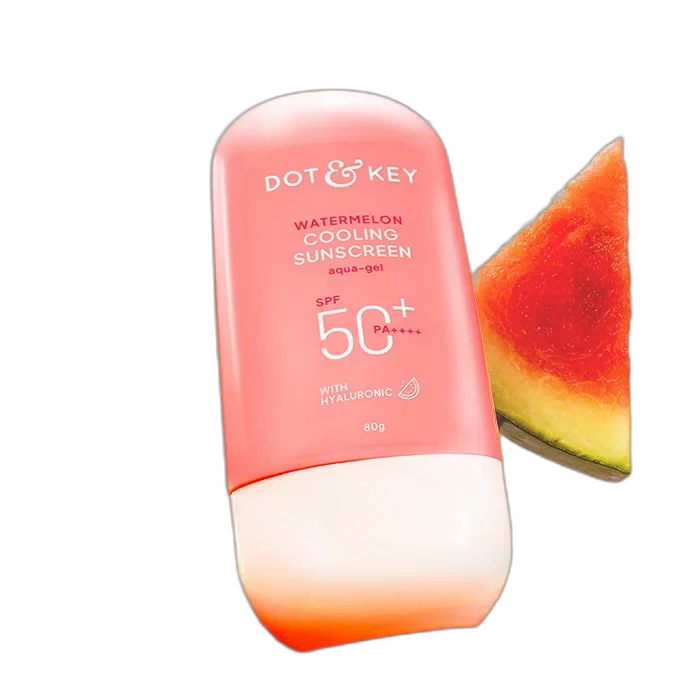
Watermelon Hyaluronic Sunscreen SPF 50
Indian SPF 50 Value Pick
 Verified reviewer
Pros & cons.
- +Includes Tinosorb S, a modern photostable broad-spectrum UV filter rare in budget sunscreens
- +Genuine SPF 50 broad-spectrum coverage with stabilized avobenzone
- +No white cast on any skin tone
- +Lightweight gel texture comparable to mid-tier Korean sunscreens
- +Affordable for the filter system sophistication
- +Contains niacinamide and hyaluronic acid for compound benefits
- +Wearable under makeup without pilling
- −Strong watermelon fragrance rules out sensitive or rosacea-prone skin
- −50 mL size runs out quickly at proper dosing
- −Not water-resistant
- −Still uses some first-generation filters alongside Tinosorb S
The full review.
In the world of budget sunscreens, the ingredient list usually tells you exactly what you’re getting before you ever try the product. Most sub-$15 chemical sunscreens rely on first-generation filters — octinoxate, avobenzone, ethylhexyl salicylate — which are functional but produce mediocre broad-spectrum coverage unless they’re carefully stabilized. Avobenzone in particular is notorious for breaking down under UV exposure within hours, which is why sunscreens that list it without a photostabilizer are effectively downgrading their own protection after the first hour in the sun. Dot & Key’s Watermelon Hyaluronic Sunscreen is the rare budget formula that doesn’t fall into this trap, because it includes bis-ethylhexyloxyphenol methoxyphenyl triazine — better known as Tinosorb S — in its filter system. That one ingredient is why this sunscreen deserves attention beyond its pleasant texture and watermelon marketing.
Tinosorb S is a photostable broad-spectrum UV filter developed by BASF that absorbs across both UVB and the full UVA range (up to about 380 nm), which is the gold-standard coverage profile you want in any sunscreen. It’s also a photostabilizer — when paired with avobenzone, Tinosorb S prevents the avobenzone from degrading under UV exposure, meaning the broad-spectrum coverage that avobenzone provides on application actually persists through the day instead of fading within an hour. This ingredient is standard in European sunscreens, common in Korean sunscreens, and almost entirely absent from American sunscreens (it’s not FDA-approved for use in the US, which is a large part of why American sunscreens lag behind international standards). Its inclusion in a $15 Indian gel sunscreen is genuinely unusual and is what makes this product competitive with significantly more expensive Korean and European formulations.
The filter system as a whole is a combination of octinoxate (UVB), avobenzone (UVA, stabilized here by Tinosorb S), ethylhexyl salicylate (UVB and solvent), and Tinosorb S (broad-spectrum and photostabilizer). This gives you genuine SPF 50 broad-spectrum coverage in a gel-cream base that absorbs clear into the skin without any white cast — a combination that was effectively impossible in Indian budget sunscreens until very recently. For deeper skin tones in particular, the absence of a white cast is a major functional feature. Too many mineral-only sunscreens leave a visible ashy layer that ranges from inconvenient to completely unwearable, and this product sidesteps that problem entirely.
The supporting cast is well-chosen. Sodium hyaluronate, glycerin, and panthenol provide hydration that keeps the formula wearable for normal and combination skin despite the gel texture. Niacinamide appears further down the list and contributes barrier and anti-pigmentation benefits — particularly relevant for the Indian-market audience, where hyperpigmentation is a primary concern and the compound effect of UV blocking plus topical niacinamide is exactly what dermatologists recommend for melasma and PIH prevention. Cucumber and aloe extracts add a mild soothing layer that’s more sensory than clinical, but it contributes to the overall experience of applying a sunscreen that feels like skincare rather than a chore.
Texture is where this sunscreen earns most of its enthusiastic user reviews. It spreads like a hydrating serum — thin, watery, slightly slippery — and absorbs within about 30 seconds. There’s no tacky residue, no chalky finish, and no pilling under makeup. The finish is slightly dewy rather than matte, which may or may not be what you want depending on your skin type and aesthetic preference. For oily skin in tropical heat, some users find the dewy finish slides around on the skin under heavy humidity and requires a thin powder on top for staying power. For normal and combination skin, it works as a finishing layer without any additional fuss.
The main drawbacks are the watermelon fragrance and the small 50 mL size. The scent is a signature of the Watermelon line and unavoidable — if you don’t want scented sunscreen, this isn’t the product for you. The size runs through quickly if you apply the full recommended dose of a quarter teaspoon for the face and neck, which is the dose required to actually achieve the SPF 50 rating on the label. Most users under-apply sunscreen, which means the 50 mL tube might last longer than it should, but it also means the effective protection is lower than the label promises. This isn’t specific to Dot & Key — it’s the universal problem with real-world sunscreen application — but it’s worth noting because hyperpigmentation-prone users are exactly the audience that can’t afford to under-protect.
At $15 for 50 mL, this sits at a price where you can genuinely compare it with Korean sunscreens like Beauty of Joseon Relief Sun or Biore UV Aqua Rich. The Korean options are still superior in texture precision and filter complexity, but Dot & Key closes the gap more than any Indian budget sunscreen I’ve seen to date. For Indian consumers who can’t easily access imported Korean sunscreens, this is a genuinely strong local alternative.
Formula
Texture
Texture is where this sunscreen earns most of its enthusiastic user reviews. It spreads like a hydrating serum — thin, watery, slightly slippery — and absorbs within about 30 seconds. There’s no tacky residue, no chalky finish, and no pilling under makeup. The finish is slightly dewy rather than matte, which may or may not be what you want depending on your skin type and aesthetic preference. For oily skin in tropical heat, some users find the dewy finish slides around on the skin under heavy humidity and requires a thin powder on top for staying power. For normal and combination skin, it works as a finishing layer without any additional fuss.
Scent
The main drawbacks are the watermelon fragrance and the small 50 mL size. The scent is a signature of the Watermelon line and unavoidable — if you don’t want scented sunscreen, this isn’t the product for you.
Best for
For deeper skin tones in particular, the absence of a white cast is a major functional feature. Too many mineral-only sunscreens leave a visible ashy layer that ranges from inconvenient to completely unwearable, and this product sidesteps that problem entirely.
Works for
For normal and combination skin, it works as a finishing layer without any additional fuss.
Not ideal for
For oily skin in tropical heat, some users find the dewy finish slides around on the skin under heavy humidity and requires a thin powder on top for staying power.
Ingredient analysis.
Full INCI list · pH 5.5
Aqua, Ethylhexyl Methoxycinnamate, Butyl Methoxydibenzoylmethane, Ethylhexyl Salicylate, Bis-Ethylhexyloxyphenol Methoxyphenyl Triazine, Glycerin, Citrullus Lanatus (Watermelon) Fruit Extract, Sodium Hyaluronate, Niacinamide, Butylene Glycol, Panthenol, Allantoin, Tocopheryl Acetate, Cucumis Sativus (Cucumber) Fruit Extract, Aloe Barbadensis Leaf Extract, Dimethicone, Xanthan Gum, Phenoxyethanol, Ethylhexylglycerin, Parfum.
Skin match.
The science.
The Science
This formula uses bis-ethylhexyloxyphenol methoxyphenyl triazine (Tinosorb S) for two reasons: broad-spectrum coverage and photostabilization. Tinosorb S is an organic UV filter that absorbs at approximately 310 nm (UVB) and 340 nm (UVA), covering the full UV spectrum from 280 to 400 nm. A 2009 paper in Photochemistry and Photobiology studied combined UV filter photostability and found Tinosorb S stays stable under UV exposure. It also stabilizes avobenzone (butyl methoxydibenzoylmethane) in combination, extending the functional lifespan of the avobenzone UVA coverage.
Avobenzone alone is photochemically unstable and loses 50-60% of its UV absorption capacity within one hour of sun exposure. Pairing it with Tinosorb S or octocrylene reduces degradation; some formulations show less than 10% loss in that time. This justifies choosing sunscreens with modern stabilizer systems over cheaper avobenzone-only products.
The SPF 50 rating blocks approximately 98% UVB at the standardized 2 mg/cm² test dose. However, multiple studies show real-world sunscreen application falls below this standard. A 2013 paper in the British Journal of Dermatology found average application at roughly 0.5-0.8 mg/cm², which drops effective SPF to approximately 30-40% of the labeled value. Dermatologists recommend SPF 50+ over SPF 30 because the built-in margin compensates for under-application.
Niacinamide in a daily sunscreen adds barrier support and melanogenesis inhibition to the primary UV protection. A 2005 study in the International Journal of Cosmetic Science showed niacinamide stimulates ceramide synthesis and reduces transepidermal water loss. A 2002 paper in the British Journal of Dermatology showed it reduces melanosome transfer from melanocytes to keratinocytes.
References
- Photostability of UV filters — Photochemistry and Photobiology (2009)
- Real-world sunscreen application and SPF — British Journal of Dermatology (2013)
Dermatologist Perspective
Dermatologists prefer sunscreens with modern photostable filter systems for daily use, especially for patients with hyperpigmentation, melasma, or photosensitive conditions. Board-certified dermatologists note that filter photostability matters as much as the SPF rating. An unstabilized avobenzone formula can drop to an effective SPF 10-15 within hours, while a Tinosorb S-stabilized system stays closer to its labeled rating all day. For Indian patients, dermatologists treating melasma frequently recommend broad-spectrum SPF 50 products with Tinosorb S or equivalent modern filters because UVA exposure drives recalcitrant pigmentation. This sunscreen's filter system meets those recommendations, though dermatologists would flag the added fragrance for patients with reactive skin or active rosacea.
Where it fits in your routine.
Apply this as the final morning skincare step, after moisturizer and before makeup. Use about a quarter teaspoon (roughly two finger-lengths) for the face and neck to reach the labeled SPF rating. Dispense onto clean fingertips, warm it, and press or pat it into the skin instead of rubbing. Wait 60-90 seconds for absorption before applying makeup. Reapply every two hours during long sun exposure, or after sweating and towel contact. One morning application works for urban use with intermittent indoor/outdoor transitions.
At approximately $15 for 50 mL, this chemical sunscreen offers high value in the Indian market because it includes Tinosorb S. Most Indian budget sunscreens at this price use old filter systems. This means you get the same formulation sophistication found in $25-35 European sunscreens or $20-30 Korean premium sunscreens for less. One tube lasts 4-6 weeks with proper sunscreen dosing. Daily application of the correct amount costs roughly $130-180 annually. This is a value upgrade for users switching from inferior filter systems or expensive imported Korean sunscreens. The 50 mL size is the main catch; you will use tubes quickly if you apply the full recommended dose.
Oily, combination, or normal skin in tropical or subtropical climates wanting a lightweight broad-spectrum SPF 50 at a budget price. It fits hyperpigmentation-prone users who need photostable broad-spectrum coverage but cannot pay premium Korean sunscreen prices.
Skip this if you have sensitive, rosacea-prone, or fragrance-reactive skin; the watermelon scent is too strong for reactive barriers. Skip this if you need water-resistant sun protection for swimming or intense sweating. Skip this if you prefer unscented sunscreen or avoid chemical UV filters.
Product details.
Thin, watery gel that spreads like a serum.
Strong sweet watermelon scent — the signature of the Watermelon line.
Plastic tube with flip cap in the brand's signature pink.
Spreads like a hydrating serum—thinner than typical Western chemical sunscreens. It absorbs within 30 seconds without a white cast, greasy film, or heavy residue, leaving a slight dewy finish. The strong watermelon fragrance is immediate.
4-6 weeks with daily face-and-neck application at proper sunscreen dosing.
12 months
All Year
The backstory.
Dot & Key launched the Watermelon line to address the Indian summer-skincare problem, and this SPF 50 formulation is the line's most serious product. The inclusion of Tinosorb S represents a deliberate choice to offer genuine broad-spectrum protection rather than relying on older chemical filter systems — a formulation upgrade that most competitors at this price point skipped.
About Dot & Key
Emerging Brand (2–5 years)Dot & Key launched in India in 2018. This sunscreen belongs to the brand's Watermelon line, which uses lightweight summer-friendly formulations. It is one of Dot & Key's most popular products in Indian markets.
Common myths.
Chemical sunscreens are worse than mineral sunscreens.
Modern chemical filters like Tinosorb S, Uvinul A Plus, and Mexoryl XL provide comparable or better broad-spectrum coverage than zinc oxide and titanium dioxide. They have better cosmetic elegance and leave no white cast. The 'chemical vs mineral' debate is outdated; the specific filter system matters, not the category.
SPF 50 is overkill if you're only going for a walk.
SPF 50 provides protection headroom because real-world application is usually below the standardized test dose. Applying 0.5 mg/cm² of an SPF 50 product gives SPF 15-25 in practice — this is better than applying an SPF 30 product at that same suboptimal dose.
FAQ.
Does this sunscreen leave a white cast?
No. This chemical sunscreen uses modern filters and absorbs completely clear into all skin tones. This makes it popular in Indian markets, where mineral sunscreens often leave visible residue on deeper skin tones.
Is SPF 50 necessary or is SPF 30 enough?
Both work if you use the standard dose (2 mg/cm²), but most people apply less. SPF 50 offers a higher protection margin for under-dosing. Use SPF 50 for extended outdoor exposure, tropical climates, and hyperpigmentation-prone users.
Can I use this under makeup?
Yes. The lightweight gel texture absorbs fast and leaves no tacky film to make makeup pill or slip. Wait 60-90 seconds after application before applying base makeup.
Is this sunscreen water-resistant?
It is not rated water-resistant. Use a dedicated water-resistant sunscreen for swimming, sweating, or water sports, and reapply every 40-80 minutes. It works well for daily urban use under normal conditions.
Does it contain Tinosorb S?
Yes. This is one of the few budget sunscreens that uses Tinosorb S (bis-ethylhexyloxyphenol methoxyphenyl triazine), a modern photostable broad-spectrum UV filter found in European and Asian premium sunscreens. This ingredient allows the product to provide SPF 50 broad-spectrum protection in a lightweight gel texture.
Is it fragrance-free?
No. The product has a strong added watermelon scent, a signature of the Dot & Key Watermelon line. Fragrance-sensitive users need an unscented alternative.
Can I use this during pregnancy?
Yes. Chemical UV filters like avobenzone, octinoxate, and Tinosorb S are safe for topical use during pregnancy, though some users choose mineral-only sunscreens as a precaution. The formula has no retinoids or salicylic acid.
What the community says.
"No white cast, disappears into skin"
"Lightweight gel feel works in Indian summer"
"Contains modern Tinosorb S filter"
"Affordable SPF 50"
"Doesn't pill under makeup"
"Strong watermelon fragrance bothers sensitive users"
"50 mL size runs out quickly with proper dosing"
"Not water-resistant"
"Not suitable for very dry winter skin"
People also looked at.