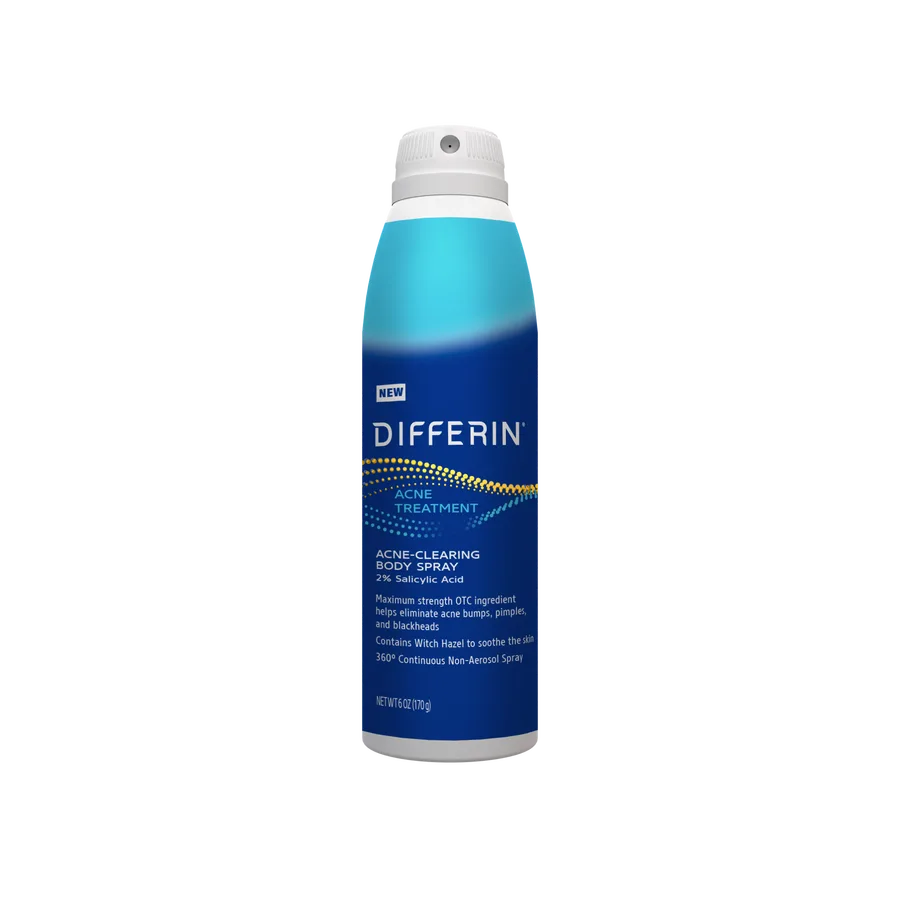
Acne-Clearing Body Spray
Body Acne Problem-Solver
 Verified reviewer
Pros & cons.
- +360-degree spray format solves the fundamental accessibility problem of treating back acne
- +Triple-acid formula (salicylic + glycolic + witch hazel) provides multi-mechanism body acne treatment
- +Fast-drying formula allows dressing within 60 seconds without residue on clothing
- +Affordable at $19.99 for a 6 oz can — good value for a specialized body acne treatment
- +From Galderma/Differin — genuine dermatological credibility, not a generic body wash with trace actives
- +Fragrance-free formula avoids adding unnecessary sensitizers to already irritated body acne
- −Denatured alcohol as the second ingredient is significantly drying with repeated use
- −Strong chemical smell during application requires ventilation
- −360-degree spray nozzle doesn't always deliver even coverage from all angles as marketed
- −Too aggressive for dry, sensitive, or eczema-prone body skin
- −Some users report defective spray mechanisms requiring product exchange
The full review.
Body acne occupies a strange position in skincare culture. Millions of people deal with it — breakouts across the back, chest, and shoulders that affect confidence, clothing choices, and comfort. Yet the treatment market has largely ignored it, offering face products with a vague ‘you can use this on the body too’ shrug. Differin’s Acne-Clearing Body Spray is one of the rare products designed specifically for the practical reality of body acne: you can’t easily treat what you can’t easily reach.
The 360-degree continuous spray format is the genuine innovation here. Traditional acne treatments — creams, gels, lotions — require direct manual application, which means back acne treatment has always required either Olympic-level flexibility, a willing partner, or creative use of long-handled applicators. The spray format eliminates this barrier. Hold the can over your shoulder, press, and a fine mist covers the area evenly without precise targeting. It is a delivery system solution to what was always a delivery system problem.
Differin — manufactured by Galderma, the dermatology company behind the landmark OTC adapalene gel — brings genuine clinical credibility to a category dominated by body washes with trace amounts of acne-fighting ingredients. The formula reflects that seriousness: a triple-acid approach combining 2% salicylic acid, 3% glycolic acid, and 2.5% witch hazel. This is not a gentle daily prevention product. This is an active treatment formulated for the thicker, more resilient skin of the torso.
The pharmacology is logical. Salicylic acid at 2% — the maximum OTC concentration — provides oil-soluble pore penetration, dissolving the sebum-and-dead-cell plugs that form body acne lesions. Glycolic acid at 3% adds water-soluble surface exfoliation, clearing the dead cell layer on top that traps oil beneath. Witch hazel contributes astringent properties that temporarily tighten pore openings and control surface oil. Three mechanisms, three angles of attack, calibrated for skin that can handle the combination.
The vehicle is where the honest trade-offs begin. Alcohol denat. sits as the second ingredient — the rapid-evaporating base that makes the spray practical. It dries within thirty to sixty seconds, allowing you to dress immediately without sticky residue on your clothing. Without the alcohol, a water-based spray would take five to ten minutes to dry and would feel clammy under clothes. The alcohol solves a real usability problem.
But alcohol denat. on skin comes with documented costs: barrier disruption, transepidermal water loss, and the potential for irritation with repeated daily use. On body skin, which is thicker and less reactive than facial skin, the impact is less severe than it would be on the face. But the drying effect compounds over weeks, especially with the dual-acid exfoliation happening simultaneously. Users in arid climates or those using this three times daily often report noticeable dryness and peeling by the second or third week.
The scent is, frankly, intense. The alcohol and acid combination produces a strong chemical smell during spraying that several users describe as requiring ventilation. It dissipates within a couple of minutes as the product dries, and the finished product on skin has no detectable scent. But the application moment itself is not pleasant. This is a functional treatment product, not a self-care experience.
Results, for those who can tolerate the formula, are genuinely promising. Early user feedback — the product launched in mid-2022 — suggests visible improvement in body breakouts within one to two weeks, with significant clearing by the four-to-six-week mark. The combination of BHA pore clearing and AHA surface exfoliation appears to address both existing lesions and the conditions that create new ones. Post-inflammatory marks left by body acne take longer — eight to twelve weeks — but the glycolic acid contributes to gradual fading.
The price is reasonable for a specialized body acne treatment from a dermatologist-developed brand. At twenty dollars for a six-ounce can, the per-ounce cost is competitive, and the spray format means very little product is wasted. Two to three months of daily use from a single can represents good value compared to the cost of multiple failed body washes.
The nozzle, marketed as 360-degree, receives mixed feedback. Some users find it sprays reliably from various angles; others report it works best in a relatively narrow directional range and requires positioning adjustments. For true back coverage, having someone else confirm full coverage for the first few applications helps establish the right technique.
As a specialized product for a specific, underserved skin concern, the Differin Acne-Clearing Body Spray represents genuine innovation in a neglected category. The triple-acid formula is effective but demanding. The alcohol base enables the practical spray format but limits who can use it comfortably. And the delivery system actually addresses the accessibility problem that has frustrated body acne sufferers for decades. For oily-skinned individuals with persistent body acne who have exhausted gentler options, this spray offers a legitimate new tool.
Ingredient analysis.
Full INCI list
Active: Salicylic Acid 2%. Inactive: Water, Alcohol Denat., Glycolic Acid, Hamamelis Virginiana (Witch Hazel) Water, Polysorbate 20, Ammonium Hydroxide, Disodium EDTA
Skin match.
The science.
The Science
This formula uses a dual-acid approach, combining BHA (salicylic acid) and AHA (glycolic acid) to treat acne more comprehensively than either acid alone. Salicylic acid is lipophilic, so it penetrates the lipid-rich sebaceous follicles to dissolve the corneocyte accumulation that forms microcomedones. A 2020 multicenter study in the Journal of the European Academy of Dermatology and Venereology confirmed that salicylic acid-based regimens significantly reduce non-inflammatory and inflammatory acne lesions.
Glycolic acid provides water-soluble exfoliation of the stratum corneum surface. As the smallest AHA molecule, glycolic acid penetrates the skin well. Research in Dermatologic Surgery showed that glycolic acid at 2-10% concentrations effectively reduces epidermal thickening and comedone formation. The 3% concentration in this formula provides surface exfoliation without reaching the peeling-grade concentrations used in chemical peels.
The BHA and AHA combination attacks body acne from two angles: salicylic acid clears congestion inside pores, while glycolic acid removes the surface cell buildup that traps sebum and creates new comedones. A review in the Journal of Clinical and Aesthetic Dermatology concluded that combination acid approaches are more effective for acne treatment than single-acid monotherapy.
Truncal acne differs from facial acne because the skin is thicker, pores are larger, and sebaceous glands are more active on the chest and back. These anatomical differences justify the aggressive triple-acid approach in this formula, which would be too harsh for thinner facial skin.
References
- Effectiveness of a combination of salicylic acid-based products for the treatment of mild comedonal-papular acne — Journal of the European Academy of Dermatology and Venereology (2020)
Dermatologist Perspective
Dermatologists view truncal acne as an undertreated condition. It often requires more aggressive topical therapy than facial acne because the chest and back have a thicker epidermis and more active sebaceous glands. Board-certified dermatologists note that the BHA and AHA combination in this spray follows evidence-based approaches to comedonal body acne. The spray delivery system also solves the practical barrier that limits treatment compliance for back acne. The main concern for dermatologists is the high alcohol content and its potential to disrupt the barrier with daily use; clinicians typically advise starting with once-daily application and checking for excessive dryness before increasing frequency.
Guidance
Where it fits in your routine.
Shake well before use. Hold the can 4-6 inches from the skin. Spray a thin, even layer over clean, dry skin on the chest, back, shoulders, or other acne-prone body areas. Let it dry completely (about 60 seconds) before dressing. Apply once daily to test tolerance. If skin tolerates it after one week, use twice daily as needed. Use up to three times daily maximum. If dryness or irritation occurs, use once daily or every other day. Apply an oil-free body moisturizer to surrounding untreated areas if dryness spreads.
At $19.99 for 6 ounces, this specialized body acne treatment from a dermatologist-developed brand offers solid value. The single-size offering lacks an economy option, but the spray format works efficiently; one can lasts two to three months with daily use. The monthly cost of approximately $7-10 competes with body acne washes that require larger amounts per use. The genuine Galderma/Differin provenance adds credibility that justifies the price over generic body acne sprays.
This works for anyone with recurring body acne, especially on the back and chest, who finds hard-to-reach areas difficult to treat. It suits oily-skinned people whose body acne does not respond to body washes alone and who need a targeted, leave-on treatment. The quick-drying, residue-free format benefits athletes and those who sweat frequently.
The alcohol and dual-acid combination worsens dry, sensitive, or eczema-prone body skin. This formula is too aggressive for mild body acne; use a salicylic acid body wash first. The alcohol smell affects those sensitive to strong chemical scents during application.
Product details.
It has no added fragrance, but denatured alcohol and acids create a noticeable alcohol and chemical scent. The smell is strong when spraying and dissipates within 1-2 minutes as the product dries.
An aerosol-style spray can uses a 360-degree twist-lock nozzle to spray from any angle. This design solves the accessibility problem of treating back acne alone. Finish matteinvisiblefast-absorbing
The first spray produces a fine, cool mist with a clear alcohol scent. It dries to an invisible finish within 30-60 seconds. The acid combination causes mild stinging or tingling for some users, especially on active breakouts. The spray coverage is mostly even, though some users find the nozzle lacks the marketed 360-degree capability. Apply once daily to test skin tolerance before increasing frequency.
2-3 months with once-daily application to affected body areas
24 months
All Year Background
The backstory.
Body acne is one of dermatology's most undertreated conditions — affecting millions but lacking the product innovation that facial acne receives. Differin, having established credibility with its landmark OTC adapalene gel, leveraged that reputation to enter the body acne space with a product designed around the practical challenge that makes body acne so persistent: you can't easily reach your own back. The spray format was the solution, and the triple-acid formula was calibrated for body skin that can handle more aggressive treatment than the face.
About Differin
Established Brand (5–20 years)Galderma, a global dermatology company, founded Differin as a 1981 joint venture. The brand changed the market in 2016 when its adapalene gel became the first prescription-strength retinoid approved for OTC sale, backed by 20 years of clinical safety data and 40 million prescriptions worldwide.
Common myths.
Body acne is caused by poor hygiene
Truncal acne, like facial acne, stems from hormones, genetics, and excess sebum, not dirt. Over-washing worsens body acne by disrupting the skin barrier. This spray addresses the causes: salicylic acid clears clogged pores, glycolic acid removes dead cell buildup, and witch hazel controls surface oil.
Face acne products can be used on the body
Some facial actives work on the body, but body skin is thicker and more resilient. It often needs higher concentrations or multi-acid approaches. This spray uses 2% salicylic acid and 3% glycolic acid. This combination is more aggressive than most facial products; it works for body skin but is too harsh for the face.
FAQ.
Can I use Differin Body Spray on my face?
No — this formula targets body skin, which is thicker and more resilient than facial skin. The 2% salicylic acid, 3% glycolic acid, and denatured alcohol as the second ingredient is too aggressive for most facial skin. Use Differin's facial products for face acne.
How often should I use the Differin Body Spray?
Use once daily to test your skin's tolerance. The triple-acid formula causes dryness and irritation, especially during the first two weeks. Increase to twice daily if your skin tolerates it well. Use it up to three times daily, though most users get good results using it once or twice daily.
Can I use this spray with Differin Adapalene Gel?
Use the adapalene gel on your face and the body spray on your body in one routine. Do not use both on the same area at once; combining a retinoid with dual-acid exfoliation irritates most skin. To treat body acne with adapalene, alternate it with the body spray on different days.
Does this spray really work on back acne?
Users report visible back acne improvement within 1-2 weeks and significant clearing by 4-6 weeks. The spray format solves the main back acne treatment challenge: reaching the area alone. Results work best with daily application and a gentle body wash.
Why does the spray smell so strong?
The denatured alcohol, the second ingredient, causes the noticeable scent. This alcohol acts as a fast-drying vehicle that makes the spray practical — it dries within 60 seconds so you can dress immediately. The scent dissipates within 1-2 minutes. If the smell bothers you, spray in a ventilated area and wait briefly before moving to an enclosed space.
What the community says.
"Effectively treats hard-to-reach back and chest acne"
"Lightweight, fast-drying formula leaves no residue"
"360-degree spray works from multiple angles"
"Visible clearing of breakouts within days for some users"
"Combines three active exfoliants in one convenient product"
"Strong alcohol/chemical smell — users recommend ventilation while spraying"
"Spray nozzle can be difficult to aim precisely for back application"
"Denatured alcohol is drying, especially with repeated daily use"
"Can cause irritation and stinging on sensitive areas"
"Some reports of defective spray mechanisms"
People also looked at.