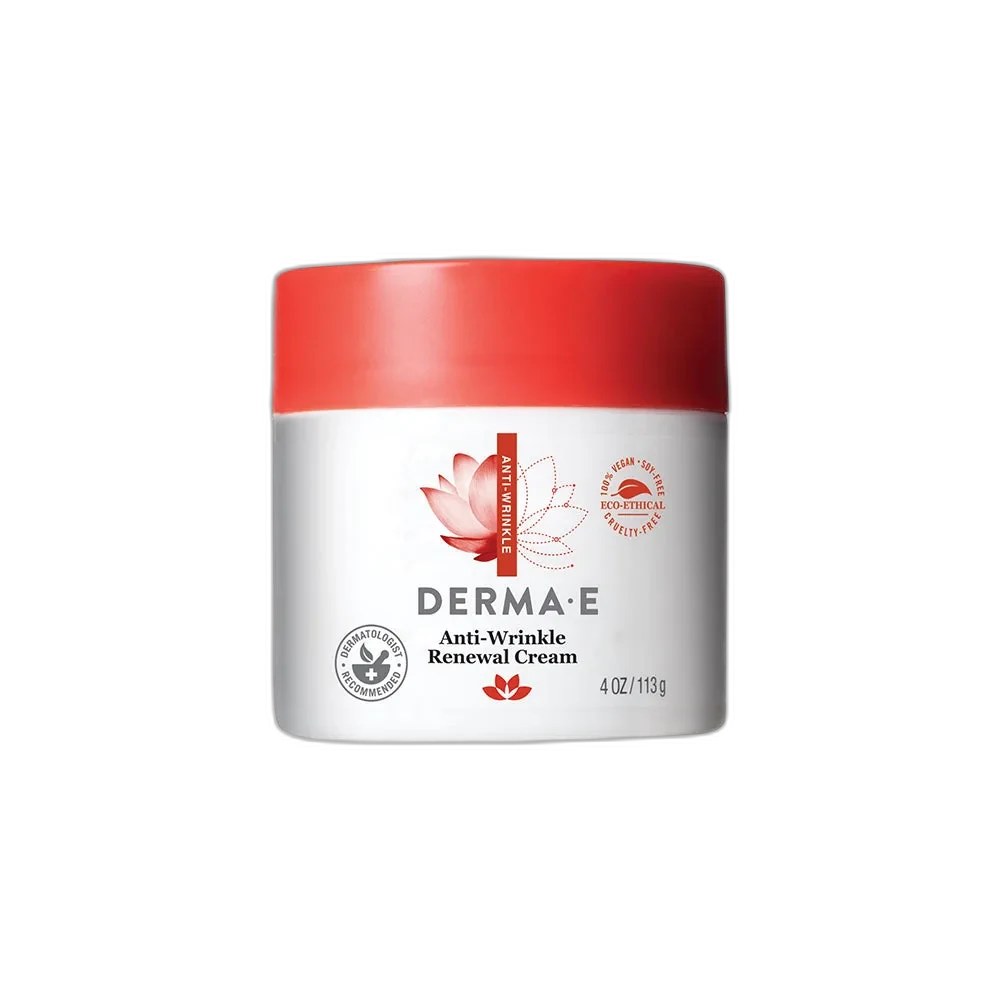
Anti-Wrinkle Renewal Cream
Budget Retinol Staple
 Verified reviewer
Pros & cons.
- +Contains both real retinol and bakuchiol at accessible prices
- +40+ year track record of continuous market presence
- +Rich emollient base makes it tolerable for daily retinoid use
- +Vegan and cruelty-free certification
- +Excellent value at roughly $4-5 per month of nightly use
- +Gentle enough for retinol beginners without sacrificing efficacy
- −Natural fragrance is polarizing and problematic for sensitive skin
- −Jar packaging is suboptimal for retinol stability
- −Retinol concentration is not disclosed and is lower than dedicated serums
- −Not pregnancy-safe due to vitamin A content
- −Dated packaging reads as old-fashioned next to modern clinical brands
- −Scent is distinctly herbal-medicinal, not universally appealing
The full review.
About Derma E
Launched in 1984.
Who Should Buy
Retinol beginners on a budget who want a vitamin A routine without spending $50-150 on a serum. People with normal to dry skin who tolerate natural fragrance and want a thick nighttime moisturizer that also works as a retinol delivery system. Longtime Derma E customers who use this cream and have no reason to switch to trendier options. Anyone curious about bakuchiol-plus-retinol combinations who wants to experiment without luxury prices.
Who Should Skip
Sensitive skin that reacts to fragrance. Pregnant or nursing users (retinol is contraindicated). People already using prescription retinoids who do not need more vitamin A. Anyone who expects airless-pump packaging for retinol and dislikes the jar format. For everyone else, this is a top budget retinol pick, and its 40-year track record builds confidence.
Texture
The application shows the cream’s age. The texture is thick and slightly waxy at first, then softens as you massage it in. It absorbs fully within minutes and leaves a velvety, non-greasy finish.
Scent
The fragrance polarizes users. The INCI lists ‘natural fragrance oils’, and the scent smells herbal-medicinal, like 80s and 90s health food store products. Some buyers love this nostalgia. Others find it off-putting, especially those expecting the fragrance-free formulations common in modern dermatologist-developed brands. Sensitive skin users should patch-test the natural fragrance carefully—it is a main reason this cream lacks a universal recommendation.
Packaging
The jar packaging is another dated choice. Airless pumps are the gold standard for retinol stability because retinol oxidizes quickly in air and light. A screw-top jar exposes the contents to oxygen every time you open it, which should theoretically degrade the retinol concentration over time. In practice, Derma E uses vitamin E as a stabilizer, and the formula’s 40-year track record suggests real-world degradation is less severe than chemistry predicts. Still, a pump or tube is a better format, and the jar is a valid drawback for users prioritizing formulation precision.
Common Praise
Performance is consistent and well-documented once you accept the packaging and fragrance. During the first two weeks, skin adapts to the retinol with possible mild dryness or flaking—usually manageable at this concentration. After four to six weeks of nightly use, texture improves and fine lines look softer. At twelve weeks, cumulative improvements are real—not prescription-tier dramatic, but clearly present. Over 15,000 reviews on Amazon and natural health retailers confirm this: this cream works gradually for people who commit to nightly use for a full quarter. Users who quit after two weeks because they see no immediate results miss the cream’s actual benefit: a slow, sustainable transformation rather than a quick fix.
Ingredient analysis.
Full INCI list
Purified Water, Carthamus Tinctorius (Safflower) Seed Oil, Stearic Acid, Glycerin, Glyceryl Stearate SE, Cetyl Alcohol, Microcrystalline Cellulose, Cellulose Gum, Persea Gratissima (Avocado) Oil, Sesamum Indicum (Sesame) Seed Oil, Helianthus Annuus (Sunflower) Seed Oil, Bakuchiol, Retinol, Panthenol, Tocopheryl Acetate, Allantoin, Phenoxyethanol, Ethylhexylglycerin, Natural Fragrance Oils
Skin match.
The science.
The Science
Retinol has a robust case in skincare. Research since the 1980s — including work by Albert Kligman and Barbara Gilchrest — shows topical retinoids stimulate collagen synthesis, increase cell turnover, and reduce photoaging signs. Retinoic acid receptors in epidermal and dermal cells trigger gene expression changes for skin renewal. Skin enzymes convert over-the-counter retinol to retinoic acid in two steps, creating a milder version of the pathway used by prescription tretinoin. The evidence is consistent: retinoids work.
Bakuchiol has a smaller, interesting evidence base. A 2019 study in the British Journal of Dermatology used a double-blind 12-week trial to compare bakuchiol against retinol. It found comparable improvements in wrinkle depth and pigmentation, but bakuchiol had lower irritation rates. The sample size was modest and needs independent replication, but the peer-reviewed paper is strong evidence for a 'retinol alternative.' This cream combines bakuchiol and retinol to potentially provide dual-pathway activation with less irritation — a logical formulation strategy.
The emollient base of safflower, avocado, and sesame oils provides linoleic acid and other fatty acids to support barrier function during retinoid use. Topical linoleic acid helps stratum corneum lipid integrity, which matters when retinoids temporarily disrupt barrier function. Panthenol, allantoin, and vitamin E add soothing and antioxidant activity to buffer the retinol effect.
The jar packaging is the main scientific limitation because it exposes retinol to air and light. Retinol degrades easily; an airless pump would preserve activity better. The formula's vitamin E helps stabilize the retinol, but the jar format prioritizes tradition and cost over pharmaceutical optimization.
Dermatologist Perspective
Dermatologists often suggest over-the-counter retinol moisturizers like this one as a gentle entry point for patients who want vitamin A benefits but cannot tolerate or access prescription retinoids. Board-certified dermatologists say the retinol and bakuchiol combination is a reasonable approach for beginners, and the emollient base buffers the typical retinoid adjustment period. Common cautions include the fragrance content — which makes the cream unsuitable for sensitive or rosacea patients — and the jar packaging, which is not optimal for retinol stability. For budget-conscious patients starting retinol, this cream is a frequent, accessible option, though not a first-line recommendation for patients who can afford more precisely formulated products.
Where it fits in your routine.
Apply a pearl-sized amount to clean, dry skin at night, after cleansing and hydrating serums. Spread it evenly over the face and neck, but avoid the immediate eye area. Use it three nights per week for the first two weeks to let skin adapt, then use it nightly if tolerated. Do not layer with other retinoids, AHAs, BHAs, or benzoyl peroxide on the same night; this causes over-exfoliation without extra benefit. Always use broad-spectrum SPF the next morning because retinol increases photosensitivity. Keep the jar lid tightly closed and away from direct sunlight. Use within 6-12 months of opening.
At about $22 for a 4 oz jar, this is a top-value retinol cream near the drugstore aisle. One jar lasts four to six months with nightly face application. This makes the monthly cost $4 to $5 — a competitive price for any vitamin A product. Compared to RoC Retinol Correxion at $25-30, Neutrogena Rapid Wrinkle Repair at $25, or higher-priced retinol serums from Paula's Choice or The Ordinary, this cream offers comparable or better monthly value. The main caveat is that the retinol concentration is likely lower than these competitors, so results may be slower — but at this price, the cream is a legitimate entry to retinol without a large financial commitment.
Retinol beginners on a budget want a real vitamin A product without spending $50+ on a dedicated serum. It works for users with normal to dry skin who tolerate natural fragrance and want a thick nighttime moisturizer that delivers retinol and bakuchiol together.
Skip this if you have sensitive skin, rosacea, fragrance allergies, or are pregnant or nursing. Skip if you use prescription retinoids — The CeraVe Skin Renewing Retinol Serum adds irritation without benefit — or if you require airless pump packaging for retinol stability.
Product details.
Rich, thick cream that softens on contact
Herbal, slightly medicinal natural fragrance
Classic white jar with blue lid — dated but instantly recognizable in health food aisles
The cream feels thick and slightly waxy at first but absorbs fully within two minutes. The natural fragrance is herbal and slightly medicinal. Skin needs a mild two-week adjustment period to retinol. Purging is uncommon at this low concentration.
4-6 months with nightly face application
12 months
fall winter
The backstory.
Derma E launched in 1984 in Southern California as one of the original vitamin-based skincare lines sold through health food stores, decades before 'clean beauty' became a marketing category. The Anti-Wrinkle Renewal Cream is one of the brand's original formulations and has been continuously sold since the mid-80s with periodic updates. The most recent reformulation added bakuchiol to the vitamin A base, updating the formula for the retinol-alternative era without abandoning the original active.
About Derma E
Legacy Brand (20+ years)Derma E launched in 1984 as a vitamin-based natural skincare line in health food stores — a 'clean beauty' brand before the term existed. The Anti-Wrinkle Renewal Cream is an original formulation sold for over 40 years; recent reformulations add bakuchiol to the original retinyl palmitate.
FAQ.
Is this strong enough to actually work?
It contains retinol and bakuchiol at moderate concentrations for a daily moisturizer. It is weaker than a prescription retinoid or a 0.5% retinol serum, but 12+ weeks of consistent nightly use shows measurable improvements in texture and fine lines for most users.
Can I use it with my prescription retinoid?
No — using two retinoid products on the same night increases irritation without adding benefit. If you use prescription tretinoin or adapalene, skip this cream and use a basic fragrance-free moisturizer instead.
Is the jar packaging a problem for retinol stability?
Airless pumps provide the best retinol stability, so this setup is not ideal. However, Derma E uses vitamin E to stabilize the formula, which has stayed in continuous production for decades. Keep the jar closed, store it away from direct sunlight, and use the jar within 6-12 months of opening.
Is it safe during pregnancy?
No — the cream contains retinol. Retinol belongs to the vitamin A family, which dermatologists advise avoiding during pregnancy. For anti-aging during pregnancy, use products with bakuchiol only (without vitamin A) or prescription-free peptide moisturizers.
Will the natural fragrance irritate my skin?
The fragrance polarizes users of this cream. Sensitive skin needs a patch-test or should skip it. Normal skin that tolerates essential oil blends usually has no problem. If 'natural fragrance' causes reactions in other products, this one will likely bother you too.
How long does a jar last?
A 4 oz jar lasts 4-6 months with nightly face application. This costs roughly $4-5 per month, a competitive price for a retinol product. Do not over-apply; a pearl-sized amount covers the whole face.
What the community says.
"affordable entry to retinol"
"rich nourishing texture"
"gentle enough for daily use"
"long track record"
"contains natural fragrance"
"scent is polarizing"
"jar packaging isn't ideal for retinol stability"