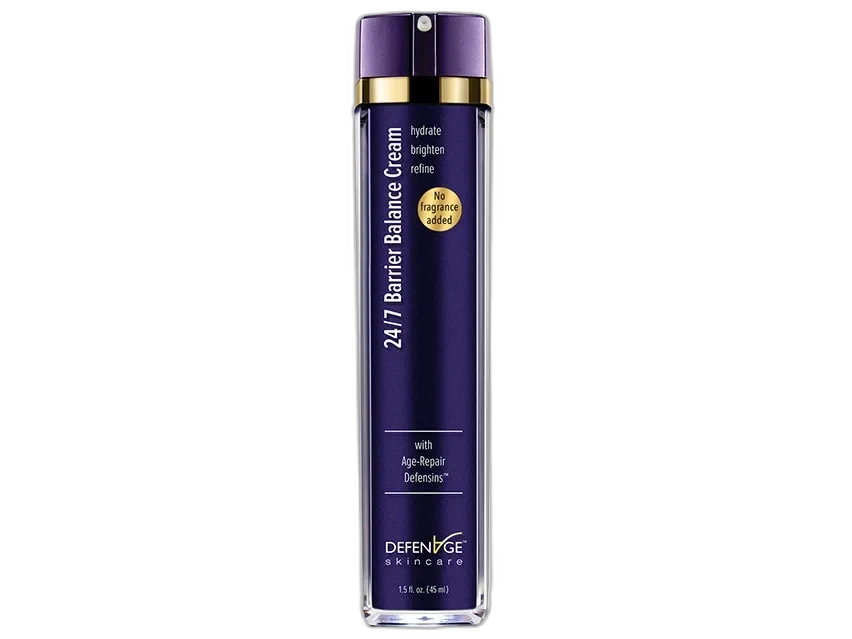
24/7 Barrier Balance Cream
Clinical Peptide Standout
 Verified reviewer
Pros & cons.
- +Patented defensin peptide platform with published clinical trial data backing
- +Rich, cushiony texture suitable for sensitive and post-procedure skin
- +Layers well with retinoids rather than competing with them
- +Pregnancy-safe alternative to retinoid-based anti-aging routines
- +Well-studied supporting cast of peptides, niacinamide, and panthenol
- +Sold through dermatologist offices and medical spas nationwide
- +Visible firmness and texture changes reported around 8-12 weeks
- +Tolerated by most sensitive skin types despite the active peptide load
- −Premium $95 price tag for only 1.5 oz of product
- −Jar packaging exposes oxidation-sensitive peptides to air and light
- −Shea butter content makes it less ideal for oily or acne-prone skin
- −Requires consistent 8-12 week use before full benefits emerge
The full review.
Most peptide creams trace their lineage back to the same handful of Matrixyl and Argireline patents from the early 2000s. DefenAge’s 24/7 Barrier Balance Cream is one of the few that doesn’t. The defensins at the heart of this formula were originally studied in immunology labs, where they showed up as the body’s frontline response to wound healing. Somewhere along the way, a team of researchers and a dermatologist looked at that mechanism and asked a question most brands never get to: what if we could signal the skin’s own dormant stem cells to wake up and differentiate into new keratinocytes, the way they already do after an injury? That question became a patent, which became a clinical trial, which became this cream.
The trial matters here because so few emerging skincare brands bother to fund one. DefenAge published a 12-week split-face study in the Journal of Drugs in Dermatology showing measurable improvements in fine lines, pore appearance, and skin texture on the side treated with the defensin system versus a standard regimen. That’s not a massive sample and it’s not a miracle — but it’s a meaningful amount of independent-looking data to put behind a peptide product, and it’s enough to take the mechanism seriously rather than filing it alongside the usual dermal-marketing vocabulary.
The formula itself is a proper cream, not a dressed-up serum. It leans on caprylic/capric triglyceride, glycerin, squalane, and shea butter as its base, which is why it feels cushiony rather than clinical when you apply it. The defensin complex sits about a third of the way down the ingredient list, followed by palmitoyl tripeptide-1 and tetrapeptide-7 — a classic signal peptide duo that does the downstream collagen work while the defensins handle the cell-generation side. Niacinamide, panthenol, allantoin, and bisabolol round it out as the barrier-support cast. The whole thing reads like a formulator who actually wanted the peptides to survive the commute from jar to face, not just appear on a press release.
Texture
Texture is where this cream quietly wins people over. It’s rich without being heavy, absorbs faster than most luxury creams of similar weight, and leaves a velvety non-greasy finish that sits comfortably under makeup or sunscreen. The formula is fragrance-free — no floral or powdery notes layered in to cover the base oils, just a faint neutral cream smell that disappears within seconds of application. It’s one of the quieter signals that DefenAge actually cares about the clinical crowd it’s marketing to.
Common Praise
The results timeline is where managing expectations matters. The first week or two, this feels like a very nice moisturizer — comfort, softness, that’s it. The interesting changes start showing up around week three, which tracks with what the clinical trial reported. Users consistently describe their skin looking a little more “awake” around that point — smoother texture, slightly refined pores, a subtle firmness that isn’t dramatic but is noticeable in side-by-side photos. The fuller benefits the study measured emerged between weeks eight and twelve, and that’s the honest window you should give this cream before deciding whether it’s worth the money.
Common Complaints
And money is the real question. $95 for 1.5 oz puts this cream squarely in luxury-clinical territory, and you can stack up plenty of excellent peptide moisturizers for half the price. What you’re paying for here is the defensin mechanism, the patent, and the clinical data — not a flashier texture or a rarer base oil. If you’re someone who values published evidence and is specifically drawn to non-retinoid anti-aging routines (whether for pregnancy, sensitivity, or personal preference), it’s one of the few creams on the market that can reasonably justify its price. If you’re happy with a strong retinoid regimen and a $30 ceramide cream, this isn’t going to replace either of those.
Packaging
One note on packaging: DefenAge chose a frosted glass jar with a silver lid, which photographs beautifully but exposes peptides to oxygen and light every time you open it. For a brand this committed to its clinical story, airless packaging would have been the more consistent choice. Store it somewhere cool and dark, use a clean fingertip or spatula, and don’t leave the lid off.
The short version: this is a real peptide cream doing real work, and it’s the kind of product that rewards patience and a full eight-to-twelve-week runway. It’s not the cream you buy for instant glow. It’s the cream you buy if you want to see what happens when a formulator actually believes in the mechanism they’re selling.
Ingredient analysis.
Full INCI list
Water, Caprylic/Capric Triglyceride, Glycerin, Cetearyl Olivate, Sorbitan Olivate, Cetyl Alcohol, Glyceryl Stearate, Squalane, Dimethicone, Butyrospermum Parkii (Shea) Butter, Defensin (Defensin-1, Defensin-2), Palmitoyl Tripeptide-1, Palmitoyl Tetrapeptide-7, Niacinamide, Tocopheryl Acetate, Panthenol, Sodium Hyaluronate, Allantoin, Bisabolol, Xanthan Gum, Phenoxyethanol, Ethylhexylglycerin, Disodium EDTA
Skin match.
The science.
The Science
The defensin peptides at the core of this cream are unusual in the skincare landscape. Human alpha-defensins and beta-defensins were first characterized as antimicrobial peptides in the immune system, where they participate in wound healing and tissue regeneration. DefenAge's patented platform uses synthetic versions of these peptides — marketed as Defensin-1 and Defensin-2 — and repositions them for cosmetic use on the hypothesis that they can signal LGR6+ progenitor cells in the hair follicle bulge region to differentiate into new keratinocytes, refreshing the epidermis from a deeper source than surface exfoliation reaches.
The most-cited evidence for this cream specifically is a 12-week split-face clinical trial published in the Journal of Drugs in Dermatology in 2018, which evaluated DefenAge's three-product system and reported statistically significant improvements in wrinkle depth, pore appearance, and skin texture on the treated side. While the study was industry-sponsored and had a modest sample size, it's a meaningful step above the ingredient-level marketing most peptide brands rely on.
The supporting peptides — palmitoyl tripeptide-1 and palmitoyl tetrapeptide-7 — are better-established in the literature. Tripeptide-1 has decades of research behind its ability to signal collagen synthesis, and tetrapeptide-7 has been shown to reduce the production of interleukin-6, an inflammatory cytokine associated with photoaged skin. Together, these form the downstream collagen-and-inflammation arm of the formula while the defensins handle the upstream renewal piece.
Niacinamide at cosmetic concentrations has robust evidence for barrier support, reduction of transepidermal water loss, and modulation of melanosome transfer — all relevant to the "barrier balance" positioning. Panthenol, allantoin, and bisabolol add well-characterized soothing activity, which matters because anything driving turnover needs a comfort cushion underneath.
References
- A Novel, Volumetric, Full-Face Topical Anti-Aging Defensin Technology — Journal of Drugs in Dermatology (2018)
Dermatologist Perspective
Board-certified dermatologists who carry DefenAge in their offices typically position this cream for patients who want visible anti-aging results but cannot or prefer not to use retinoids — pregnant patients, those with retinoid-intolerant sensitive skin, and patients recovering from in-office procedures like microneedling, chemical peels, or laser resurfacing. Dermatologists familiar with the defensin platform note that the mechanism is genuinely distinct from the retinoid pathway, making it a reasonable complementary product rather than a retinoid substitute for most patients. Clinical use has generally found the cream well-tolerated even on reactive skin, Dermatologists recommending this product typically advise patients to commit to the full 8-12 week window the clinical trial measured before judging results, and to pair it with daily sunscreen — without which no anti-aging routine, peptide-based or otherwise, will deliver meaningful results.
Where it fits in your routine.
Apply a pea-sized amount twice daily to a cleansed face and neck, patting gently until absorbed. In the AM, layer it over antioxidant serums and under sunscreen; the silicone-and-squalane base works under both mineral and chemical SPFs. In the PM, apply after your retinoid or exfoliating treatment absorbs; the cream's cushioning effect buffers retinoid dryness without stopping its activity. Use a clean fingertip or small spatula to dispense from the jar to minimize peptide oxidation, and screw the lid tight between uses. Use the cream consistently twice daily for 8-12 weeks before assessing results; DefenAge's trial showed clinical changes in that window.
At $95 for 1.5 oz, this cream sits in the luxury-clinical tier and only comes in one size. Other peptide moisturizers at this price usually use a standard Matrixyl patent. Here, you pay for the defensin platform and its published clinical data. The math works for users seeking non-retinoid anti-aging with evidence beyond ingredient-level marketing. If you use retinoids and a $30 ceramide cream, this is likely overkill. The research and mechanism justify the $95 price, not the packaging or base oils. Use it twice daily on face and neck; one jar lasts about 2-3 months.
This works for anyone seeking visible anti-aging results without retinoids—due to pregnancy, sensitive skin, or personal preference—who values published clinical data and accepts an 8-12 week window. It is also a strong pick for post-procedure recovery routines where barrier support and gentle renewal matter more than actives that could compromise healing skin.
If you already like your retinoid routine and a cheap ceramide moisturizer, the extra benefits likely don't justify the premium. Skip this if you have oily, acne-prone skin (the shea butter content matters) or if a $95 moisturizer exceeds your budget.
Product details.
Thick, cushiony cream with soft slip that melts into skin instead of sitting on top
It is scent-free. A faint, neutral cream smell from the base oils dissipates on application.
Frosted glass jar with a silver lid — thick feel, but not ideal for the oxidation-sensitive peptides inside
The first week feels like any premium moisturizer — soft and comfortable with no drama. Changes start around week 3 as turnover increases; some users see brief sensitivity or mild flushing as new cells reach the surface. This is not acne-style purging.
About 2-3 months with twice-daily face and neck application
12 months
All Year
The backstory.
DefenAge launched in 2016 as a spin-off from defensin research originally explored for wound healing and oncology applications. The founders — including a dermatologist and biotech researchers — reformulated the peptides for cosmetic use, funded a split-face clinical trial before launch, and positioned the line primarily through dermatologist offices and medical spas rather than mass retail.
About DefenAge
Established Brand (5–20 years)DefenAge launched in 2016 using a patented peptide platform called Age-Repair Defensins. A team including dermatologist Dr. Adam Geyer and University of California researchers developed it. The brand's 12-week split-face clinical trial appeared in the Journal of Drugs in Dermatology in 2018.
Common myths.
Defensins work like growth factors. People with a cancer history should avoid them.
The defensins in this cream are synthetic peptides, not growth factors. They signal existing LGR6+ cells instead of stimulating proliferation pathways linked to growth factor concerns. People with medical concerns should consult their dermatologist.
Use the entire DefenAge system for the defensins to work.
The published clinical trial used a three-product system, but Barrier Balance Cream alone has the full defensin complex. The serum and eye cream add complementary delivery, but the peptide mechanism works without them.
FAQ.
What are defensins and how do they work in this cream?
Defensins are small peptides found in the human immune system. This cream uses synthetic Defensin-1 and Defensin-2 to signal dormant LGR6+ stem cells in the skin's basal layer to differentiate into new keratinocytes. These work with the palmitoyl tripeptide and squalane in the formula to drive renewal and support the barrier.
Can I use DefenAge 24/7 Barrier Balance Cream with retinol?
Yes, and it is one of the better moisturizers to use with retinoids. The defensin mechanism complements retinol's turnover effect instead of competing with it. The shea butter and squalane in this cream buffer retinol-related dryness without interfering with its activity.
Is this cream safe to use after in-office procedures?
DefenAge sells this cream widely through medical spas for post-procedure care. The shea and squalane base supports the barrier and works well after microneedling, peels, and laser, but follow your provider's specific post-procedure timeline.
Does it contain retinol or acids?
No — this cream uses defensin peptides and palmitoyl peptides for anti-aging. It contains no retinol, AHAs, or BHAs. This makes it pregnancy-safe and suitable for sensitive routines where retinoids are not an option.
Why is it so expensive?
The Age-Repair Defensin peptides are patented and made in small batches. The brand funded its own clinical trials—costs a $30 drugstore moisturizer cannot absorb. Whether that justifies $125 for 1.75 oz depends on if you value clinical data over the formulation alone.
Is it fragrance-free?
Yes — the current formulation is fragrance-free and has no added parabens. This makes it a standard choice for post-procedure protocols and dermatologists treating sensitive patients. The INCI list contains no fragrance or masking agents.
What the community says.
"Visible firmness after 8-12 weeks"
"Cushiony texture"
"Pairs well with retinoids"
"Post-procedure friendly"
"Expensive for the size"
"Jar packaging"
"Subtle early results"